
Supplier Relationship Management Software: UK Guide
Manage suppliers on evidence, not memory. What SRM software does, the Kraljic matrix, and a worked supplier scorecard for UK wholesalers.
Supplier relationship management software helps a business track how its suppliers perform, which ones matter most, and what has been agreed with each of them. For a UK wholesaler, distributor or manufacturer, the practical version is simpler than the enterprise brochures suggest: one place where supplier records, purchase orders, deliveries, invoices and performance scores sit together, so decisions about suppliers are based on evidence rather than memory.
This guide explains what supplier relationship management (SRM) is, what SRM software actually does, how to segment suppliers, how to build a scorecard from data you already hold, and when a growing business needs dedicated software.
What is supplier relationship management?
The Chartered Institute of Procurement & Supply (CIPS) defines it plainly: “Supplier relationship management is the management and maintenance of the relationship between a buyer and supplier” (CIPS).
CIPS also describes a relationship spectrum. At one end, relationships are “price-focused, transactional, and sometimes adversarial in nature”. In the middle sit bespoke, single-source and outsourced arrangements, where dependency rises because the goods are higher in value or risk. At the far end are strategic suppliers, where collaboration is high and some relationships become partnerships.
The point for a growing business is that not every supplier needs the same effort. A packaging supplier you could replace next week needs a clean ordering process. The one firm that makes your best-selling product needs regular reviews, shared forecasts and a plan for when things go wrong.
What does SRM software do?
Supplier relationship management software varies widely, from modules inside large procurement suites to simple supplier portals. Most of it covers some mix of the following:
| Capability | What it means in practice | Data it needs |
|---|---|---|
| Supplier records | One record per supplier: contacts, terms, bank details, certificates, approved products | Supplier master data |
| Segmentation | Group suppliers by importance and risk so effort goes where it matters | Spend, product criticality, alternatives |
| Performance scorecards | Measure on-time delivery, in-full delivery, quality and invoice accuracy | Purchase orders, receipts, returns, invoices |
| Contract and terms tracking | Prices, payment terms, renewal dates, minimum order quantities | Agreements, price lists |
| Risk and compliance | Expiring certificates, insurance, single-source exposure | Documents with expiry dates |
| Collaboration | Shared forecasts, issue logs, review notes, supplier portal | Forecasts, meeting records |
The CIPS guidance on performance gives a sensible starting list of what to measure: responsiveness to queries, quality of account management, accuracy of invoicing, and “important product or service attributes: size, weight, quality, availability or cost” (CIPS Knowledge: Supplier Relationship Management).
Notice that most of the useful capabilities depend on transaction data. A scorecard cannot be accurate unless every delivery is booked in against its purchase order and every invoice is matched.
Segment suppliers before you score them
The best-known way to decide how much effort each supplier deserves is the Kraljic matrix, from Peter Kraljic’s 1983 Harvard Business Review article “Purchasing Must Become Supply Management”. It places purchases on two axes: their impact on profitability, and the complexity or risk of the supply market (Wikipedia: Kraljic matrix). That gives four groups:
| Kraljic group | Profit impact | Supply risk | Typical SRM approach |
|---|---|---|---|
| Non-critical items | Low | Low | Simplify ordering, reduce admin, consolidate suppliers |
| Leverage items | High | Low | Compare suppliers, negotiate on price and terms |
| Bottleneck items | Low | High | Secure supply, hold buffer stock, find alternatives |
| Strategic items | High | High | Close collaboration, shared forecasts, regular reviews |
CIPS makes a related point: the relationship process “should be managed at the product/service level, not at company level”. One supplier can be strategic for one product line and non-critical for another.
Build a supplier scorecard from data you already hold
A scorecard is the most useful single output of supplier relationship management software. Keep it small. Three or four measures, calculated the same way every month, beat twenty measures nobody trusts.
Common scorecard measures
- On time: the share of purchase order lines received on or before the agreed date.
- In full: the share of lines received at the full ordered quantity.
- OTIF (on time in full): the share of lines that were both. This is stricter than either measure alone.
- Invoice accuracy: the share of invoices that match the purchase order and goods received note without query. Our guide to three-way matching explains the check.
- Lead time and its variability: how long orders really take, and how much that varies. See our guide to supplier lead time.
A worked example: three suppliers, one quarter
Hypothetical example. All suppliers and figures are illustrative assumptions, not client data or industry benchmarks.
A UK wholesaler reviews three suppliers at the end of a quarter, using its own purchase order lines, goods received notes and invoices.
| Measure | Supplier A | Supplier B | Supplier C |
|---|---|---|---|
| PO lines received | 120 | 80 | 40 |
| Lines on time | 108 | 78 | 30 |
| Lines in full | 114 | 70 | 39 |
| Lines on time and in full | 104 | 69 | 29 |
| On time | 90.0% | 97.5% | 75.0% |
| In full | 95.0% | 87.5% | 97.5% |
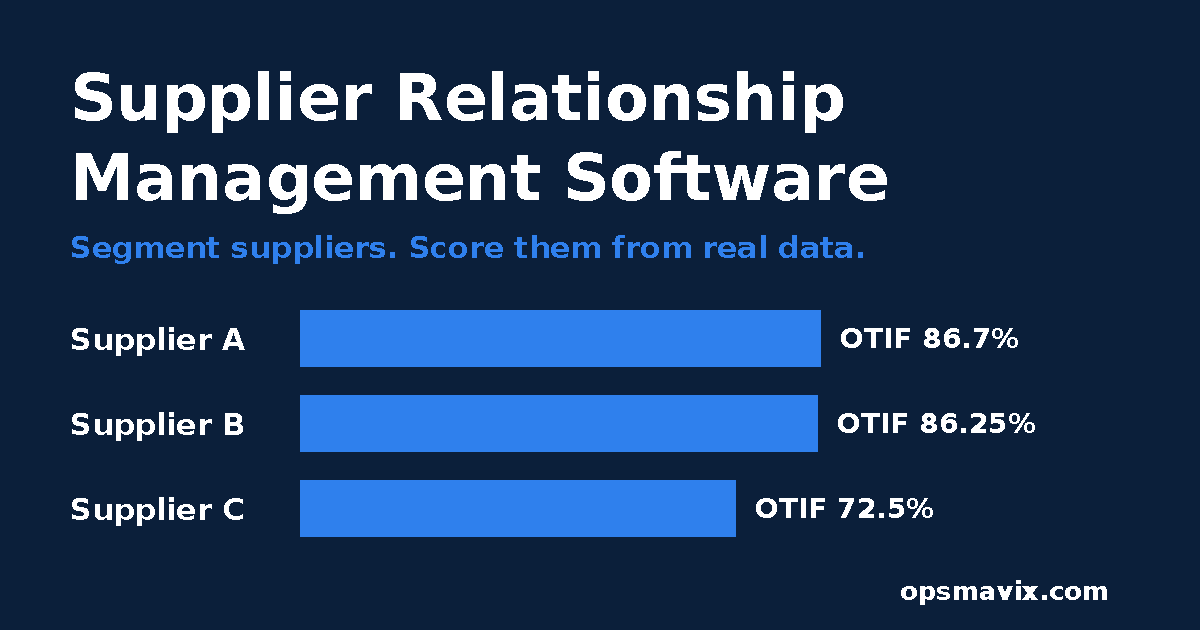
| OTIF | 86.7% (104 ÷ 120) | 86.25% (69 ÷ 80) | 72.5% (29 ÷ 40) |
| Invoices received | 40 | 25 | 20 |
| Invoices matched first time | 38 | 25 | 16 |
| Invoice accuracy | 95.0% | 100.0% | 80.0% |
Suppliers A and B have almost the same OTIF, but for different reasons. A is sometimes late; B is punctual but often short. That changes the conversation: with A you discuss lead times, with B you discuss stock availability or allocation. Supplier C is late a quarter of the time and gets one invoice in five wrong. If C supplies a strategic or bottleneck item, that is a priority review. If it supplies non-critical items, switching may be simpler than fixing.
None of these numbers can be produced without receipts booked against purchase orders. That is why a purchase order tracking system usually comes before SRM software, not after.
Your side of the relationship: paying on time
Supplier relationships run both ways. In the UK, late payment between businesses has legal consequences. GOV.UK states that if no payment date is agreed, “the law says the payment is late 30 days after” the customer receives the invoice or the goods or service are delivered, whichever is later (GOV.UK: Late commercial payments).
Suppliers can then claim statutory interest, which GOV.UK describes as “8% plus the Bank of England base rate for business to business transactions”, unless the contract sets a different rate (GOV.UK: Charging interest). They can also claim fixed debt recovery costs of £40 for debts up to £999.99, £70 for £1,000 to £9,999.99 and £100 for £10,000 or more (GOV.UK: Debt recovery costs).
So an SRM process should track your own performance too: how quickly invoices are approved and paid, and how many are stuck in a query. Slow approvals damage relationships with exactly the suppliers you most need to keep. Protecting supplier payments also means checking any request to change bank details; our supplier bank details change process guide covers that.
When does a business need SRM software?
A spreadsheet of suppliers and a quarterly review can work for a small business. Dedicated software, or a supplier module in your operations system, starts to pay its way when:
- you buy from more than a few dozen active suppliers;
- several people raise purchase orders and receive goods;
- you rely on one or two suppliers for products that drive most of your margin;
- supplier certificates, insurance or approvals expire and need chasing;
- disputes about late or short deliveries are settled by whoever has the best memory;
- invoice queries take longer to resolve than the original order took to deliver.
Before buying, check three things. Does the software calculate scorecards from your actual receipts and invoices, or does someone type ratings in? Does it connect to the system where purchase orders are raised? And who will run the supplier reviews it produces? Software cannot hold a review meeting for you.
For the inbound side of ordering, our guide to supplier order management software covers acknowledgements, expediting and short deliveries.
FAQ
What is supplier relationship management software?
Software that records supplier details and agreements, measures supplier performance, and helps you decide how to manage each supplier. Typical features include supplier records, segmentation, scorecards, contract tracking and risk alerts.
What is the difference between SRM and procurement software?
Procurement software runs the buying process: requisitions, approvals, purchase orders and invoice matching. SRM focuses on the supplier over time: performance, risk and the relationship. Many products cover both, and SRM depends on procurement data to work.
What should a supplier scorecard include?
Start with on-time delivery, in-full delivery, OTIF and invoice accuracy, all calculated from purchase orders, goods received notes and invoices. Add quality or responsiveness measures only if you can record them consistently.
What is the Kraljic matrix?
A model from Peter Kraljic’s 1983 Harvard Business Review article. It groups purchases by profit impact and supply risk into non-critical, leverage, bottleneck and strategic items, so effort goes where it matters most.
Do small businesses need SRM software?
Not always. A small business with a handful of suppliers can manage with good purchase records and a regular review. The need grows with the number of suppliers, the number of people buying and how dependent you are on a few key suppliers.
How OpsMavix Can Help
OpsMavix builds owned, fixed-price purchasing, stock and approval systems for UK wholesalers, distributors and manufacturers. In those systems, supplier records, purchase orders, goods received and invoice approvals sit in one place, so supplier performance can be reported from real transactions rather than typed-in ratings.
See our inventory automation system, wholesale order management system and invoice approval workflow automation, or tell us how you manage suppliers today.
Sources
All reviewed 26 October 2026.
- CIPS: Supplier relationship management
- CIPS Knowledge: Supplier Relationship Management (PDF)
- Wikipedia: Kraljic matrix
- GOV.UK: Late commercial payments: charging interest and debt recovery
- GOV.UK: Charging interest on commercial debt
- GOV.UK: Claim debt recovery costs
The suppliers and figures in the worked example are hypothetical. The cover is an OpsMavix diagram.
Keep reading
Getting value from OpsMavix? Add us as a preferred source on Google — you'll see more of our operations content in your AI Overviews, AI Mode and Search.