
What Is a Purchase Order? Meaning, Example and Process (UK)
A purchase order is the buyer's numbered, authorised instruction to a supplier to supply set items at agreed quantities, prices and terms. Here's what goes on one, a worked UK example with VAT, and how the PO process runs from need to payment.
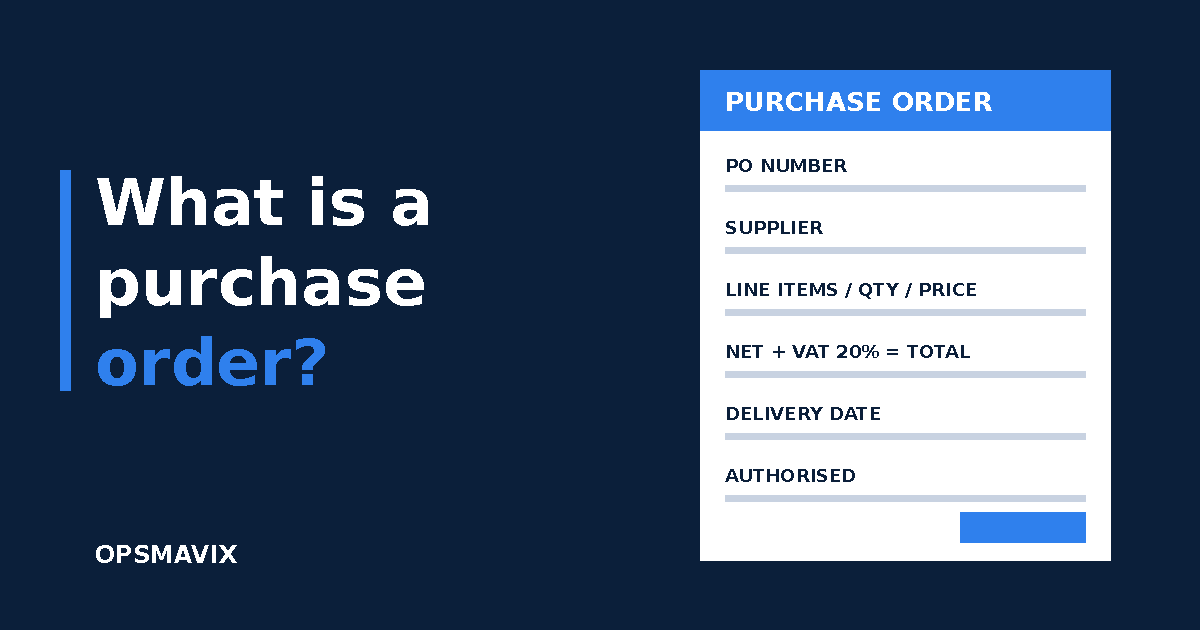
If you’re new to purchasing, the purchase order is the first document worth understanding properly, because almost everything else in buying hangs off it. The delivery gets checked against it, the invoice gets checked against it, and the payment is only safe when all three agree. This guide explains what a purchase order is, what goes on one, a fully worked UK example with VAT, how it differs from an invoice, a requisition and a sales order, and how the purchase order process runs from start to finish.
What is a purchase order?
A purchase order is a formal, numbered instruction from a buyer to a supplier that says: please supply these items, in these quantities, at these prices, delivered here by this date, on these payment terms. The buyer raises it; the supplier receives it and either accepts, queries or rejects it.
Three things make a purchase order different from simply emailing a supplier “can you send 200 more hinges?”:
- It is specific. Every line has a SKU or description, a quantity and a unit price, so there is nothing left to interpretation.
- It is numbered. The PO number becomes the reference the supplier quotes on the delivery note and the invoice, so every later document can be tied back to it.
- It is authorised. A PO should only be raised once someone with budget authority has approved the spend, which is what turns it from a request into a commitment.
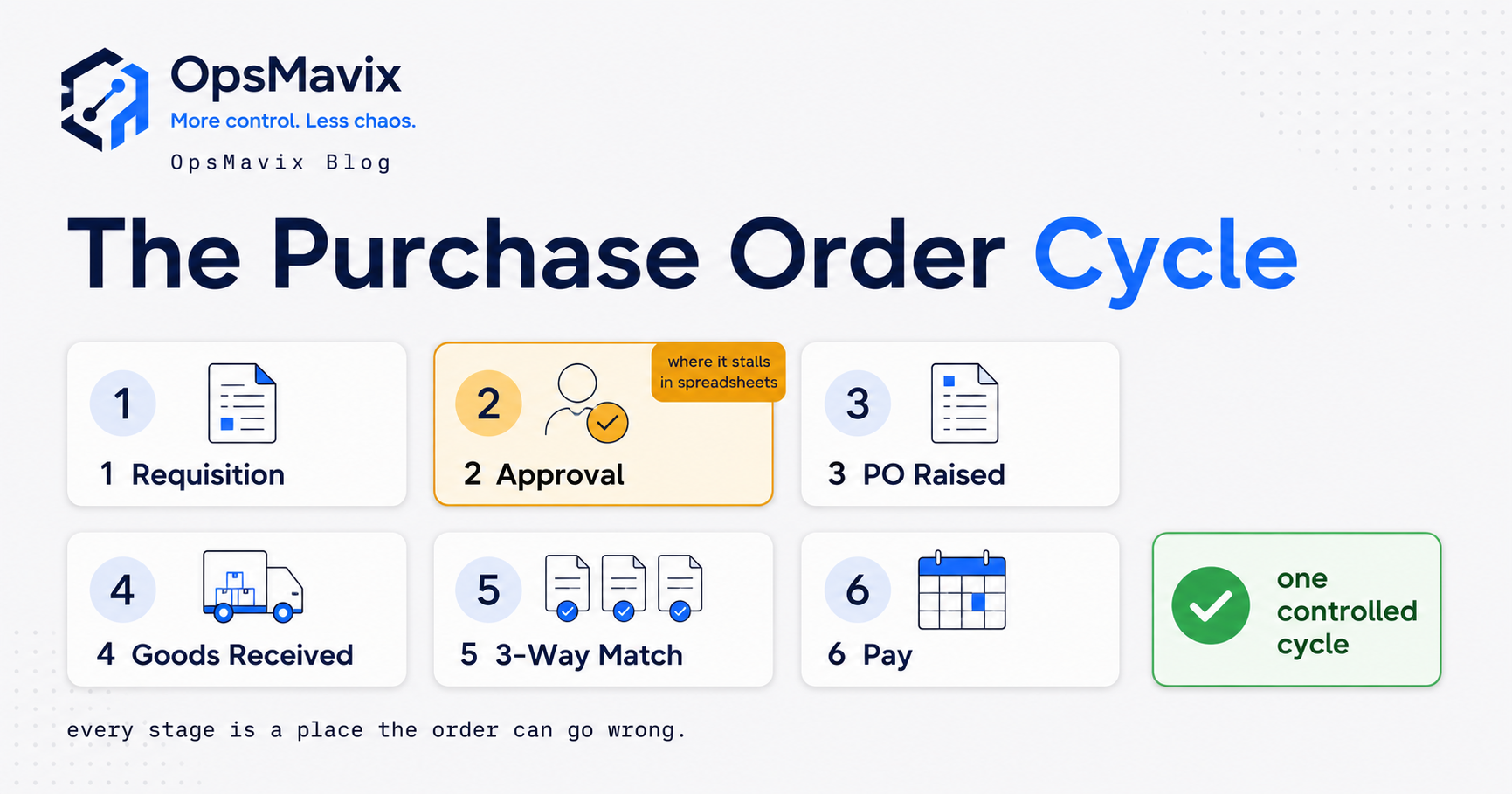
In the language of procurement, raising a purchase order is the moment a business moves from asking internally to committing externally. If you want to see where that moment sits in the bigger picture, our guide to the purchase order cycle walks every stage end to end.
What goes on a purchase order?
There is no single mandatory template for a purchase order in the UK, but a well-built PO carries the same core fields. Leave one out and you create a gap someone will have to fill later by phone or email.
| Field | What it is | Why it matters |
|---|---|---|
| PO number | A unique reference for this order | Ties the delivery note, goods received note and invoice back to one order |
| Date | When the PO was issued | Starts the clock on lead time and payment terms |
| Supplier details | Name, address, contact, supplier account code | Makes sure the order goes to the right legal entity |
| Delivery address | Where goods should arrive | Avoids deliveries to the wrong site or office |
| Line items / SKU | Item codes and descriptions | Removes ambiguity about exactly what is being bought |
| Quantity | How many of each item | The figure receiving will count against |
| Unit price | Agreed price per unit | The figure the invoice will be checked against |
| VAT | VAT rate and amount per line or in total | Shows the expected tax so the invoice can be checked |
| Totals | Net, VAT and gross totals | The financial commitment the business is making |
| Delivery date | When the goods are needed | Lets you chase late orders before they cause a stockout |
| Payment terms | e.g. 30 days net from invoice | Sets when the supplier expects to be paid |
| Authorisation | Who approved it and when | Proves the spend was sanctioned before it was committed |
Many businesses also add terms and conditions (or a link to them), a buyer contact, a cost centre or project code, and any delivery instructions such as booking-in requirements.
A purchase order example
Here is a fully worked purchase order for a fictional UK wholesaler, Example Ltd, buying three lines of packaging and hardware from a supplier. All names, codes and prices are illustrative, and VAT is shown at the UK standard rate of 20%, which GOV.UK lists as the rate for most goods and services.
Purchase order PO-01042 · Issued 14/10/2026 · Supplier: Supplier Co Ltd · Deliver to: Example Ltd, Unit 4 · Required by 21/10/2026 · Terms: 30 days net · Approved by: Operations Manager
| Line | SKU | Description | Qty | Unit price | Line total (net) |
|---|---|---|---|---|---|
| 1 | HG-200 | Stainless steel hinge, 75mm | 200 | £1.85 | £370.00 |
| 2 | CT-4030 | Shipping carton, 400 × 300 × 300mm | 500 | £0.68 | £340.00 |
| 3 | TP-48 | Packing tape, 48mm × 66m | 24 | £2.45 | £58.80 |
| Net total | £768.80 | ||||
| VAT at 20% | £153.76 | ||||
| Total including VAT | £922.56 |
The arithmetic is simple, but it is exactly what the rest of the process depends on. When the delivery arrives, receiving counts 200, 500 and 24 against this PO. When the invoice arrives, accounts checks it against £1.85, £0.68 and £2.45 and a gross figure of £922.56. If the supplier invoices 500 cartons at £0.72, the PO is what tells you that is wrong.
Purchase order vs invoice vs requisition vs sales order
These four documents get mixed up constantly, mostly because they describe the same transaction from different angles.
| Document | Who creates it | Who it goes to | What it does | When |
|---|---|---|---|---|
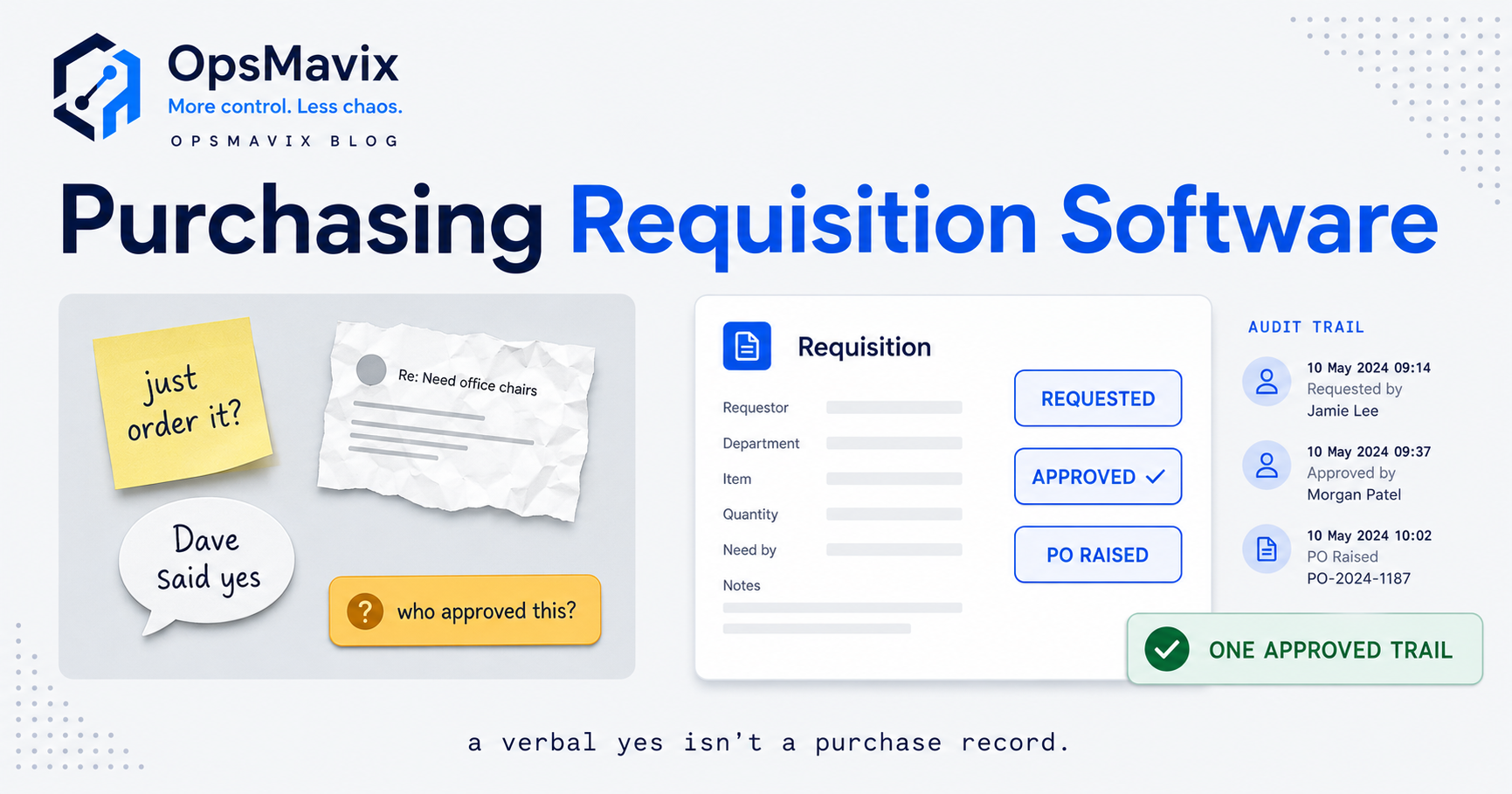
| Purchase requisition | An employee in the buying business | Their own manager or budget holder | Asks internally for permission to buy | Before the PO |
| Purchase order | The buyer (procurement) | The supplier | Commits to buy at agreed terms | After approval |
| Sales order | The supplier | Their own warehouse and accounts | Records the supplier’s side of the same order | When the supplier accepts the PO |
| Invoice | The supplier | The buyer’s accounts payable | Requests payment for what was supplied | After delivery (or per terms) |
The easiest way to keep them straight: a requisition is an internal ask, a purchase order is the buyer’s commitment, a sales order is the supplier’s mirror image of that commitment, and an invoice is the bill. One buyer’s purchase order usually becomes the supplier’s sales order.
How the purchase order process works
The purchase order process is a short chain of control steps. Each one produces something the next step relies on.
- Need identified. Stock hits a reorder point, a job needs materials, or equipment needs replacing.
- Requisition raised. Someone records what is needed, how many and roughly what it will cost.
- Approval. A budget holder signs off the spend, usually by value threshold.
- PO raised. The approved requisition becomes a numbered purchase order and is sent to the supplier.
- Supplier accepts. The supplier confirms price, quantity and delivery date — the point at which both sides are committed.
- Goods received note. On delivery, the goods are counted and checked against the PO and recorded on a goods received note.
- Three-way match. The PO, the goods received note and the supplier invoice are checked against each other. Our guide to 2-way vs 3-way matching explains why the delivery check matters.
- Pay. Once the match passes, the invoice is paid on the agreed terms.
- Close. The PO is closed so it no longer shows as an open commitment.
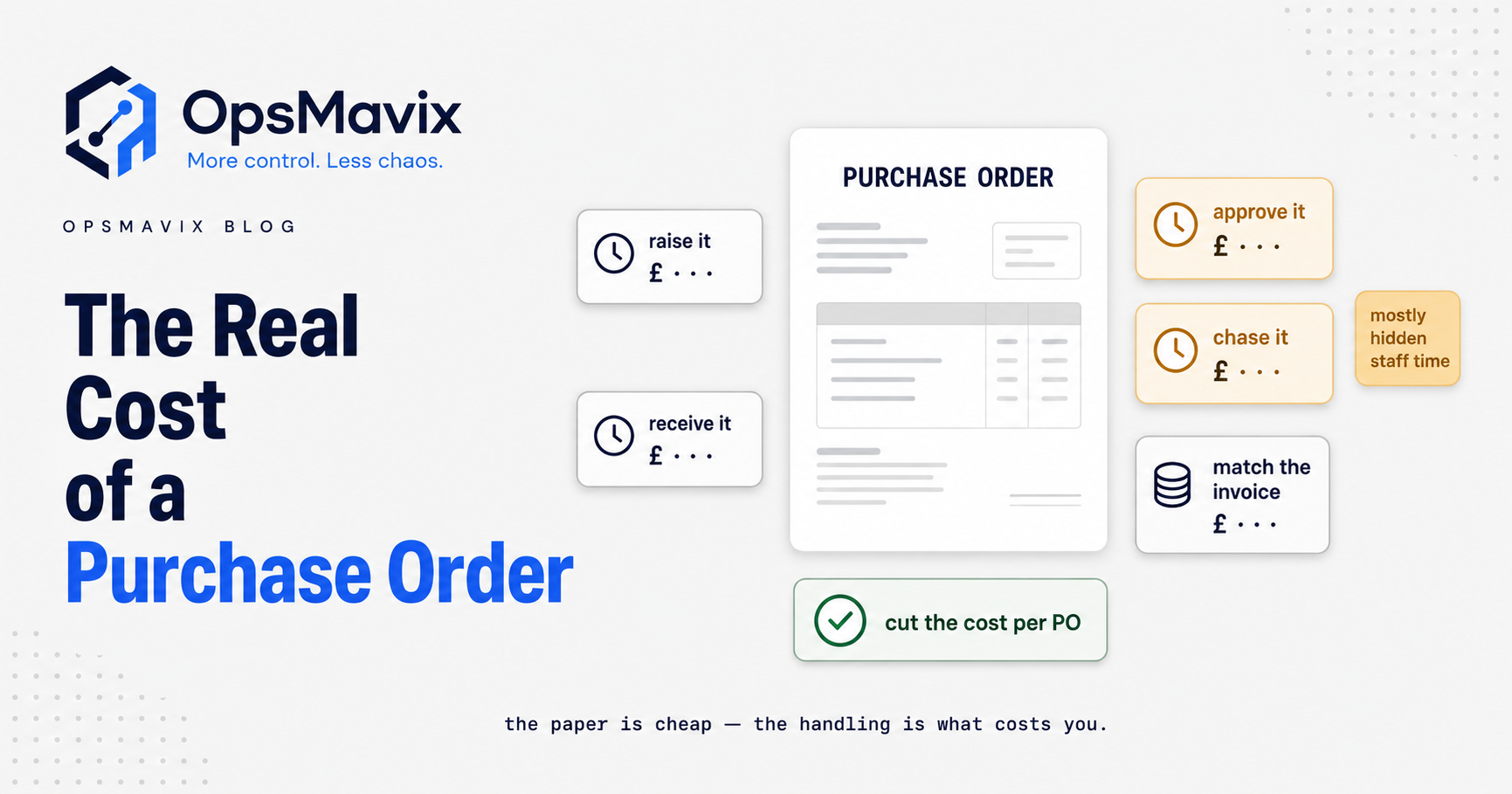
Each of those steps costs time to run, which is why it pays to know the cost of a purchase order in your own business before deciding how much process each order deserves.
Is a purchase order legally binding?
In general terms, a purchase order is an offer to buy. Under general contract principles in the UK, once the supplier accepts that offer — by confirming it in writing, or in many cases by simply fulfilling the order — a contract is usually formed on the terms that apply. Until then, the buyer can normally withdraw or amend it.
Where it gets complicated is whose terms apply. Buyers often print their terms on the PO, and suppliers often send their own terms with their acknowledgement. Which set wins depends on the facts and the sequence of documents. This is a general explanation, not legal advice: if a specific order or dispute matters, speak to a qualified solicitor.
Types of purchase order
Most small businesses only ever use the first type, but it helps to recognise the others:
- Standard purchase order. A one-off order with known items, quantities, prices and delivery date. The everyday PO.
- Planned purchase order. Items and prices are agreed up front, but delivery dates are firmed up later through release orders against it.
- Blanket purchase order. Covers repeated purchases of an item or category over a period, often with a spending cap, without fixing every quantity and date in advance.
- Contract purchase order. Sets the terms and conditions with a supplier; individual standard POs then reference that contract.
When a spreadsheet PO system stops working
Plenty of businesses start with a PO template in Excel and a shared folder, and that is fine at low volume. These are the signs it has stopped working:
- PO numbers clash or get skipped, so two orders share a reference or nobody is sure the sequence is complete.
- Approvals happen in email, and you can’t prove which version of an order was signed off.
- Nobody can say what is on order right now without opening several files.
- Deliveries aren’t checked against the PO, so short or wrong deliveries are found weeks later, if at all.
- Invoices are paid without being matched, because the PO and the delivery record live somewhere accounts can’t see.
- Reordering is guesswork, because open POs aren’t visible next to current stock.
If several of these sound familiar, it is usually time for a proper purchase order system for small business rather than a bigger spreadsheet. Our guide to purchase order management software covers what that software should actually do.
FAQ
Does a purchase order include VAT?
It can, and for VAT-registered UK buyers it usually should show it. Many POs show net line prices with VAT calculated separately, as in the example above, so the expected gross total is clear. The purchase order itself is not a VAT invoice, though: you reclaim VAT from the supplier’s valid VAT invoice, not from your own PO.
Who raises a purchase order?
The buyer. In a larger business that is usually procurement or a designated buyer; in a small business it might be the owner, an operations manager or a warehouse lead. What matters is that the PO is only raised after the spend has been approved by someone with authority to approve it.
What is a PO number?
A PO number is the unique reference given to a purchase order. The supplier quotes it on their acknowledgement, delivery note and invoice, which lets you tie every document in the transaction back to the original order. It should be sequential and never reused.
What is the difference between a purchase order and an invoice?
A purchase order is sent by the buyer before supply to commit to an order. An invoice is sent by the supplier after supply (or on the agreed terms) to request payment. The invoice should be checked against the PO before it is paid.
Do small businesses need purchase orders?
Not for every purchase, but for stock, materials and anything above a modest value, yes. A PO gives you a written record of what you agreed, a reference to check deliveries and invoices against, and a simple view of what is on order — protection that costs very little to put in place.
How OpsMavix Can Help
OpsMavix builds owned, fixed-price operations systems for UK and US wholesale, distribution, ecommerce and manufacturing businesses that have outgrown spreadsheets but don’t need a heavyweight ERP. Purchase orders, approvals, goods receiving and invoice matching live on one record, linked to your stock, with no per-seat fees. See our inventory automation system and invoice approval workflow automation pages, or get in touch to talk through how you buy today.
Keep reading
Getting value from OpsMavix? Add us as a preferred source on Google — you'll see more of our operations content in your AI Overviews, AI Mode and Search.