
What Does It Actually Cost to Process a Purchase Order?
The cost of processing a purchase order has almost nothing to do with the price of what you're buying — it's the hidden labour of raising, approving, chasing, receiving and matching every order, plus the extras nobody counts (maverick spend, wrong quantities, late deliveries). This guide breaks the per-PO cost into its real components, gives you a transparent £ worked build-up you can plug your own numbers into, and shows how tightening the requisition-to-match flow cuts what each order costs to handle.
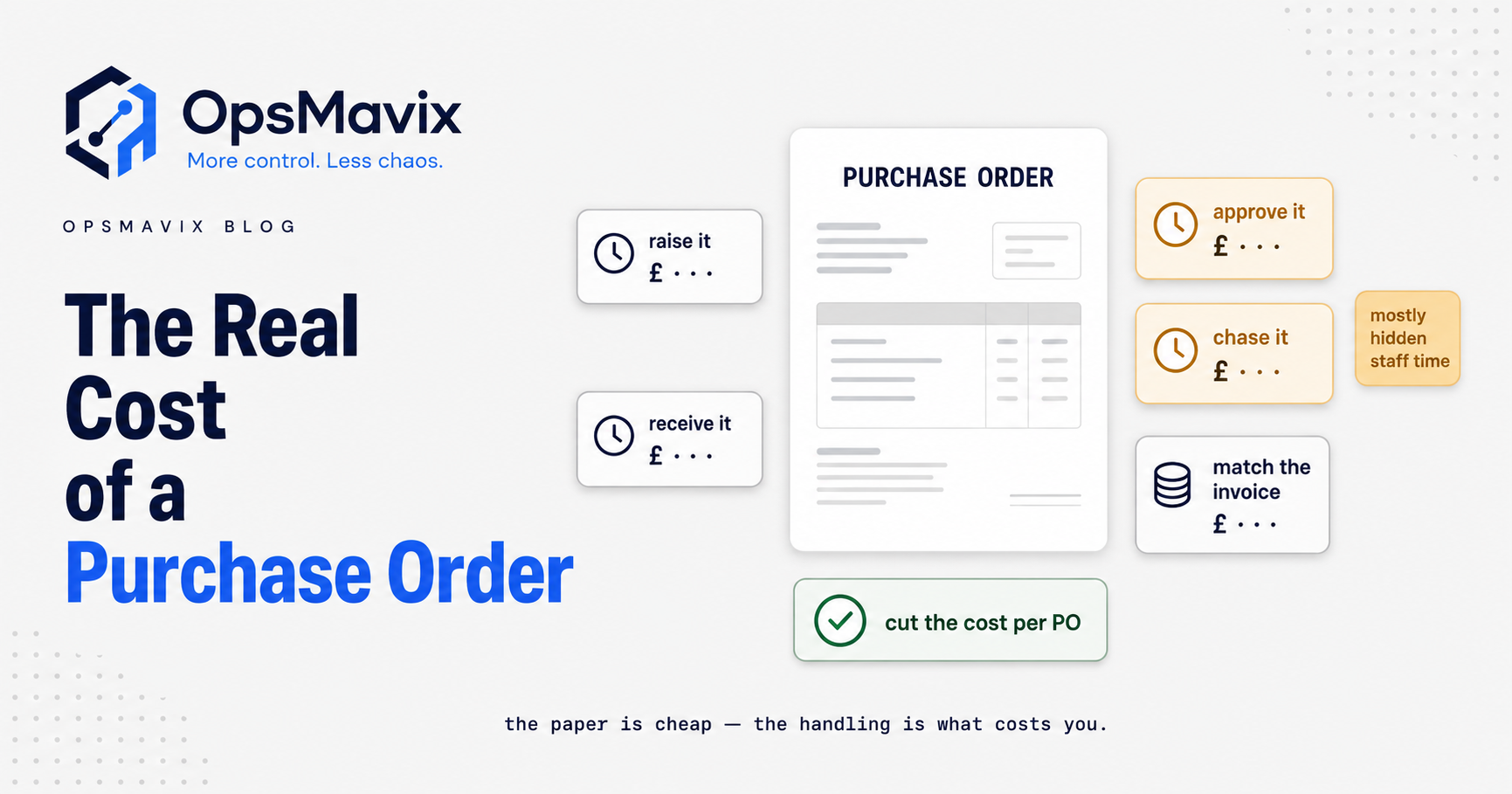
Quick summary: The cost of processing a purchase order is almost entirely the staff time it consumes, not the price of the goods on it. Across raising the order, getting it approved, chasing the supplier, booking the delivery in and matching the invoice, a single PO typically eats a chunk of several people’s day in small, uncounted slices. Because that cost is labour spread across many hands, it never appears on any invoice — which is exactly why it’s usually far higher than businesses assume, and why tightening the flow from requisition to match is where the money is.
Nobody sends you a bill for what it costs to process a purchase order. That’s the whole problem. The £4-a-unit line on the PO is visible; the forty minutes of combined staff time it took to raise, approve, chase, receive and match that order is invisible, spread across a buyer, a manager, a warehouse hand and someone in accounts, none of whom logged it. Ask most businesses what one PO costs them to handle and you’ll get a shrug — which means it’s never been measured, never been targeted, and is almost certainly higher than anyone would guess.
This page is about that hidden number: what actually goes into it, how to build it up honestly in £ using your own figures rather than a borrowed benchmark, and how the shape of your requisition-to-match flow makes each order cost two or three times more than it needs to. For how to track POs from raised to received in the first place, start with the purchase order tracking system guide; this one is specifically about the cost.
In this guide
- Why “the cost of a purchase order” is mostly hidden labour
- The real components of per-PO cost
- A transparent £ build-up (plug in your own numbers)
- Why you shouldn’t trust a benchmark figure
- The hidden extras nobody counts
- Where the cost actually piles up
- How to cut the cost of a purchase order
- How an owned system lowers the per-PO cost
- FAQ
Why “the cost of a purchase order” is mostly hidden labour
When people first think about what a purchase order costs, they think about the money leaving the business — the goods, the freight, the VAT. But that’s the cost of the purchase, not the cost of the order. The cost of the order is everything you spend to turn a need into a paid, received, reconciled transaction, regardless of what’s being bought. Buy £50 of stationery or £5,000 of steel and the paperwork journey is nearly identical: someone requests it, someone approves it, someone raises the PO, someone chases it, someone books it in, someone matches the invoice. The processing cost barely moves with the order value, which is why a low-value PO can cost more to handle than the thing it’s buying.
And that processing cost is labour. There’s a licence fee for whatever software you raise POs in, and a scrap of overhead for storage and stationery, but the overwhelming majority of the per-PO cost is human minutes — small slices of attention from several different people, none of whom experience it as expensive because none of them spend more than a few minutes at a time. A buyer keys in five minutes. A manager approves in two. A warehouse hand books in for three. Accounts matches in four. Individually trivial; collectively, multiplied by every order you raise in a year, a real operating cost that nobody has ever added up.
That invisibility is the reason it stays high. A cost you can see gets negotiated, shopped around, questioned at budget time. A cost that’s smeared across five people’s days in two-minute increments never gets that scrutiny, because it never shows up as a line anyone owns. The first move in managing the cost of a purchase order isn’t cutting it — it’s seeing it, because you can’t manage a number you’ve never calculated.
The real components of per-PO cost
Break one purchase order into the stages it actually passes through and the cost stops being a mystery. Each stage consumes someone’s time, and the time is the cost. There are broadly six, and understanding the difference between a requisition and a purchase order matters here because the request stage — before the PO even exists — is where a surprising amount of the cost hides.
1. Raising the requisition. Someone identifies the need and asks for it. In a loose setup this is an email, a Slack message or a corridor conversation, which feels free but isn’t — it’s time spent, and worse, it’s time spent in a form that can’t be tracked or approved cleanly, so it generates follow-up cost later.
2. Approval. The request has to be authorised by whoever holds the budget. This is one of the most expensive stages hiding as one of the cheapest, because approval is rarely instant — the request sits in an inbox, gets forgotten, gets chased, gets approved on a phone between meetings. The two minutes of actual decision hide hours of latency and the chasing that latency creates.
3. Raising the PO. Converting the approved request into a formal purchase order — supplier, lines, quantities, prices, delivery address, terms. If the requisition was informal, this stage also involves re-keying and interpreting what was actually wanted, which is re-work dressed up as data entry.
4. Sending and chasing the supplier. The PO goes out, and then someone has to confirm it landed, confirm the price still holds, confirm the delivery date, and chase when the acknowledgement doesn’t come. Every chase is a fresh slice of time, and slow suppliers multiply it.
5. Receiving the goods. The delivery arrives and someone books it in — counting what came, matching it to the open PO, recording it, and flagging anything short, over or wrong. Done well this is quick; done against a paper pad or a spreadsheet that doesn’t link to the order, it’s slow and it seeds errors that cost more downstream. This is the goods receiving process, and how tightly it links to the PO decides how much it costs.
6. Matching and paying the invoice. The supplier invoice arrives and has to be checked against the order and the receipt before it’s paid — three-way matching. Where the three documents live in three disconnected places, this is manual, slow, and the single most error-prone stage of the lot.
Every one of those stages is time, and time is money — the money that never made it onto any invoice.
A transparent £ build-up (plug in your own numbers)
Rather than quote a benchmark you can’t verify, here’s the honest way to work out your per-PO cost: estimate the minutes each stage takes, price the minutes at a loaded hourly rate, and add a small allowance for tooling and errors. A loaded rate means salary plus employer’s NI, pension and overhead — a rough rule of thumb is to take the gross hourly rate and add roughly 30% for on-costs.
Here’s an illustrative build-up using placeholder figures. These are examples to show the method, not benchmarks — swap in your own. Say your average person involved earns a loaded rate of £24/hour, which is £0.40 per minute.
| Stage | Who | Minutes (example) | Cost at £0.40/min |
|---|---|---|---|
| Raise requisition | Requester | 8 | £3.20 |
| Approve | Manager | 4 | £1.60 |
| Raise PO | Buyer | 6 | £2.40 |
| Send + chase supplier | Buyer | 7 | £2.80 |
| Receive + book in | Warehouse | 6 | £2.40 |
| Match + pay invoice | Accounts | 9 | £3.60 |
| Subtotal (labour) | 40 min | £16.00 | |
| Tooling / storage allowance | £0.75 | ||
| Error / rework allowance (see below) | £2.50 | ||
| Total per PO (example) | £19.25 |
Two things about this table matter more than the total. First, the number is dominated by labour — strip out tooling and errors and you’re still at £16 of pure staff time for a single order. Second, it’s built from minutes you can actually measure in your own business by timing a handful of real POs end to end. If your loaded rate is higher, or your approval bounces between three people, or your matching is a month-end scramble, your number climbs fast. A business raising 200 POs a month at this illustrative rate is spending roughly £3,850 a month — over £46,000 a year — just to process orders, before a penny of the goods themselves.
To use this properly: time five real purchase orders through every stage, average the minutes, multiply by your loaded per-minute rate, add your tooling and error allowances, and multiply by your annual PO volume. That’s your true cost of purchasing administration — a number most businesses have never seen.
Why you shouldn’t trust a benchmark figure
Search “average cost of a purchase order” and you’ll find confident numbers thrown around — often quoted as a range, sometimes as a single figure, usually with no source you can actually check. Treat all of them with suspicion, for three reasons.
First, the figures are wildly context-dependent. A PO processed by a lean team on a connected system that auto-matches costs a fraction of one that bounces through email approvals and manual month-end reconciliation. The same “purchase order” can cost a few pounds or well over thirty depending entirely on the flow around it — so any single average is averaging things that shouldn’t be averaged.
Second, many quoted figures fold in indirect costs (a share of software licences, office overhead, management time) using assumptions the source rarely spells out, so you can’t tell whether you’re comparing like with like or borrowing someone else’s overhead model.
Third — and this is the honest bit — a benchmark tells you nothing actionable. Even if a figure were accurate for the average business, you don’t run the average business. What you can change is your number, and to change it you have to measure it. A borrowed benchmark is a conversation-starter at best and a false comfort at worst (“we’re probably around the industry figure” is not a measurement). Build your own from the stages above and you get something you can actually act on: a per-PO cost you can watch fall as you tighten the flow.
The hidden extras nobody counts
The stage-by-stage build-up above is the baseline cost — what a clean, correct PO costs to process. But plenty of POs aren’t clean, and the cost of the messy ones is where the real money hides. These extras rarely make it into anyone’s estimate because they don’t feel like PO cost; they feel like “just how it goes.”
Maverick spend. Purchases made outside the proper process — someone orders directly, pays on a card, skips the requisition entirely. The hidden cost isn’t just the lost negotiating leverage; it’s the clean-up. Now someone has to reconcile a purchase that has no PO, chase a receipt that was never raised, and force it through matching after the fact. An off-process purchase costs more to administer than an on-process one, not less, because all the control work happens retrospectively and by hand.
Wrong quantities and specifications. A PO raised for the wrong quantity, the wrong variant, or the wrong price triggers a cascade: the supplier queries it, or worse doesn’t and ships the wrong thing, and now you’re processing a return, a credit note, a corrected PO and a corrected invoice. One error can double or triple the processing cost of that order.
Late and part deliveries. Every delivery that’s late or arrives in pieces multiplies the receiving and matching work — more chasing, more part-receipts to book, more invoice lines to reconcile against a split delivery. The order that comes in three drops costs roughly three times the receiving effort of the one that comes in one.
Duplicate and error-driven rework. Duplicate POs, duplicate payments caught (or not caught) at matching, invoices that won’t reconcile and get parked for month-end — all of it is rework, and rework is the most expensive time in the whole process because it’s unplanned and it interrupts.
The pattern across all four: the cost of a purchase order isn’t a fixed number, it’s a distribution. The clean POs cost your baseline; the messy ones cost multiples. Which means the fastest way to cut your average per-PO cost is usually to cut the number of messy ones — to stop errors and off-process spend at the front, rather than absorb their clean-up at the back.
Where the cost actually piles up
If you total the stages, the expense doesn’t sit where people expect. Most assume “raising the PO” is the cost, because that’s the visible act with a screen and a button. It isn’t. The cost piles up in three quieter places.
Approval latency. The decision is quick; the waiting is expensive. A request that sits for three days generates chasing, re-explaining, re-prioritising and sometimes a duplicate order raised in frustration. The two-minute approval hides hours of drag around it.
Chasing — suppliers and each other. A huge share of purchasing time is spent asking where things are: where’s the acknowledgement, where’s the delivery, where’s the invoice, who approved this, did this ever go out? Chasing produces nothing; it’s pure friction cost, and it scales directly with how little visibility your process gives.
Matching and exceptions. When the PO, the receipt and the invoice live in separate systems, matching is manual detective work, and every mismatch — a short delivery, a price change, a split bill — becomes an investigation. This is where errors from every earlier stage finally surface and get paid for, at the highest hourly rate in the chain (accounts) and under month-end time pressure.
Notice what these three have in common: none of them is the act of ordering. They’re all the cost of a process that can’t see itself — where nobody knows the status of anything without asking a person. That’s the real driver of per-PO cost, and it’s also the most fixable.
How to cut the cost of a purchase order
Because the cost is labour, cutting it means removing minutes and removing errors — not buying cheaper goods. The levers, roughly in order of payoff:
- Kill approval latency. Route requests to the right approver automatically, with the budget context attached, so the decision happens in the two minutes it should rather than dragging for days. Set threshold-based auto-approval for low-value routine spend so trivial orders don’t consume a manager’s attention at all.
- Standardise the requisition. Capture the request once, in a structured form, at the point of need — so the PO can be raised from it without re-keying or interpreting. This kills the re-work stage and makes approval and matching cleaner downstream.
- Stamp out maverick spend. Make the proper process the easy path. Off-process buying almost always happens because the official route is slow or painful; fix the friction and most of it disappears, taking its expensive retrospective clean-up with it.
- Link receiving to the PO. Book deliveries in against the open order at the door, so quantities are confirmed and discrepancies flagged at the moment of receipt — not reconstructed at month-end. This cuts both the receiving cost and the matching cost.
- Automate the match. Where the order, receipt and invoice share one record, clean invoices match themselves and only genuine exceptions reach a person. This removes the single most expensive stage almost entirely for the majority of orders.
- Cut the messy-PO rate. Every error prevented at the front is a multiple of processing cost saved at the back. Correct data, confirmed prices and structured requests do more for your average per-PO cost than speeding up any single stage.
The theme is consistent: the cost of a purchase order falls when the process can see itself and when clean orders flow without a human touching them. You’re not trying to make people faster at manual work — you’re trying to remove the manual work from the clean 80% so people only spend time on the 20% that genuinely needs judgement.
How an owned system lowers the per-PO cost
The reason per-PO cost stays high in most businesses isn’t that anyone is slow — it’s that the process is disconnected. The requisition lives in email, the PO in an accounting tool, the receipt on a warehouse pad, the invoice in an inbox, and the approval in someone’s head. Because nothing is joined, every stage requires a human to carry information from one island to the next, and every hand-off is a chance to wait, to chase, to re-key, and to make the errors that cost multiples to fix. The cost isn’t in any single stage; it’s in the gaps between them.
An owned, right-sized operations system closes the gaps by putting the whole flow on one record. The request is captured once in a structured form; approval routes automatically with the budget context attached and clears in minutes; the PO is generated from the approved request without re-keying; the delivery is booked in against that same PO at the door; and the invoice is matched automatically against the order and the receipt within your own tolerances, so only real exceptions reach a person. The clean orders — the majority — flow from need to paid with almost no human minutes spent, which is precisely the labour that made up most of the cost.
That’s the shift: instead of paying baseline processing cost on every order and multiples on the messy ones, you pay almost nothing on the clean ones and reserve your people’s time for the exceptions that actually need a decision. A purchase order tracking system that follows each PO from raised to received to matched is what makes that possible, because it gives the process the visibility that kills the chasing, the latency and the month-end reconciliation scramble in one move.
This is exactly the gap OpsMavix builds for — businesses that have outgrown spreadsheets and disconnected tools, where the requisition, the PO, the receipt and the invoice already exist but live in disconnected places, so every order costs far more in hidden labour than it should. Pulling the whole flow — including supplier order management — onto one record is what turns per-PO cost from an invisible, unmanaged number into one that visibly falls.
FAQ
What is the average cost of processing a purchase order?
There’s no reliable universal figure, and you shouldn’t trust the benchmarks you’ll see quoted online — the cost swings enormously with your team’s rates, how many people touch an order, and how connected your process is. The same PO can cost a few pounds on a lean, automated flow or well over thirty on one that bounces through email approvals and manual month-end matching. Instead of borrowing a number, time five real orders through every stage, price the minutes at your loaded hourly rate, and build your own figure — it’s the only one you can actually act on.
Why does a purchase order cost so much to process?
Because the cost is almost entirely staff time, spread across several people in small, uncounted slices — raising, approving, chasing, receiving and matching. Each slice feels trivial, so nobody logs it, which is exactly why the total stays hidden and usually higher than assumed. The expense piles up not in the act of ordering but in approval latency, chasing suppliers and each other, and manual invoice matching — all symptoms of a process that can’t see its own status without asking a person.
How do I calculate the cost of a purchase order?
Estimate the minutes each stage takes (requisition, approval, PO creation, chasing, receiving, matching), multiply by a loaded per-minute staff rate — gross rate plus roughly 30% for NI, pension and overhead — then add a small allowance for tooling and for the rework caused by errors. Time a handful of real orders rather than guessing. Multiply the per-PO figure by your annual PO volume and you get your true cost of purchasing administration, a number most businesses have never calculated.
Does the cost of a PO depend on the order value?
Barely. The processing cost is the paperwork journey, which is nearly identical whether you’re buying £50 of stationery or £5,000 of steel — someone still requests, approves, raises, chases, receives and matches it. This is why low-value POs can cost more to process than the goods are worth, and why consolidating small orders and auto-approving routine low-value spend is one of the quickest ways to cut total processing cost.
What’s the fastest way to reduce per-PO cost?
Cut the number of messy orders and remove human touches from the clean ones. Errors, maverick spend and part deliveries each cost multiples of a clean PO to sort out, so preventing them at the front saves more than speeding up any single stage. Then connect the flow so approval routes automatically, receipts book in against the PO, and clean invoices match themselves — leaving your people to handle only the genuine exceptions rather than processing every order by hand.