
The Peoplevox Alternative Beyond the Warehouse Walls
Peoplevox is a strong ecommerce warehouse management system — but its walls end at the warehouse door, while the leaks in orders, purchasing and reporting sit outside them. Here's where it fits, where it doesn't, and why the honest alternative isn't another WMS but one operations system shaped to how you actually run.
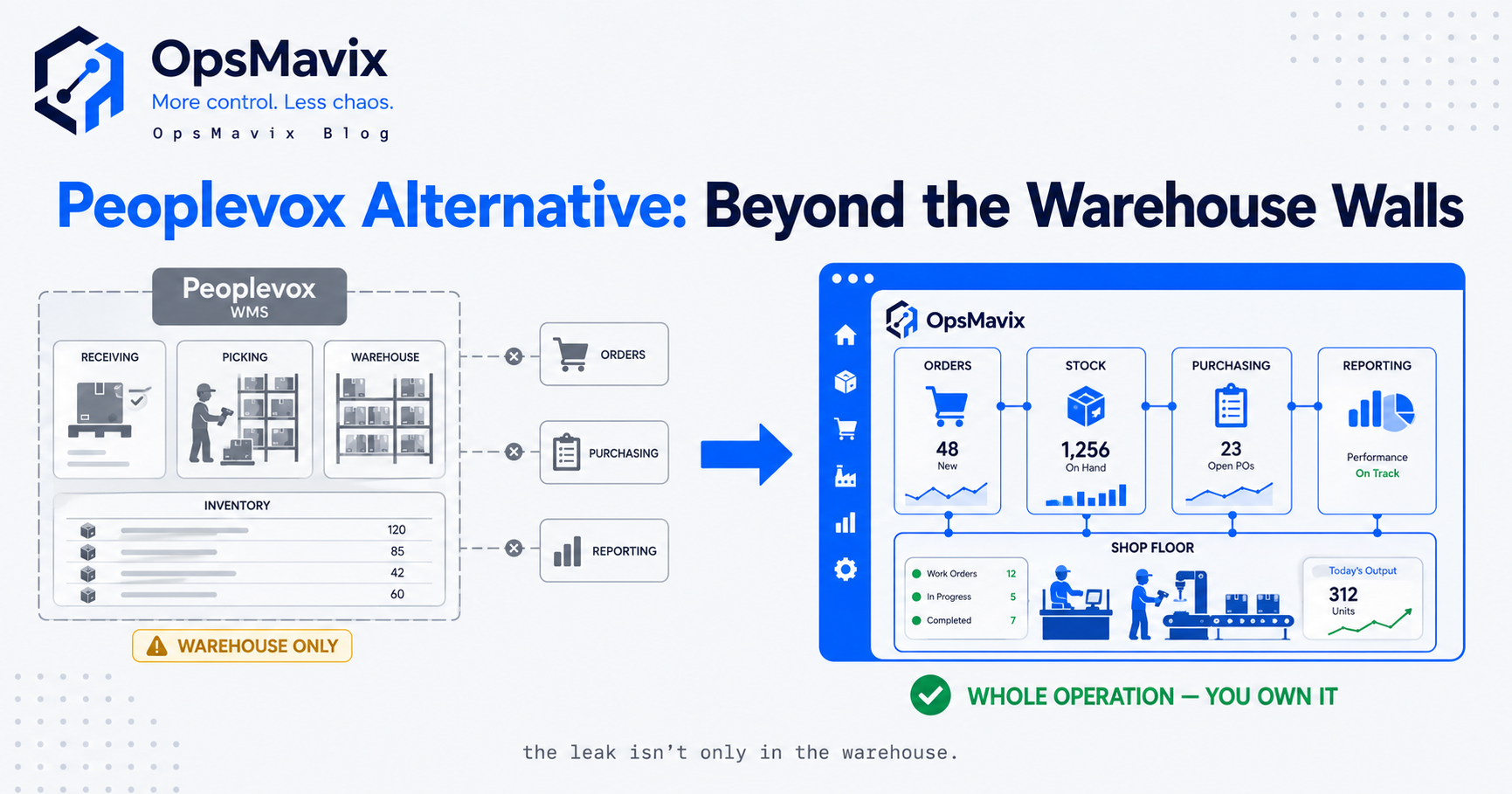
The best Peoplevox alternative is usually not another warehouse management system. It’s one owned operations system shaped to how your business actually runs — because the reason most people go looking isn’t that Peoplevox picks and packs badly. It’s that the leak they’re chasing lives outside the warehouse, in the orders, purchasing and reporting that a WMS was never built to hold. Swap one warehouse tool for another and you’ve re-solved a problem you didn’t have, while the real one keeps costing you.
Most people searching this term aren’t unhappy with Peoplevox’s features. They’re bending an operation around a tool scoped to one room of the building, or paying for warehouse depth they use while the parts that break — the supplier order that arrived short, the reorder point nobody watched, the report that needs numbers from three systems — sit in spreadsheets beside it. That’s not a WMS failing. It’s a WMS doing its job inside its walls, and the walls being narrower than the problem.
Key Takeaways
- Peoplevox is a genuine ecommerce WMS, owned by Descartes Systems Group since 2020, and strong at warehouse execution: picking, packing, put-away and dispatch accuracy.
- Its scope ends at the warehouse door — orders, purchasing, supplier management and cross-system reporting sit outside what a WMS is built to hold.
- Most “alternative” searches are scope problems, not feature problems — you’re patching the gaps around the warehouse, not inside it.
- Pricing is quote-based, scaled to your volume and modules, so the real comparison is total cost against what you actually use — not a headline number.
- Sometimes buying Peoplevox is simply correct — a high-throughput ecommerce warehouse with clean upstream systems should buy the specialist and move on.
- The right-sized middle is one operations system you own — the practical layer between a spreadsheet and an ERP, spanning the walls a WMS stops at.
What Peoplevox Actually Is
Be fair to it first. Peoplevox is a cloud warehouse management system built for ecommerce and retail, owned by Descartes Systems Group since its 2020 acquisition. Descartes is a large logistics-technology company; Peoplevox originated as a UK-focused WMS and slots into that wider portfolio. What it does well is warehouse execution: barcode-driven picking, packing, put-away, stock accuracy on the shelf, and getting parcels out the door fast and correctly. For a warehouse under real order pressure, that’s a serious, worthwhile job done properly.
If your pain is genuinely on the warehouse floor — mispicks, slow dispatch, no real-time view of what’s on which shelf — Peoplevox is a strong answer, and replacing working warehouse software is its own kind of leak. The honest question is only ever whether the floor is where your pain actually lives. For most operations chasing an alternative, it isn’t. The mechanics of the room where a warehouse management system earns its keep are exactly the part that already works.
Where Peoplevox Hits Its Ceiling
The ceiling isn’t a weakness in the product — it’s the edge of the category. A WMS assumes orders arrive clean and stock arrives on time, then executes brilliantly on that assumption. The leaks live in everything that assumption skips.
Take purchasing. A WMS receives stock; it doesn’t decide what to buy, chase the supplier who shipped short, or hold the reorder logic that stops you stocking out of your best seller. That sits outside the walls, usually in a spreadsheet, which is where supplier order management quietly becomes the most expensive gap in the building — a late or short delivery the warehouse can’t see coming and can’t fix.
Take orders. A WMS acts on orders it’s handed. But where do bespoke B2B terms, price tiers, backorders or a phone order that never touched a marketplace feed get handled? Not in the warehouse tool. And take reporting: the question that matters — margin after real carriage by channel, stock-turn by supplier, the true cost of returns — needs data from orders, purchasing and finance stitched together. A WMS reports on the warehouse, so someone rebuilds the real answer from exports every month. Add multi-site into it and the seams multiply, because multi-location inventory is a whole-operation question a single-warehouse execution tool answers only for its own four walls.
The Pricing Reality
Peoplevox does not publish standard pricing — it’s quote-based, scoped to your operation. That’s normal for warehouse software at this level, and it’s not a criticism: the model reflects that a WMS is sized to your throughput, SKU count, sites and the modules you switch on. Expect a setup and implementation cost plus a recurring subscription, quoted against your volume, and expect it to scale as you grow.
The point isn’t a number — inventing one would be dishonest, and figures move. The point is what you’re paying for: deep warehouse execution. If your warehouse genuinely needs that depth, it’s money well spent. If you’re buying a full WMS to solve a purchasing or reporting leak that lives outside it, you’re paying warehouse prices for a warehouse answer to a question the warehouse can’t hear — and still keeping the spreadsheets. Model the quote against what you’ll actually use, not against the feature list.
When Peoplevox Is Genuinely the Right Choice
Sometimes buying it is the correct call, and we’ll say so plainly. If you run a high-throughput ecommerce or retail warehouse — real pick volumes, tight dispatch SLAs, a floor that lives or dies on stock accuracy — and your upstream systems are already clean (orders arrive structured, purchasing is handled elsewhere and works, reporting isn’t your bottleneck), then you want a specialist WMS, and Peoplevox is a strong one. Building your own warehouse execution engine to replace one that already turns cleanly is spending money to stand still.
The test is honest and narrow: is your pain inside the warehouse walls, and is everything around those walls already working? If yes, buy the specialist. If the warehouse is the one part that’s fine and the leaks are upstream and downstream, a deeper WMS won’t touch them.
The Right-Sized Middle: One Operations System
Here’s the fork most alternative searches miss. It isn’t “Peoplevox versus another WMS.” It’s “keep bolting tools and spreadsheets around a warehouse system, or run one operations system that spans the walls.” The second is the OpsMavix position: a right-sized operations system you own — the practical layer between a spreadsheet and a full ERP, for the business that’s outgrowing spreadsheets but not looking for, and not wanting, an enterprise suite.
What that changes: orders entered once off whatever they arrive on and validated so wrong codes can’t flow downstream; purchasing and reorder logic in the same system as stock, so a short delivery is visible the day it happens, not the day you stock out; one true stock figure every function reads from; and reporting that answers the cross-system question directly because the data already lives in one place. Warehouse execution stays as good as it needs to be — you don’t lose picking discipline; you stop paying for a tool that only sees one room. It’s the same logic behind an operations control system: the leaks join up, so the system that closes them has to as well.
The Honest Build-vs-Buy Take
Buy Peoplevox when the warehouse is the problem and everything around it works — a specialist beats a generalist inside its own walls every time, and a clean-upstream, high-throughput ecommerce warehouse should buy it and get on with the day. Don’t buy it to solve a leak it can’t see. If you’ve been comparing WMS options because orders, purchasing or reporting keep breaking, you’re shopping in the wrong aisle: a deeper warehouse tool leaves those exactly where they are and adds a bill.
The honest version of the “what next” question is scope, not features. Name where your worst leak actually lives. If it’s on the floor, buy the specialist. If it’s in the seams between orders, stock, purchasing and reporting, the answer is one operations system that owns those seams — shaped to how you run, held outright, with nothing bent to fit and nothing left in a spreadsheet beside the tool. That’s the alternative worth searching for, and it’s rarely another WMS.
Keep reading

Getting value from OpsMavix? Add us as a preferred source on Google — you'll see more of our operations content in your AI Overviews, AI Mode and Search.