
Warehouse Management Software Solutions: What They Actually Cover, and When You Only Need Part of One
Warehouse management software solutions govern five physical steps — goods-in, putaway, bin locations, directed picking and dispatch. Most growing UK warehouses only trip on two or three of them, yet get sold the whole enterprise stack. This guide breaks down what each tier actually covers and when a right-sized system you own beats renting a WMS forever.
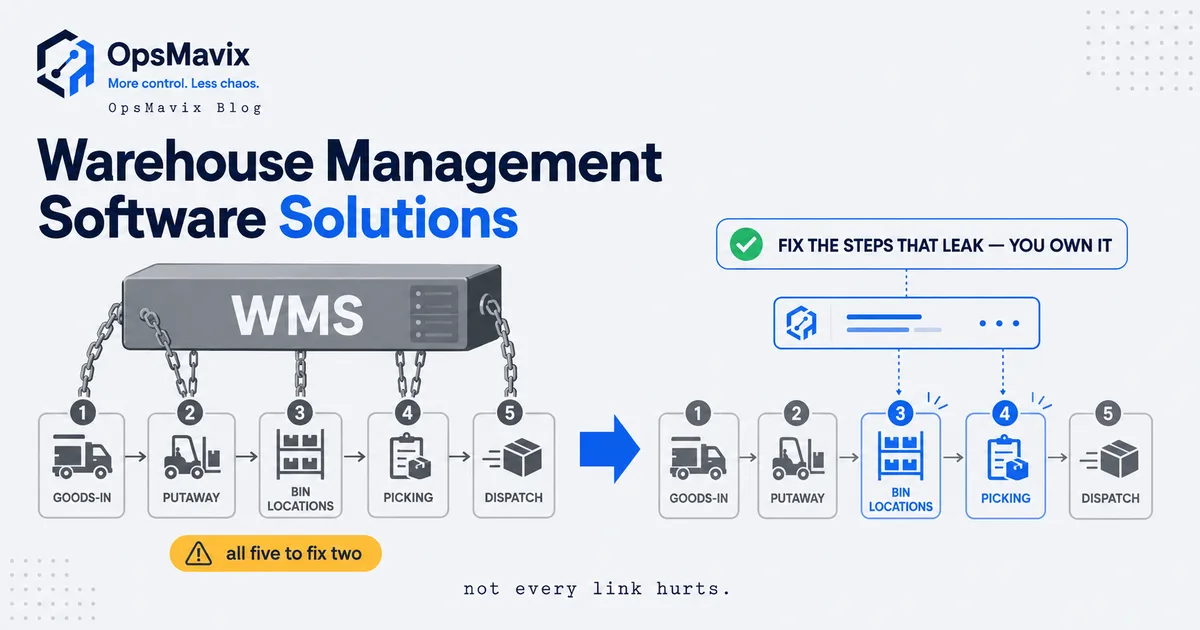
Warehouse management software solutions are the systems that govern the physical journey of a unit through your building — from the moment it lands on your goods-in bay to the moment it leaves on a courier’s van. Underneath the marketing, every one of them is trying to control the same five steps: receiving stock in, putting it away, knowing which bin it’s in, directing the pick, and confirming the dispatch. The gap between the cheapest app and the six-figure enterprise platform isn’t which steps they touch — it’s how deeply, how rigidly, and how much you pay forever for steps your warehouse doesn’t actually trip on.
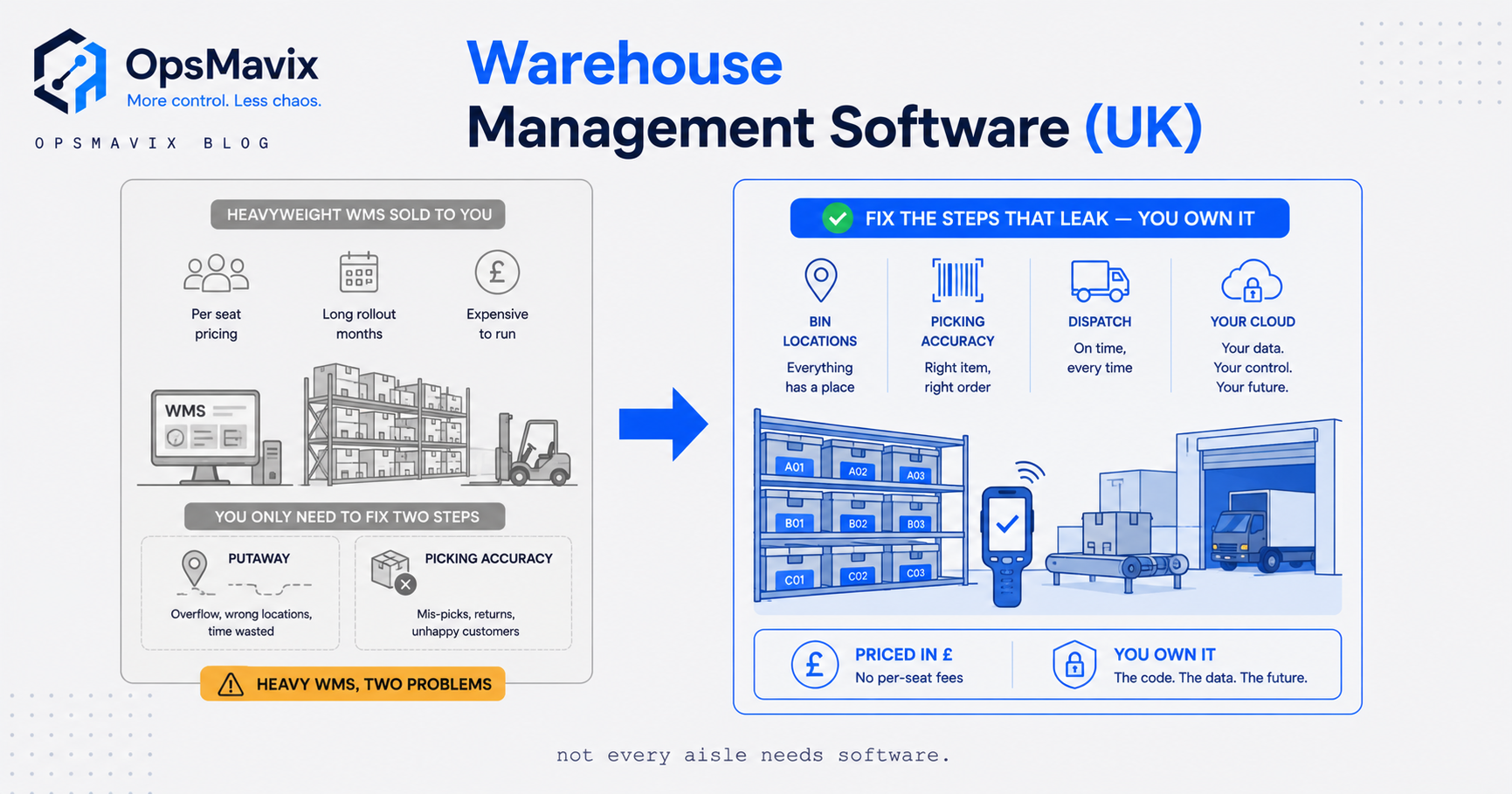
That last point is where most growing UK operations lose money. A warehouse rarely leaks in all five places at once. It leaks in one or two — the pick path is chaos, or putaway is a free-for-all so nothing is ever where the system says. Yet the market’s answer to “our picking is a mess” is almost always “buy a full warehouse management system,” which prices, provisions and complicates all five steps to fix the one that hurt. This guide covers what a warehouse management software solution genuinely does at each step, the real tiers from app to enterprise, and how to tell when you need the whole thing versus a right-sized system built around only the steps you’re failing.
The Five Steps Every Warehouse System Governs
Whatever the badge on the box, a warehouse management software solution exists to control stock through five physical stages. Everything else — the dashboards, the KPIs, the labour reports — is downstream of getting these right.
- Goods-in (receiving). Stock arrives against a purchase order or ASN, gets checked, and is booked into the system so it officially exists and can be sold.
- Putaway. The received stock is moved to a storage location and that location is recorded, so the system knows where it physically is — not just that you own it.
- Bin locations. Every storage position has an address (aisle-bay-level-bin), and every unit is tied to one, so “we have 40” always comes with “and here’s exactly where.”
- Directed picking. When an order drops, the system tells a picker the optimal path and the exact bins to visit, and makes them confirm each pick before the stock leaves.
- Dispatch. The picked order is packed, matched to a courier and label, and confirmed out — decrementing stock and closing the order in one recorded event.
The thing worth internalising is that these steps form a chain, and the chain is only as trustworthy as its weakest link. Perfect directed picking is worthless if putaway was sloppy and the stock isn’t actually in the bin the system points to. A tidy dispatch process means nothing if goods-in booked the wrong quantity. This is why “our stock is always wrong” is almost never a counting problem — it’s a broken link somewhere in this chain, and the fix is finding which one. Our guide on what a warehouse management system is walks the chain end to end; here we’re focused on which links you actually need to pay for.
Goods-In and Putaway: Where Accuracy Is Won or Lost
Every downstream number inherits the accuracy of goods-in. If a delivery of 500 gets booked as 5 cartons without confirming units, or a short-shipment isn’t caught, the system starts the day already lying, and no amount of clever picking recovers it. A good receiving process checks the physical count against what was ordered, records discrepancies as they happen, and only then declares the stock live and sellable. This is the same discipline as a proper goods received note — the point where “we ordered it” becomes “we verifiably have it.”
Putaway is the quieter killer. In a lot of growing warehouses, receiving is at least witnessed, but putaway is a free-for-all: whoever’s nearest grabs the pallet and slots it wherever there’s space, and nobody records where. The stock now exists in the system with no location, or worse, a stale one. When a picker is sent to find it, they can’t, so they grab it from wherever they happen to spot it, and the phantom counts begin.
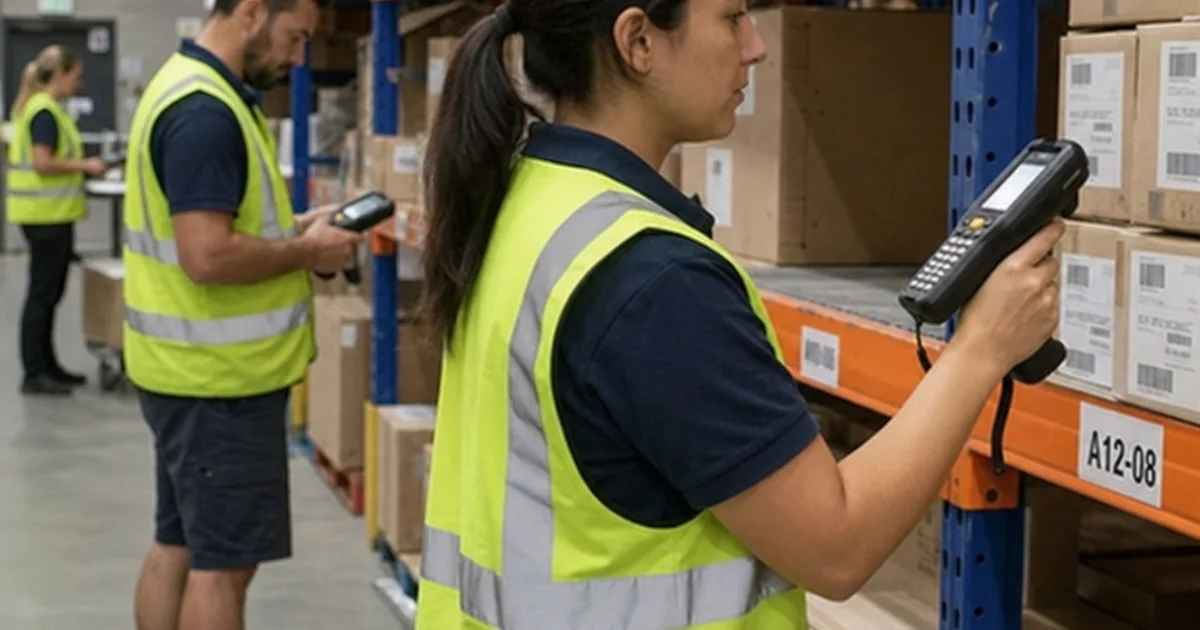
One warehouse manager described the state before any system as “guessing and manually counting material” — that’s exactly the symptom of putaway with no recorded location. The fix isn’t more counting. It’s making putaway a confirmed event: scan the unit, scan the bin it’s going into, and now the system knows precisely where those units live. Do that and the single most common complaint in stock-holding SMEs — being unable to “see what’s on my warehouse like an Excel sheet” — quietly goes away, because the system finally holds the map.
Bin Locations and Directed Picking: The Money Steps
If you only ever fix two links in the chain, fix these two. Bin locations and directed picking are where a warehouse system earns most of its keep, and where the cheap tools most often fall short.
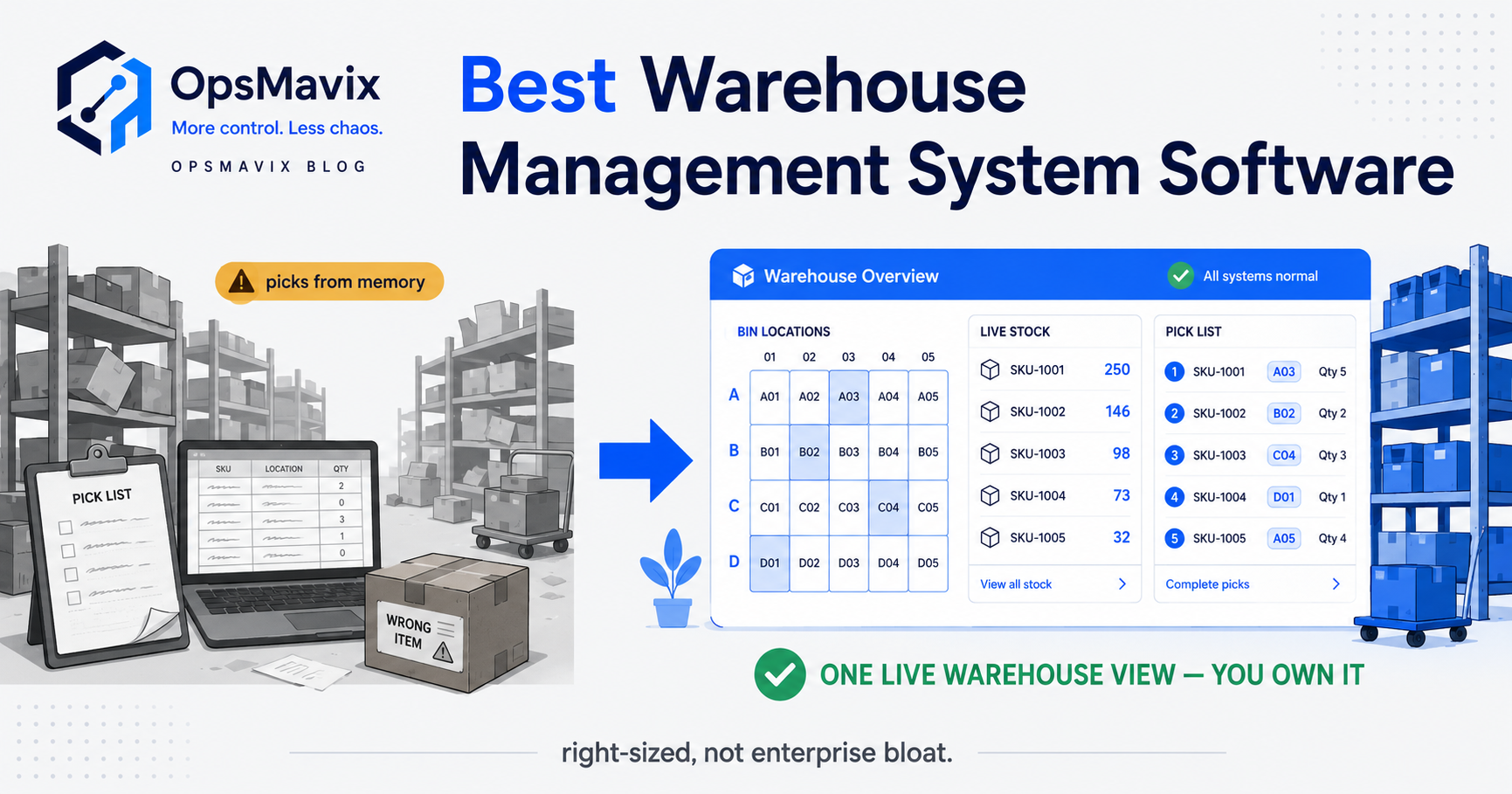
Bin locations turn “we have it somewhere” into “it’s in C-04-2.” Without addressed bins, a warehouse runs on the tribal knowledge of whoever’s worked there longest — which is fine until they’re on holiday and the temp can’t find the fast movers. Proper bin discipline, covered in depth in our warehouse bin locations guide, means every unit has an address and the system can route to it. It also makes smarter storage possible: fast movers near dispatch, slow movers up high and out of the way.
Directed picking is the payoff. Instead of a picker wandering the building with a paper list, the system hands them an optimised route — visit these bins in this order, take these SKUs, these quantities — and requires a scan-confirm at each stop. Two things happen. First, walking time collapses, because nobody’s crossing the warehouse twice. Second, and more valuable, mis-picks collapse, because the picker can’t move the count by grabbing the wrong item or the wrong number without the system objecting. Which picking strategy suits you — single-order, batch, zone, wave — is a real decision, and our picking methods compared breakdown covers the trade-offs.
Here’s the operator reality the glossy demos skip: an inventory manager we’ve heard the same story from many times admitted their team “would consistently oversell items we didn’t even have on hand.” That isn’t a sales problem. It’s a picking-and-count problem — the stock figure said available because a mis-pick or an unrecorded movement corrupted it upstream. Directed, confirmed picking against addressed bins is the mechanic that stops the count drifting in the first place.
Dispatch and the Handoff Out
Dispatch is the moment the warehouse’s internal truth becomes the customer’s experience. The order is packed, checked against what was picked, matched to a courier service and label, and confirmed out — and that confirmation is what should decrement stock and close the order, in one recorded event rather than three disconnected ones.
Where dispatch is loose, two failures recur. The first is the overnight-batch trap: stock only updates hours after it physically left, so the website and the other channels trade all day off numbers that are already wrong. The second is the silent-drop problem — an order gets picked and shipped but the system isn’t told cleanly, so it lingers as “open” or the stock never comes off. One 3PL operator’s public complaint captured the nightmare version precisely: “hundreds of our orders were missing… inventory wasn’t being diminished.” That’s dispatch and count falling out of sync at scale.
A right-sized dispatch step ties the pack-and-ship confirmation to the stock decrement and the order status as a single transaction, so what left the building, what the count says, and what the customer sees are the same fact. This is the same event-driven discipline that makes order fulfilment software trustworthy: the moment goods move, every number that depends on them moves too.
Warehouse Management Software Solutions: The Real Tiers
“Warehouse management software solutions” spans an enormous range of price and weight. Here’s the honest map of the tiers, what each is genuinely good for, and where each stops.
| Tier | What it really is | Best for | Where it stops |
|---|---|---|---|
| Inventory app with light warehouse features | A stock tool that adds basic locations and picking | One room, low SKU count, simple flow | Bin logic and directed picking are shallow; putaway often not enforced |
| Mid-market WMS (SaaS) | Purpose-built warehouse platform, monthly per-user/module | Established warehouses wanting the full five-step chain off the shelf | You bend your process to its model; per-seat fees scale with your team; support and roadmap aren’t yours |
| Enterprise WMS | Heavy, configurable platform, consultant-led rollout | Large multi-site DCs, complex labour and automation, high volume | Months to implement, expensive to run, vast reach you mostly won’t touch |
| Right-sized owned system | Software built around only the steps you’re failing, owned by you | Growing operations tripping on one or two links, not all five | You maintain what you own — but you extend it because the code is yours |
Be fair to each tier, because each is right for someone. The light inventory app is genuinely enough for a single small room with a simple range — don’t overbuy. A mid-market WMS is a solid, proven choice if you want the whole five-step chain, off the shelf, today, and you’re comfortable running your warehouse the platform’s way and paying per seat as you grow. And a full enterprise WMS earns its cost at genuine scale — multiple distribution centres, conveyor and robotics integration, hundreds of pickers — where that depth is the point. Our roundups of the best warehouse management system software and options for a warehouse management system for small business go tier by tier on the named products.
The tier that’s routinely missold is the middle. A business with a picking problem and a putaway problem gets sold a platform that also prices, configures and complicates goods-in, bin strategy and dispatch it was already handling fine — and rents the whole thing forever, per user, on someone else’s roadmap.
When a Full WMS Is Overkill
A full warehouse management system is overkill when you don’t have a full warehouse management problem. That sounds obvious, but it’s the diagnosis almost nobody performs before buying. The useful question isn’t “do we need a WMS?” — it’s “which of the five steps are actually leaking, and by how much?”
Signs you need only part of a solution, not the whole platform:
- The leak is concentrated. Your goods-in is fine and dispatch is fine, but picking accuracy is your entire problem. You need directed picking and bin discipline — not a receiving and labour-management suite you’ll never switch on.
- You already run tools that work. Your accounts package, your ecommerce platform, your courier integrations are fine. You don’t need to rip them out; you need the missing warehouse layer to talk to them.
- You’re being sold reach you can’t name. If the demo spends most of its time on modules you can’t picture using, that’s reach you’ll rent forever and touch never.
- Per-seat pricing scares you as you grow. When adding warehouse staff means adding licences indefinitely, the tool taxes the exact growth it’s meant to support.
There’s a specific objection worth naming here, because operators say it themselves: “we’re not big enough for a real WMS.” Often true — and yet the light inventory tools underneath still let them oversell and lose the count, and the niche SaaS above charges enterprise money for it. The honest answer for a lot of growing UK warehouses isn’t up or down a tier. It’s sideways: a system shaped to the two steps you’re failing, wired into what you already run, and owned outright — the same inventory automation system discipline of letting each physical event update the truth automatically, applied only where you actually need it.
A Worked Example: The Two-Step Leak
Numbers make it concrete. These figures are illustrative — not a claim about a specific client — but the shape is one warehouse managers recognise on sight.
A UK homeware distributor runs a single 12,000 sq ft warehouse, around 2,000 SKUs, shipping roughly 180 orders a day across a Shopify store and two trade accounts. Goods-in is witnessed and fine. Dispatch is fine. The leak is entirely in the middle two steps: putaway is unrecorded, so bin locations drift, and picking is paper-list and unconfirmed. Average order value is about £60.
On paper it functions. In practice, two leaks run every single day:
- Mis-picks. With unconfirmed paper picking, roughly 2% of orders ship wrong — call it 3–4 a day. Each one costs the return courier, the refund or reship, the re-pick labour, and staff time on the apology. Conservatively £18 all-in per mis-pick. That’s around £65 a day, or roughly £16,000 a year, walking out on couriers — before the customers who simply stop reordering.
- Search time. Because putaway isn’t recorded, pickers hunt for stock the system can’t locate. Say 90 seconds of avoidable searching on a third of picks across the day. Across the team that’s an easy 1.5–2 hours of paid labour a day spent walking and hunting — call it £9,000–£12,000 a year in wages producing nothing.
Add the two and this warehouse is bleeding on the order of £25,000 a year out of two broken links — while goods-in, dispatch and its existing Shopify and courier setup all work fine.
The fix isn’t an enterprise platform that re-does all five steps. It’s exactly two: record putaway as a scan-confirm event so every unit has a live bin, and switch picking to directed, scan-confirmed routes against those bins. Wire it into the Shopify and courier tools already in place. The result is one live count that stops drifting, pickers who walk a route instead of hunting, and mis-picks caught before the box is sealed — for a fraction of a full WMS, owned rather than rented per seat forever.
FAQ
What do warehouse management software solutions actually include?
At their core, all of them control five physical steps: goods-in (receiving stock against an order), putaway (moving it to a recorded location), bin locations (giving every position an address), directed picking (routing pickers to exact bins and confirming each pick), and dispatch (packing, labelling and confirming the order out while decrementing stock). Cheaper tools touch these steps lightly; enterprise platforms control them deeply and add labour management, automation integration and multi-site logic. The steps are the same; the depth, rigidity and price are what differ between tiers.
Do I need a full WMS or just part of one?
It depends entirely on which steps are leaking. Most growing warehouses fail on one or two links — usually putaway and picking — while receiving and dispatch work fine. If that’s you, a full WMS prices and complicates all five steps to fix the two that hurt, and you rent the rest forever. A right-sized system built around only your failing steps, wired into the tools you already run, is often cheaper, faster to go live, and shaped to how you actually work. The way to know is to measure the leak per step before you buy anything.
What’s the difference between an inventory app and a warehouse management system?
An inventory app answers “how many do we own?” A warehouse management system answers “how many, exactly where, and how do we move them accurately?” The extra ground is putaway, bin-level location, directed picking and dispatch confirmation — the physical control of stock through the building, not just the count of it. Many inventory apps bolt on light location and picking features, but the enforcement (scan-confirm putaway, directed routes, blocked mis-picks) is usually shallow, which is exactly where accuracy is won or lost.
Will a warehouse system connect to my ecommerce store and couriers?
It should, and the connection is the whole point of getting one. Your online store is where orders originate and stock must decrement in real time; your couriers are where dispatch is confirmed. A right-sized system is built around the platforms you already use rather than forcing you to replace them, so a pick-and-pack confirmation updates the shared count, the website availability and the order status as one event. The failure mode to avoid is any setup that updates stock on an overnight batch, because that puts every channel a day behind reality.
We keep overselling stock we don’t have — is that a software problem?
It’s a count-integrity problem, and software is the fix only if it targets the right step. Overselling happens because the available figure is wrong, and it’s usually wrong because a mis-pick, an unrecorded putaway, or a loose dispatch corrupted the count upstream. Directed, scan-confirmed picking against recorded bin locations stops the count drifting at the two steps where it most often breaks. A dashboard that merely displays the wrong number more attractively won’t help; the mechanic that forces confirmation at each physical move is what does.
How OpsMavix Can Help
OpsMavix builds right-sized, owned warehouse systems for growing UK operations that are tripping on specific steps — not all five. Instead of selling you a light inventory app that lets the count drift, or a full enterprise WMS where you’d use a sliver and rent the rest forever per seat, we start by measuring which of the five steps — goods-in, putaway, bin locations, directed picking, dispatch — is actually leaking time and money, and by how much. Then we build the exact layer that fixes it: scan-confirmed putaway so every unit has a live bin, directed picking that blocks mis-picks before they ship, and dispatch that keeps your count, your website and your couriers telling the same story — wired into the ecommerce and accounts tools you already run, and owned outright by you. It’s the practical layer between an inventory tool that’s run out of road and a WMS that’s overkill. If your stock is never where the system says and you’re reordering things you already own, start by seeing exactly which step is costing you most: Book a Free Operations Leak Audit
Sources
- Google Search Central — helpful, reliable, people-first content — guidance this guide is written against (substance and original analysis over rewritten summaries).
- Operator language in this article is drawn from anonymised, real practitioner complaints about inventory and warehouse tools (overselling, phantom counts, unrecorded putaway, missing orders), attributed generically to protect sources. Cost figures in the worked example are illustrative, not a claim about a specific client.
Keep reading
Getting value from OpsMavix? Add us as a preferred source on Google — you'll see more of our operations content in your AI Overviews, AI Mode and Search.