
Warehouse Management Software UK: What Fits a Growing Operation
A practical look at warehouse management software in the UK for growing operations: what it does for picking, put-away and bin locations, and why a right-sized owned system often beats a full enterprise WMS for a business that has outgrown spreadsheets and disconnected tools.
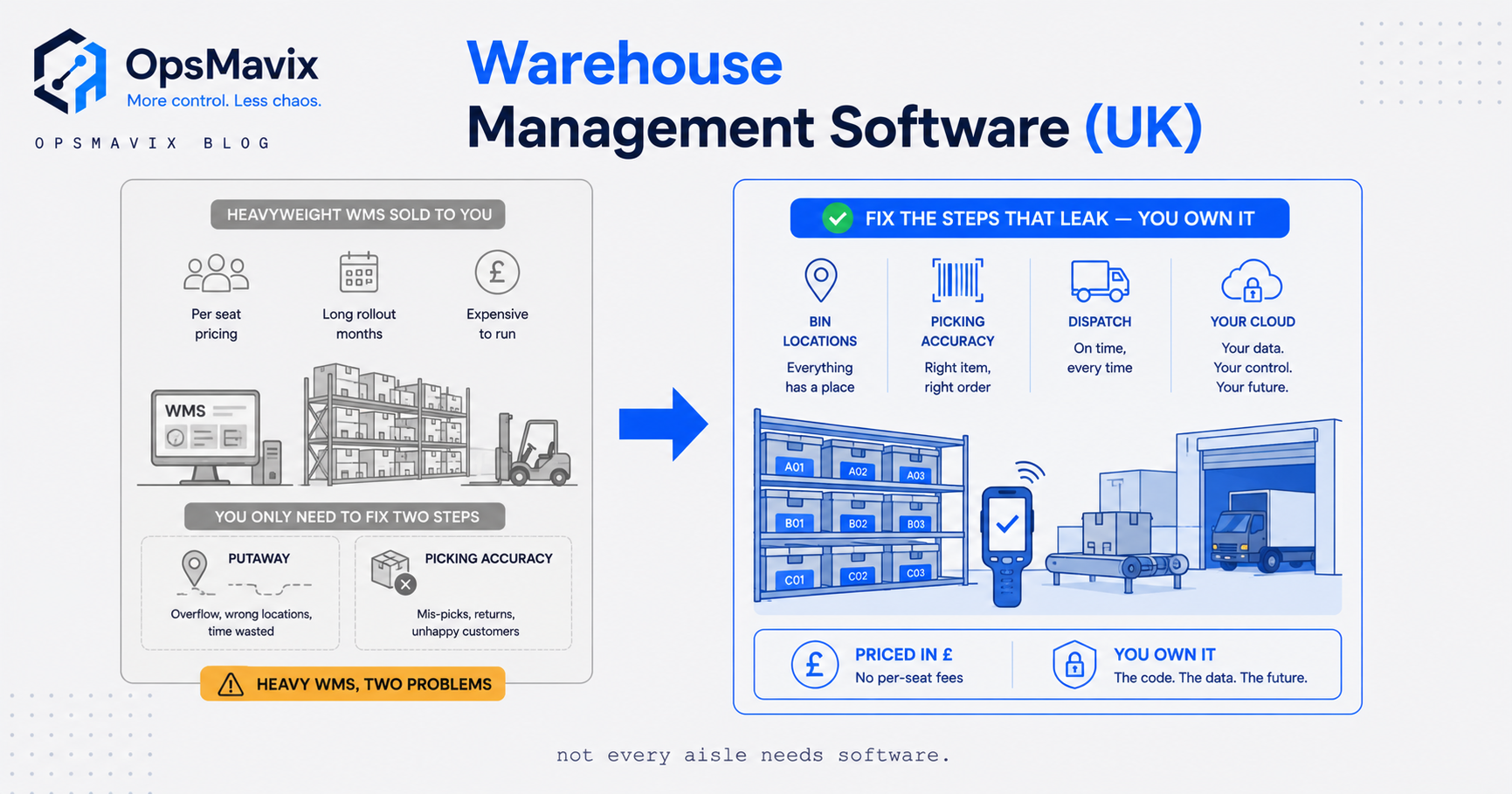
Warehouse management software in the UK is the layer that controls the physical journey of stock through your building: booking a delivery in, putting it away in a known place, telling a picker exactly where to walk, and confirming what left on the van. For a growing UK operation, the reason to care is rarely academic. It is that pickers are walking miles for every order, and the number on the screen almost never matches what is actually on the shelf. Those two problems cost real money every day, and they are the two most warehouse software is bought to solve.
The trap is what gets sold instead. A business says “our picking is chaos and our stock is always wrong,” and the market answers with a full enterprise warehouse management system: a long implementation, a per-seat licence forever, and a hundred features for problems this warehouse does not have. This guide covers what warehouse management software actually does, the specific leak it closes, how picking, put-away and bin locations fit together, why integrations and ownership matter, and how to tell when the enterprise option is genuinely overkill for a UK SMB.
What Warehouse Management Software Actually Does
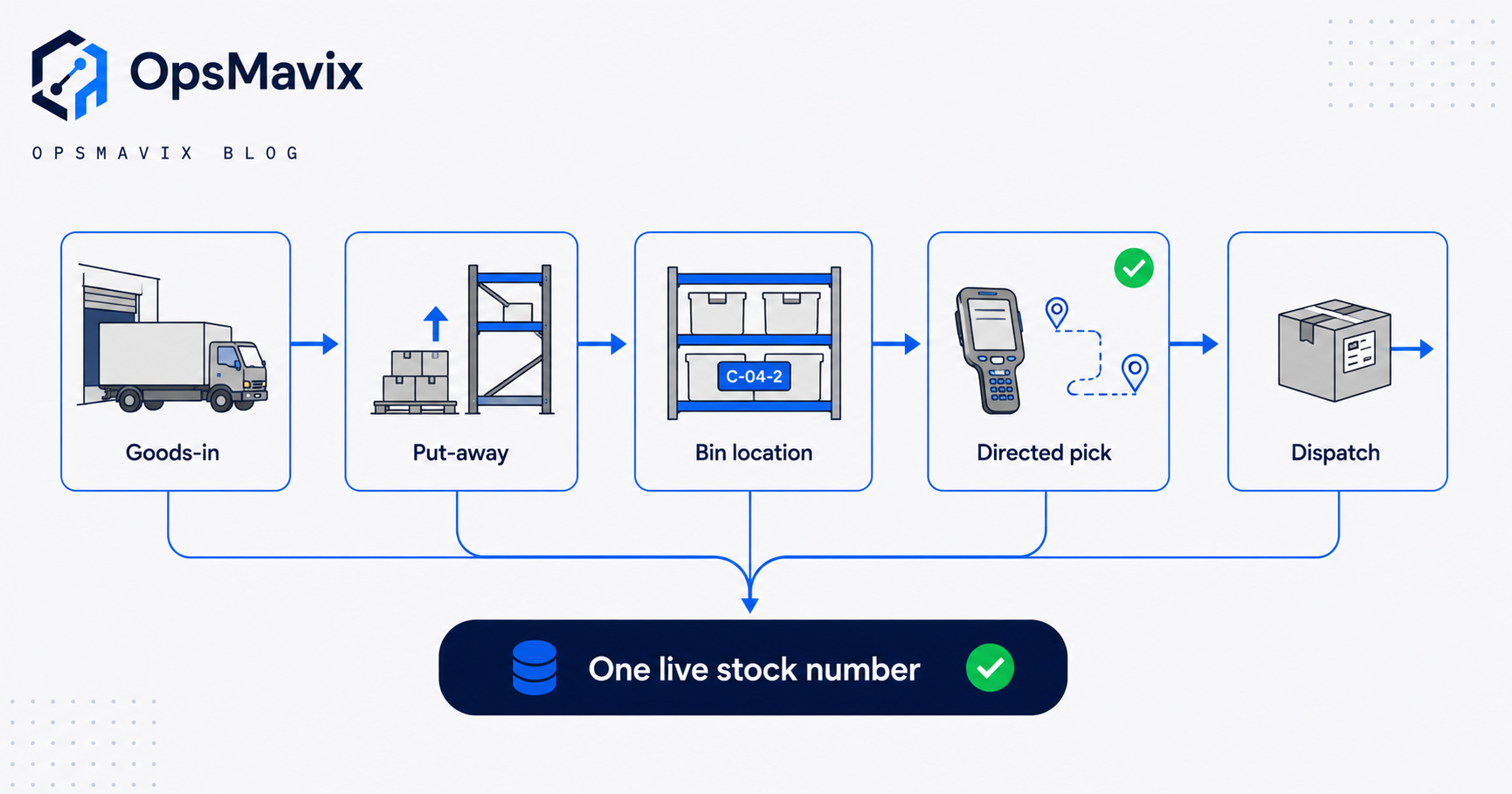
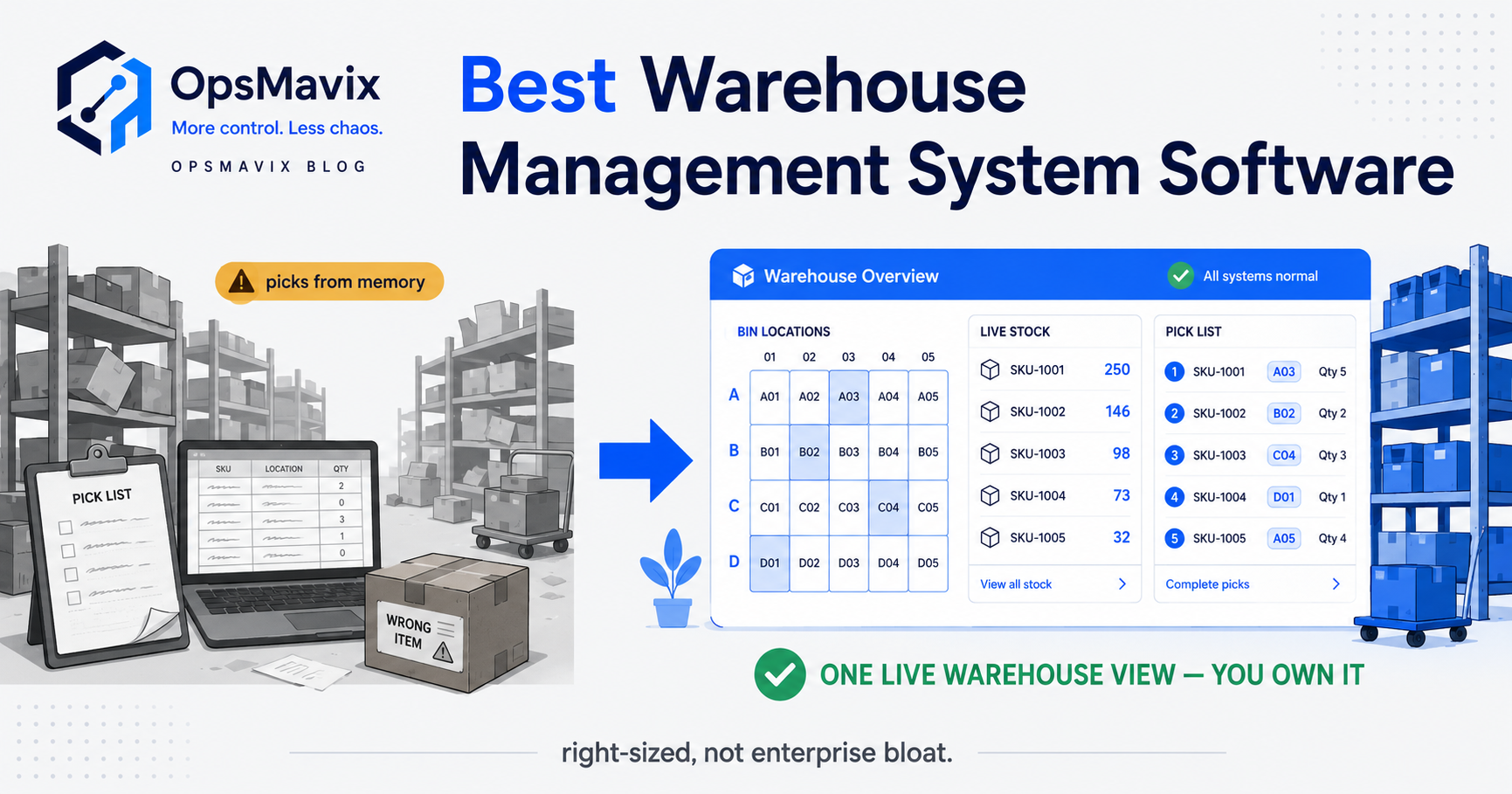
Strip away the badges and every warehouse management system is trying to control the same short chain of physical events. Stock arrives and is checked in against a purchase order. It gets moved to a storage location, and that location is recorded. Every unit is tied to a bin address so “we have 40” always comes with “and here is exactly where.” When an order drops, the system routes a picker to the right bins in a sensible order and makes them scan-confirm each pick. Then the order is packed, matched to a courier, and confirmed out, which decrements stock in one recorded event.
The value is not in any single step. It is in the chain being trustworthy end to end, because it is only as reliable as its weakest link. Flawless directed picking is worthless if put-away was sloppy and the stock is not in the bin the system points to. A tidy dispatch process means nothing if goods-in booked the wrong quantity. This is why “our stock is always wrong” is almost never a counting problem. It is a broken link, and the job of the software is to make each link a confirmed, recorded event rather than a guess. Our guide to warehouse management software walks the full chain in detail.
The Real Leak: Miles Walked and Stock That Never Matches
Two leaks dominate growing UK warehouses, and they are worth naming precisely because they are where the money is.
The first is travel. In a typical picking operation, travel time accounts for around 50% of total order-picking time. Half of what you pay a picker to do is walking, not picking. When a picker works from a paper list and their own memory of where things live, they cross the building twice, double back for a missed line, and hunt for stock that moved. None of that shows on an invoice, but it sets how many orders per hour your labour can physically manage, and it caps your throughput long before you notice.
The second is accuracy. Research from the Auburn University RFID Lab found the average retail inventory accuracy sits at about 65%, meaning roughly a third of records do not match reality. In a warehouse that shows up as the count on screen saying you can sell something you cannot find, or a picker grabbing from the nearest spot instead of the recorded one and quietly corrupting the number for everyone after them. Oversells, emergency stock-takes and “just go and physically check” become the daily texture of the operation. Directed, scan-confirmed picking against real bin locations is the single mechanic that stops the count drifting, because a picker cannot move the number by grabbing the wrong item or the wrong quantity without the system objecting.
Picking, Put-Away and Bin Locations: The Physical Core
If you only ever fix three things, fix these, because they carry most of the return.
Put-away is the quiet killer. In a lot of growing warehouses receiving is at least witnessed, but put-away is a free-for-all: whoever is nearest grabs the pallet and slots it wherever there is space, and nobody records where. The stock now exists in the system with no location, or a stale one, and every downstream pick inherits that lie. The fix is to make put-away a confirmed event: scan the unit, scan the bin it is going into, and the system now knows precisely where those units live.
Bin locations turn “it is somewhere in the back” into “it is in C-04-2.” Without addressed bins a warehouse runs on the tribal knowledge of whoever has worked there longest, which is fine until they are on holiday and a temp cannot find the fast movers. Addressed bins also make smarter storage possible: fast movers near dispatch, slow movers up high and out of the way, which cuts the walking the whole operation depends on.
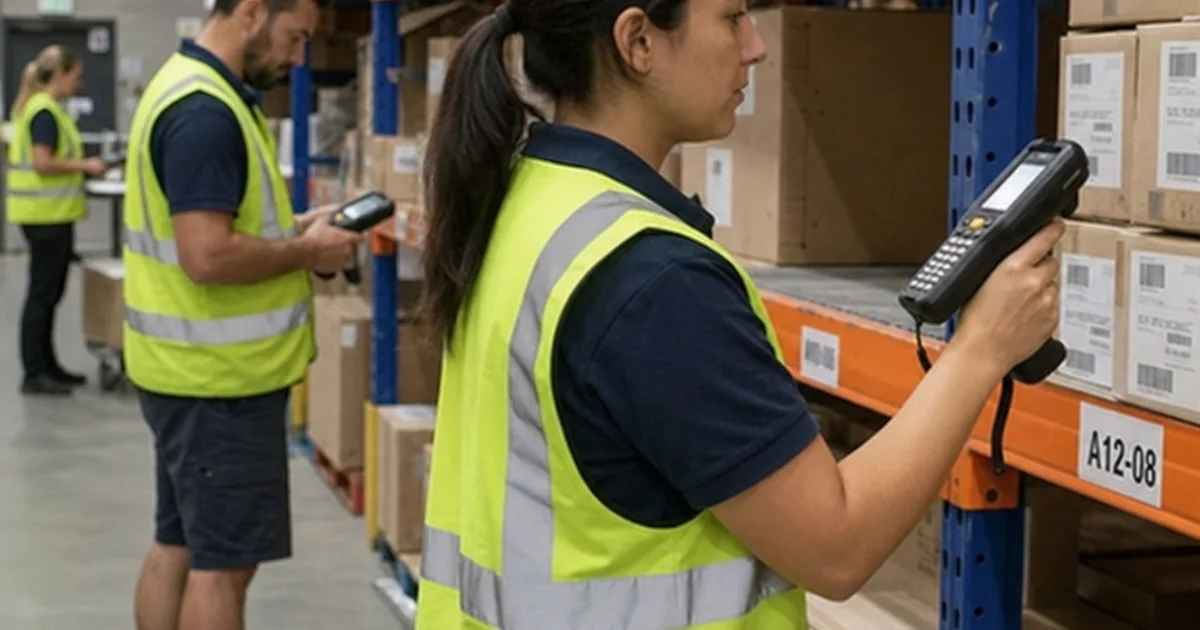
Directed picking is the payoff. Instead of wandering with a paper list, the picker gets an optimised route, the exact bins and quantities, and a scan-confirm at each stop. Walking time collapses because nobody crosses the warehouse twice, and mis-picks collapse because the count cannot move without a confirmed scan. These three steps are the reason a system exists at all, and they are exactly the steps a growing UK warehouse most often gets wrong. A focused build for a smaller site, covered in our warehouse management system for small business guide, can close all three without touching the rest of an enterprise platform.
Integrations and Why Ownership Matters
A warehouse does not operate in isolation. Orders arrive from a website, a marketplace, a trade counter, or a phone call, and dispatch has to feed the accounts and the courier. Warehouse software earns its keep only when the live stock number flows to and from those systems: the shop shows real availability, the accounts see cost of goods as it leaves, and a picked order books a courier label without anyone rekeying it. When those links are missing, staff paper over the gap with spreadsheets and copy-paste, which reintroduces exactly the errors the software was meant to remove.
This is where ownership becomes the real decision, not a technical footnote. With a rented enterprise platform your integrations live inside someone else’s roadmap. You wait for a connector, pay for a module, or bend your process to fit what the vendor supports, and every channel you add is another per-seat or per-order line on the bill. An owned operations system inverts that: the integrations are built around how your business already runs, they connect to the specific channels and courier and accounts package you use, and adding the next channel is a change you commission rather than a fee you pay forever. You are not locked to a vendor’s priorities, and the system can grow into a fuller cloud-based warehouse management system as the operation scales, rather than being replaced.
The Overkill Trap: When Enterprise WMS Is Too Much
Enterprise warehouse management systems are built for operations running many sites, complex cross-docking, labour-management analytics, wave planning and thousands of order lines an hour. If that is you, buy one. Most growing UK SMBs are nowhere near that shape, and the mismatch is expensive in three ways.
Cost is the obvious one. Per-seat or per-order licensing scales with your growth, so the tool gets more expensive precisely as you get busier, and you pay for the ninety features you never switch on alongside the ten you use. Time is the second: enterprise implementations run for months of configuration, migration and consultant days before a single pick benefits. The third is fit. A big platform expects you to run the way it was designed, so you re-model your warehouse, your codes and your process around the software, then retrain staff on flows that do not match how the building works. That last cost quietly kills adoption, because staff route around a system that fights them, and the expensive platform ends up half-used with the spreadsheets still running underneath.
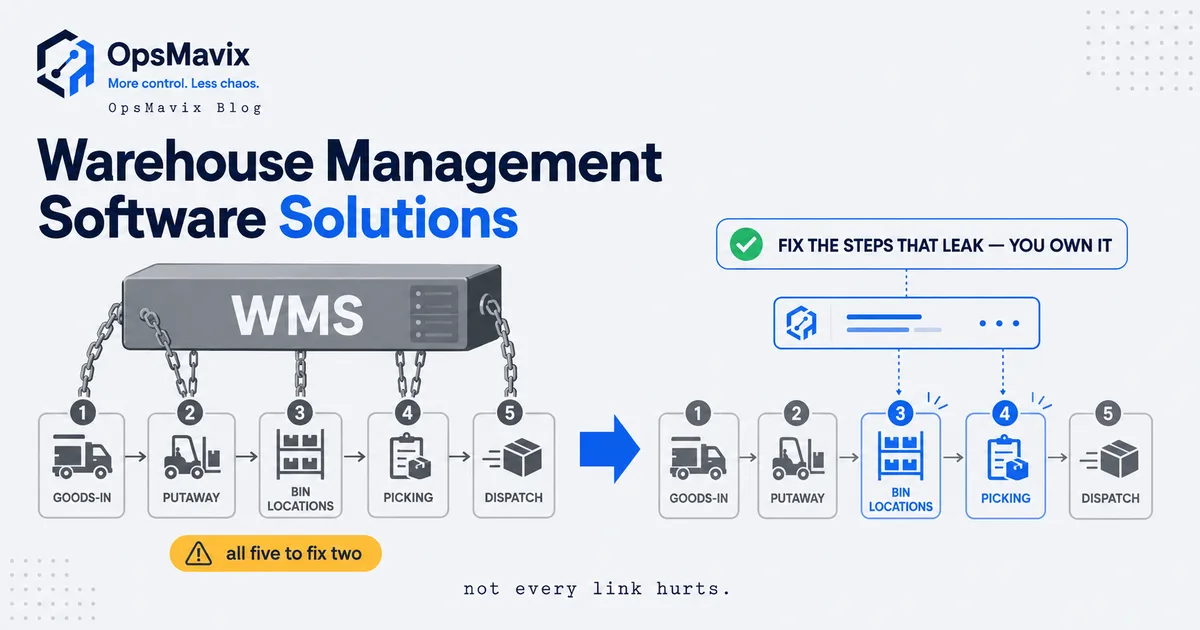
The honest test is simple. Count the steps in the chain where you actually leak. If it is put-away, bins and picking, you have a two or three step problem, and buying a five hundred step platform to fix three of them is how growing operations burn budget they did not need to spend.
Three Ways to Buy Warehouse Software Compared
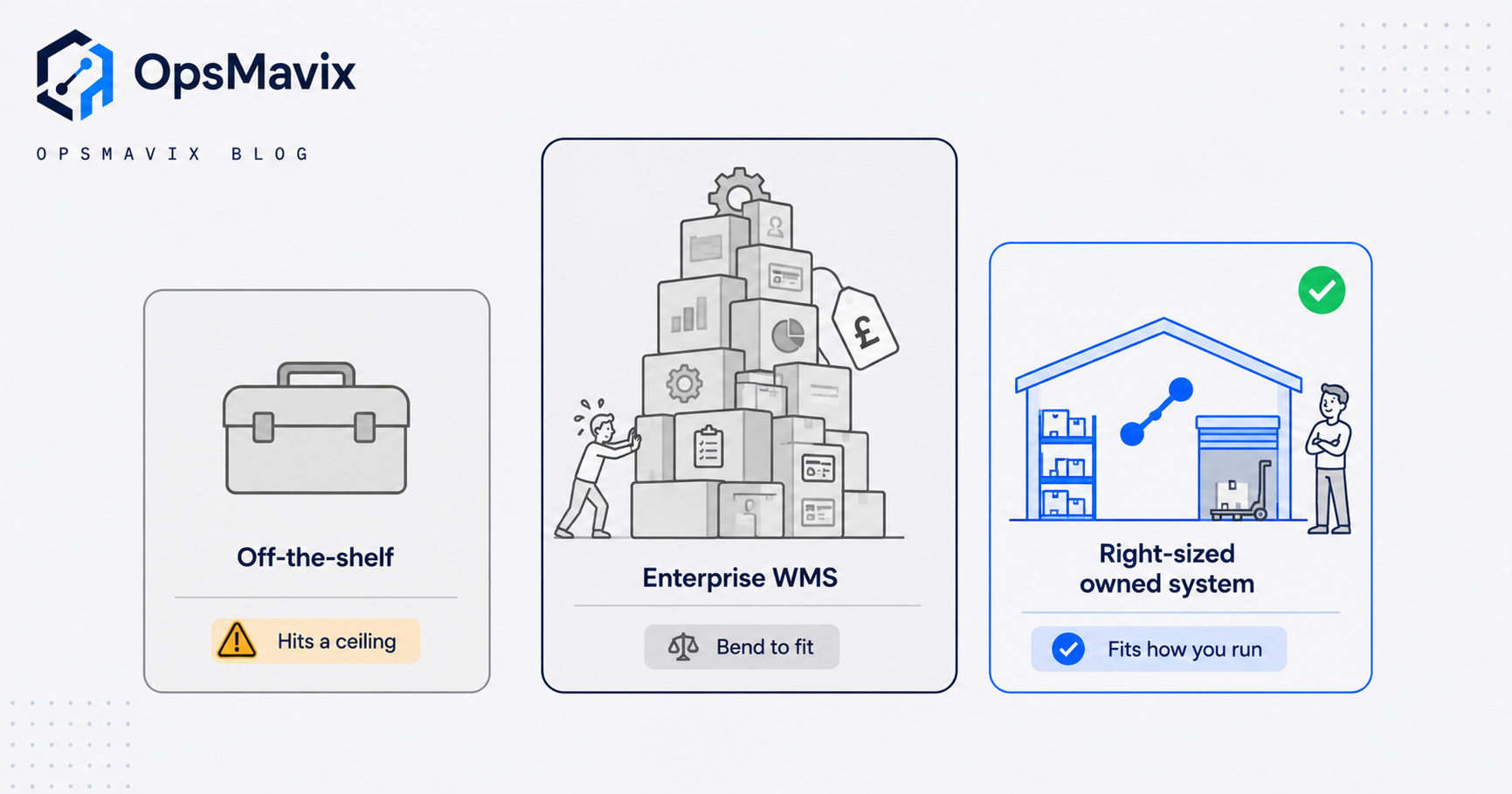
There are broadly three routes for a UK warehouse, and the right one is the cheapest that closes your real leak.
| Cheap or generic off-the-shelf tool | Full enterprise WMS | Right-sized owned system | |
|---|---|---|---|
| Best for | Simple operations, low order volume, single channel | Multi-site, high-volume, complex distribution | Growing SMBs with a clear two or three step leak |
| Picking and bins | Basic or bolt-on; often no directed picking | Deep, configurable, more than most SMBs use | Built around your exact pick paths and bin scheme |
| Integrations | Limited connectors; gaps filled by spreadsheets | Broad, but per-module and on the vendor’s roadmap | Built for your specific channels, courier and accounts |
| Cost shape | Low monthly fee, cheap until you outgrow it | High licence per seat or order, forever | Owned build; expand as needed, no per-seat rent |
| Time to value | Fast to switch on | Months of implementation | Focused build on the steps that leak first |
| Who bends | You work within its limits | You bend the warehouse to the software | The software fits how you already run |
| Scales to | Hits a ceiling, then replace | Scales high, at cost and complexity | Grows into a fuller system, up to an ERP later |
The off-the-shelf tool is a genuinely good answer until you outgrow it. The enterprise WMS is the right answer for genuinely enterprise-shaped operations. The owned system is the one most growing UK warehouses actually need and rarely get offered: fix the leaking steps now, own the thing, and expand it when the operation demands more.
A Worked Example: A Midlands Wholesaler
The figures below are illustrative, not a claim about a specific client.
Picture a Midlands wholesaler shipping around 250 orders a day from a single unit, running four pickers on paper lists with stock tracked in a spreadsheet and a basic accounts package. Two leaks show up clearly.
Travel first. With around half of picking time spent walking, and no directed routing, pickers cross the building repeatedly. If each picker loses roughly an hour a day to avoidable walking and re-finding stock, that is four hours daily across the team. At a fully-loaded rate of about £14 an hour, that is £56 a day, near £14,000 a year, walking out of the door as movement nobody bills for.
Accuracy second. At the sort of record accuracy the Auburn research describes, oversells and mismatches are routine. Say a handful of orders a week ship wrong or get delayed by a stock hunt. Each mis-pick costs twice, the courier out and the courier back, the re-pick, the refund admin, and the customer who quietly reduces their orders. Ten mis-handled orders a week at a conservative £25 all-in is £250 a week, another £13,000 a year, before you count the lost repeat business.
Now the buy decision. A full enterprise WMS here might mean a months-long implementation and a licence that grows with volume, easily into five figures a year plus setup. Against a real leak of roughly £27,000 a year, the enterprise route can cost more than it recovers for a warehouse this size, and you would remodel the operation to fit it. A right-sized owned system that adds scan-confirmed put-away, addressed bins and directed picking, wired to the wholesaler’s existing sales channel and accounts, targets exactly those two leaks. Fix them and the same four pickers handle more orders with fewer errors, on a system the business owns and can extend rather than rent forever.
FAQ
What is the difference between warehouse management software and inventory software?
Inventory software tracks what you own and how much. Warehouse management software tracks where every unit physically is and controls how it moves: put-away, bin locations, directed picking and dispatch. A growing warehouse usually needs both, ideally as one connected system so the count and the location never disagree.
Do I need barcodes and scanners for warehouse software to work?
For the accuracy and picking gains, effectively yes. The mechanic that stops your count drifting is the scan-confirm at put-away and at pick, and that needs a barcode or label on the unit or bin and a handheld or phone to read it. The hardware is cheap relative to the labour and error costs it removes.
How much does warehouse software cost in the UK?
It ranges widely. Cheap off-the-shelf tools run a modest monthly fee, enterprise systems run into five figures a year plus implementation, and an owned system is a one-off build you keep. For context on the money already at stake, UK warehouse storage alone runs about £9 to £15 per square foot a year, so wasted space and slow throughput are costs the software is meant to claw back.
Is a full WMS overkill for a small UK warehouse?
Often, yes. Enterprise systems are built for multi-site, high-volume distribution. If your leaks are put-away, bins and picking at a single site, a right-sized system that fixes those steps is usually cheaper to buy, faster to run and easier for staff to adopt than a platform built for a much larger operation.
Can a right-sized system grow with the business?
That is the point of owning it. You fix the leaking steps first, then extend the same system as volume, channels or sites are added, up to and including a fuller ERP layer later. You are not stuck at a ceiling and forced to rip and replace, which is the usual fate of a cheap tool once you outgrow it.
How OpsMavix Can Help
OpsMavix builds right-sized operations systems for warehouses that are outgrowing spreadsheets but should not be paying to bend themselves around a full enterprise WMS. We start by finding where your chain actually leaks, usually put-away, bin locations and picking, then build an owned system that closes those steps and connects to the sales channels, courier and accounts you already use, so one live stock number is trusted across the business and it grows as you do. The UK logistics sector contributes around £175 billion to the economy, and the warehouse operations that win in it are the ones whose stock and picking they can actually trust. If pickers are walking miles and the count never matches, that is a leak worth mapping before you buy anything. Book a Free Operations Leak Audit
Sources
- Blue Link ERP: Optimize Your Warehouse Order Picking Strategy. States that around 50% of total order-picking time is travel time.
- CYBRA: Average Retailer Inventory Accuracy. Cites the Auburn University RFID Lab finding that average retail inventory accuracy is about 65%.
- SFI Logistics: How Much Does Warehouse Storage Cost in the UK?. UK warehouse storage costs of roughly £9 to £15 per square foot per year, plus 3PL pallet rates.
- SFI Logistics: UK Logistics Statistics 2026. UK logistics contributes around £175 billion to the economy, plus warehouse floorspace figures.
Keep reading
Getting value from OpsMavix? Add us as a preferred source on Google — you'll see more of our operations content in your AI Overviews, AI Mode and Search.