
Odoo Alternative UK: Right-Sized Beats the Whole Suite
An Odoo alternative isn't a cheaper version of the same thing — it's a different answer to the question. Odoo gives you a suite of dozens of apps, most of which you'll never switch on, plus the admin of running them. A focused custom operations system covers what you actually do without the suite overhead. Here's where Odoo genuinely fits, the run-cost most buyers miss, and how to decide.
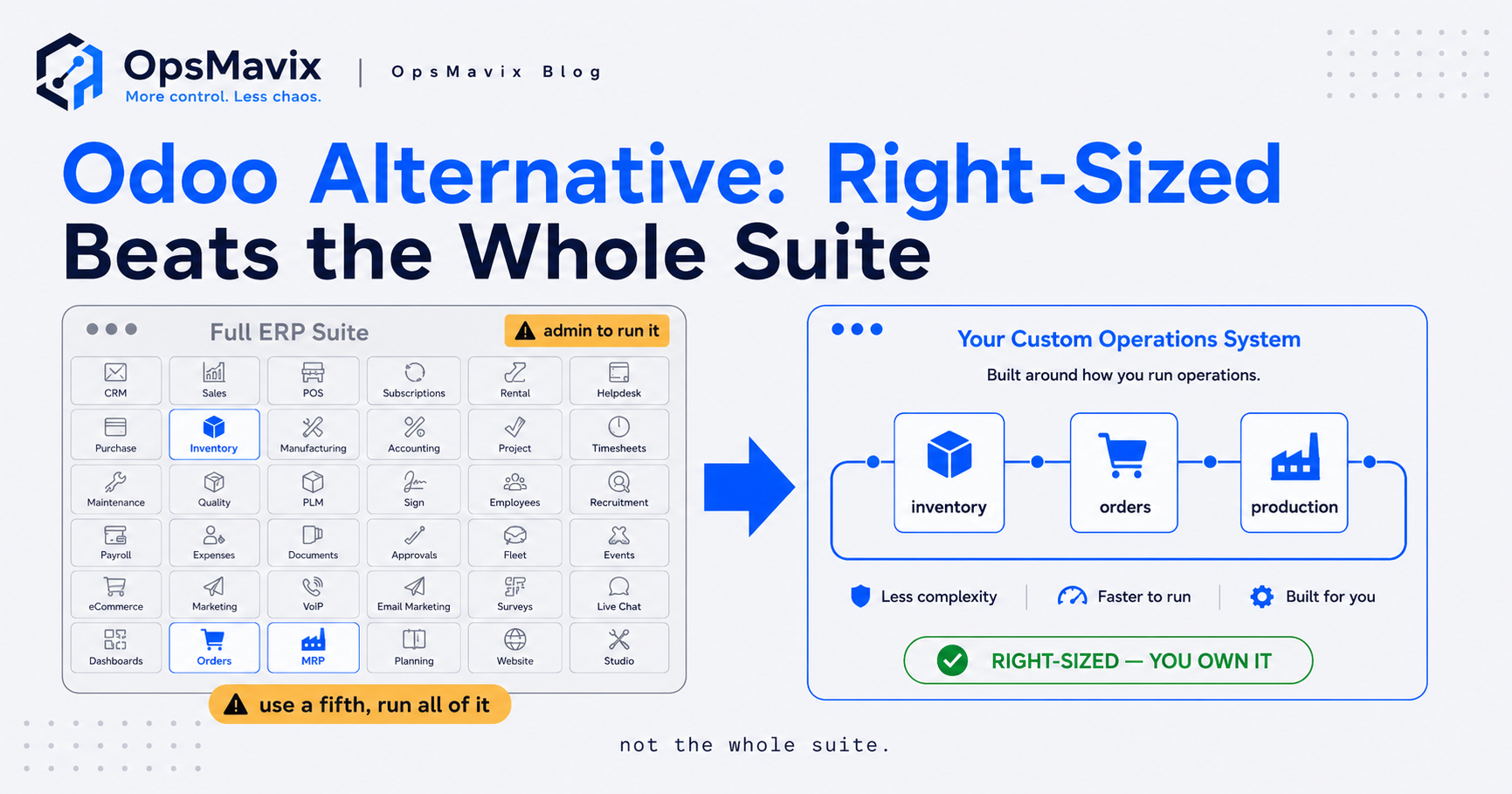
The right Odoo alternative depends on a question most comparison articles skip: do you need a whole business suite, or do you need the three or four things you actually do every day to finally work together? Odoo is a modular open-source ERP from the Belgian company of the same name — a catalogue of dozens of official apps (CRM, Sales, Accounting, Inventory, Manufacturing, Purchase, Project, HR, Website, Point of Sale and dozens more) that you switch on and stitch together into one platform. When a business genuinely runs every corner of itself through one integrated suite, that breadth is the point. You start looking for an alternative when you realise you’re buying a thirty-room house to live in four rooms — and paying to heat, clean and maintain the other twenty-six.
This post covers what Odoo is and who it honestly suits, the “you’ll use a fifth of it” problem, the run-cost of owning a suite, what a right-sized system replaces, and when you genuinely need the full thing. The frame throughout is not “a cheaper Odoo” — it’s a different shape of answer, and it links up to the deeper ERP pieces rather than re-arguing them here.
Key Takeaways
- An Odoo alternative is a category choice, not a price choice — the real question is whole suite versus a system shaped to the handful of things you actually do.
- Odoo’s strength is breadth: dozens of integrated apps across finance, sales, inventory, manufacturing and HR, sharing one database. That breadth is exactly what makes it heavy for a business that needs a slice of it.
- Most SMEs switch on a fraction of the suite yet still carry the configuration, upgrade and admin load of the whole platform — you pay in effort for apps you never use.
- The run-cost is the hidden bill: per-user licensing, an implementation partner, version upgrades, and someone to keep it all configured — separate from whether the software fits.
- A right-sized custom system covers your real flow — inventory, orders, production, reporting — without the suite around it, and you own it outright rather than renting seats.
- Odoo is the correct call when you truly run multiple departments through one platform and have the IT capacity to keep a suite healthy. Be honest about whether that’s you.
1. What Odoo Is, and Who It Honestly Suits
Odoo is a modular ERP: a shared platform with a large catalogue of apps you enable as needed. Turn on Inventory and Sales and you have order-and-stock management; add Accounting and the books live in the same database; add Manufacturing (its MRP app), Purchase, Project, HR and eCommerce and, in principle, you’re running most of a mid-sized business through one login. It comes in two editions — a free, open-source Community version with the core apps, and a paid Enterprise version that adds the rest of the catalogue, mobile apps, the Studio customisation tool and support. The paid Enterprise edition is today sold as Standard and Custom plans (with Studio and multi-company sitting in Custom), and UK buyers are priced per user per month (billed in euros on Odoo’s Europe pricelist), with a “one app free” tier for a single module.
Be fair about where that shines. If you genuinely operate across many departments — finance, sales, procurement, manufacturing, HR, a website — and want them sharing one data model instead of a dozen disconnected tools, a suite like Odoo does a real job. Everything reconciles because everything lives in the same place. A company with the appetite and the in-house capability to configure and maintain it can cover a lot of ground with one platform. No custom build competes with the sheer surface area an established suite ships with on day one.
2. The “You’ll Use a Fifth of It” Problem
Here’s the pattern that sends people looking for an alternative. A business needs inventory that doesn’t drift, orders entered once, and production it can actually see — three or four real jobs. It adopts Odoo because Odoo can do all of that and everything else besides. Then it discovers that “everything else besides” isn’t free floor space you can ignore. Every app you switch on has settings, master data and workflows to configure, and the ones you leave off still shape how the platform is set up, updated and reasoned about. You wanted four rooms; you bought and now maintain the whole house.
The cost isn’t only money — it’s configuration time and cognitive load. A suite is generalised by design, so it asks you to make hundreds of decisions to fit its abstractions to your reality: warehouse routing rules, accounting mappings, product variant logic, approval chains, roles across apps you may never open. For a business whose need is narrow and specific, most of that setup is answering questions about parts of an operation you don’t run, just to make the parts you do run behave. That’s the tax of buying breadth you don’t need.
3. The Run-Cost of a Suite (Not Just the Licence)
The sticker price — the per-user monthly fee — is the part everyone compares, and the smallest part of the picture. The bill that surprises people is the run-cost: what it takes to stand a suite up and keep it standing. Most SMEs don’t implement Odoo alone; they engage an implementation partner, because configuring a platform this broad to fit a real business is genuinely specialist work. That’s a project cost up front, often a retainer after, and Odoo doesn’t publish implementation pricing because it varies widely by partner and scope. You find out what it costs by getting quotes.
Then it keeps costing. Odoo ships new major versions regularly, and staying supported means upgrading — which, once you’ve customised the platform to fit, becomes its own recurring project because customisations have to be carried forward each time. Add per-user licences that climb as your team grows, hosting, and the standing need for someone who understands the configuration well enough to change it safely. None of that is Odoo being badly built; it’s the ordinary economics of owning a large, general platform. The licence is the down payment, not the price.
4. What a Right-Sized System Replaces Instead
A right-sized operations system starts from the opposite end. Instead of a catalogue you configure down, it’s built up around the specific flow you run — the orders, the stock, the production, the reporting that make up your actual day — and nothing else. There’s no Manufacturing app to leave dormant, no HR module to ignore, no accounting abstraction to map yourself to. The system holds one true record of what you sell and stock, orders entered once and validated against your real catalogue, and the handful of reports you genuinely make decisions from. If your operation is inventory-and-orders shaped, that’s what gets built — the way a custom inventory system is shaped to how you actually move stock, not to a generic warehouse template.
The difference shows up as things you don’t have to do. You don’t configure apps you’ll never use. You don’t carry a suite’s worth of upgrade risk to change one screen. You don’t pay per seat for a platform whose four-fifths you ignore. And you own it — no per-user rent, no vendor tier that gates the feature you needed, nothing that reprices as you grow. This is the middle ground OpsMavix builds for: businesses outgrowing spreadsheets but not genuinely running a full multi-department ERP. Where that middle ground sits relative to a proper ERP is the whole subject of operational systems versus ERP, worth reading before you assume a suite is the only grown-up option.
5. When You Genuinely Need the Full Suite (the Honest Bit)
Not everyone should build, and pretending otherwise would be dishonest. If you genuinely operate across many departments that all need one shared source of truth — finance closing the books off the same data sales quotes from, procurement raising POs against the same stock manufacturing consumes, HR and payroll in the mix — then the integrated breadth of a suite is doing real work that a focused system deliberately leaves out. That’s the honest case for Odoo, and it’s a strong one.
Two other tests point the same way. First, capacity: a suite needs an owner — internal IT or a standing partner — to keep it configured, upgraded and healthy. If you have that, the run-cost is a manageable overhead; if you don’t, it becomes the thing that quietly rots. Second, trajectory: if you’re heading into multi-entity finance, consolidations and the accounting depth a full ERP is built around, growing into a suite can be the right long game. That finance-versus-operations distinction is where a lot of buyers mis-size themselves, and finance ERP versus operational ERP untangles it. If that’s your direction, Odoo fitting is a feature, not a failure.
6. How to Decide Without Over-Buying
The decision comes down to matching the shape of the tool to the shape of the need, not to which product demos best. List the jobs you actually do daily — the ones that hurt when they break. If that list is four or five operational things (stock, orders, production, the reports you run the business on), a suite is mostly floor space you’ll pay to maintain and never walk into. If that list genuinely spans finance, sales, procurement, manufacturing, HR and web, all needing to share one record, you’re in suite territory and should treat the run-cost as the price of admission.
Then price the honest total, not the licence. For Odoo that’s per-user fees plus an implementation partner plus upgrades plus an owner to keep it configured, over three years. For a right-sized custom system it’s a fixed build you own — OpsMavix works in the £3k–£25k range for Starter and Growth systems — with no per-seat creep after. Compare like for like: the three-year cost of running a suite you use a fifth of, against owning the fifth outright. Where OpsMavix sits in the broader map of operational tooling is covered in operational ERP — read it if you’re still deciding which category you’re shopping in.
Odoo vs a Right-Sized Custom System
| Odoo (full modular suite) | Right-sized custom system | |
|---|---|---|
| Built for | A whole business run through one integrated platform | The specific operational flow you actually run |
| Scope | Dozens of apps you configure down to your needs | Built up around your inventory, orders, production, reporting |
| Setup | Configure the suite, usually via an implementation partner | Fixed-scope build shaped to how you already work |
| Pricing | Per user per month (billed in euros for UK), plus partner + upgrades | Fixed build (£3k–£25k range), you own it |
| Ongoing cost | Licences, version upgrades, an owner to keep it configured | No per-seat creep; changes when you decide |
| Lock-in | You work inside the platform’s model and release cycle | Your data model and workflows; nothing to switch off |
| Best fit | Genuine multi-department operation with IT to run it | outgrowing spreadsheets, not a full-suite business |
FAQ
What is the best Odoo alternative?
There isn’t one universal answer, because “alternative” hides two different needs. If you genuinely want a full multi-department suite but not Odoo specifically, you’re comparing other suites — a different question. If what you actually need is the handful of operational things you do every day to finally work together — inventory, orders, production, reporting — the alternative isn’t another suite at all. It’s a right-sized system built around that flow and owned by you, without the dozens of apps and the admin of running them.
Is a custom system just a cheaper Odoo?
No, and framing it that way leads to bad decisions. Odoo is a broad suite you configure down to your needs; a right-sized custom system is built up around your specific operation and deliberately leaves out everything you don’t do. It’s a different shape of answer, not a discount version of the same one. You lose the breadth you weren’t going to use and gain a tool that fits exactly, plus outright ownership instead of per-user rent.
How much does Odoo really cost in the UK?
The licence is the visible part — Odoo is priced per user per month on its Enterprise plans (billed in euros on the Europe pricelist for UK buyers), with a free tier for a single app. The real cost is the run-cost: most businesses need an implementation partner to configure it, version upgrades recur, and you need someone to keep it maintained. Odoo doesn’t publish implementation pricing because it varies by partner and scope, so get quotes and model three years, not one month.
How OpsMavix Can Help
OpsMavix builds right-sized operational systems for businesses caught in the exact spot Odoo often overshoots — outgrowing spreadsheets and disconnected tools, but not genuinely running a full multi-department ERP. Instead of standing up a suite of dozens of apps and configuring down to the fifth you’ll use, we build up around the flow you actually run: inventory that stops drifting from the shelf, orders entered once and validated, production you can see, and the reports you make real decisions from — and nothing else to maintain. You own it outright, with no per-user rent, no upgrade tax on customisations, and nothing a vendor can reprice or switch off as you grow.
If you’re weighing Odoo and quietly suspecting you’d use a fraction of it, don’t decide on a demo — decide on the number. Book a Free Operations Leak Audit and we’ll map where your current tools and manual work cost you today, what it’s worth to close that gap, and whether a right-sized system or a full suite is the honest fit for how you actually run. If Odoo is genuinely the better call for you, we’ll tell you that too.
Keep reading
Getting value from OpsMavix? Add us as a preferred source on Google — you'll see more of our operations content in your AI Overviews, AI Mode and Search.