
The Sage 200 Alternative for Operations, Not Just Accounts
Sage 200 is a strong accounting-first ERP with real UK finance heritage — but the operational side stays thin, so spreadsheets quietly fill the gap. This is the honest guide to when a Sage 200 alternative makes sense, and why the real alternative is usually not another ERP but one operations system shaped to how you actually run.
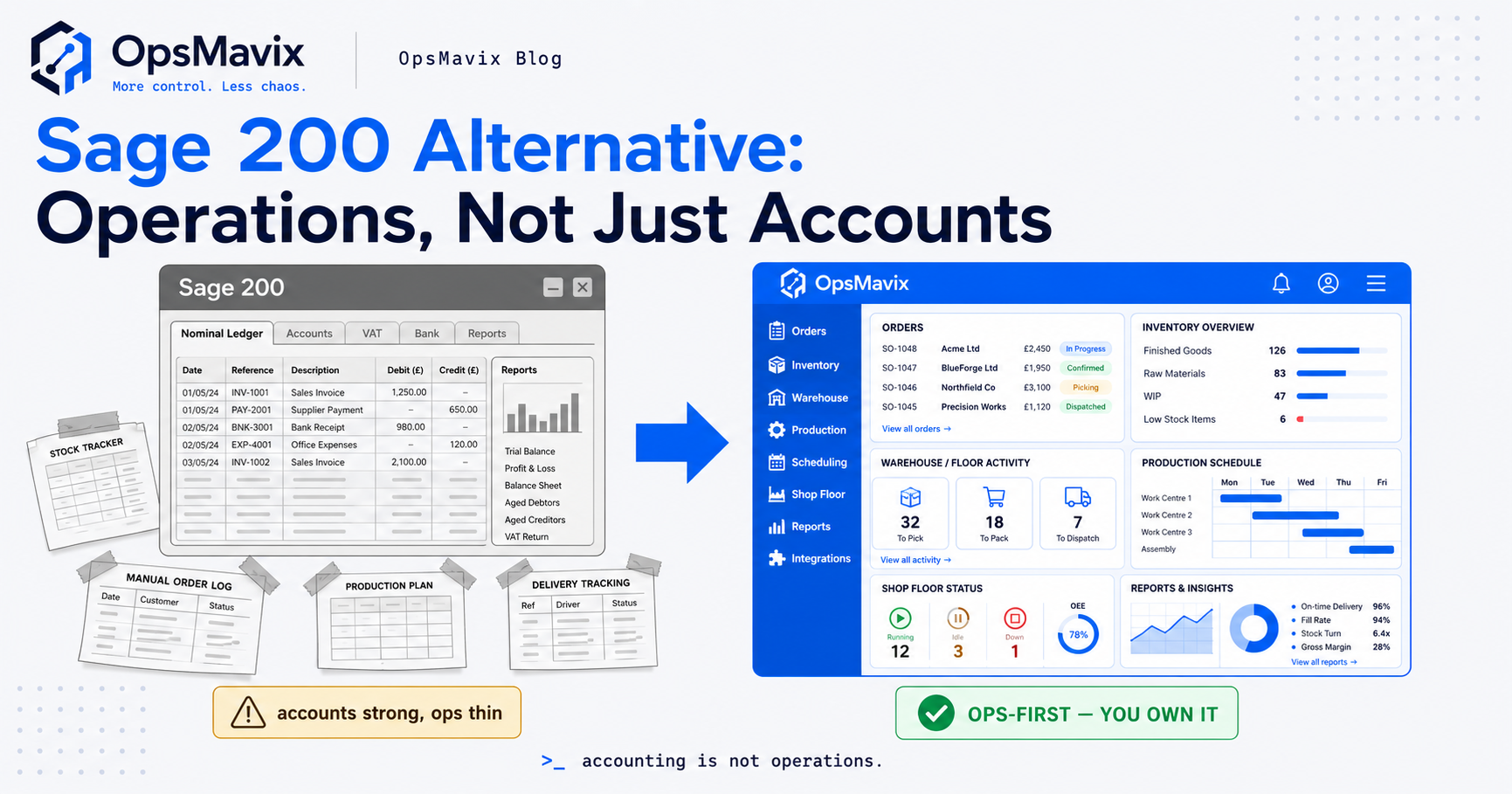
The best Sage 200 alternative is usually not another accounting-first ERP with a slightly different logo — it’s one owned operations system shaped to how your business actually runs its stock, orders and production. Sage 200 is a capable, finance-heavy product with genuine UK heritage, and for the books it does a serious job. The reason people go looking for an alternative is rarely the accounting. It’s that the operational half of the day — the parts that happen before an invoice exists — still ends up living in spreadsheets beside the ERP, and no stronger finance module fixes that.
Most people searching this term aren’t unhappy with Sage 200’s features. They’re quietly bending their operation to fit a tool built finance-first, or paying for modules they use a fraction of while the real leak — the manual re-keying, the stock that drifts, the report nobody can get out cleanly — sits untouched. Swapping one accounting-led ERP for another resets the clock without closing the gap. The honest question isn’t “which alternative product”, it’s “what shape of answer matches the jobs that hurt when they break”.
Key Takeaways
- A Sage 200 alternative is a category choice, not a product swap — do you need a stronger set of accounts, or a system that finally holds your operations?
- Sage 200’s strength is finance — a mature UK accounting-first ERP with commercials and stock, and optional manufacturing and distribution modules around a finance core.
- The ceiling is operational depth — the closer you get to shop-floor, warehouse and order-flow specifics, the more the work slides back into spreadsheets beside the ERP.
- Pricing is quote-based — sold through partners on a per-module, per-user subscription, so the sticker is only part of the run-cost.
- A right-sized operations system covers your real flow — stock, orders, production, reporting — owned outright, sitting between a spreadsheet and a full ERP.
- Sage 200 is genuinely right when finance depth is the point and operations are relatively standard. Be honest about which side actually hurts.
What Sage 200 Actually Is
Sage 200 is the mid-market ERP from Sage, the long-established British business-software company headquartered in Newcastle upon Tyne. It sits above Sage 50 and targets businesses that have outgrown small-business accounting but aren’t running a large-enterprise platform. It’s sold in editions — commonly Sage 200 Standard and Sage 200 Professional — with Professional offering the deeper configuration, multi-company and heavier commercial handling that larger or more complex operations need.
At its core it’s accounting-first, and that’s not a criticism — it’s the heritage and it’s done well. You get proper financials: nominal, sales and purchase ledgers, cash management, VAT handling and the reporting an accountant trusts. Around that finance core sit commercial modules — sales and purchase order processing, stock control — and optional modules for manufacturing, distribution, project accounting, business intelligence and CRM. The shape to hold in your head is a strong financial spine with operational modules arranged around it, rather than an operations platform that happens to also do the books. That distinction is the whole story, and it’s the same fault line covered in finance ERP versus operational ERP.
Where Sage 200 Hits Its Ceiling
The ceiling isn’t in the accounts; it’s in the operational specifics that don’t map cleanly onto a finance-shaped model. A finance-first ERP is generalised around the transaction — the order, the invoice, the ledger entry. The moment your operation has texture the standard modules don’t hold — a picking sequence, a bundle drawn from several SKUs, a works order the shop floor needs live, a supplier arrangement that isn’t a tidy PO — each becomes a workaround. And a workaround in an ERP usually means a spreadsheet next to the system, or a manual re-key between them.
That’s where the leak lives. The stock figure in Sage 200 is only as true as the manual movements someone remembered to post, so it drifts from the shelf. The report a manager runs the business on — margin by customer after real carriage, stock-turn by supplier, the true cost of a return — is a shape the standard reporting doesn’t produce, so someone rebuilds it from exports every month. The optional manufacturing and distribution modules narrow the gap, but they’re generalised too, and deep shop-floor or warehouse specifics tend to push back into side-systems. That’s the pattern to watch, and it’s the same ground as operational systems versus ERP — the operational half never quite lands inside a finance-led tool.
The Pricing Reality
Sage 200 doesn’t carry a public price you can add to a basket. It’s sold through Sage business partners and resellers on a subscription model, and the number is quote-based — assembled from your edition, which modules you switch on, and how many users you need. The figure is specific to your setup, so the only way to know it is to get quotes, ideally more than one, since partners scope and price differently.
The mechanics matter more than any single figure, and there’s no invented number here because there isn’t one to state honestly. You pay per module and per user on a recurring subscription, and — as with most mid-market ERPs — the implementation is a separate cost from the licence. Configuring a finance-led platform to fit a real business is specialist work, usually done with that partner, so the run-cost is the subscription plus setup plus the help to keep it configured. The licence is the down payment, not the price. Model three years and the full run, not the first monthly quote.
When Sage 200 Is Genuinely the Right Choice
Sometimes buying Sage 200 is simply the correct call, and pretending otherwise would be dishonest. If finance depth is the actual point — serious multi-company accounting, consolidations, strong VAT and audit handling, the reporting an accountant signs off on — then a mature, finance-first UK ERP is doing exactly the job it was built for, and a focused operations system deliberately leaves that depth out. If your books are the hard part and your operations are relatively standard, Sage 200 fitting is a feature, not a failure. The same holds on trajectory and continuity: if you’re heading into the finance complexity a full ERP is built around, or you need an established product with a partner ecosystem that will still exist in five years, growing into Sage 200 is the right long game. If that’s you, buy it — don’t build around it out of pride.
The Right-Sized Middle: One Operations System
There’s a middle most ERP comparisons skip. Between a spreadsheet that’s stopped coping and a full finance-first ERP that overshoots sits one owned operations system — built up around the flow you run rather than configured down from a finance core. Instead of a stock module kept true by hand, one true record moved automatically as things happen. Instead of orders re-keyed between systems, orders entered once and validated against your real catalogue. Instead of the works order in someone’s head, production you can see. And the reports you make decisions from, built to the shape of the question — not rebuilt from exports each month. It’s the practical layer between a spreadsheet and an ERP, shaped to how you move stock rather than to a generic template, the way custom inventory systems are built to a real operation.
The point isn’t to replace your accounts — Sage can keep doing the books it does well. The point is to stop the operational half leaking into spreadsheets beside the ERP, and to own the system that holds it, with no per-module creep and nothing a vendor can reprice or switch off. This is the spot OpsMavix builds for: outgrowing spreadsheets and disconnected tools.
The Honest Build-vs-Buy Take
The honest decision comes down to matching the shape of the tool to the shape of the pain. If the hard part is genuinely the accounts — multi-company finance, consolidations, audit depth — then a finance-first ERP like Sage 200 is the right buy, and a focused operations system won’t replace it. If the hard part is the operation — stock that drifts, orders re-keyed by hand, production nobody can see, reports rebuilt from exports — then a stronger set of accounts was never going to close that leak, and swapping to another accounting-led ERP just resets the clock.
Price the whole run, not the sticker: subscription plus modules plus per-user plus implementation, over three years, against a system you own outright. Most businesses searching for a Sage 200 alternative already know the answer — the accounts are fine, the operation is where the day gets eaten. If that’s you, the alternative isn’t another ERP. It’s one operations system shaped to how you run, owned by you, sitting where a spreadsheet has stopped coping and a full ERP would overshoot. If Sage 200 is genuinely the better call for your accounts, we’ll tell you that too.
Keep reading
Getting value from OpsMavix? Add us as a preferred source on Google — you'll see more of our operations content in your AI Overviews, AI Mode and Search.