
Custom Inventory Systems: When Off-the-Shelf Isn't Enough
There's a moment your packaged inventory tool stops fitting — bloat, workarounds, pricing that climbs. Here's when a custom inventory system is the right next step.
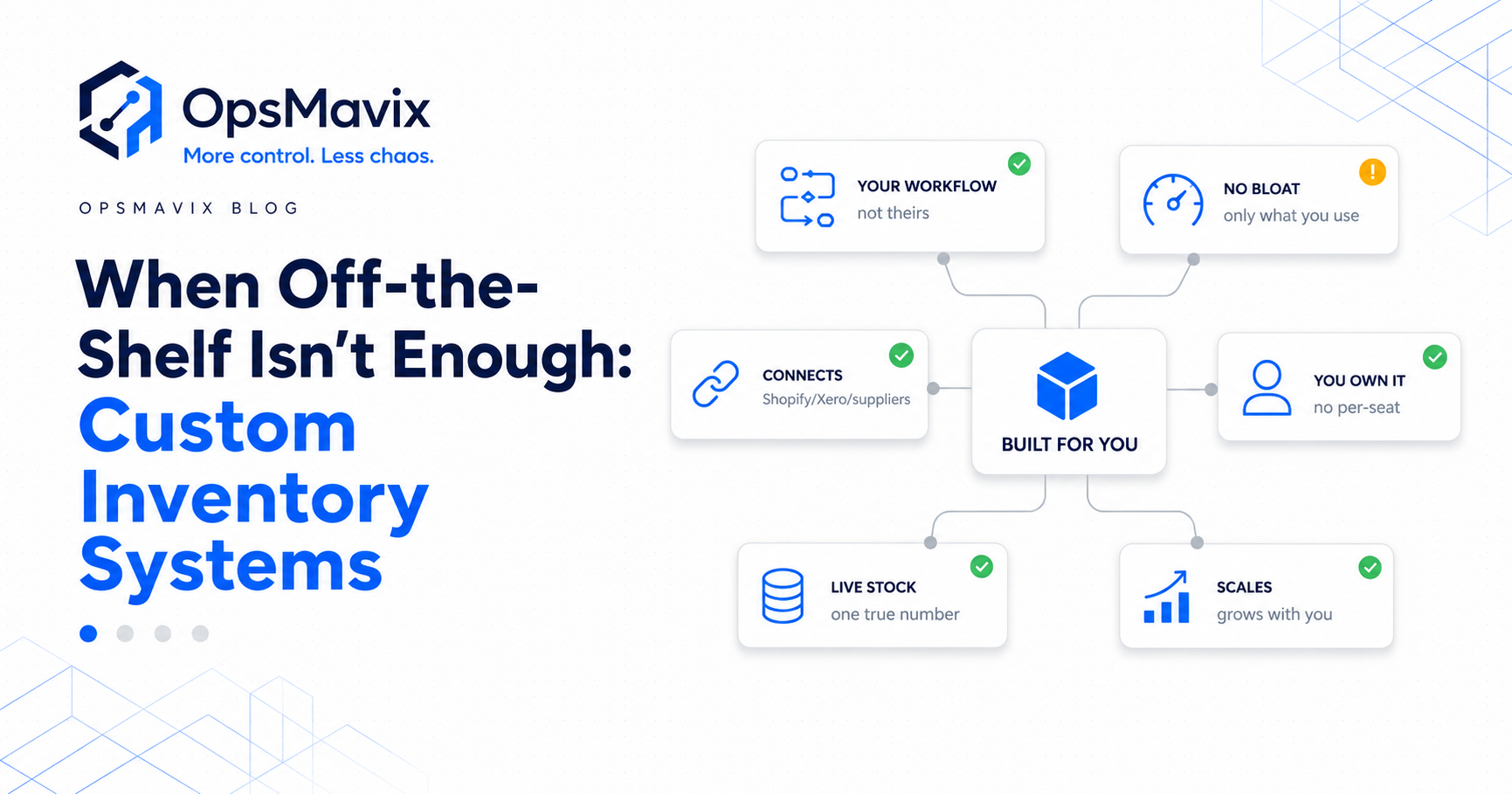
You don’t outgrow inventory software because your business got worse. You outgrow it because it got bigger than the tool was built for. The off-the-shelf app or no-code base that ran your stock beautifully at a few hundred thousand in turnover starts buckling as you scale: more workarounds than workflow, data scattered across tabs, and a monthly bill that keeps climbing.
That’s the point where a custom inventory system stops being overkill and becomes the obvious fix. Not because packaged tools are bad. Because yours is now fighting the way you actually work, and the gap widens every quarter you grow. Here’s how to spot the ceiling, and what building around your process actually changes.
Key Takeaways
- Off-the-shelf inventory tools fail at the point where your process gets more specific than the software allows.
- The warning signs: bloat, stacked workarounds, climbing per-seat pricing, and being the only person who understands the setup.
- A custom system is built around how you work, not the other way round — and you own it outright.
- You outgrew the tool, not your ability. The DIY build proved the need; it just hit a ceiling.
- The right time to build is when maintaining the patchwork costs more than replacing it would.
1The Tool Stops Fitting Your Process
Packaged inventory software is built for the average business. The closer you get to scale, the less average you become. You have a bundling rule, a two-warehouse transfer quirk, a supplier who ships in odd units. At first you bend your process to the tool. Then you build a workaround. Then a workaround for the workaround. The software hasn’t broken. It just was never shaped to you.
2The No-Code Base Hits Its Ceiling
Plenty of capable founders skip the packaged app and build it themselves, usually in Airtable. It works, and they’re rightly proud of it. Then growth arrives. As one operator put it, they “quickly outgrew the capabilities… needed more advanced datatypes and validations,” and the slick base became “base and field bloat… fragmented data… difficult to oversee.” That’s not a skill failure. It’s a tool ceiling. No-code is brilliant until your stock logic needs real data integrity, and then the thing you built to escape the spreadsheet starts to feel like one.
3The “Cheap” Stack Stops Being Cheap
The DIY route sells itself on price: why pay when you can build it yourself? Then the bill creeps. Per-seat tiers punish you for hiring, so you pay for ten seats when you hit six. Platform fees climb until you’re asking the community, “Does everyone use hacks to bypass Airtable’s crazy pricing?” Plenty describe the once-cheap stack as now “costing a hand and a leg.” A custom inventory system flips the model. You pay once to have it built, and you own it. No per-seat escalator, no annual hike, no renting access to your own stock data.
4You’ve Become the Single Point of Failure
There’s a quieter cost that never shows on an invoice. When you’ve hand-built the stock setup, you’re the only person who fully understands it. Every fix routes through you. Every new hire needs you to explain why the count behaves the way it does. The system meant to free you has quietly made you the unpaid in-house developer, and the business can’t run a stocktake without you in the room. That fragility is the real ceiling, and no amount of tinkering removes it.
5Going Back to the Spreadsheet Isn’t the Answer
When the patched-together tool finally frustrates you enough, the temptation is to rip it out and go “back to a simple Excel spreadsheet.” It feels like relief for about a week. Then you’re straight back into the exact sprawl you built the base to escape: stock counted in two places, nothing syncing, the number you can’t trust. Retreating to the spreadsheet isn’t simplifying. It’s undoing the one good instinct you had, which was that your stock deserved a real system.
6What “Custom” Actually Gets You
The fear is that custom means rigid, that you’d trade a flexible tool for a locked box. It’s the opposite. A custom inventory system is shaped around your real stock movements: how you receive, bundle, transfer, return and reorder, with proper validation so bad data can’t get in. It connects to what you already use, like Shopify, Xero and your suppliers, so nothing gets re-keyed. And because it’s built for you and handed over, you own it: documented, handoff-able, runnable by the team without you. Flexibility without the fragility.
How To Know It’s Time
The honest test isn’t “is my current tool annoying.” Most tools are. It’s whether maintaining the patchwork now costs more than replacing it would. Add up the hours spent on workarounds, the climbing platform fees, the oversells from data that doesn’t sync, and the risk of one person holding it all together. When that figure clears the cost of building something fit for purpose, the tinkering has stopped being thrift and started being a leak.
FAQ
What is a custom inventory system?
It’s stock-management software built specifically around how your business works — your receiving, bundling, transfers, returns and reorder logic — rather than a packaged app you adapt to. It connects to the tools you already use, enforces clean data, and is owned by you instead of rented per seat.
When should I move from off-the-shelf to a custom inventory system?
When the tool stops fitting your process: you’re stacking workarounds, the per-seat or platform pricing keeps climbing, your data is fragmented across places that don’t sync, or only one person understands the setup. The clearest signal is when maintaining the patchwork costs more than replacing it.
Isn’t a custom inventory system overkill for a growing business?
Usually not, if you’ve already outgrown a packaged tool or a no-code base. Custom doesn’t mean enterprise-scale. It means sized to how you work now. The real overkill is paying climbing fees and your own hours to keep a tool alive that no longer fits.
Will I lose the flexibility I had in Airtable or a no-code tool?
No, you gain it. A custom system is built around your process and can change as you grow, with the data integrity no-code tools lack at scale. The difference is it’s robust and owned by you, rather than held together by workarounds only you understand.
What happens to the inventory data I already have?
It comes with you. A proper build maps and migrates your existing stock data into a clean structure with validation, so you start from your real figures, not a fresh, empty system. You own the data outright, with no platform holding it hostage.
How OpsMavix Can Help
OpsMavix builds custom inventory systems for businesses that have outgrown the packaged app or the no-code base. Shaped around your real stock movements, connected to the tools you already use, and handed over so the team can run it without you. You own it outright: no per-seat escalator, no bloat, no being the single point of failure.
If keeping your current setup alive is costing more in hours, fees and oversells than it should, that’s a measurable operational leak. Book an Operations Leak Audit and we’ll map exactly where your inventory tool stops fitting, and what building around how you work would change.