
Odoo Competitors: The Suite Landscape, Sorted (and Where a Build Fits)
Odoo competitors aren't one list — they're different categories of suite answering different questions. Mid-market ERPs like NetSuite, Dynamics 365 Business Central and SAP Business One sit above SMB suites like Zoho One and open-source options like ERPNext. This is an even-handed map of who each one suits and where it stops, why picking the category matters more than any feature comparison, and where a right-sized custom operations system fits for firms that don't need the whole suite.
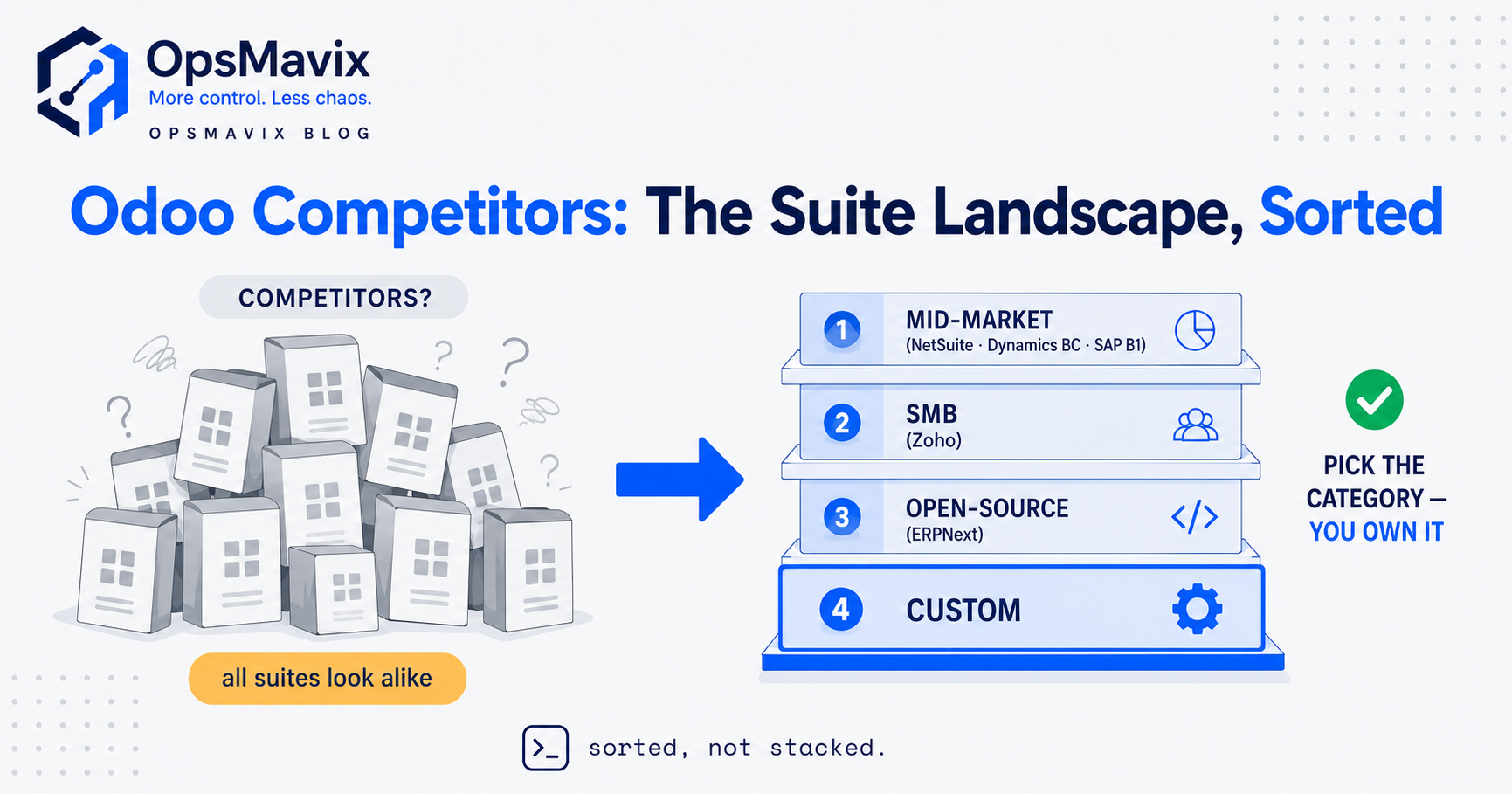
Odoo competitors fall into a few clear categories, and knowing which category you’re actually shopping in matters far more than any single feature comparison. Odoo is a modular business suite from Belgium — dozens of integrated apps (accounting, inventory, sales, manufacturing, CRM, HR and more) sold as one platform, in an open-source Community edition and a paid Enterprise edition, priced per user rather than per module. The tools people line up against it aren’t all the same kind of thing: some are heavier mid-market ERPs, some are lighter SMB suites, some are open-source platforms you host yourself. Compare them as if they were interchangeable and you’ll evaluate for weeks and still choose badly.
This post maps the landscape honestly. We’ll walk the main named rivals — NetSuite, Microsoft Dynamics 365 Business Central, SAP Business One, Zoho One and ERPNext — by who each suits, what it’s built around, and where it stops, then get to the option most roundups skip: a right-sized custom operations system, for firms that need the operational half of a suite without buying and running the whole thing. No fake pricing, no invented feature claims, no strawmen — just where each fits. If your question is really “which single tool do I move to instead of Odoo,” that’s the Odoo alternative piece; this is the whole-field map around it.
Key Takeaways
- Odoo competitors sort into categories, not a flat list — mid-market ERP suites (NetSuite, Dynamics 365 Business Central, SAP Business One), SMB all-in-one suites (Zoho One), open-source ERP (ERPNext), and the custom camp — so “best alternative” depends on which category your problem sits in.
- Mid-market ERPs are the step up, not sideways — broad, powerful, multi-entity-capable, and heavier to buy and run; right when you genuinely need suite-grade breadth, overkill when you don’t.
- Zoho One is the affordable all-in-one camp — a large bundle of apps priced per employee, strong value for a small business wanting many tools cheaply, lighter on deep operational and manufacturing depth.
- ERPNext is the open-source camp — like Odoo in spirit, free to self-host, with paid hosting available; powerful and low-licence-cost, but you carry the setup and maintenance.
- Every suite in every category asks you to fit your operation to its template — the run-cost, the configuration and the admin come with all of them, Odoo included.
- The custom camp is the middle ground — a system shaped to how you actually run, feeding the accounting you already have, owned outright — for firms too big for spreadsheets and too specific for a whole suite.
Why “Odoo Competitors” Hides the Real Choice
Before comparing names, sort the market — because the word “competitors” quietly assumes every option answers the same question, and they don’t. The first category is mid-market ERP suites — NetSuite, Dynamics 365 Business Central and SAP Business One — full platforms built to run finance, operations, supply chain and more across a growing or multi-entity business. The second is SMB all-in-one suites — Zoho One being the clearest example — broad bundles of business apps aimed at smaller firms wanting a lot of tools for a low per-head price. The third is open-source ERP — ERPNext most prominently — where the software is free to run and the cost moves into hosting, setup and maintenance instead of licences.
Odoo is unusual because it straddles two of these at once: it’s open-source like ERPNext and a broad suite like the mid-market names, positioned at SMB-to-mid-market. That’s why its “competitors” spray across categories — you’re comparing it to things above it, beside it and beneath it simultaneously. The mistake that wastes evaluation weeks is judging a heavy mid-market ERP against a lightweight SMB suite on price, or expecting an open-source platform to arrive as finished as a paid cloud one. Name your category first, then compare like with like.
Mid-Market ERP: NetSuite, Dynamics 365 Business Central, SAP Business One
This is the category above Odoo for many buyers — full ERP suites built to run a whole business, not just its operations. NetSuite (owned by Oracle) is a cloud-only, born-in-the-cloud ERP aimed at mid-market and fast-growing companies, strong on multi-subsidiary financials, consolidation and running several entities from one system. Dynamics 365 Business Central is Microsoft’s ERP for small and mid-sized businesses — the successor to Navision/NAV — cloud-first, licensed per named user across Essentials and Premium tiers, and a natural pick for firms already living in Microsoft 365 and the Power Platform. SAP Business One is SAP’s suite for small and mid-sized businesses (distinct from the enterprise-grade S/4HANA), available on-premise or in the cloud, usually delivered through SAP partners, and long favoured in distribution and manufacturing SMEs.
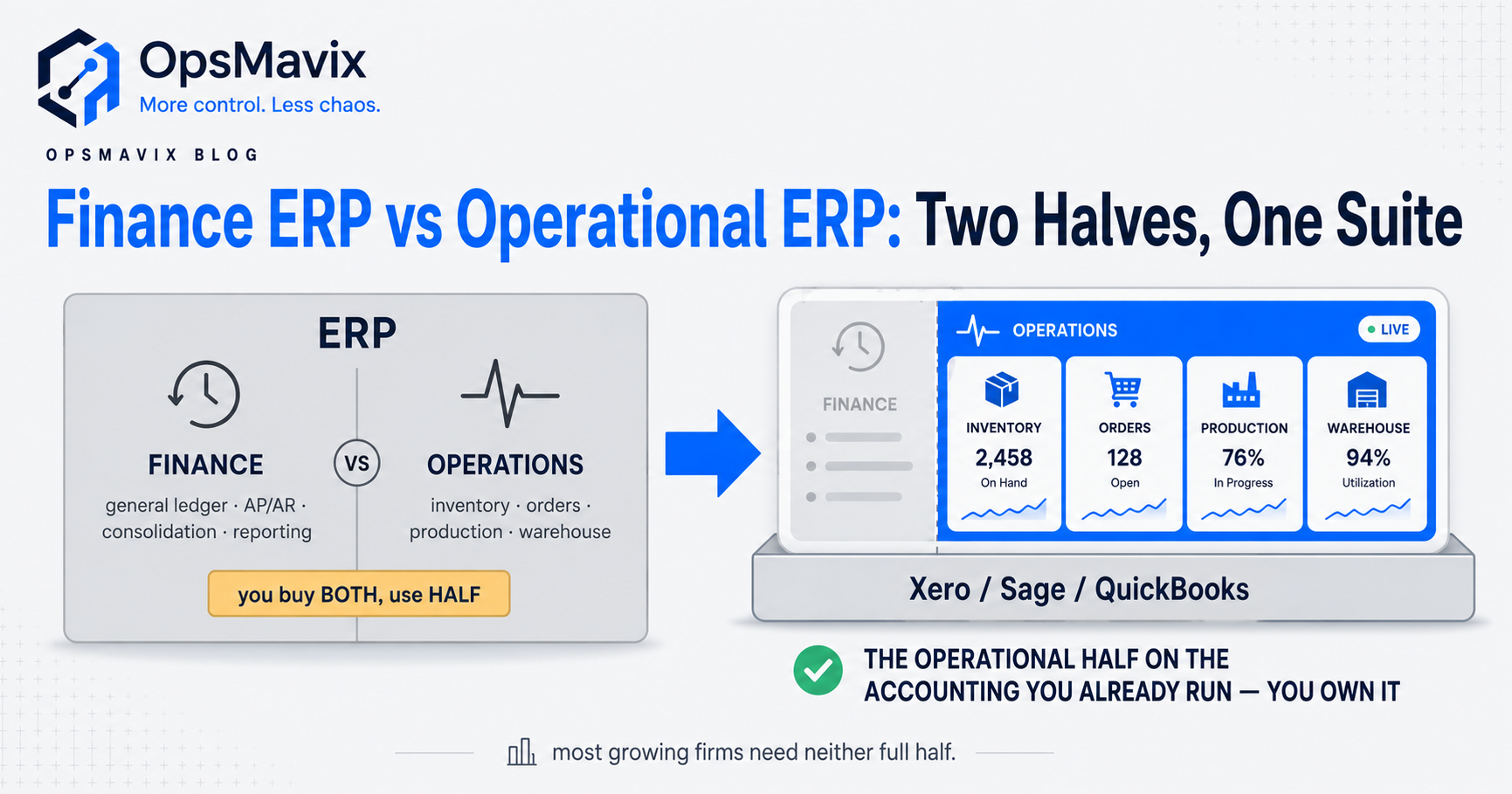
All three are genuine, capable systems, and when you truly need suite-grade breadth — multiple entities, complex finance, deep supply chain, functions well beyond day-to-day operations — this category is the right answer, not a failure of nerve. The honest caution is weight. Mid-market ERPs bring implementation projects, partner involvement, ongoing licence and support cost, and a surface area far larger than a focused operation touches. Buying this category to fix an operations-shaped problem means paying for and running a great deal you’ll never switch on, and the implementation can stall on its own complexity. Whether an operational pain even needs a full suite is exactly the split covered in finance ERP vs operational ERP.
SMB All-in-One: Zoho One
Zoho One sits in a different category and is worth understanding as such. It’s an integrated suite of dozens of Zoho business apps — CRM, Books (accounting), Inventory, Projects, HR, help desk and many more — sold as one bundle priced per employee rather than per app, which makes it strikingly affordable for a small business that wants a lot of tools joined up. For a smaller firm whose needs are broad but shallow — a bit of CRM, some accounting, light inventory, a project tracker — Zoho One’s breadth-for-the-money is a real draw, and the apps share data in a way loose point tools don’t.
That per-employee breadth is also its ceiling relative to a dedicated operational suite. A wide bundle of apps trades depth for coverage: the inventory, manufacturing and warehouse capability is lighter than a mid-market ERP’s or a purpose-built operations system’s, and stitching many apps into one clean operational flow can itself become a configuration project. Zoho One suits a small business that values many decent tools cheaply over deep operational muscle in any one of them. If your pain is specifically stock, orders or production drifting rather than “we need more business apps,” a broad bundle is the wrong shape — the reasoning behind that is in what operational ERP actually is.
Open-Source ERP: ERPNext
ERPNext is the closest option to Odoo in spirit, and often the first name raised when someone wants Odoo’s model without Odoo. It’s an open-source ERP built on the Frappe framework, covering accounting, inventory, manufacturing, sales, purchasing, CRM and HR, free to download and self-host, with paid managed hosting available from its maker if you’d rather not run it yourself. For a technically confident SMB that wants full-suite functionality with a very low licence cost and no vendor lock on the software itself, ERPNext is a serious, credible option — and the community and module coverage are real, not a toy.
The honest trade-off is the one that comes with all open-source infrastructure: low licence cost is not low total cost. Someone has to install, configure, integrate, update and maintain it — either your own capable people or a paid implementation partner — and that effort doesn’t disappear because the software is free. Like Odoo’s Community edition, ERPNext rewards a firm with the appetite and skills to run it and taxes one that doesn’t. It’s the right camp when you specifically want open-source ownership and have the capacity to carry the maintenance; it’s the wrong camp when you wanted a finished system, not a platform to finish.
The Thread Through Every Category: You Fit the Suite
Step back from the names and one thing is true of all of them, Odoo included. A suite — mid-market, SMB or open-source — is a template. It ships with an assumed way of running finance, stock, orders and production, and adoption means fitting your operation to that assumed shape, configuring what bends and working around what won’t. That’s not a criticism of any one product; it’s what a general suite is. It has to serve thousands of businesses, so it can’t be shaped precisely to yours.
For many firms that’s a fair trade — you accept the template to get breadth you couldn’t build alone. But it’s the cost the feature comparisons never list: the configuration project, the processes you change to suit the software, the admin of keeping a broad system fed and upgraded, and the parts you pay for and never use. The question underneath a suite choice isn’t only “which template is closest?” It’s “how much of our operation are we willing to bend to a template at all, and is the breadth worth the bending?”
The Category Most Roundups Skip: a Right-Sized Custom System
Every suite roundup treats the choice as “which template do I adopt?” It usually is — until none of the templates fit without reshaping how you run or paying for two-thirds you’ll never touch. When your operation is too big for spreadsheets but too specific for a whole suite, the honest option isn’t another platform in another category; it’s a right-sized custom operations system, built around how you actually take orders, move stock and run the work, that you own outright. Stock kept as one true figure that matches the shelf. Orders entered once, validated against your real catalogue. Production and reporting shaped to your process, not a generic module you configure into a rough approximation of it.
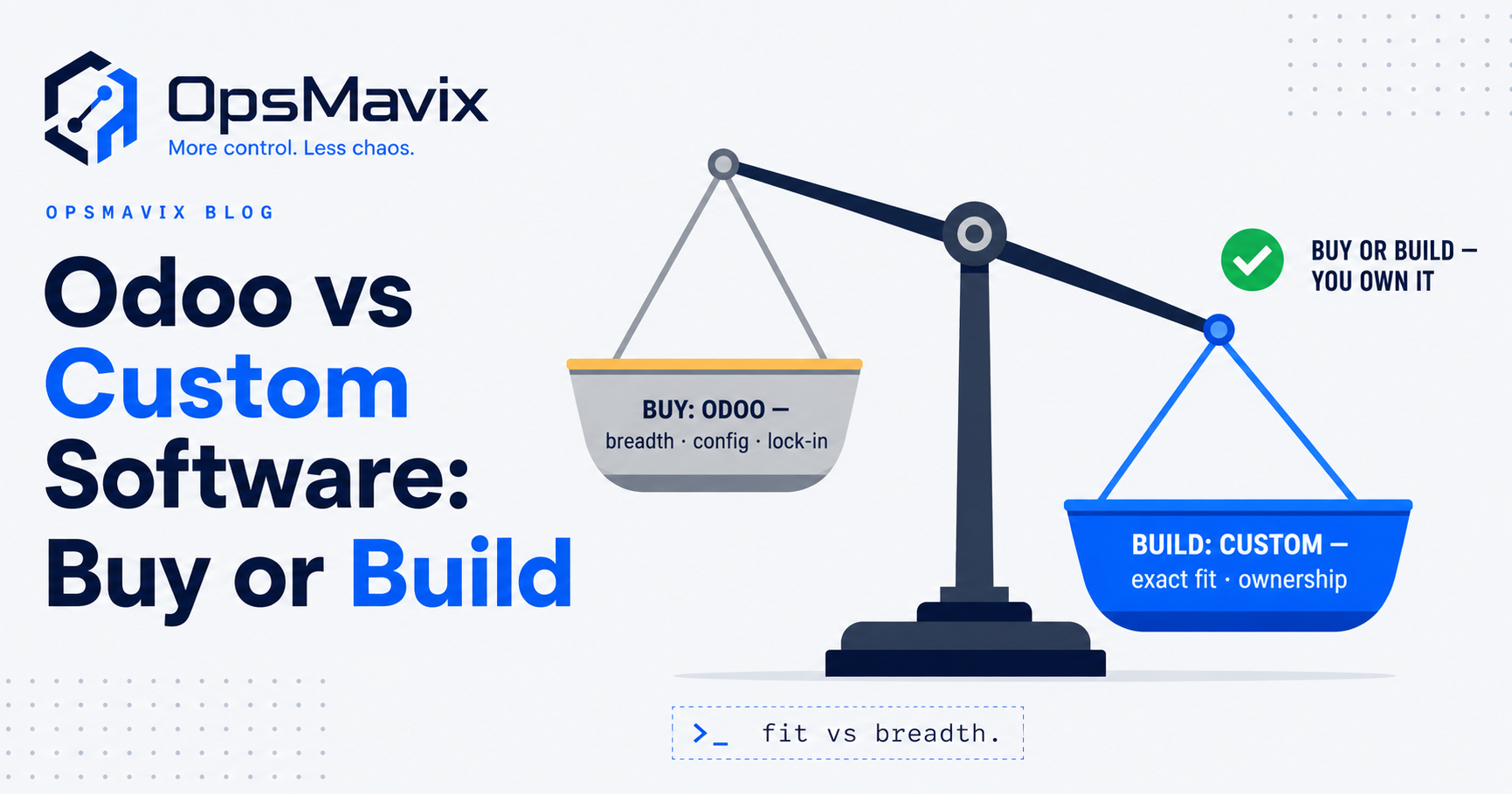
The point isn’t that suites are bad — it’s that a build is sized to your operation instead of a template you bend to. It sits deliberately between the outgrown spreadsheet and the heavy full suite: the operational capability you’ll actually use, feeding the accounting you already run rather than replacing it, with no per-user bill that climbs as you hire and nothing a vendor can reprice or switch off. Where a suite is a whole business operating system you adopt wholesale, a right-sized build is the specific operational slice that was actually leaking, done to fit. For stock that keeps drifting from the shelf, custom inventory systems are the spine of exactly that.
The Landscape at a Glance
| Option | Category | Best fit | Where it stops |
|---|---|---|---|
| Odoo | Open-source + suite (SMB–mid) | Firms wanting broad apps with an open-source option | Config and admin burden; you fit the template |
| NetSuite | Mid-market cloud ERP | Multi-entity, finance-heavy, fast-growing firms | Cost and weight for an operations-only need |
| Dynamics 365 Business Central | Mid-market ERP (Microsoft) | Microsoft-stack SMBs wanting a full ERP | Suite-grade project to run a focused operation |
| SAP Business One | SMB/mid ERP (SAP) | Distribution/manufacturing SMEs, partner-led | Implementation weight for simpler needs |
| Zoho One | SMB all-in-one bundle | Small firms wanting many apps per head, cheaply | Lighter operational and manufacturing depth |
| ERPNext | Open-source ERP | Technical SMBs wanting to self-host a full suite | You carry setup, integration and maintenance |
| Custom operations system | Custom build | Too big for spreadsheets, too specific for a suite | Not an off-the-shelf quick start |
Pick the Category, Then the Tool
The useful decision has two steps, and most buyers skip the first. Step one: name the category your problem actually lives in. Do you need a full business suite across finance and operations and multiple entities — mid-market ERP? A broad, cheap bundle of decent apps for a small firm — an SMB suite? An open-source platform you’ll host and maintain yourself — open-source ERP? Or is one specific operational area leaking while the rest is fine — the custom camp? Answer that honestly and the shortlist collapses from a dozen names to two or three in one category, compared like with like.
Step two is the ordinary work: within the right category, pilot with your own data, check the specific integrations and reports you need, and model total cost over a few years — licences plus implementation plus the admin of running it. What you must not do is compare across categories on a single axis, because a mid-market ERP will always look “more powerful” than an SMB bundle and an SMB bundle will always look “cheaper” than a mid-market ERP, and neither comparison tells you what fits. The best answer might be Odoo. It might be one of these rivals. And for a firm whose operation is too specific for any template, it might be a build — the option that doesn’t ask you to reshape the business to match the software.
FAQ
Who are the main Odoo competitors?
They sort into categories rather than a flat list. In the mid-market ERP category, NetSuite (Oracle), Dynamics 365 Business Central (Microsoft) and SAP Business One (SAP) are full suites built to run finance and operations across a growing or multi-entity business. In the SMB all-in-one category, Zoho One bundles dozens of business apps at a per-employee price. In the open-source category, ERPNext is the closest to Odoo’s own model — free to self-host, with paid hosting available. Which is your real competitor depends entirely on whether you need a full suite, a cheap broad bundle, an open-source platform, or just one operational area fixed.
Odoo vs NetSuite — how do they differ?
They sit in different weight classes. NetSuite is a cloud-only mid-market ERP owned by Oracle, strong on multi-subsidiary financials and consolidation, aimed at larger and faster-growing firms, and priced and implemented accordingly. Odoo is a modular SMB-to-mid-market suite with an open-source edition and per-user pricing, generally lighter and cheaper to start. NetSuite tends to win when you genuinely need multi-entity finance depth; Odoo tends to win on cost and flexibility for a smaller operation. Neither is a bad choice — they answer differently sized questions.
Is ERPNext a good Odoo alternative?
For the right firm, yes. ERPNext is an open-source ERP built on the Frappe framework, covering accounting, inventory, manufacturing, sales, CRM and HR, and like Odoo it’s free to self-host with paid managed hosting available. It suits a technically capable SMB that wants full-suite functionality with a very low licence cost and open-source ownership. The trade-off is that someone has to configure, integrate and maintain it — the cost moves from licences to labour, so it fits firms with the appetite and capacity to run it and taxes those without.
Is Zoho One cheaper than Odoo?
Often, at the headline, because Zoho One is priced per employee for a large bundle of apps, which is strong value for a small firm wanting breadth. But cheaper-per-head isn’t the same as a better fit. Zoho One trades depth for coverage — its inventory, manufacturing and warehouse capability is lighter than a dedicated operational suite’s — so if your pain is a specific operational area drifting rather than “we need more business apps,” the low price buys the wrong shape. Compare on fit for your actual problem, not on the per-head figure alone.
When should I build a custom system instead of picking a suite?
When your operation is too big for spreadsheets but too specific for any suite’s template — you’d be paying for and running two-thirds of a platform you’ll never touch, or reshaping how you work to fit the software. That’s the signal for a right-sized custom operations system: the operational capability you’ll actually use, shaped to how you genuinely run, feeding the accounting you already have, owned outright with no per-user bill that climbs as you grow. If a suite’s template genuinely fits, buy the suite — we’ll say so. The build is for the firms none of the templates fit without bending the business.
How OpsMavix Can Help
OpsMavix builds right-sized operational systems for firms weighing the full suites and quietly realising they’d use a fifth of one — too big for spreadsheets, too specific for Odoo, NetSuite, Business Central, SAP Business One, Zoho or ERPNext. Instead of adopting a whole platform and bending your operation to its template, we build the operational slice that’s actually leaking — stock kept as one true figure that matches the shelf, orders entered once and validated against your catalogue, production and reporting shaped to your process — feeding the accounting you already run rather than replacing it. You own it outright: no per-seat licence that climbs as you hire, nothing a vendor can reprice or switch off.
If you’ve mapped the Odoo competitors and none of the categories fit without over-buying or reshaping how you work, that middle ground is exactly what we build. Book an Operations Leak Audit and we’ll map where your operations actually leak today, what it’s costing you, and whether a right-sized build is the honest fit — or whether one of the suites genuinely does the job. We’ll tell you straight.
Keep reading
Getting value from OpsMavix? Add us as a preferred source on Google — you'll see more of our operations content in your AI Overviews, AI Mode and Search.