
Mintsoft vs Linnworks: Which One Fits How You Actually Sell and Ship?
Mintsoft leans warehouse and 3PL fulfilment with client billing; Linnworks leans multichannel order and stock sync across marketplaces. Here's who each really suits, where each hits its ceiling, how the pricing works, and the third path for teams that fit neither.
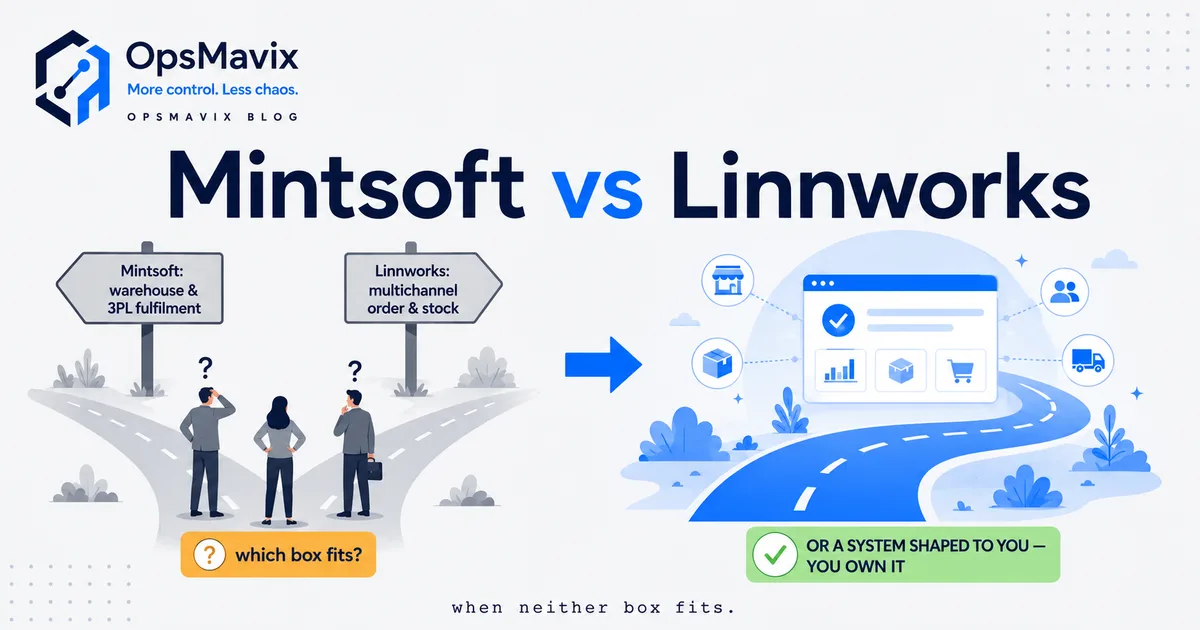
If you are weighing Mintsoft vs Linnworks, the short version is this: Mintsoft (part of The Access Group) is built around the warehouse — pick, pack, dispatch and multi-client 3PL billing — while Linnworks is built around the channels, keeping orders and stock in sync across Amazon, eBay, Shopify and the rest. Neither is “better” in the abstract. One thinks like a fulfilment operation, the other thinks like a multichannel seller, and the right pick depends on whether your day is defined by shipping accurately from a warehouse or by not overselling across a dozen sales channels.
Both are proper platforms, not spreadsheets with a barcode font. If you are comparing them seriously, you have already outgrown manual order entry and stock counts that lie. The real question is which system’s core assumptions match your operation — and where each one runs out of road once your process stops looking like the vendor’s template.
Key Takeaways
- Mintsoft is warehouse-first. Its strongest hand is 3PL fulfilment: multi-client separation, storage and handling charges, client billing and pick/pack workflows are first-class.
- Linnworks is channel-first. It is built to route orders and sync stock across many marketplaces and carts so a multichannel seller stops overselling.
- They overlap in the middle — both do orders, stock and some warehouse management — but they were shaped for different jobs, and the overlap hides the difference.
- Both price around throughput. The bill is indexed to order volume with modules and add-ons stacked on top, so the cost is designed to climb as you grow.
- Both are boxes. You configure inside their model; the moment your workflow needs something the box does not do, you adapt to it, not the other way round.
- There is a third option most comparisons skip: one operations system shaped around how you actually run, that you own outright.
Mintsoft vs Linnworks: The Core Difference
The cleanest way to read the Mintsoft vs Linnworks question is to ask where each system’s centre of gravity sits.
Mintsoft’s centre of gravity is the warehouse. It is a cloud order and warehouse management system built largely for third-party logistics providers and the businesses that fulfil for other brands. It handles goods-in, barcode-driven picking and packing, multiple warehouses, and — the part that earns its keep — separating inventory by client and billing each one for storage, handling and shipping. If your revenue comes from running a warehouse well, Mintsoft speaks your language.
Linnworks’ centre of gravity is the channel. It is a multichannel order and inventory platform built to sit between a seller and every place they sell — marketplaces, carts, carriers — routing incoming orders and pushing stock levels back out so the same unit is not sold twice in two places. If your revenue comes from selling the same products across many channels without overselling, Linnworks speaks your language.
They meet in the middle. Both touch orders, both touch stock, both have a warehouse-management layer. That overlap is exactly what makes the choice confusing, because a demo of either will show you order lists and stock counts and look broadly similar. The difference is in what each one makes easy versus what it makes you fight for.
Where Mintsoft Is Strong
Mintsoft’s best case is the multi-client fulfilment house. Working out what each brand owes for storage and picks at month-end is precisely the admin that quietly bleeds margin when it lives in a spreadsheet, and Mintsoft builds that billing into the core rather than bolting it on.
Its strengths cluster around warehouse operations:
- 3PL billing and client separation — chargeable rates, per-client inventory, storage and handling charges, and a client portal so brands can see their own stock.
- Warehouse workflows — goods-in, barcode scanning, pick and pack, and multi-warehouse handling as native concerns, not afterthoughts.
- A broad integration count and support for many sales channels and couriers, so a fulfilment operation can plug in the tools its clients already use.
Where does Mintsoft hit its ceiling? When your operation is not really a warehouse-and-billing model. If you are a single brand whose real problem is listing and repricing across ten marketplaces, Mintsoft’s channel side can feel thinner than a dedicated multichannel tool — and you may find yourself wanting Linnworks’ channel discipline on top. We go deeper on the fulfilment use case in our guide to using Mintsoft for 3PL.
Where Linnworks Is Strong
Linnworks’ best case is the multichannel seller who lives in fear of overselling. When the same product sells on Amazon, eBay, a Shopify store and a marketplace or two, keeping one true stock figure across all of them by hand is, as one operator described it to us, “beyond error-prone.” Linnworks exists to make that automatic.
Its strengths cluster around orders and channels:
- Multichannel order routing — orders from every connected channel land in one place, with rules to route, batch and process them.
- Stock sync across channels — sell a unit on one channel and the count drops on the others, which is the mechanism that stops the classic oversell-then-cancel spiral.
- Channel and listing breadth — a wide set of marketplace, cart and carrier connections, plus listing and forecasting features available as part of the wider platform.
Where does Linnworks hit its ceiling? When your real job is warehouse operations or fulfilling for other people. If you need proper per-client 3PL billing, or deep warehouse process, or you manufacture and kit rather than just pick and ship, you are asking a channel-management platform to do a fulfilment job it was not shaped for. Our post on Linnworks for wholesale B2B walks through where that boundary shows up.
Mintsoft vs Linnworks: Side-by-Side
| Mintsoft | Linnworks | |
|---|---|---|
| Centre of gravity | The warehouse / fulfilment | The sales channels |
| Built for | 3PLs, fulfilment houses, warehouse-heavy sellers | Multichannel retailers and brands selling their own stock |
| Standout strength | Multi-client 3PL billing + pick/pack | Order routing + stock sync across marketplaces |
| Warehouse ops | Deep, native | Present, secondary to channels |
| Channel/listing tools | Present, secondary to warehouse | Deep, native |
| Owner | The Access Group | Linnworks (UK) |
| Pricing shape | Volume-banded + modules; quoted per business | Volume-tiered + add-ons; quoted per business |
| Ceiling shows up when | You need heavy channel/listing automation or you manufacture | You need 3PL billing, deep warehouse ops or production |
The table is a starting point, not a verdict. Two operations with the same order count can land on opposite sides of it depending on whether the thing that earns their money is a warehouse or a channel mix.
How the Pricing Actually Works
Here both systems behave the same way, and it is the part to understand before you sign either contract: you are not buying a box for a flat fee, you are buying a meter.
Both Mintsoft and Linnworks price around throughput. You sit in a band or tier defined by how many orders you push through in a month, that band sets your base cost, and as your volume climbs you move up. On top of the base sit modules and add-ons — deeper warehouse features, listing management, forecasting, particular connectors — several of which also scale with usage. So the “price” of either is never one number; it is a base band plus whatever you bolt on, which is why two businesses on the same order tier can pay very different totals.
Neither vendor publishes firm figures for its paid tiers; quotes are given per business and the numbers move. Mintsoft runs an entry plan with heavier 3PL tiers stacked above it, and Linnworks bands by order volume with add-ons on top — but neither headline number is public in a form you can bank on, so treat any second-hand figure as shape-only and confirm current pricing directly with each vendor before you model anything.
The costs that catch people out sit off the headline quote entirely: onboarding, data migration, training, non-standard integration work, and the support tier you need to reach a human quickly. Count the whole iceberg or the comparison is dishonest. For the full breakdown of how the meter behaves as you scale, see our take on Linnworks vs a custom system.
Worked Example: When Neither Box Fits
Picture a growing homeware business. It manufactures some of its own lines, buys in others, sells them across a Shopify store plus Amazon and eBay, and fulfils a couple of small partner brands out of the same warehouse for a fee.
Run that through the two options and the seams show:
- On Linnworks, the channel sync is excellent — nothing oversells across the three sales channels. But the small amount of fulfilment it does for partner brands has nowhere clean to live; there is no proper per-client billing, so the finance person ends up back in a spreadsheet working out what each partner owes.
- On Mintsoft, the warehouse and the partner billing are handled properly. But the multichannel listing and repricing across its own Amazon and eBay presence feels thin, so it bolts on a second tool for that — and now stock has to sync between two systems, which is the exact drift it was trying to kill.
Either way, this business ends up running one platform plus a workaround spreadsheet or a second subscription to cover the half the box does not do. That is the tell. As one seller described the underlying problem, “I spend hours every week copy-pasting orders into spreadsheets” — after buying software specifically to stop doing that.
Put a rough number on the leak. If two people each spend an hour a day on reconciliation and workaround admin the system should have handled, that is roughly 40 hours a month of skilled time spent feeding software — real money leaking every month, quietly, on top of the licence fee.
The Third Path: A System Shaped Around You
Here is the honest take. If your operation is a clean fit for one of these boxes, buy the box. A 3PL that needs standard client billing should look hard at Mintsoft. A single brand that needs raw multichannel sync should look hard at Linnworks. Off-the-shelf is cheaper and faster to stand up when your process matches the template, and you should not pay to rebuild what already exists. We keep a fair roundup of the field in our Mintsoft competitors and Linnworks alternative posts.
The third path matters when neither box fits — when your operation mixes warehouse fulfilment, multichannel selling, production and partner billing, and forcing that into a single-purpose platform costs you in workarounds, integration glue and staff time for years. That is where one operations system, shaped to how you already run and owned by you rather than rented against someone else’s roadmap, stops being a luxury and starts being the cheaper option over time. It is the right-sized layer for a business that is too complex for one narrow box but not looking to disappear into a full ERP.
You do not need to decide that today. Get clear first on where your process actually leaks, and whether a box closes the leak or just moves it.
FAQ
Is Mintsoft or Linnworks better for a 3PL? Mintsoft, in most cases. Multi-client separation, chargeable rates and client billing are first-class in Mintsoft and secondary in Linnworks. If per-client invoicing is central to how you make money, that is a strong signal.
Is Mintsoft or Linnworks better for multichannel selling? Linnworks, in most cases. It is built to route orders and sync stock across many marketplaces and carts, which is exactly the multichannel seller’s core pain. Mintsoft can connect channels, but its centre of gravity is the warehouse.
Can one platform do both fulfilment and multichannel selling? Partly. Both have some of the other side. But if you do both seriously — real 3PL billing and heavy multichannel listing — you usually end up running a second tool or a spreadsheet alongside, which reintroduces the stock drift you were trying to remove.
How much do Mintsoft and Linnworks cost? Both price around order volume with modules and add-ons on top, quoted per business rather than published as firm figures. Model the cost over three years against your expected growth, and always confirm current numbers directly with each vendor.
How OpsMavix Can Help
OpsMavix builds right-sized operations systems for businesses that have outgrown spreadsheets but do not fit — or have outgrown — a single off-the-shelf platform. If you are stuck between Mintsoft and Linnworks because neither quite matches how you sell and ship, that is usually a sign your operation is doing more than one box was designed to hold.
We start with a free Operations Leak Audit: we map where your current process is bleeding time and money — the reconciliation admin, the workaround spreadsheets, the stock drift between systems — before you commit to any platform. Sometimes the answer is “buy the box,” and we will tell you so plainly. Sometimes it is a system shaped around your actual workflow, that you own outright, with no per-order meter and no per-seat creep.
If your Mintsoft-vs-Linnworks decision keeps stalling because the honest answer is “a bit of both,” book a free Operations Leak Audit and we will map the leak before you sign anything.
Sources
- Mintsoft — product and 3PL/warehouse management overview (The Access Group). Confirm current pricing directly.
- Linnworks — multichannel order and inventory platform overview. Confirm current pricing directly.
- OpsMavix operator interviews and mined multichannel/fulfilment practitioner feedback (2026).
Keep reading
Getting value from OpsMavix? Add us as a preferred source on Google — you'll see more of our operations content in your AI Overviews, AI Mode and Search.