
Mintsoft for 3PL: Where It Fits, and Where 3PLs Outgrow It
Mintsoft is built for 3PL and fulfilment work, and for a standard multi-client operation it fits well. The strain shows when a growing 3PL has client-billing rules the tool can't model, per-order costs that bite at volume, or reporting a client wants that won't come out. Here's where Mintsoft is genuinely the right call, and where owning your exact billing and bin logic wins instead.
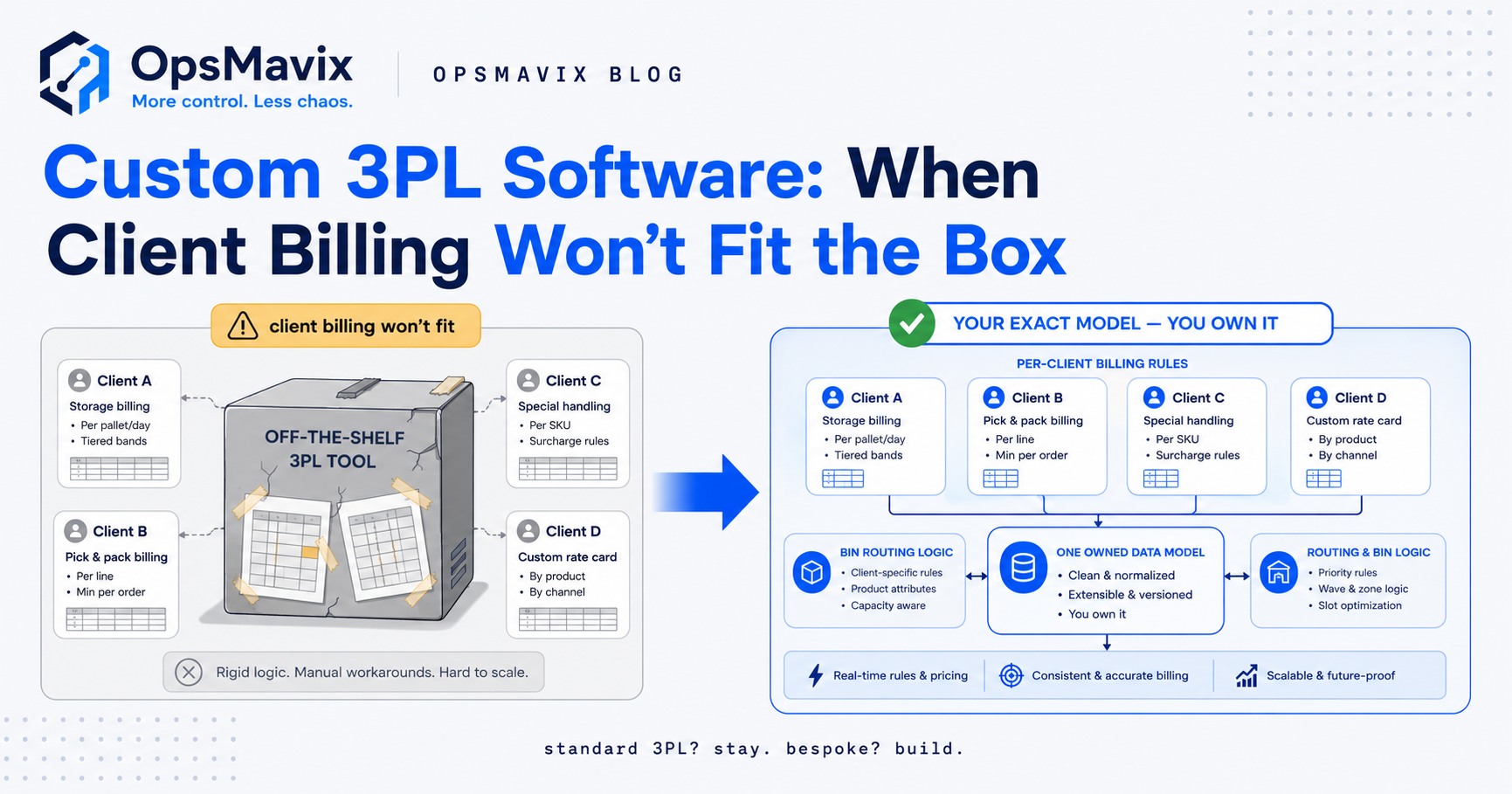
Mintsoft for 3PL is a good fit for most standard fulfilment houses, and a bad reason to stay put once your billing outgrows it. Mintsoft is a UK cloud order and warehouse platform (now part of the Access Group) built largely around third-party logistics and multichannel fulfilment — it packages client accounts, order intake, stock control and warehouse pick-and-pack into one product aimed at 3PLs. If you run a fairly standard model — clients send stock, you store it, orders arrive, you pick, pack, ship, then bill on storage and per-order fees — it does much of that on day one. Its exact features, tiers and pricing shift over time, so treat what follows as the category shape and verify the current details directly.
The question isn’t whether Mintsoft is good software for 3PLs — for a large slice of the market it plainly is. It’s where a growing 3PL hits the edge of what any packaged tool will bend to: a client-billing arrangement it has no field for, a per-order cost curve that bites hardest in your busiest months, an integration or report your best client wants that you can’t get out. This post is fair about where Mintsoft is the right call and honest about where owning your billing, bin logic and channel flow beats renting. For the broader options, the Mintsoft alternative breakdown and the Mintsoft competitors roundup cover those; this one keeps the 3PL vertical as its spine.
Key Takeaways
- Mintsoft is built for 3PL and fulfilment work — for a standard multi-client operation with predictable volumes, it fits its template well and is usually the right call.
- You outgrow it at the billing edge first: client-specific surcharges, frozen rates or tier logic the product can’t model, so month-end invoices get finished by hand in a spreadsheet.
- Per-order pricing scales against you — a busy fulfilment month should be your best month, not your most expensive software month.
- Integration gaps and locked-in reporting are the other tells — a channel or client system it won’t quite reach, and per-client numbers you can’t export.
- The swap is a genuine fork: another 3PL SaaS (cheaper, like-for-like, if your model is standard) versus a custom system you own, shaped to your exact billing and bin logic.
- Don’t switch on principle. A standard-flow 3PL with predictable volumes should stay on Mintsoft or a like-for-like tool. Move only when the workarounds and per-order fees cost more, year on year, than building the right thing once.
What Mintsoft Does for a 3PL
Take the category behaviours, not a spec sheet. A fulfilment WMS in Mintsoft’s class gives a 3PL client accounts to run many brands under one roof, order intake from marketplaces and carts, stock control across bins and locations, pick-and-pack workflows on the floor, courier integrations for labels and tracking, and a billing layer to charge clients for storage and fulfilment. That’s the bulk of what a fulfilment house needs to open its doors, delivered as a rented product rather than a project.
The pull is obvious: order intake, courier connections and a stock ledger are solved problems you don’t want to build from scratch. The exact edges of what Mintsoft covers — which couriers and channels it reaches natively, what its billing module can express — move release to release, so check the live documentation for the current state.
Where Mintsoft Fits (the Honest Bit)
Be fair to Mintsoft: it does a real job for a large share of fulfilment houses. If you run a fairly standard 3PL — clients send stock, you store and pick and ship it, you bill on storage plus per-order fees, and your channels are mainstream ones it reaches natively — a packaged tool covers most of your operation without a developer in sight. Building your own to replace a wheel that already turns spends money you didn’t need to.
The clearest signal that renting is right: your billing fits the fields, and your month-end invoice comes out of the software finished, with no client’s deal so unusual that you’re patching it by hand. A 3PL on predictable volumes and terms usually should rent — the OpsMavix view for any tool that fits: don’t move for the sake of moving.
Sign One: Client-Billing Rules the Tool Can’t Model
This is where 3PLs feel the edge first, and the most expensive place to feel it. Every fulfilment house bills differently once it grows: a client on a frozen legacy rate, a surcharge for oversized items, a per-pallet storage tier that steps at volume, a returns fee only some brands pay, a minimum monthly charge, a bundled pick-and-insert rate for one brand’s peak. Packaged platforms model the common patterns well and struggle at the specific ones — the deal you struck with your third-biggest client that looks like nobody else’s.
The tell is the invoice spreadsheet. When the software can’t hold a client’s exact billing logic, the numbers get exported and finished by hand each month — a permanent tax and a fresh place for errors to hide. The pattern is common enough to state plainly: you export the platform’s invoice, then rebuild half of it in a spreadsheet every month, because your surcharge and minimum-charge rules just aren’t in there. When that’s your normal month-end, your billing model has outgrown the one you’re renting — and every rounding error is either your margin or a client dispute.
Sign Two: Per-Order Cost That Bites Hardest at Volume
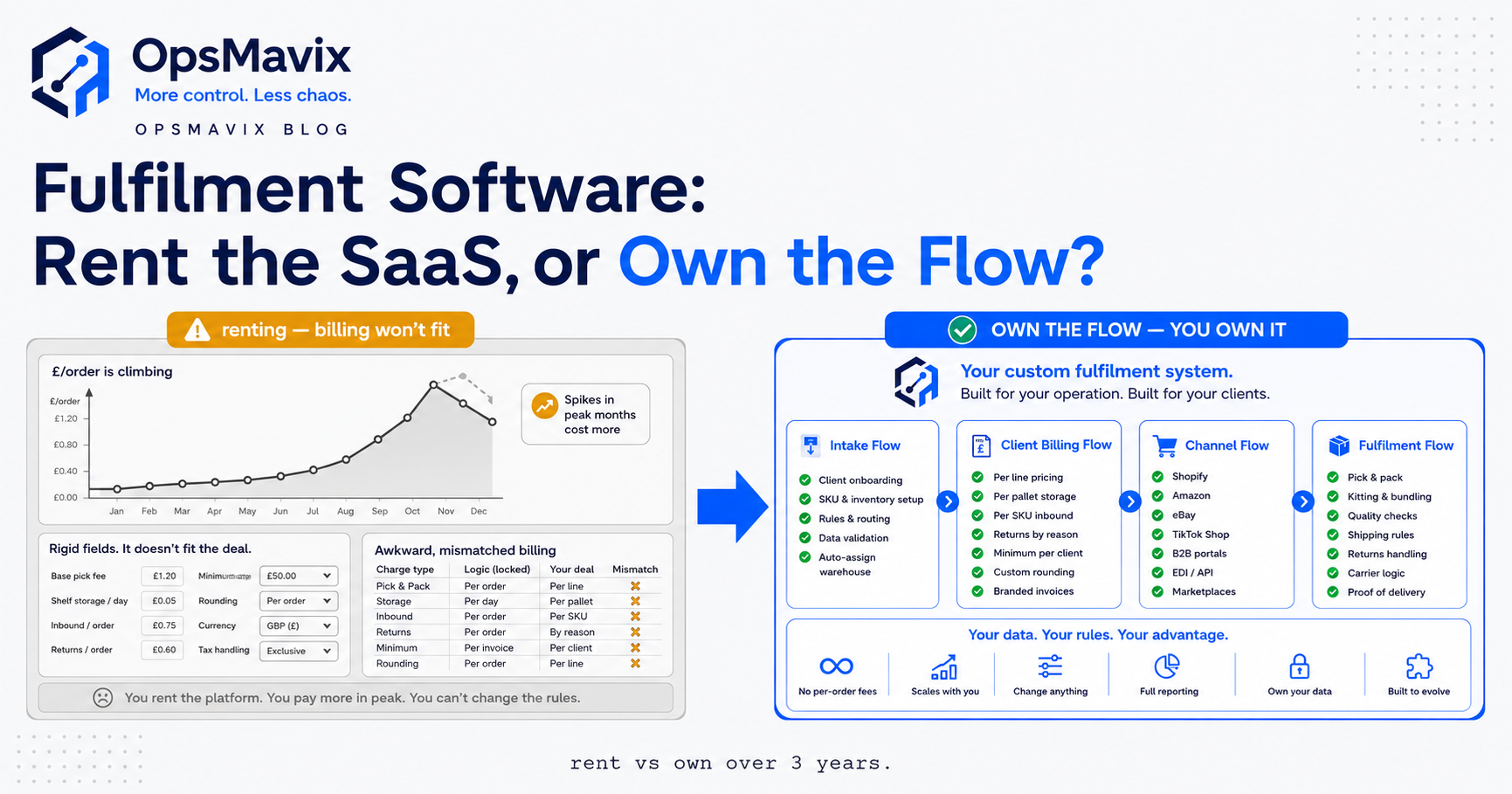
A packaged platform looks affordable right up until your parcel volume climbs. Then the question isn’t the monthly fee but how it scales: per-order, per-shipment or per-tier pricing means your busiest, most profitable month is also your most expensive software month. For a 3PL on thin margins, software that takes a slice of every parcel pulls directly on the number you’re trying to grow.
There’s a second-order version: the tier wall. Growth pushes you into the next band, and the jump often bundles capabilities you don’t need in order to escape the one limit you actually hit — priced for an operation a size above yours. Picture a 3PL shipping 8,000 orders a month; push through peak to 20,000 and that per-order line more than doubles, none of the extra spend buying a capability you didn’t already have. Model how a platform prices against your projected volume before you commit.
Sign Three: Integration Gaps and the Per-Client Report You Can’t Get Out
The third tell comes in two shapes, both about data you can’t quite reach. The first is the integration gap: a channel, marketplace, courier or client’s own system the platform doesn’t connect to natively. So orders arrive by CSV, or someone re-keys them, or brittle middleware breaks on a bank holiday — a channel the software won’t quite reach becomes exactly the rekey work it was meant to kill.
The second is reporting you can’t get out. Your clients increasingly want their own numbers — stock ageing, throughput, SLA hit-rates, cost breakdowns by SKU — and a packaged platform gives you the reports it decided to build, not the one your best client is asking for. When the data sits behind a fixed report set with no clean export, you rebuild it by hand or you tell the client no — and “no” is how a 3PL loses accounts. It’s the same problem as warehouse management software that won’t bend to your process: the tool’s model, not yours, decides what you can see.
Your Swap Options: Another 3PL SaaS, or a System You Own
When you decide to move, there are two roads, and choosing the wrong one wastes a year. Road one is another 3PL SaaS — a like-for-like fulfilment platform in the same WMS class. If your reason for leaving is narrow (a missing integration, a friendlier price band, a UI your team fights) and your model is otherwise standard, this is the sane, cheaper move. Most fulfilment houses looking away from a tool should price a straight like-for-like swap first — for the same reasons a Fulfillor alternative is often just another rental — and it’s frequently the right answer.
Road two is a custom system you own — built around your exact intake, bin and routing logic, client billing and channel flow, on one data model that belongs to you. This is the right road when the reason you’re leaving isn’t one feature but the shape itself: your billing can’t be expressed by any off-the-shelf tool, the per-order curve is eating margin, and the reporting and integration gaps keep multiplying. The mistake cuts both ways — road two for a problem road one would have solved cheaply, or road one again and again for a problem only ownership fixes.
What a Custom 3PL System Does Differently
A custom system isn’t a stripped-down WMS or a cheaper clone of Mintsoft — it’s built around how your operation runs. Client billing is the clearest win: your surcharge rules, frozen rates, storage tiers, returns fees and monthly minimums built into the flow, so the invoice comes out finished, not exported to be repaired. Order intake is shaped to every channel you take orders from, ingested once and validated against your catalogue, so the integration gap closes. Bin logic, pick routing and pack rules match your warehouse floor and your slotting decisions, not a generic template.
Underneath all of it sits one owned data model. Every order, movement, storage day and client charge is a record in a system you control, so reporting stops being a fixed menu — a client wanting stock ageing by brand or an SLA breakdown by courier is a query against your own data, not a feature request behind a vendor’s roadmap. That same model holds one true stock figure across every client and channel, decremented the instant anything ships, so two brands sharing a shelf can’t both sell the last unit — the part of a fulfilment platform you’d actually use, owned outright.
How to Decide: Rent vs Own, on the Three-Year Number
A packaged platform might run a few hundred pounds a month at your current size, and at low, flat volume it genuinely is the cheaper call, so rent and don’t look back. The picture changes when you project forward: per-order and per-tier pricing climbs with parcels and clients, so a 3PL growing through its bands pays meaningfully more in year three than year one — plus the unbilled hours rebuilding invoices and re-keying orders.
A custom system inverts the shape. The cost lands mostly upfront — OpsMavix builds in the £3k–£25k range, with the paid Gap Analysis credited against the build — and you own the result, with no per-order meter and nothing a vendor can reprice underneath you. Below your break-even volume, rent and don’t look back. Above it, every busy month you keep renting is money handed to a meter instead of into an asset. The move earns its keep when the shape is wrong and getting wronger, not when one report merely annoys you.
FAQ
Is Mintsoft good for a 3PL?
For a standard fulfilment house, yes. Mintsoft sits in the 3PL/fulfilment WMS category and hands you client accounts, order intake, stock control, pick-and-pack and billing as a rented product. If your billing fits its fields, your channels are ones it reaches natively, and your volumes are predictable, it’s usually the right call. Its exact features and pricing change over time, so verify the current details directly. You outgrow it when billing, integrations or reporting drift past what the template will hold.
What are the best alternatives to Mintsoft for a 3PL?
It depends on why you’re leaving. If your model is standard and the reason is narrow — an integration, a price band, a UI you dislike — the best alternative is usually another 3PL SaaS in the same fulfilment WMS class, a like-for-like rental that fits better. If the reason is structural — client billing the tool can’t model, per-order pricing eating margin at volume, per-client reporting you can’t export — then a custom system you own, shaped to your exact billing and bin logic, addresses the actual cause.
When should a 3PL stay on Mintsoft?
When it fits. A fulfilment house with predictable volumes, a standard model, billing the platform can hold, and channels it connects to natively should stay put — the upfront cost of a build isn’t worth it, and replacing working software is a leak in itself. The signals to move come together, not alone: you’re rebuilding invoices by hand, per-order fees climb faster than your margin, integration gaps keep appearing, and clients want data you can’t get out. One annoyance isn’t a reason to migrate a live operation. A pattern of them is.
Is a custom 3PL system more expensive than Mintsoft?
On the headline number, a packaged platform is cheaper to start. The honest comparison is total cost over three years: per-order pricing climbs as you ship more, and the manual invoice and re-keying work is an unbilled tax. A custom build (OpsMavix works in the £3k–£25k range, with the paid Gap Analysis credited off the build) lands mostly upfront, then runs with no meter and no vendor that can reprice it. For a 3PL the platform genuinely fits, renting wins on cost — we’d tell you so.
How OpsMavix Can Help
OpsMavix builds fulfilment and order systems shaped to how a 3PL actually runs — client-billing rules built into the flow so month-end invoices come out finished, orders ingested once from every channel you take them from, bin and pick logic that matches your floor, one owned data model every report and stock figure reads from. No per-order meter, no tier wall, nothing a vendor can retire underneath you. If you’re a smaller or standard-flow house with predictable volumes, we’ll tell you plainly a packaged platform is the cheaper call — the move only pays when the shape is wrong and the workarounds already cost real money.
If you’ve hit the edge of what a rented fulfilment WMS will bend to but aren’t chasing an enterprise system, that middle ground is exactly what we build. We’ll map where your billing, intake, integrations and reporting break down today, put a real number on it, and tell you honestly whether owning beats renting. Book a Free Operations Leak Audit
Keep reading
Getting value from OpsMavix? Add us as a preferred source on Google — you'll see more of our operations content in your AI Overviews, AI Mode and Search.