
Linnworks for Wholesale & B2B: The Trade-Order Gap
Linnworks is strong multichannel software built for direct-to-consumer selling, but the moment you sell to trade the fit gets awkward. Per-customer price lists, credit terms, rep and phone orders, minimum-order rules and backorders are the everyday shape of wholesale — and they're the parts a DTC platform handles thinly or not at all. Here's exactly where the trade-order gap opens, and what a system shaped to how you actually sell does instead.
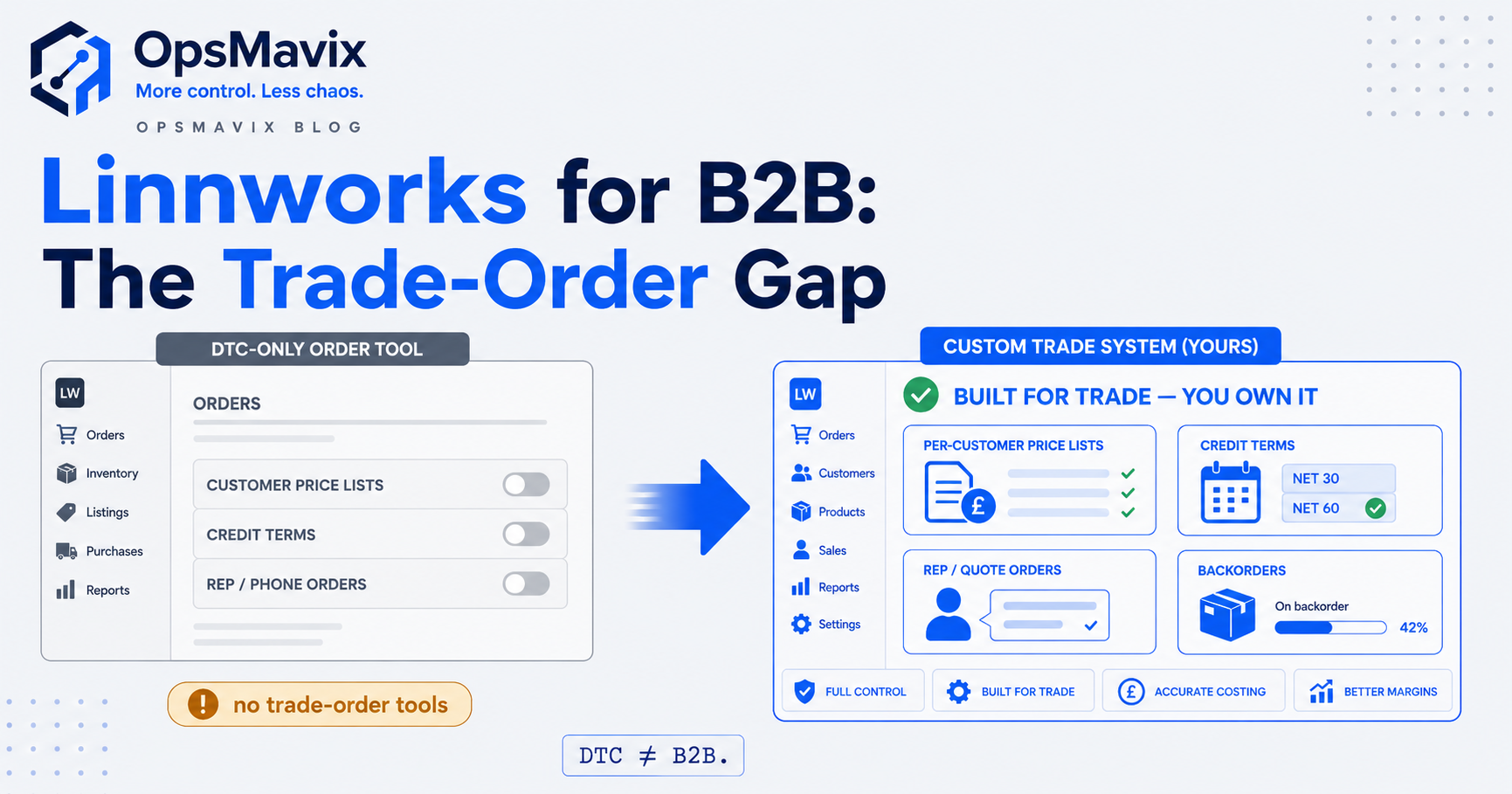
Using Linnworks for B2B or wholesale works right up to the point where your orders stop looking like consumer orders — and then the gaps show. Linnworks is a capable UK-born multichannel platform: it pulls orders from marketplaces and webstores into one dashboard, syncs stock across channels, and automates pick-and-ship. That machine is built around a specific shape of order — a consumer buys a few units, pays up front, ships to their door. Trade orders don’t look like that, and the further you sit from the consumer template, the more you feel the tool bending the wrong way.
This post is about that gap specifically — the parts of wholesale a direct-to-consumer platform handles thinly or not at all. It’s not a case for ripping Linnworks out; if you’re a DTC seller who takes the occasional trade order, it’s fine. But if per-customer pricing, credit terms, rep-entered orders and backorders are your everyday reality, you’re running a wholesale business on software designed for a shop. We won’t re-teach what a proper trade OMS is — B2B order management for wholesalers covers that ground — this is the Linnworks-shaped version of the question.
Key Takeaways
- Linnworks is DTC-first. Its order engine is built around consumer orders pulled from 100+ marketplaces and webstores, paid up front and shipped as parcels — a strong fit for that job.
- Trade orders break the template. Wholesale runs on per-customer price lists, credit terms, minimum-order rules, rep and phone orders, and part-shipped backorders — the parts a DTC platform handles thinly or not at all.
- Channel pricing isn’t customer pricing. Linnworks holds prices per channel or subsource, not a negotiated price list per trade account — which is where most wholesale margin lives.
- The rep and phone order is the tell. When orders arrive by call, email or a rep’s visit against agreed terms, not a tidy feed, you end up re-keying and patching with spreadsheets.
- Part-ship’s trade layer is the gap, not the split itself. Linnworks can ship part of an order now and keep the rest as an open order that stock allocates against — but invoicing only for what went, moving the account’s balance and chasing what’s owed is the half a DTC flow leaves out.
- Pure DTC ecommerce → keep Linnworks. The gap only matters if trade selling is your normal operation, not an occasional exception.
Where Linnworks Actually Comes From
Linnworks describes itself as a platform for omnichannel retailers, and the product bears that out. It connects to 100+ channels — Amazon, eBay, Shopify, Walmart, TikTok Shop, BigCommerce and dozens more — drops every order into one dashboard, and lets you create, edit or cancel orders and route them with rules-based automation to the right stock location, carrier and packaging. Stock stays synced across channels so you don’t oversell, and dozens of shipping integrations handle labels and dispatch. For a business selling to consumers across several storefronts, that’s a real job done well.
Notice the shape underneath, though. Every one of those channels is a consumer channel, and the order it produces is a consumer order: known price, paid at checkout, one shipment to one address — and the automation, stock sync and carrier routing all assume that shape. Linnworks does have some B2B plumbing — an order property to flag business shipments, connections to a few trade-leaning marketplaces — but the core is tuned for the parcel-to-a-doorstep world. That’s not a criticism; it’s what the tool was built to be excellent at.
What a Trade Order Actually Involves
Line up a consumer order and a trade order and they barely share a skeleton. A consumer order is a fixed price, paid now, shipped once. A trade order is a negotiated price that depends on who’s buying, often on credit against agreed terms, frequently under a minimum order value or quantity, and just as often only partly shippable today with the balance owed. None of that is exotic — it’s the daily mechanics of selling to other businesses.
That’s the gap in one sentence: a DTC platform assumes the order’s terms are already settled and identical for everyone, and a wholesale order is where the terms are the work. When the software has no native home for those facts — the price on account, the payment on 30 days, the quantity under a floor you’ve set — they migrate into someone’s head, a side-spreadsheet, or an order’s notes field, which is exactly where trade operations start leaking.
Customer Price Lists and Terms — the Core Mismatch
This is the sharpest edge. Linnworks can hold more than one price for a SKU — channel-specific or subsource-specific prices, so the same item lists at different numbers on different storefronts. That’s genuinely useful for multichannel DTC. It is not the same thing as a per-customer price list, and conflating the two is where a lot of wholesalers get caught. A trade business doesn’t price by channel; it prices by account — this stockist on tier B, that distributor on an agreed discount off list, a key account on a bespoke matrix.
Modelling that on channel-level pricing means either inventing a “channel” per customer (which doesn’t scale past a handful) or applying the right price by hand and hoping nobody fat-fingers it. Add credit terms — who’s on account, what limit, how many days, who’s over and should be on stop — and you’re describing a layer of commercial logic a DTC order platform simply doesn’t carry. The usual patch is a pricing spreadsheet the desk cross-references before keying: slow, error-prone, detached from the system meant to be the source of truth. A wholesale order management system treats the price list and terms as first-class — the account carries its own pricing and credit position, and the correct number appears because the system knows who’s buying.
Rep, Phone and Quote Orders — Intake the Feed Doesn’t Cover
Linnworks is built to receive orders — they arrive as a structured feed from a marketplace or webstore and flow into the dashboard clean. Wholesale intake often works the other way round: a rep places an order from a visit, a buyer phones or emails it in, a quote gets built, negotiated, then converted when it’s accepted. You can create orders manually in Linnworks and bulk-load them by CSV, so trade intake isn’t impossible — it’s just manual, unvalidated against account-specific rules, and untethered from the quote-to-order flow a trade desk runs.
The practical cost is re-keying and its errors. An order taken on a call or off an emailed PO gets typed in by hand, against a price the operator has to look up, with no quote history and no check the customer’s within terms — every one a place a wrong item number, quantity or price slips through. A system built for trade starts from the order the way it really arrives, validates it against the account’s catalogue and pricing at entry, and carries the quote through to order without a second keying. That intake problem, and its upstream mirror when you’re the one placing purchase orders, is worth reading alongside supplier order management software.
Backorders and Part-Shipment — the Fulfilment Gap
Consumer fulfilment is binary: the item’s in stock and ships, or it isn’t and the order waits or cancels. Trade fulfilment lives in the middle. A customer orders ten lines; you have eight in full, one partial, one out. The wholesale answer is almost never “hold the whole order” — it’s ship what you can now, keep the rest open, invoice for what actually went, and track the balance so it follows automatically when stock lands. That’s a normal Tuesday in distribution. Linnworks can handle the mechanical half of this: it supports splitting a despatch to ship part of an order now and keep the remainder as an open order, and it can allocate incoming stock to those open orders by priority. What it doesn’t carry is the trade layer wrapped around the split — invoicing only for what actually shipped, moving the customer’s credit position and outstanding balance as the order part-fills, and chasing what’s owed.
When the tool splits the despatch but leaves the commercial side untracked, the outstanding balance falls out of the system onto a spreadsheet or a memory — which is how a part-filled order’s invoicing drifts from what actually shipped, or the balance owed against the account gets forgotten. Invoicing has to match what shipped, not what was ordered, and the account’s credit position has to move as each part-shipment goes out. Getting this right is a system property, not a setting you toggle — the deeper mechanics are in backorder management. The point here is narrow: if part-shipping against trade accounts is routine for you, you need software that models the commercial side of the split, not just the despatch.
What a System Shaped to Trade Orders Does Instead
Put the gaps together and the shape of the right tool falls out. It carries the customer as the centre of gravity, not the channel: each account holds its own price list, credit limit and terms, so the correct price and credit position are known the moment you pick the customer — no lookup, no spreadsheet cross-check. It takes orders the way they actually arrive and validates each line against that account’s real catalogue and pricing at entry, so wrong items, quantities and prices are refused rather than discovered later. It enforces your minimum-order rules. And it treats fulfilment as the messy trade reality it is: part-ship, backorder, invoice for what went, chase the balance, all as live states rather than notes.
Crucially it does all that against one true stock figure, so trade and DTC orders draw from the same pool and you don’t oversell across the two. This isn’t a heavier Linnworks or a cheaper clone — it’s a different centre of gravity: Linnworks organises the world by channel and optimises the parcel; a trade system organises by customer and optimises the account. Where you sell to businesses on terms, that difference is the whole game — and it’s why a right-sized custom inventory and order system tends to fit a wholesaler where a DTC platform keeps asking you to bend.
Linnworks vs a Trade-Shaped System
| Linnworks (DTC multichannel platform) | Trade-shaped order system | |
|---|---|---|
| Built around | The channel and the parcel | The customer and the account |
| Order intake | Structured marketplace/webstore feeds | Rep, phone, email, portal — validated at entry |
| Pricing | Per channel / subsource | Per-customer price list, tiers, agreed rates |
| Credit terms | Not a native layer | Limit, terms and stop-list on the account |
| Minimum orders | No native rule | Enforced where you set them |
| Backorder / part-ship | Splits the despatch; no trade layer around it | Live state — ship, hold, invoice for what went, chase balance |
| Ownership | Rented, per-order flow | Fixed build (£3k–£25k range), you own it |
| Best fit | Pure DTC across marketplaces | Wholesale/trade as the everyday operation |
When Linnworks Is Still the Right Call (the honest bit)
Be fair to the tool: for a lot of businesses Linnworks is exactly right, and switching would be a self-inflicted leak. If you sell to consumers across marketplaces and a webstore, take payment at checkout, ship parcels, and trade orders are a rare exception you handle by hand, Linnworks does its core job well and a custom build would be reinventing a wheel that already turns. Occasional wholesale on a mostly-DTC business is a manual-entry annoyance, not a structural mismatch.
The line is whether trade selling is your normal operation or your exception. When most orders come on account against negotiated prices, when reps and the phone are your real intake, when credit terms and minimum orders govern who can buy what, and when part-ship and backorder are a daily fact — you’ve stopped being a DTC seller who dabbles in trade and become a wholesaler running on the wrong shape of software. The honest question isn’t whether Linnworks can take a trade order — it can, awkwardly — it’s how much that awkwardness costs you every month against building the thing that fits.
FAQ
Is Linnworks good for B2B and wholesale?
Linnworks is built for direct-to-consumer multichannel selling — pulling orders from marketplaces and webstores into one dashboard, syncing stock and automating pick-and-ship. It can take a business order and hold different prices per channel, so light wholesale is workable. It isn’t built around the core mechanics of trade — per-customer price lists, credit terms, rep and quote orders, minimum-order rules and backorders — so a business whose everyday operation is B2B ends up patching those gaps with manual entry and spreadsheets.
Can Linnworks handle customer-specific price lists?
Not natively in the way wholesale needs. Linnworks supports channel-specific and subsource-specific prices — different numbers for the same SKU on different storefronts — which is not the same as a negotiated price list held per trade account. Modelling per-customer pricing on channel-level pricing doesn’t scale past a handful of accounts, so most wholesalers apply the right price by hand against a separate spreadsheet. A trade-focused system holds the price list and credit terms on the customer, so the correct price appears because the system knows who’s buying.
Does Linnworks do credit terms and backorders?
Linnworks can split a despatch — shipping part of an order now and keeping the rest as an open order that incoming stock allocates against by priority. What its order engine doesn’t carry is the trade layer around that split: account credit limits, payment terms and stop-lists, and invoicing that tracks only what actually shipped while the outstanding balance moves against the account. Those are everyday states in distribution, and when the software doesn’t model the commercial side of a part-shipment it falls onto spreadsheets and memory — where the balance owed gets forgotten or the invoice drifts from what actually went.
Should I switch off Linnworks for a wholesale system?
Only if trade is your normal operation, not an exception. If you’re a DTC seller taking the occasional trade order, keep Linnworks — switching would be a leak of its own. If most of your orders are on account, priced per customer, taken by reps or phone, and routinely part-shipped, you’re running a wholesale business on consumer-order software, and a system shaped to trade orders will fit where the platform keeps bending the wrong way.
How OpsMavix Can Help
OpsMavix builds right-sized wholesale order management systems for businesses that have outgrown a DTC platform but aren’t ready for — or don’t want — a full ERP. Instead of bending a consumer-order engine to trade selling, we build the flow around how you actually sell: each customer carrying its own price list, credit limit and terms; orders taken the way they arrive and validated at entry so wrong items and prices can’t slip through; minimum-order rules where you set them; and part-ship, backorder and correct invoicing as live states, all against one true stock figure so trade and DTC orders never oversell each other. You own it outright — no per-order creep, nothing a vendor can switch off.
If Linnworks is fighting you every time a trade order comes in — the price lookups, the re-keyed phone orders, the backorders living on a spreadsheet — that friction is a leak with a number on it. Book a Free Operations Leak Audit and we’ll map exactly where your trade orders cost you today, what it’s worth to close, and whether a system shaped to how you sell is the honest fit for the business you’re actually running.
Keep reading
Getting value from OpsMavix? Add us as a preferred source on Google — you'll see more of our operations content in your AI Overviews, AI Mode and Search.