
Fulfillor vs Mintsoft: Which 3PL Fulfilment Platform Fits How You Actually Run?
Fulfillor and Mintsoft both run multi-client 3PL fulfilment, both price on monthly order volume, and both cover inventory, orders, pick-pack-ship and reporting. Fulfillor is the billing-and-SLA-first specialist; Mintsoft rides The Access Group's scale. The right pick depends on how your billing rules, integrations, and reporting actually behave. This breaks down where each fits and where each hits a wall.
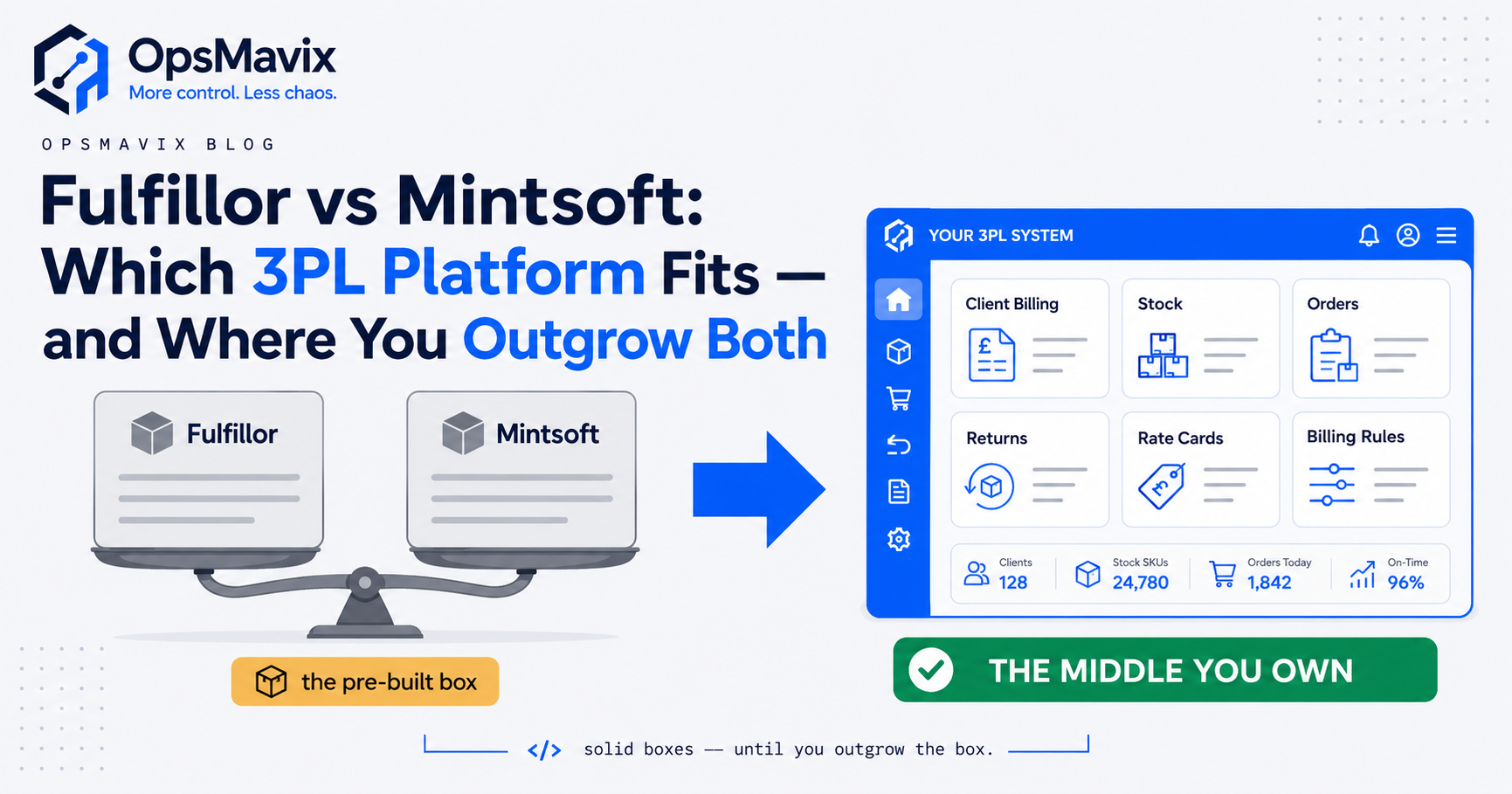
Fulfillor vs Mintsoft comes down to a single question: do you want a 3PL-native platform that leads with client billing and SLAs (Fulfillor), or one that rides the weight of a large UK software group (Mintsoft, owned by The Access Group since 2020)? Both run multi-client warehouses. Both price on monthly order volume. Both cover inventory, orders, pick-pack-ship, and reporting, and each advertises a large integration library. The difference is where they put their weight, and which one bends the way your operation already moves.
If you run a fulfilment house or a growing 3PL, you’re not really comparing feature lists. You’re asking which tool stops you re-keying orders, mis-billing clients, and explaining stock discrepancies at month-end. That’s the lens this uses.
Key Takeaways
- Fulfillor is 3PL-first by design. Multi-client inventory, SLA-based pick/pack/ship, and activity-based client billing sit at the centre. Pricing is usage-based (order volume, warehouse size, clients, users) and quote-only — no public sticker price.
- Mintsoft is order-volume priced and Access-backed. Public tiers start from £159/month for ecommerce brands and wholesalers and £375/month for 3PLs, scaling with order count, and it inherits the reliability (and the roadmap politics) of a large software group.
- Both cap out at “the tool’s model.” You configure billing rules and order rules inside their boxes. When your actual process needs a rule the box doesn’t offer, you work around it.
- Both price on order volume, then diverge at the edges. Mintsoft bundles unlimited browser users and meters advanced automation as paid modules; Fulfillor bundles the automation but meters extra user licences on top of the volume tier. Do the arithmetic on your real numbers, not the headline price.
- Integrations are table stakes now. A big connector count sounds decisive until the one channel you need is the one on neither list.
- A third option exists. For some operators the answer is neither — it’s one system shaped to how you run, that you own outright.
What Fulfillor Actually Is
Fulfillor is a cloud 3PL warehouse management system built for multi-client fulfilment. It keeps each client’s inventory, workflows, and billing separate while running everything from one connected system: barcode picking, packing, shipping, returns, client billing, and reporting.
The standout is that billing and SLAs aren’t bolted on. They’re the spine. Client-specific fulfilment rules, cut-off times, and per-carrier logic drive the pick-pack-ship flow, and invoices generate off actual storage, handling, and fulfilment activity rather than a flat monthly guess.
Fulfillor doesn’t publish a public price. It’s usage-based, quoted on warehouse size, monthly order volume, client count and users, with 3PL tiers banded by monthly orders (roughly up to 3,000, up to 5,000, up to 10,000, and 10,000-plus). Extra user licences are metered on top of the tier, so a lean team moving high volume can pay less than a large team of light-touch users.
What Mintsoft Actually Is
Mintsoft is The Access Group’s cloud order and warehouse management system, aimed at ecommerce brands, retailers, 3PLs, and fulfilment houses. It brings inventory, order processing, picking and packing, shipping integrations, and billing into one interface, and you can run multiple warehouses and clients from a single login.
Ownership is the quiet advantage. Access acquired Mintsoft in 2020, so you’re buying into a large, established UK software provider with the stability that implies. That’s real reassurance if you’ve been burned by a small vendor going quiet.
Pricing is order-volume based and, unlike Fulfillor, published: from £159/month for ecommerce brands and wholesalers, from £375/month for 3PLs, with tiers by order count and business type and add-on modules for order rules, batch scheduling, white-labelling, and advanced analytics. Core plans bundle unlimited browser users. The important nuance: the sticker price is the start, not the finish. Advanced automation often lives in the paid modules.
Pricing: Order Volume, Then the Edges
This is the part most comparisons get wrong. It’s tempting to frame it as per-user versus per-order, but both platforms price on monthly order volume at the core. The real divergence is at the edges, and it still moves the bill.
- Mintsoft bundles unlimited browser users. Headcount is free; you pay as order volume climbs the tiers, and for the automation modules you switch on.
- Fulfillor bundles the automation but meters user licences. Extra seats stack on top of the volume tier, so a lean team is cheap and a big floor team is not.
- Spiky seasonal 3PL: both flex with order-volume tiers at peak; watch the module and per-user add-ons that ride along with the growth.
Run your own numbers. A 3PL doing 40,000 orders a month with six users lands in a completely different place than one doing 8,000 orders with twenty — and which platform wins depends as much on your module and seat mix as on the headline tier.
Multi-Client Billing: Where 3PLs Live or Die
Both handle multi-client billing. The question is how far the rules bend before they break.
A wholesale-and-fulfilment operator described the classic trap: one client wants storage billed per pallet, another per shelf-metre, a third per SKU with a minimum charge, and a fourth negotiated a bespoke handling rate that resets each quarter. Standard billing engines cover the first two cleanly, fudge the third, and quietly can’t do the fourth without a spreadsheet living alongside the software.
Fulfillor leans hardest into activity-based billing, so it clears more of these cases natively. Mintsoft covers the common patterns and pushes the exotic ones into modules or workarounds. Neither escapes the ceiling entirely — a configurable rule engine is still a box, and 3PL commercial terms love to live outside boxes.
Integrations and the One Channel That Isn’t There
Both advertise big integration libraries across sales channels, marketplaces, couriers, and accounting — Fulfillor 150-plus, Mintsoft a comparable set. For most operators that’s plenty. The failure mode is always the same: the one channel, courier, or ERP you depend on is the one neither platform connects to cleanly, and you end up with a CSV import ritual or a paid custom connector.
Before you sign, list your actual endpoints — every marketplace, every carrier account, your accounting system, any client’s own portal — and check each against both. A count of 150 is meaningless if your critical five aren’t in it.
Where Both Hit Their Ceiling
Here’s the OpsMavix point of view, said plainly. Fulfillor and Mintsoft are both solid tools. If your operation fits the shape they assume, buy one and move on. You’ve not outgrown fulfilment software; you’ve just got to pick the box that matches your billing and volume.
The ceiling shows up when your process stops matching the tool’s model. It sounds like: “we run a second approval step Mintsoft can’t model,” or “our biggest client’s billing needs a rule Fulfillor doesn’t offer, so we patch it in Excel.” At that point you’re paying subscription fees and still doing manual admin the software was meant to kill. The leak didn’t close. It moved.
We put a rough number on that leak with operators: two people spending a morning each at month-end reconciling billing the platform couldn’t quite handle is roughly 8 hours a week of skilled admin, plus the mis-bills you only catch after a client complains. Over a year that’s real money quietly walking out the door while you pay for software.
Build vs Buy vs Own Your System
The honest take. If you’re an early-stage 3PL and your billing is simple, buy Mintsoft or Fulfillor. Off-the-shelf is faster and cheaper than anything built, and both are competent. Match the pricing model to your volume-and-headcount shape, check your integrations, and go.
The third path is for operators who’ve already hit the ceiling: instead of a fifth billing workaround, one system shaped to how you actually run — your real billing rules, your approval steps, your reporting, connected to the channels you actually use, and you own it outright. Not an ERP. Not a cheaper Mintsoft clone. The practical layer that sits between the spreadsheet you’ve outgrown and the ERP you don’t want, built around your process instead of forcing your process into someone else’s box.
Worth reading next: the wider Mintsoft competitors landscape, a closer look at Fulfillor alternatives, and how Mintsoft handles 3PL specifically.
Pick the tool if the box fits. Ask harder questions the day it stops fitting.
Keep reading
Getting value from OpsMavix? Add us as a preferred source on Google — you'll see more of our operations content in your AI Overviews, AI Mode and Search.