Linnworks vs a Custom System: Buy the Platform or Build the Fit
Linnworks vs a custom system isn't a contest with a winner — it's a trade-off between the breadth and speed-to-start of a SaaS platform and the exact fit and ownership of a system built around your flow. Here's what each side genuinely wins on, the real cost and risk over time, the price of bending to the tool, and a checklist to decide honestly.
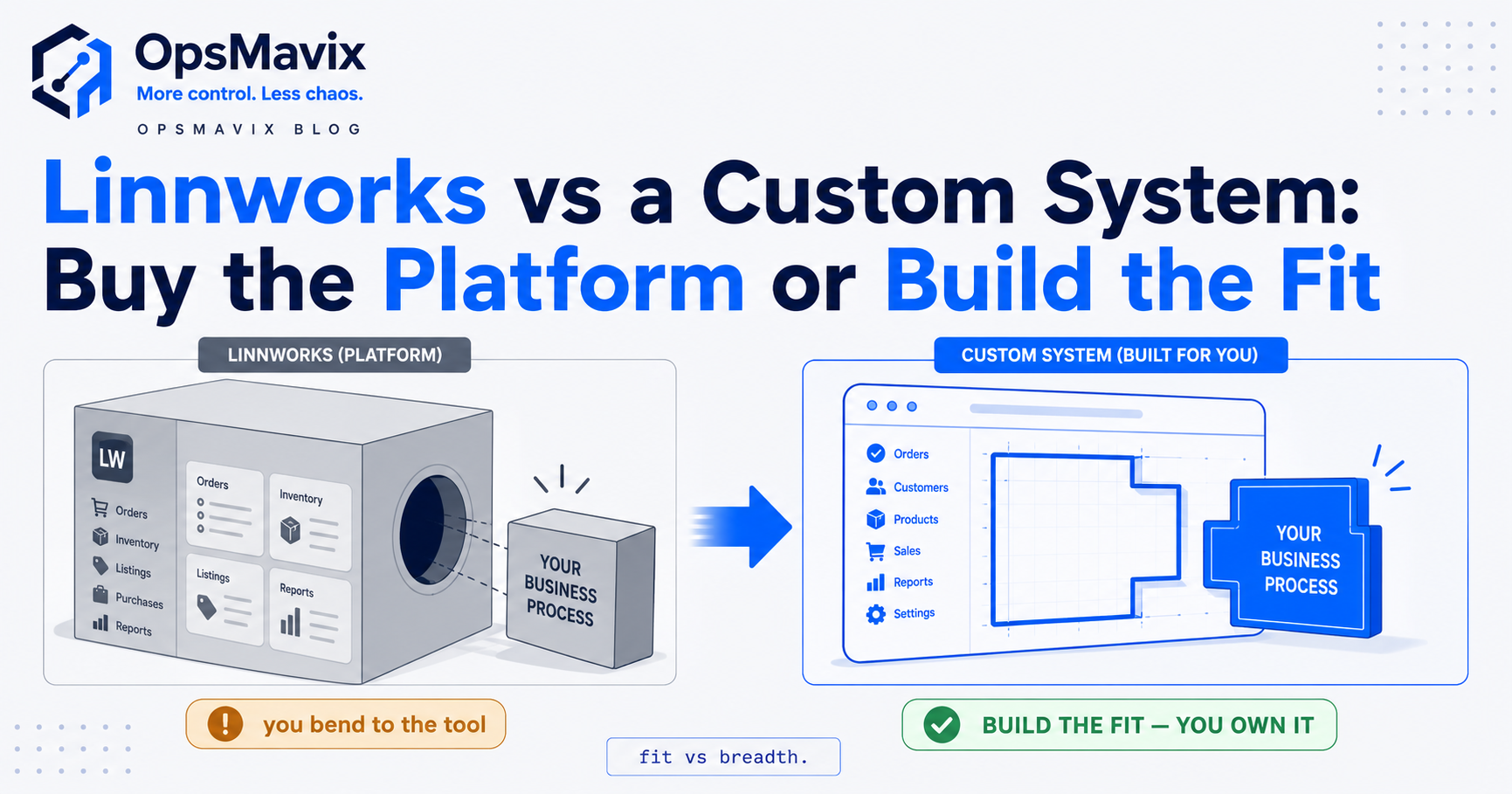
Linnworks vs a custom system is a buy-versus-build decision, and the honest answer is that neither wins in general — it depends entirely on the shape of your operation. Linnworks is a UK multichannel inventory and order management platform: it connects to a large range of marketplaces, syncs stock across them, routes and dispatches orders, and gives you that in a working product you can run in weeks. A custom system does the opposite trade — instead of breadth you switch on, you get a smaller set of things built to match exactly how you take orders and move stock, that you own outright. This post is the framework for choosing between the two, not the “we outgrew it” story.
If your question is specifically “I’ve hit the ceiling on Linnworks, what next”, that’s a different post — the Linnworks alternative guide covers the outgrowing case. Here we stay upstream of that: you’re weighing a platform you could buy against a system you could build, and you want the trade-offs laid out fairly before you commit a budget to either. So we’ll be even-handed — there are businesses that should buy Linnworks and would be wasting money building anything, and we’ll say who they are.
Key Takeaways
- Linnworks vs custom is a fit-versus-breadth trade, not a quality contest: a platform gives you many features fast; a custom system gives you the few features that match your exact flow, owned by you.
- SaaS wins on speed, breadth and shared cost — you’re live in weeks, you get channel connectors and updates maintained for you, and the R&D is split across thousands of customers.
- Custom wins on exact fit and ownership — no process you bend to the tool, no per-order pricing that taxes growth, and nothing a vendor can reprice or retire under you.
- The real comparison is total cost and risk over three years, not the first invoice: subscription plus add-ons plus the workaround tax, versus a fixed build you then run cheaply.
- The hidden cost of buying is bending to the tool — every process the platform can’t hold becomes a side-spreadsheet, and that tax is easy to miss when you’re comparing headline prices.
- The honest default is buy SaaS when your needs are standard and you’ve no appetite to own software; build only when the fit gap is real and recurring.
The Real Question: Fit vs Breadth
Most buy-versus-build arguments go wrong because they compare features, and on features a mature platform almost always wins — Linnworks connects to a large range of channels, handles order routing and dispatch, and ships a long list of things a first custom build won’t have on day one. If the contest is “who has more boxes ticked”, the platform takes it. But that’s the wrong contest: the question isn’t who has more, it’s who has yours.
A platform is built for the general case — the shape most of its customers share — earning its breadth by being broad, not precise about your operation. A custom system is the reverse: narrow by design, built around the specific way you take orders and move stock. So the real decision is whether your operation is close enough to the general case that breadth serves you, or different enough that you need precision the platform can’t give.
What SaaS Genuinely Wins On
Be fair to the platform, because it wins on real things. First, speed-to-start: you can be live on Linnworks in weeks, connected to your channels and dispatching orders, with none of the lead time a build needs. When the pain is “I need this working this quarter”, nothing custom competes with a product that already exists. Second, breadth maintained for you: a platform carries a large catalogue of channel connectors and keeps them working as those marketplaces change their APIs underneath — real, ongoing work you’d otherwise carry yourself. Third, shared cost: development is paid for across its whole customer base, so you rent a slice of engineering far larger than you’d fund alone — a supported product with a roadmap and other users, versus a build that has to prove itself. For an operation that fits the template, it’s the sensible buy.
What a Custom System Genuinely Wins On
The custom side wins on two things a platform structurally can’t give: exact fit and ownership. Exact fit means the system is shaped to how you actually operate — the kit that consumes several components the moment it’s despatched, the stock transfer between two warehouses that has to stay in sync at both ends, the consignment stock sitting at a customer’s site but still on your books, the trade order priced in a different currency. On a platform each of those is a workaround or an unsupported case; in a system built for you they’re just how it works. That’s the core of a custom inventory system — not more features than the platform, but the specific ones your operation needs and nothing you bend to.
Ownership is the other half. A platform is rented — priced by order volume, so the better you do the more you pay, and a vendor can change the price, terms or product. A custom system is a fixed build you own: no per-order creep, nothing anyone can reprice or retire beneath you. For a business whose order desk is the operation, that control is worth real money — renting the thing your business runs on is a dependency on someone else’s terms.
Total Cost and Risk Over Time
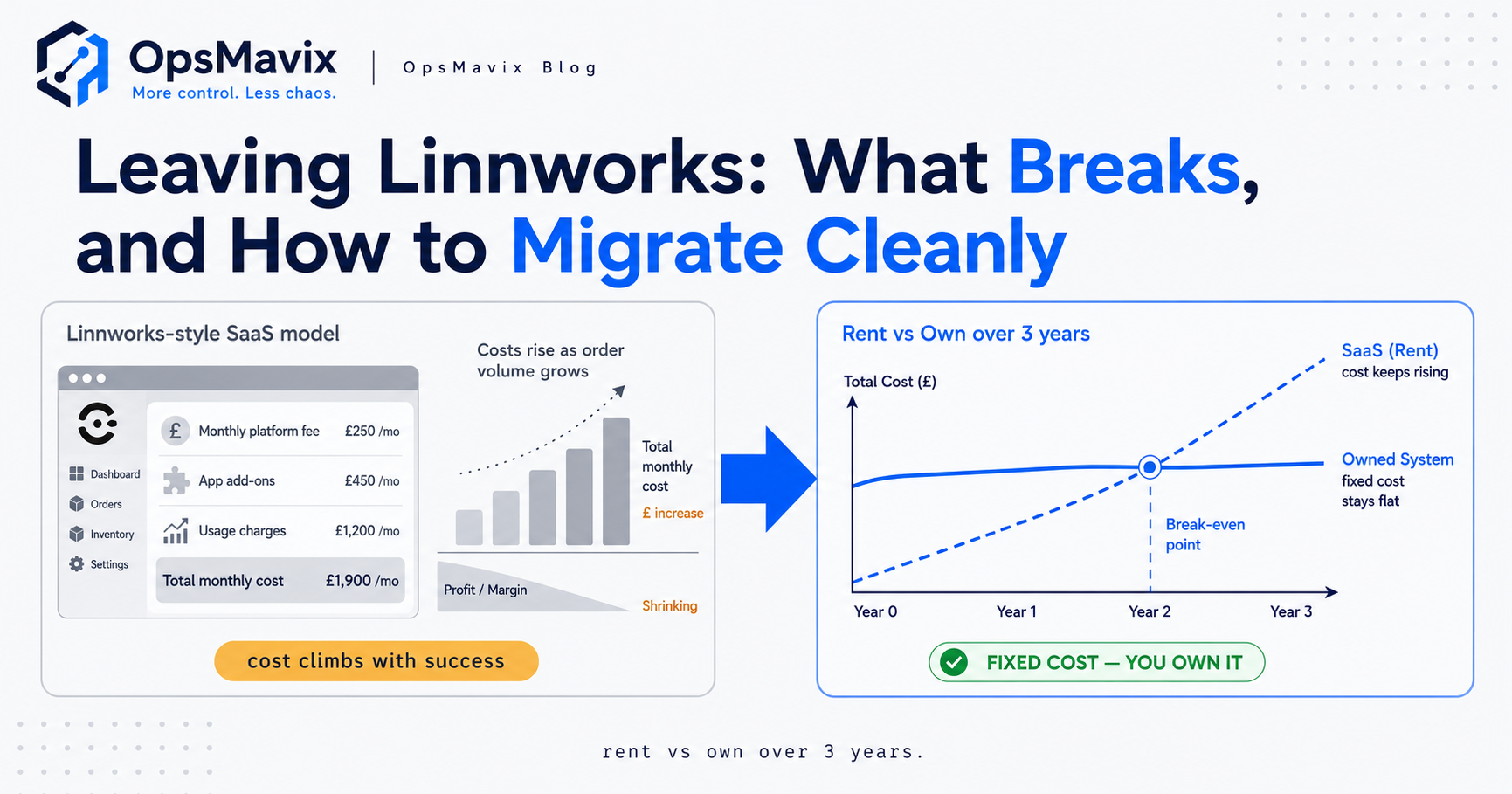
The comparison that misleads people is the first invoice, because that’s the one moment SaaS is unambiguously cheaper — a subscription you start next week always beats a build you fund up front. The honest comparison is total cost and risk over about three years. On the buy side: the subscription, priced on order volume so it climbs as you grow; the add-on modules for functions outside the core plan; the onboarding cost; and the quiet workaround tax of every spreadsheet you keep to cover what the platform can’t hold. On the build side: a larger up-front cost, then a much smaller running cost, and no per-order meter.
Neither profile is universally cheaper — that’s the point. Low, predictable volume with standard needs keeps the subscription cheap and the build hard to justify; high or fast-growing volume with real fit gaps pushes the subscription up and the workaround tax with it, and that’s where a fixed-cost owned system starts winning. The risk sides differ too: the platform’s is price rises and vendor decisions you don’t control; the build’s is delivery and maintenance, which belongs on the scale honestly.
The Cost of Bending to the Tool
This is the cost most buy-versus-build comparisons miss, because it doesn’t show up as a line item. When you buy a platform you don’t just adopt its features — you adopt its assumptions about how your business runs. Where they match, you get value for free. Where they don’t, you have three choices: change your process to suit the tool, pay for a workaround, or keep a spreadsheet on the side. All three cost something, and the spreadsheet is the sneakiest — it looks free while quietly reintroducing the drift and re-keying you bought the platform to remove.
The tell is simple: count the side-spreadsheets. If your team runs the platform plus a handful of workbooks beside it — one for price tiers, one for the odd order channel, one to reconcile a drifting stock figure — you’re paying for software twice and carrying the fit gap as unpaid labour. A little of that is normal. A lot of it, month after month, is the signal that fit is starting to outweigh breadth.
A Decision Checklist
You can settle most of this by answering six questions honestly. First: is your operation close to the standard multichannel shape, or full of specifics a template can’t hold? Standard leans buy; specific leans build. Second: what’s your order volume trajectory — flat and predictable, or growing fast? Flat leans buy; fast growth makes per-order pricing bite and leans build. Third: how many side-spreadsheets are you already running to cover gaps? Few leans buy; many leans build.
Fourth: do you have any appetite to own software — a budget for a build and someone to maintain it — or need it fully off your plate? No appetite leans buy, firmly. Fifth: how much does vendor control worry you — price rises, terms, a product decision you can’t influence? Comfortable leans buy; exposed leans build. Sixth: how central is this to the business — a supporting tool, or the operation itself? Supporting leans buy; core leans build. Count the leans. It isn’t arithmetic that produces a verdict, but if you’re stacked on one side you have your answer — and if you’re genuinely split, that usually means a hybrid.
Hybrid Paths: You Don’t Have to Pick One Side
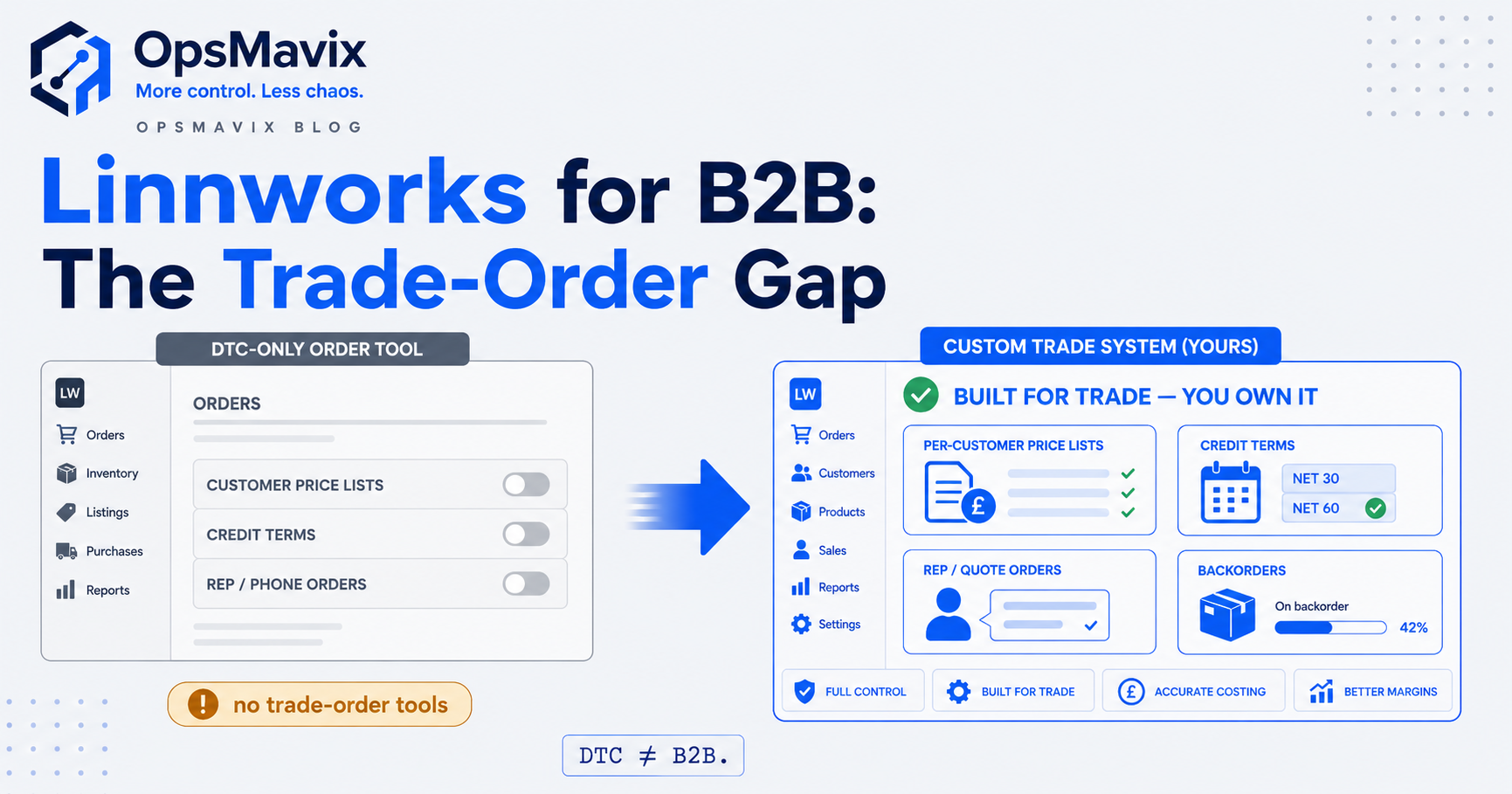
Buy-versus-build is rarely all-or-nothing, and treating it that way causes bad decisions both ways. The common hybrid is to keep the platform for what it’s genuinely good at — the broad, well-maintained channel connections — and build a custom layer only for the part that doesn’t fit. If Linnworks handles your DTC marketplace flow cleanly but your wholesale or trade orders are the mess, build the trade-order system and let the platform keep doing the DTC job. You buy the breadth and build only the fit gap, instead of paying to rebuild what already works.
The other hybrid is sequencing: start on the platform because you need to be live now, and build the custom system later, once real use has shown you exactly where the fit gaps are. The mistake at the other extreme is a full custom rebuild of things the platform does perfectly well — that wastes money as surely as bending your whole operation to a tool does, and it’s the fit-worship version of the same error. It’s the same middle ground that separates a focused operational system from a full ERP: build the part that matters, buy or keep the part that doesn’t, and refuse to pay for either one twice.
When You Should Just Buy Linnworks (the Honest Bit)
Here’s the plain version. If your operation fits the standard multichannel shape — orders arrive as clean marketplace feeds, pricing is straightforward, stock rules are ordinary — your volume is predictable rather than exploding, and you have no appetite to own and maintain software, then buy Linnworks and build nothing. You’d be paying a build cost to reproduce breadth you can rent, and carrying delivery risk to solve a problem you don’t have.
Building only makes sense when the fit gap is real, recurring and costing you — when your specifics are the normal case not the edge case, the side-spreadsheets have become a second system, and per-order pricing is taxing growth you’d rather keep. The line isn’t ideology about buy or build; it’s an honest read of how far your operation sits from the template — which, if you’re not sure, is exactly what an audit measures. If you’re weighing this against a full suite rather than a point tool, operational ERP is the wider frame for the same decision.
FAQ
Is a custom system better than Linnworks?
Neither is better in general — it’s a fit-versus-breadth trade. Linnworks gives you a large catalogue of channel connectors and order management in a working product you run in weeks, maintained for you. A custom system gives you a smaller set of features shaped to exactly how you take orders and move stock, owned outright with no per-order pricing. If your operation fits the standard multichannel shape, the platform is the better buy. If your specifics are the normal case rather than the edge case, the custom fit wins.
Is a custom system more expensive than Linnworks?
On the first invoice, always — a subscription you can start next week beats a build you fund up front. The honest comparison is total cost over about three years: subscription (priced on order volume, so it climbs as you grow) plus add-on modules plus onboarding plus the workaround tax of side-spreadsheets, versus a larger one-off build you then run cheaply. Low, predictable volume keeps the platform cheaper; high or fast-growing volume with real fit gaps is where an owned system starts winning the three-year maths.
Can I keep Linnworks and build a custom system too?
Yes, and it’s often the smartest route. The common hybrid is to keep the platform for the broad channel connections it handles well and build a custom layer only for the part that doesn’t fit — the trade orders, the bespoke pricing, the odd intake channel. You buy the breadth and build only the fit gap.
How OpsMavix Can Help
OpsMavix builds right-sized inventory and order systems for businesses caught in exactly this decision — a platform that does most of the job but fights the specifics, and a growing pile of spreadsheets covering the gap. We don’t sell a cheaper Linnworks clone, and we won’t tell you to rip out a platform that fits. What we build is the part shaped to your operation: orders entered once off whatever they arrive on, one true stock figure every channel reads from, your real pricing and order rules built into the flow instead of a workbook — owned outright, with no per-order meter. Where a platform is the right home for your standard channels, we build alongside it, not on top of it.
If you’re weighing Linnworks against building your own and want the trade-off measured rather than argued, start with the number. Book a Free Operations Leak Audit and we’ll map where a rented platform costs you today, where the fit gaps actually are, and whether buy, build or a hybrid is the honest fit for how you run now — including when the answer is “keep the platform”.
Keep reading
Getting value from OpsMavix? Add us as a preferred source on Google — you'll see more of our operations content in your AI Overviews, AI Mode and Search.