
The Extensiv Alternative: 3PL Software That Fits Your Model
The best Extensiv alternative is usually not another warehouse platform but one operations system shaped to how your 3PL actually bills and moves stock. Extensiv is a capable 3PL and order platform, yet its usage-based meter and fixed assumptions strain when your client model doesn't match its mould.
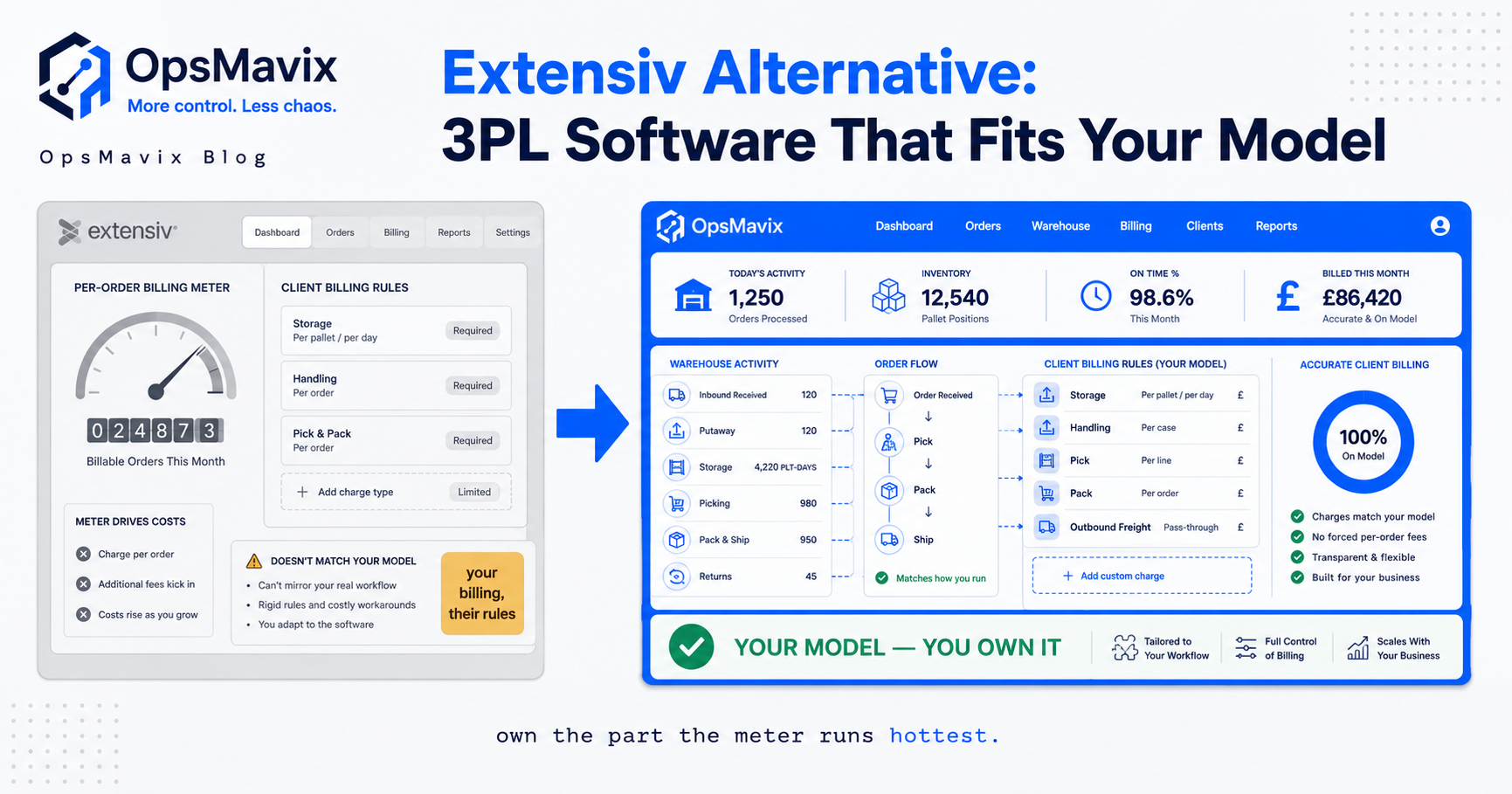
The best Extensiv alternative is usually not another 3PL platform at all. It’s one owned operations system shaped to how your warehouse actually runs and, just as importantly, how you actually bill your clients. Extensiv is a genuinely capable warehouse and order management platform for third-party logistics providers and high-volume brands. But if you’re searching for a replacement, the real question isn’t which competing tool has a longer feature list; it’s whether you need another packaged product or a system that models your operation instead of forcing your operation to model the product.
That distinction matters because most people hunting for an Extensiv alternative aren’t unhappy with what Extensiv does. They’re unhappy that their client-billing model has to bend to the platform’s rules, that they’re paying for a meter that never stops as volume climbs, and that they still drop into a spreadsheet to answer the one billing or throughput question the software can’t. This is an honest look at where Extensiv earns its place, where it hits a ceiling, and what the right-sized middle looks like.
Key Takeaways
- Extensiv is a 3PL warehouse and order platform, not a whole-business ERP. It handles multi-client warehousing, order routing, and integrations well, and it’s aimed squarely at 3PLs and high-volume sellers.
- The lineage is worth knowing: Extensiv is the 2022 rebrand of 3PL Central, formed after it brought together 3PL Central, Skubana, Scout, and CartRover into one platform family.
- Pricing is quote-based and usage-driven. Extensiv doesn’t publish sterling figures; the model scales with volume and connected modules, so the meter tends to climb as you grow.
- The real ceiling is fit, not features. A packaged platform assumes a standard billing and fulfilment shape, and the friction shows up where your 3PL model is non-standard.
- The middle option is a system you own: not an ERP, not a cheaper Extensiv clone, but software shaped to your actual client contracts and warehouse flow.
- Build-vs-buy is a fit decision, not a cost decision. Buy when your model is conventional; own a system when the workarounds are the operation.
What Extensiv Actually Is
Extensiv is cloud-based warehouse and order management software built for third-party logistics providers and the brands that sell through them. It runs multi-client warehousing, inbound and outbound order flow, inventory across locations, and a large network of pre-built integrations to marketplaces, carts, and carriers. The platform is the result of consolidation: 3PL Central rebranded as Extensiv in May 2022, after acquiring Skubana (multichannel order and inventory management), Scout (a warehouse mobility layer), and CartRover (order and marketplace integration) in 2021, folding them into a single supply-chain suite.
It’s a serious product with a real track record in the 3PL space, and it connects a broad network of warehouses and brands. If you run a fairly conventional 3PL, bill your clients in ways the platform already supports, and your fulfilment steps match its assumptions, Extensiv will very likely do the job it’s built for. This isn’t a hit piece. The question isn’t whether Extensiv is good at 3PL warehousing; it’s whether “3PL warehousing platform” is what your operation is actually short on.
Where Extensiv Hits Its Ceiling
The ceiling on any packaged platform is the same: it’s built for a standard process, and it’s excellent right up until your process isn’t standard. Extensiv assumes a particular shape to how you receive, store, allocate, pick, pack, and — critically for a 3PL — how you charge for all of it. When your business matches that shape, it’s smooth. When it doesn’t, the workarounds begin, and the workarounds are the tell.
For a 3PL, the sharpest edge is billing. Every client contract is a little different: storage by pallet on one account and by cubic volume on another, per-pick fees that step by band, receiving charges, special handling, seasonal minimums, value-added services that don’t map to any standard line item. When the platform’s billing model doesn’t quite fit a client’s terms, the “real” invoice gets rebuilt in a spreadsheet at month-end, and the software becomes the place the data lives rather than the place the money is calculated. That’s not an Extensiv-specific failing; it’s what happens to any off-the-shelf tool when your commercial model has genuinely non-standard steps.
The other ceiling is scope. Extensiv is strong inside the four walls of warehousing and order flow, but a 3PL is also a business: client onboarding, contract terms, margin per account, labour cost against revenue, and the reporting that ties throughput to profitability. Those questions sit outside the platform’s core, so they end up stitched together by hand. The leak isn’t a missing warehouse feature; it’s the gap between the warehouse system and everything the business needs to know about each client.
The Pricing Reality
Extensiv doesn’t publish sterling price lists. Its pricing is quote-based and, in practice, usage-driven — it scales with the volume you push through it and the modules and integrations you switch on. For a US-headquartered platform, expect quotes to originate in dollars and to be converted for a UK operation, so budget in approximate sterling and confirm the exact figure with them directly rather than trusting any number you read second-hand.
The important thing isn’t a specific monthly figure; it’s the shape of the model. Usage-based billing means the meter never really stops: as your order volume rises, so does the cost, whether or not you’ve unlocked any new capability you actually needed. That can be perfectly fair when your revenue rises in lockstep with volume. It becomes a problem when your margins are thin on high-volume, low-complexity accounts, because you’re paying the platform more precisely on the accounts where you can least afford it.
The honest framing is this: a subscription that scales with volume is predictable in direction but not in ceiling, and it’s rent. Over three or four years, a usage-based platform plus integrations and implementation adds up to a number that’s often in the same postcode as owning a system built around your operation — except at the end of the rental you still don’t own anything, and you’re still rebuilding the awkward client’s invoice by hand.
When Extensiv Is Genuinely the Right Choice
Sometimes buying it is the correct call, and it’s worth being straight about that. If you’re a 3PL with a fairly conventional billing model, if your clients’ terms map cleanly onto the platform’s line items, and if your fulfilment process matches its assumptions, Extensiv is a sensible buy. You’ll get a mature 3PL feature set, a broad integration network, and a warehouse layer you don’t have to build. Don’t pay to rebuild what you can rent when the rental genuinely fits.
The same is true if your constraint is speed. A packaged platform is live in weeks, and if your model is standard, configuring it properly usually beats replacing it. If your only real complaint about Extensiv is the price, an “alternative” search may be the wrong search — switching to a marginally cheaper 3PL platform moves a fit problem rather than fixing it.
The Right-Sized Middle: One Operations System
There’s a gap between “another 3PL platform” and “a full ERP”, and it’s where a lot of growing logistics operations actually belong. It’s the practical layer between a spreadsheet and an ERP: one system that models your warehousing, order flow, and — the part packaged tools keep getting wrong — your client billing, exactly the way your contracts are written.
This is the OpsMavix position, and it’s deliberately not “cheaper Extensiv”. It’s a right-sized operations system you own, shaped to the non-standard steps that break packaged tools: the pallet-and-volume split, the banded pick fees, the seasonal minimum, the margin-per-client report that has to be right the first time. The aim isn’t more modules. It’s zero workarounds, so nobody rebuilds an invoice in a spreadsheet at month-end. It’s the same principle behind a fully automated inventory system and a proper 3PL inventory management setup: stock, orders, and billing should move themselves, without a person patching the gaps between tools every morning.
For a wider view of the same buy-versus-build logic across the category, our read on warehouse management software and on Mintsoft competitors walks the same ground for adjacent fulfilment tooling. The pattern repeats across every vendor: the tool is fine; the question is fit.
The Honest Build-vs-Buy Take
Here’s the straight version. Buy Extensiv if your 3PL is conventional, your client terms fit its billing model, and your only real complaint is the meter. Own a system when the workarounds are the operation — when the spreadsheet is where the invoice actually gets built, when usage-based pricing punishes your thinnest-margin accounts, when the margin-per-client report is stitched together by hand every month.
The middle isn’t an ERP and it isn’t a cheaper Extensiv. It’s the practical layer in between, built around how you actually bill and move stock, and it’s the option most people searching for an “Extensiv alternative” didn’t know was on the table. If that sounds like your operation, the cheapest first step is simply finding out where the leak actually is.
Keep reading
Getting value from OpsMavix? Add us as a preferred source on Google — you'll see more of our operations content in your AI Overviews, AI Mode and Search.