
Linnworks Alternative: When to Stop Renting Order Software and Own the System
Linnworks is solid multichannel order software — until you're bending your process to fit it and paying more per order the better you do. This is the honest guide to when a Linnworks alternative makes sense, and why the real alternative to renting order software isn't another subscription but a system built around your exact flow that you own outright.
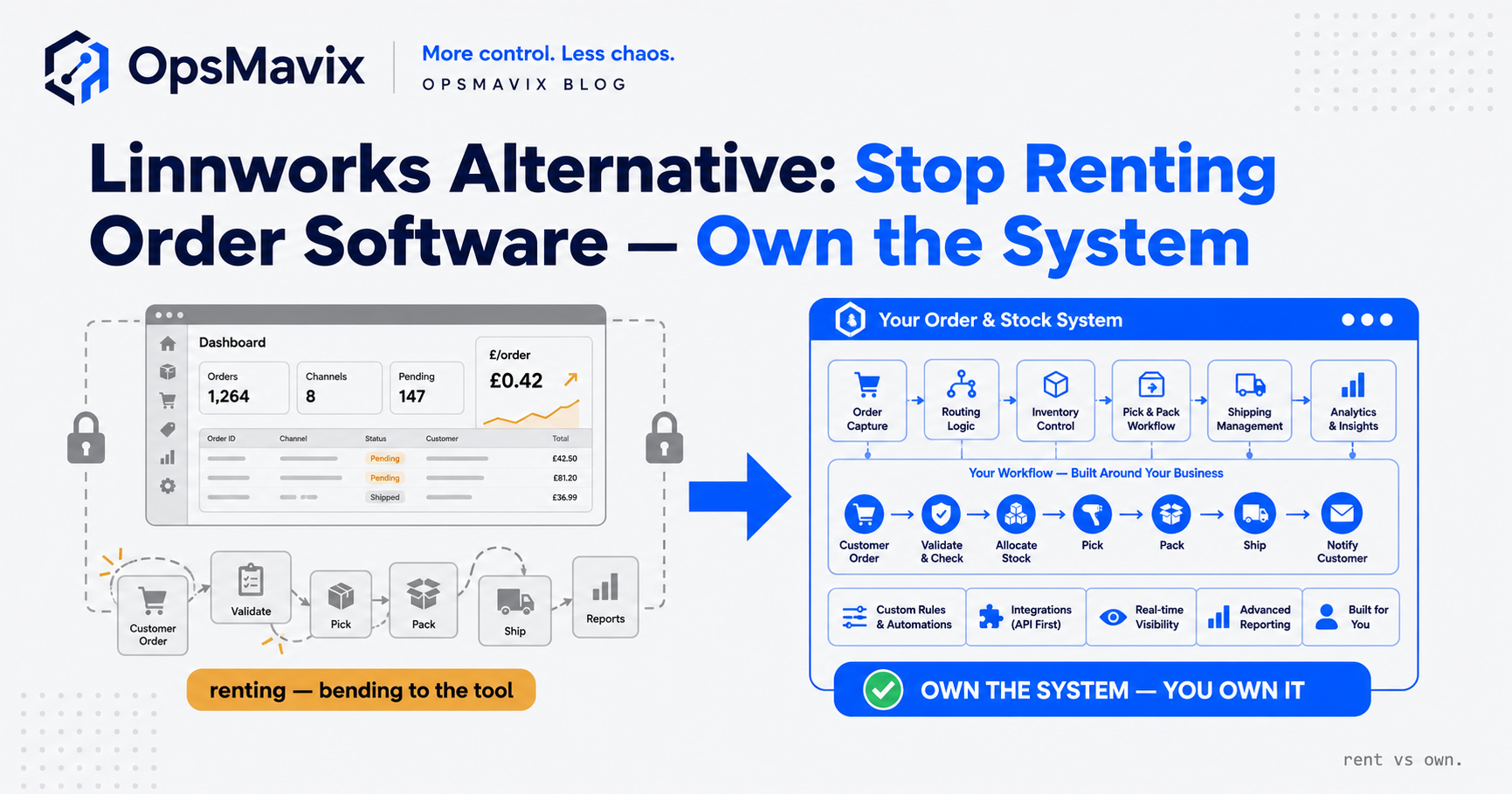
A Linnworks alternative is worth looking for the moment you notice you’re shaping your operation around the software instead of the software around your operation. Linnworks is a capable UK multichannel platform — it centralises orders and stock across marketplaces and webstores, keeps listings synced, and automates the routing and dispatch that used to eat your day. But you rent it, priced against how many orders you push through it, and it holds your process in a template it decided in advance. Past a point of complexity or volume, both facts start to cost you.
This is the honest version of the “what next” question — not “here’s a cheaper Linnworks clone”, because the real alternative to renting order software isn’t another subscription with the same shape. It’s a system built around how you actually take orders and move stock, that you own outright. Below: who Linnworks is right for, the four signs you’ve outgrown it, the migration reality, and a clear rent-versus-own way to decide. If Linnworks fits you, we’ll say so plainly.
Key Takeaways
- Linnworks is a genuine multichannel platform — order and stock sync across channels, listing management, rules-based automation and dispatch — and for a standard direct-to-consumer seller it’s a sound choice.
- You’ve outgrown it when the fit breaks: you bend your process to the product, the per-order bill climbs as you grow, the integration or field you need isn’t there, or you can’t get the report you need out of it.
- Per-order and tiered pricing means success costs more — the better your volume, the higher the bill, and add-ons for warehouse, listings and forecasting stack on top. Model this before you commit.
- The real alternative isn’t another SaaS clone — it’s a system shaped to your exact order intake, pricing and fulfilment, keeping one true stock figure, owned with no per-order creep.
- Migration is real work, not a switch-flip — export cleanly, map your data, run parallel before you cut over, don’t lose your order history.
- The honest test is rent-versus-own over three years, not the headline monthly fee — and for a low-complexity, standard-flow seller, renting stays the right answer.
1. What Linnworks Is, and Who It’s Genuinely Right For
Be fair to it first. Linnworks is a cloud multichannel inventory and order management system, majority-owned by Marlin Equity Partners since 2021, with a large catalogue of marketplace and sales-channel integrations. It pulls orders from your channels into one dashboard, keeps a central stock figure syncing back out so your listings reflect what you have, generates shipping labels, and automates order routing and processing. Warehouse and listings capability come as add-on modules — the warehouse side including SkuVault, which Linnworks acquired in 2022. That’s a real product doing a real job.
If you’re a direct-to-consumer seller with a standard channel mix — Amazon, eBay, Shopify, a couple of others — orders that arrive clean and structured from those feeds, and ordinary pick-and-ship fulfilment, Linnworks is very likely the right call. Replacing working software that fits is its own kind of leak. The question is only ever whether the fit is actually there.
2. Sign One — You’ve Bent Your Process to Fit the Product
The clearest tell that you’ve outgrown a packaged platform is that you’ve quietly reorganised how you work to keep it happy. A customer on a bespoke price tier the product has no clean home for, so you handle it in a note and hope. A bundle that draws from three SKUs. An order that arrives by phone or email instead of a tidy marketplace feed. A pre-order that shouldn’t decrement stock yet but does. Each gets a workaround, and every workaround is a small tax you pay forever plus a fresh place for the numbers to drift.
The pattern is always the same: the product handles the general case and fights you on the specifics that happen to be your normal operation. When the thing the software can’t hold cleanly is a routine part of your day, you haven’t outgrown the category — you’ve outgrown the template.
3. Sign Two — The Per-Order Bill Climbs as You Win
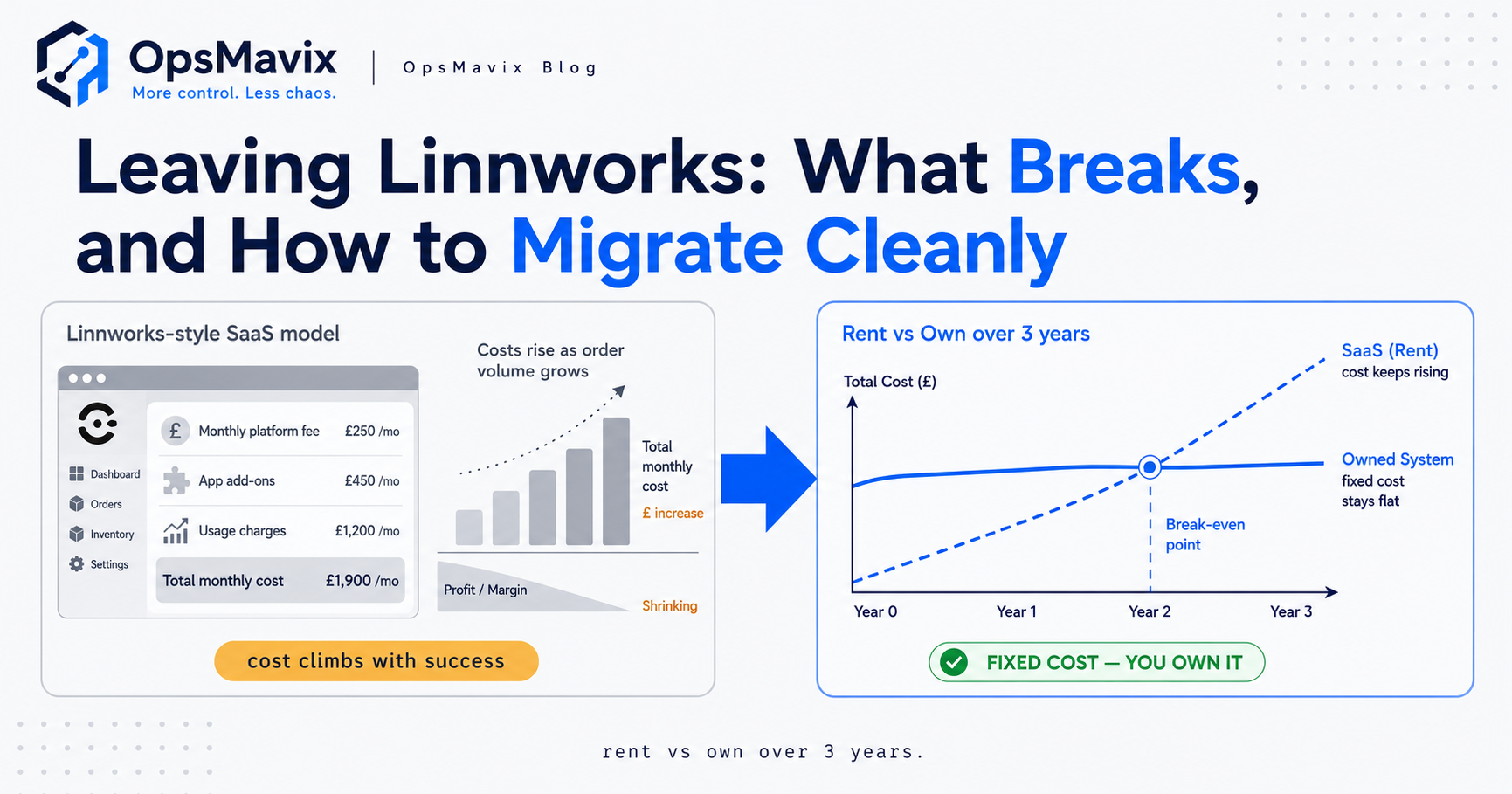
Linnworks prices on order volume — tiered plans with overage charges if you exceed your tier’s monthly order limit, and add-on modules for warehouse, listings and forecasting themselves priced against your order count. Check the current numbers directly, as they change and are quoted in dollars. The mechanics matter more than any figure: the better you do, the more you pay, and every module you switch on scales with the same success you’re trying to reward.
For a healthy-margin seller that can be perfectly acceptable — the tool earns its keep. For a high-volume, thin-margin operation it starts to feel like being taxed for growing. You wanted software that got cheaper per order as you scaled; you got one where the line goes the other way. It’s the honest economics of renting capacity by the order — and exactly what to model against a fixed-cost owned system before you sign, not after your volume has doubled.
4. Sign Three — The Integration, Field or Report You Need Isn’t There
A packaged platform integrates with what its roadmap prioritised — the mainstream marketplaces and carriers, well. The gap opens at the edges: a niche marketplace, a regional courier, an accounting or ERP setup, a supplier feed, or a bespoke checkout the product has no connector for. When the integration you need isn’t on the list, you’re back to exporting CSVs, re-keying by hand, or buying a middleware layer to bridge the gap.
The same ceiling shows up on data and reporting. Your operation tracks something the product has no field for — a job reference, a handling rule, a compliance flag — so it lives in a spreadsheet beside the tool. And the answer you need — margin by customer tier after real carriage, stock-turn by supplier, the true cost of returns by channel — is a shape the platform doesn’t produce, so someone rebuilds it from exports each month. Every side-spreadsheet is a second place the truth can drift, carrying every spreadsheet risk: no audit trail, single point of failure, silent errors.
5. Your Swap Options — Another SaaS, or a System You Own
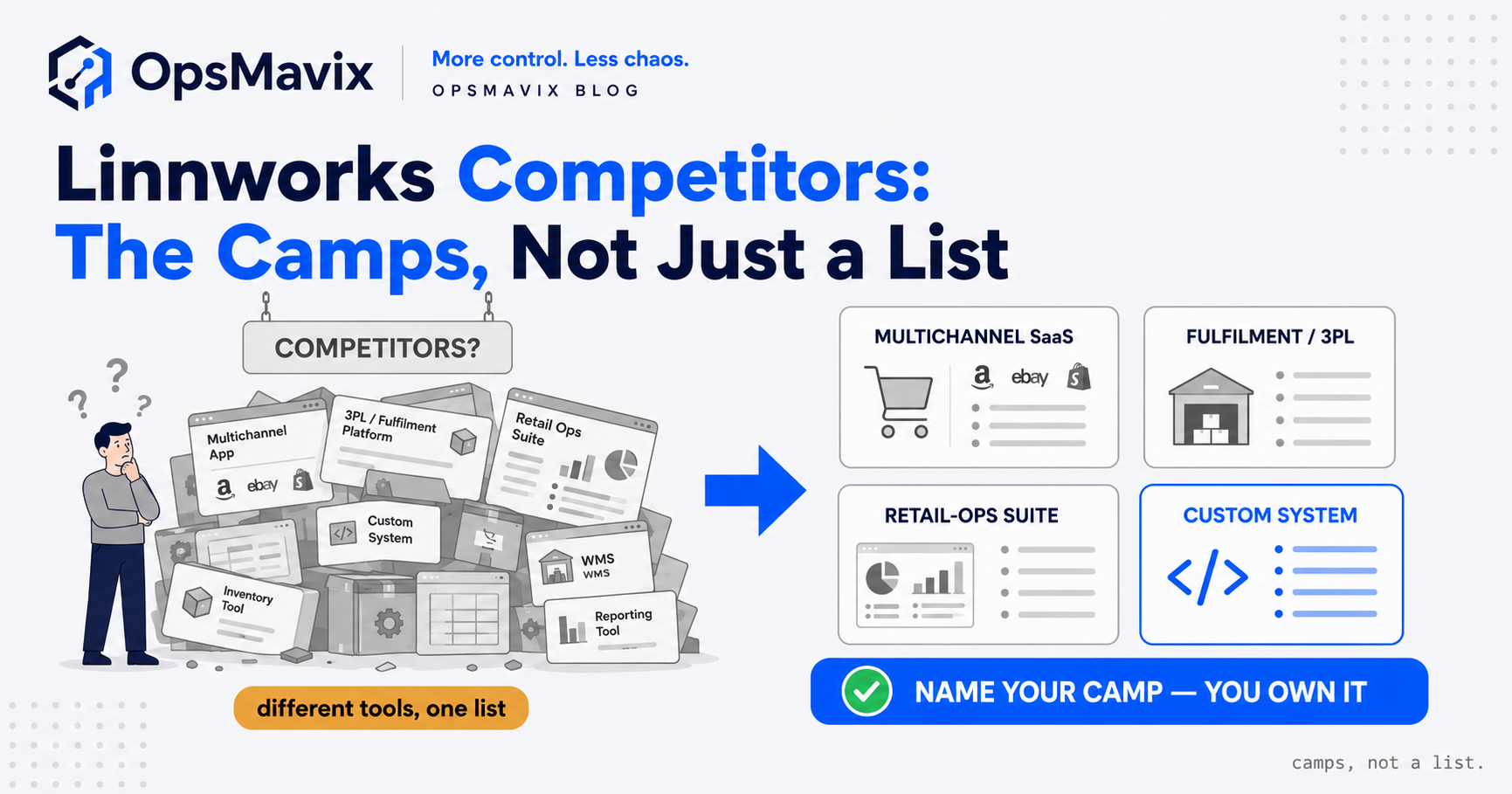
When Linnworks no longer fits, there are two honest directions. The first is a like-for-like SaaS swap — a different multichannel platform with a slightly different template. This is right when your problem is “this specific product annoys me” rather than “the packaged shape doesn’t fit my operation”. If a rival’s template matches your flow better, switch within the category.
The second is a system built around your operation that you own — right when the problem is structural: the workarounds, the per-order creep and the integration and reporting gaps are all symptoms of the template not being yours, and moving to another template just resets the clock until you hit its edges. It’s the parallel wholesalers face with a fulfilment-shaped tool never built for them — the honest version is in our Mintsoft alternative piece.
A built-for-you system isn’t a stripped-down Linnworks; it’s the parts of an order platform you actually use. Orders entered once off whatever they arrive on — feed, email, phone, portal — validated so wrong codes and quantities can’t slip through. Customer price tiers in the flow. One true stock figure every channel reads from, decremented the instant anything sells, so you stop overselling the last unit across two marketplaces. Bundles, pre-orders and handling rules treated as movements against that one shared number, not exceptions you patch around. Nothing bent to fit, nothing on a side-spreadsheet — that’s the ground custom inventory systems are built on, and for trade flows B2B order management covers the parts a DTC template handles worst: price lists, terms, quote-to-order and backorders.
6. The Migration Reality — No Sugar-Coating
Moving off a platform is real work, not a weekend switch-flip. Start by getting your data out cleanly: catalogue and SKUs, current stock, open orders, customer records, pricing, and — the one people forget — your order and channel history. That history answers “what did this customer buy last year” and “how does this season compare”, and a lazy migration loses it. Export it before you switch anything off.
Then map, don’t dump — your fields, statuses and channel identifiers need to land in the right place in the new system, which is a design step, not a paste. And cut over in parallel: run the new system alongside the old one for a real period, reconciling stock and orders across both, so you catch the divergences while you still have a safety net. Rush it and you inherit exactly the stock-discrepancy chaos you were trying to escape.
7. Rent vs Own — And How to Decide
On the headline number, SaaS wins at the start: a subscription is cheaper to switch on than a build is to commission. The honest comparison is total cost and control over three years or so. Renting is the monthly fee plus per-order overages plus every add-on priced against the same volume, on a price and roadmap the vendor can change or retire on their timeline. Owning is a fixed build cost, then a system you hold — no per-order creep, nothing to switch off. If you’re weighing where the operational middle sits between a rented tool and a full enterprise suite, operational ERP frames that ground.
The crossover point isn’t the same for everyone, so run four checks. Fit: are you bending your process to the product, or does it hold your real flow cleanly? Cost trajectory: model your per-order bill and add-ons at next year’s volume, not today’s. Gaps: count the integrations you bridge by hand and the spreadsheets beside the tool — that count is your workaround tax. Ownership: how much does it matter that a vendor controls the price, roadmap and off-switch on the software your orders depend on? Low, predictable volume with a standard flow and no gaps means rent, with a clear conscience. The four pointing the other way means you’ve outgrown the template, and the fix is a shape that’s yours.
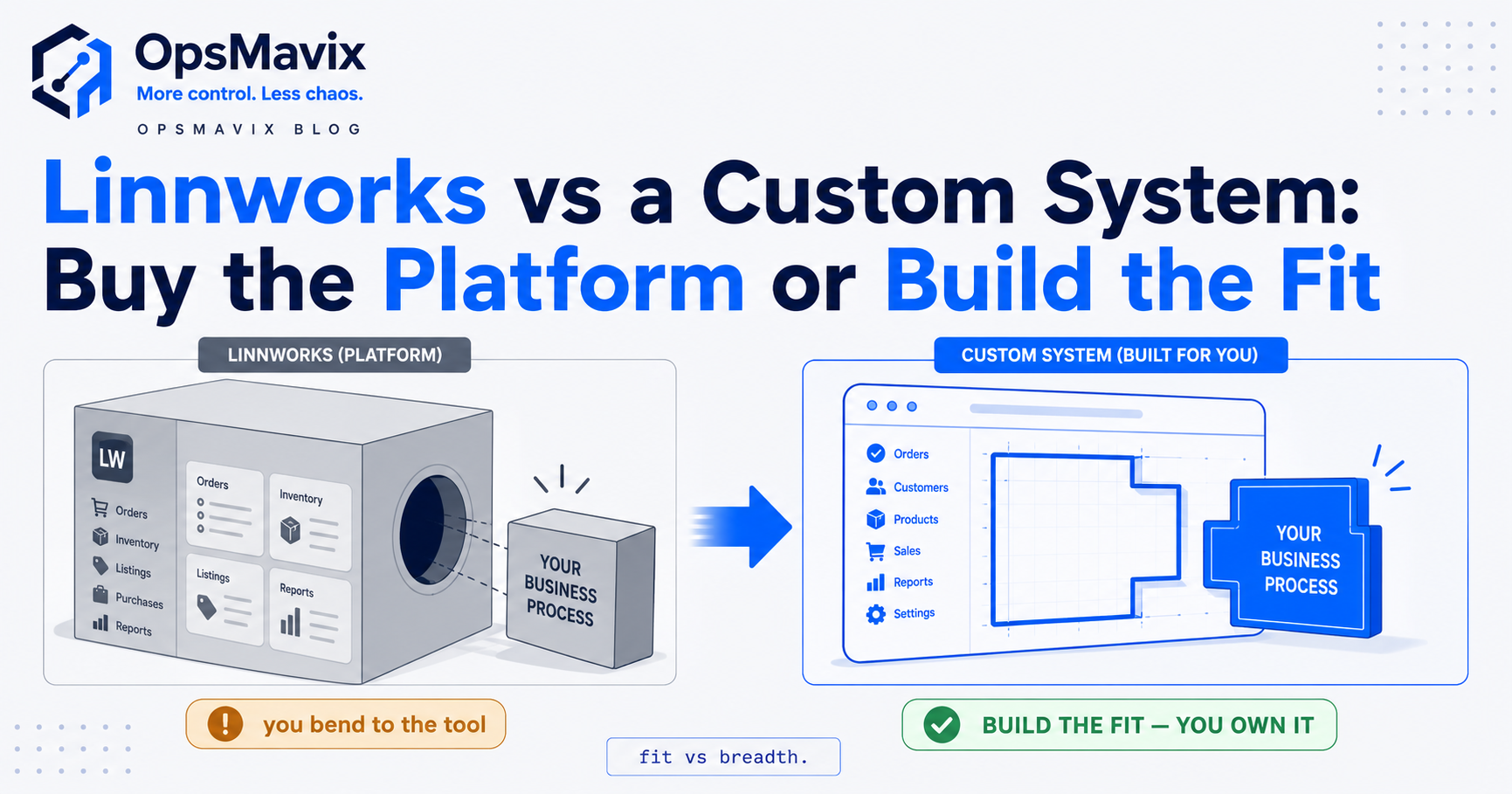
Linnworks vs a Built-For-You System
| Linnworks (packaged multichannel OMS) | Built-for-you system | |
|---|---|---|
| Core job | Order, stock sync and dispatch across channels | The same — shaped to your channels, pricing and flow |
| Order intake | Assumes clean, structured channel feeds | Built around feed, email, phone, portal — entered once |
| Odd cases (tiers, bundles, pre-orders) | Workarounds or side-spreadsheets | Built the way you actually run them |
| Integrations & fields | What the roadmap prioritised | The ones your operation needs, by design |
| Reporting | The shapes it built | The answers your decisions need |
| Pricing | Per-order / tiered, add-ons scale with volume | Fixed build (£3k–£25k range), you own it |
| Lock-in | Vendor controls price and roadmap | You hold it; nothing to switch off |
| Best fit | Standard DTC seller, low ops complexity | Outgrown the template, patching gaps |
FAQ
What is the best Linnworks alternative?
It depends on whether your problem is “I need a standard multichannel platform” or “the packaged shape doesn’t fit how I take orders and move stock”. If your flow fits the template, another packaged tool may do. If you’re bending your process to the product, paying more per order as you grow and rebuilding reports in spreadsheets, a system built around your flow — orders entered once, one true stock figure, owned by you — addresses the real cause.
Is a custom order system more expensive than Linnworks?
A subscription is cheaper to start; the honest comparison is total cost over three years or so. Per-order and tiered pricing climbs as you grow and add-ons scale with volume, so a system you build once and own can cost less over time, without the creep or lock-in. For a low-volume, standard-flow seller the platform genuinely fits, switching may not be worth it — and we’d say so.
When is Linnworks the right choice?
When you’re a direct-to-consumer seller with a standard channel mix, orders arriving clean from those feeds, ordinary pick-and-ship fulfilment and low operational complexity. At that fit, building custom would replace working software for no gain. Renting is right until the fit breaks or the volume tips the maths.
How do I know I’ve outgrown Linnworks?
The tells: you keep spreadsheets alongside it for price tiers, bundles or odd order channels; the per-order bill and add-ons climb faster than the value; the integration or field you need isn’t there; and the report you need gets rebuilt from exports every month. That’s your operation outgrowing the template.
How OpsMavix Can Help
OpsMavix builds ecommerce inventory and order systems and owned inventory automation shaped to how you actually sell — orders entered once and validated so wrong amounts can’t ship, customer price tiers in the flow, one true stock figure every channel reads from so you stop overselling, and the fields and reports you need part of the system instead of a spreadsheet beside it. You own it outright: no per-order creep, no add-on that scales with your success, nothing a vendor can reprice or switch off. It’s a right-sized system for the business that’s outgrown a packaged platform but isn’t ready for — or doesn’t want — a full enterprise suite. And if Linnworks genuinely fits how you sell, we’ll tell you to keep it.
If renting your order software is quietly costing you more the better you do, start by seeing the leak. Book an Operations Leak Audit and we’ll map where your order intake, stock sync and reporting break down today, what the workarounds and per-order fees add up to, and whether owning a system built around your flow is the honest fit.
Keep reading
Getting value from OpsMavix? Add us as a preferred source on Google — you'll see more of our operations content in your AI Overviews, AI Mode and Search.