
Linnworks Competitors: The Camps, Not Just a List
Search "Linnworks competitors" and you get a flat list that mixes four different kinds of tool — a shipping-led multichannel app, a British desktop store platform, a 3PL warehouse system and a full retail operating suite. They don't compete on the same axis, so ranking them head-to-head is meaningless. Here's the honest way to read the field: sort the rivals into camps, add the custom camp, and pick your camp before you pick a product.
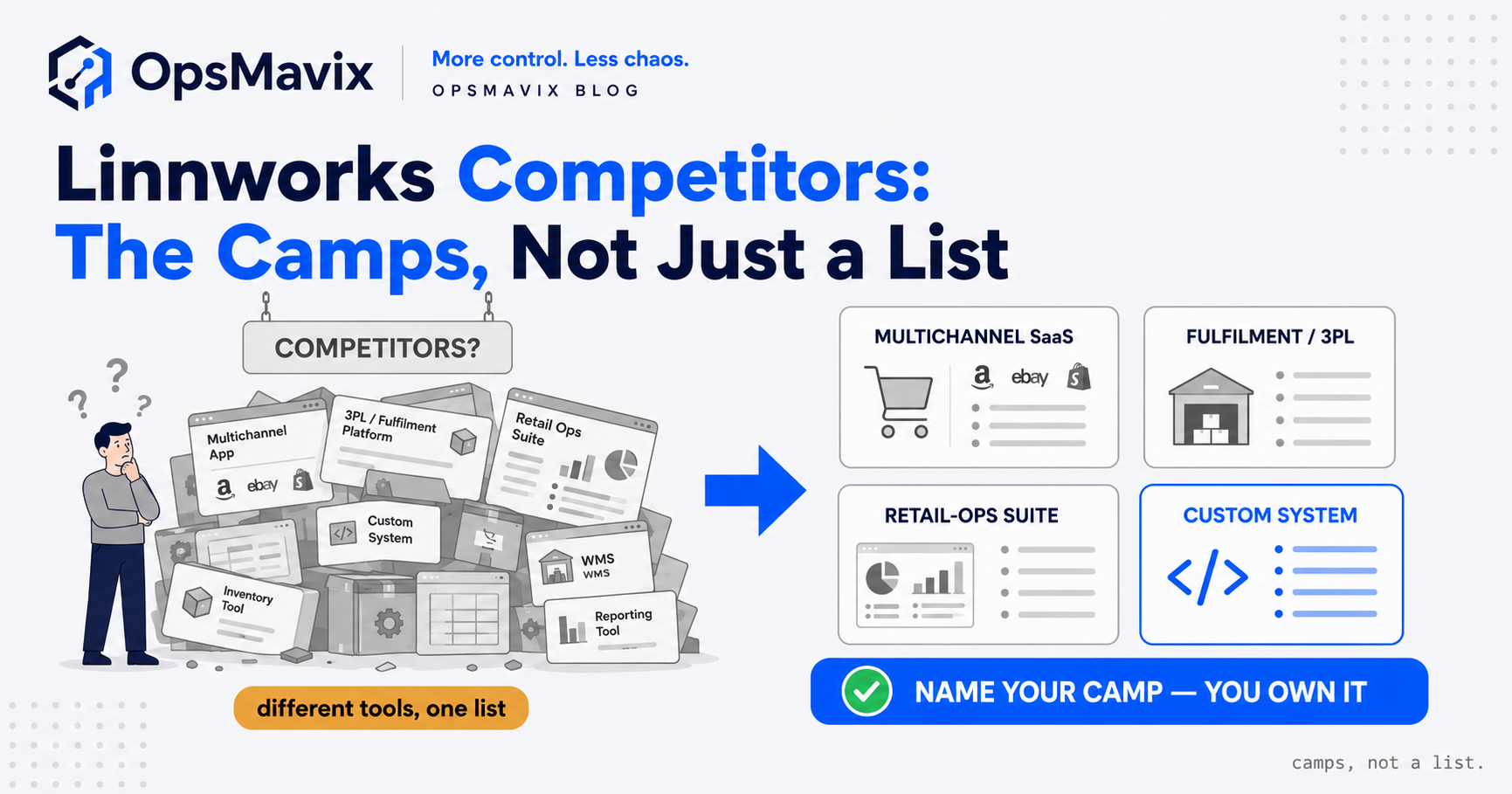
Linnworks competitors show up as a flat list — Veeqo, Sellerdeck, Mintsoft, Brightpearl and a dozen more, ranked one to ten as if they all do the same job. They don’t. Linnworks is multichannel inventory and order management SaaS for growing retailers who sell across marketplaces and their own store, and it earns its place there. But the tools that appear next to it in every comparison are different kinds of thing entirely: one is a shipping app that happens to sync stock, one is a decades-old British store platform, one is built for fulfilment houses billing clients, and one is a full retail suite with accounting inside it. Lining them up as interchangeable rivals is how people buy the wrong tool.
This post does the sorting the listicles skip. Instead of ranking, it puts the real Linnworks competitors into camps — multichannel selling tools, fulfilment and 3PL platforms, the retail-ops suite — then adds the camp the listicles never include: a system built around your own order and stock flow. The point isn’t to crown a winner. There isn’t one, because the right answer depends on which camp your business actually lives in. Name the camp first and the shortlist writes itself.
Key Takeaways
- “Which competitor is best” is the wrong first question — the tools people list against Linnworks belong to different categories, so a flat one-to-ten ranking compares things that were never doing the same job.
- Camp 1, multichannel selling tools (Veeqo, Sellerdeck) is the closest like-for-like — if you want a straight swap that syncs channels and manages orders, stay here and pick on fit.
- Camp 2, fulfilment and 3PL platforms (Mintsoft) is built around billing clients for storage and pick-fees — powerful if you run a warehouse for others, overkill if you just ship your own stock.
- Camp 3, the retail-ops suite (Brightpearl) bundles orders, inventory and accounting into one system of record — a heavier commitment that suits mid-market retailers wanting one platform for the lot.
- Camp 4, a custom system is shaped to your exact order intake, pricing and stock flow and owned by you — the fit when the packaged camps all make you keep spreadsheets on the side.
- Pick the camp before the product. If a like-for-like SaaS swap is genuinely what you need, choose inside Camp 1 and skip the rest — that’s the honest answer for a lot of readers.
Why “Competitors” Is the Wrong First Question
When you search for competitors to a tool you already know, you’re implicitly asking “what else does the same thing, but better or cheaper?” That question works when everything on the list really is the same thing. It falls apart here, because the tools that rank against Linnworks were built for different buyers with different problems. A shipping-first app optimised for label rates is not competing for the same job as a warehouse system that separates one client’s stock from another’s, which in turn is not the same job as a suite that closes your books.
So a ranking tells you almost nothing useful. A tool can sit at number one on a “best Linnworks alternatives” list and be completely wrong for you — not because it’s bad, but because it answers a question you’re not asking. The useful move is to stop ranking and start sorting: work out what kind of tool solves your problem, then compare within that kind. That’s what the camps below are for.
Camp 1: Multichannel Selling Tools (Veeqo, Sellerdeck)
This is the camp Linnworks itself lives in, and the closest to a like-for-like swap. These tools help a seller run their own multichannel operation — list products, sync stock across channels, pull orders into one place and push them out to dispatch. If your problem is “I sell on a few marketplaces plus my own store and I want one screen to manage it,” this is your camp.
Veeqo is the most-cited name here, and it comes with an unusual angle: it’s owned by Amazon and its shipping software is free, funded by carrier commissions on the labels you buy rather than a subscription. It does real multichannel inventory sync — sell on one channel and stock updates everywhere — with native ties into Amazon FBA and Amazon Shipping. For an Amazon-heavy seller who wants order and shipping management without a monthly platform fee, Veeqo is a genuinely strong, honest pick. The trade is that its centre of gravity is shipping and Amazon; the further your operation sits from that, the less the free-shipping model works in your favour.
Sellerdeck is a different animal wearing the same category badge. It’s a British company (formerly Actinic, going back to 1996, now part of the ClearCourse group) whose heritage product, Sellerdeck Desktop, is a locally installed application that manages your catalogue and orders on a PC and uploads the storefront to the web. That desktop-rooted model has loyal SME users, but it’s a different generation of tool from cloud-native multichannel SaaS — closer to a store platform with order processing than to a Linnworks-style channel hub. Worth knowing what you’re actually looking at before you shortlist it.
Camp 2: Fulfilment and 3PL Platforms (Mintsoft)
This camp looks adjacent but solves a structurally different problem. Fulfilment and 3PL platforms are built for the business that runs a warehouse for other people — storing and shipping stock that belongs to clients, and billing those clients for the privilege. The defining feature isn’t order sync; it’s client separation and charging.
Mintsoft (part of the Access Group) is the clearest example. Its warehouse management system puts 3PL client management at the core: chargeable rates, per-client inventory, billing, and a client portal where your customers log in, connect their own sales channels and pull their own reports. It carries a large library of channel and courier integrations and is aimed squarely at fulfilment houses, wholesalers and growing brands running their own warehouse. If you bill clients for storage and pick-and-pack, that machinery is exactly what you need and Linnworks would leave you improvising it.
But that same machinery is dead weight if you’re not a 3PL. A brand shipping only its own stock doesn’t need client accounts, chargeable rates or a partner portal — and paying for a warehouse-for-hire model you don’t run is its own kind of leak. This is the same fit line drawn in the Mintsoft alternative piece: brilliant when you’re a fulfilment operation, an awkward shape when you just run like one in your head. If you’re weighing Mintsoft specifically against its own field, the Mintsoft competitors breakdown sorts that camp the same way this post sorts Linnworks’.
Camp 3: The Retail-Ops Suite (Brightpearl)
Move up a level and you reach the suites — tools that don’t just manage orders and stock but try to run the whole trading operation from one place. This is a bigger commitment than a multichannel app, and a different buying decision.
Brightpearl (now Brightpearl by Sage) calls itself a “Retail Operating System,” and the label is accurate to its ambition. It brings orders, inventory, warehousing, fulfilment, purchasing, CRM and financials into a single system of record, built to be the omnichannel hub for mid-market retailers and wholesalers and to hold up under peak trading. Where Linnworks focuses on the order-and-inventory layer and leaves your accounting to a separate package, Brightpearl reaches into the accounting itself — which, since the Sage acquisition, is part of the point.
That breadth is the appeal and the catch. For a retailer who genuinely wants one platform running orders, stock and books together, a suite removes the seams between them. For a business that only needs the order-and-stock layer, it’s a lot of platform — more to configure, pay for and learn — to solve a problem a lighter tool would cover. The honest test for Camp 3 is whether you want a system of record for your whole operation, or just a better handle on orders and inventory. Only the first justifies the weight.
Camp 4: A Custom System Shaped to Your Flow
The camp the listicles never include is the one that stops the search for a lot of businesses: not another packaged tool, but a system built around how you actually take orders and move stock, that you own outright. It belongs on the map because the reason people leave Linnworks often isn’t “I want a different SaaS” — it’s “no packaged tool fits my flow without a spreadsheet bolted to the side.”
Every packaged camp above assumes a shape. Camp 1 assumes tidy marketplace feeds; Camp 2 assumes you bill clients; Camp 3 assumes you want the whole suite. When your operation has quirks none of them hold cleanly — orders that arrive by phone or email, customer-specific price tiers, bundles drawn from several SKUs, a pre-order that shouldn’t decrement yet — you end up bending the business to fit the tool and patching the rest by hand. A custom system inverts that: the software is shaped to your channels, pricing and intake, keeps one true stock figure every channel reads from, and has no per-order meter or vendor that can reprice or retire it under you. This is the ground custom inventory systems and, for trade-order businesses, B2B order management are built on.
The custom camp isn’t automatically the answer, and this isn’t a pitch to build for its own sake. It’s the right camp specifically when the packaged options all cost you a workaround — when the thing that makes your operation yours is exactly the thing the templates can’t bend to.
A Fair Comparison — Fit, Not a Winner
A comparison table that crowns a winner would repeat the exact mistake this post is arguing against. So this one ranks nothing. It maps each camp to the operation it fits, so you can find your row rather than chase a top score.
| Camp | Example tools | Built for | Best fit when | Watch out if |
|---|---|---|---|---|
| 1 · Multichannel selling tools | Veeqo, Sellerdeck | Sellers running their own channels | You want a like-for-like swap: sync stock, manage orders, tidy shipping | Your flow has quirks no field holds |
| 2 · Fulfilment / 3PL | Mintsoft | Warehouses billing clients | You store and ship other people’s stock and charge for it | You only ship your own stock |
| 3 · Retail-ops suite | Brightpearl | Mid-market retailers/wholesalers | You want one system for orders, stock and books | You only need the order/stock layer |
| 4 · Custom system | Built for you | Businesses the templates don’t fit | Every packaged tool needs a side-spreadsheet | Standard flow, no dev appetite |
Read down the “best fit when” column, not across the tools. The first row you nod at is your camp. If more than one fits, you’re probably between a packaged tool and a custom one — which is the decision the last section is about.
Name Your Camp First
The whole exercise comes down to one move done in the right order: pick the camp, then pick the product. Most bad tool decisions happen because people do it backwards — they fall for a product, then reverse-engineer a justification, and end up in the wrong camp with a tool they’ll outgrow or over-buy. Choosing the camp first is unglamorous and it’s what saves the money.
Be honest about which camp you’re in, because the answer is often “stay put.” If Linnworks fits and you just fancy a change, that’s not a reason to move. Want a like-for-like swap? You’re in Camp 1 — shortlist Veeqo and its peers and ignore everything heavier. Bill clients for fulfilment? Camp 2, and a general OMS was never going to fit. Want your whole operation on one system of record? Camp 3’s weight is justified. And if every packaged option leaves you propping up gaps with spreadsheets, that’s the signal for Camp 4 — not because custom is superior, but because your flow is the thing the templates can’t hold.
FAQ
Who are Linnworks’ main competitors?
The names that come up most are Veeqo and Sellerdeck (multichannel selling tools), Mintsoft (fulfilment/3PL), and Brightpearl by Sage (a full retail-ops suite). The catch is that these sit in different categories rather than competing on one axis — a shipping-led app, a British desktop store platform, a warehouse system for billing clients and an all-in-one suite are not doing the same job. Sort them into camps first, then compare within the camp that matches your operation.
What’s the closest like-for-like alternative to Linnworks?
Camp 1 — multichannel selling tools — is the nearest match, because it does the same core job of syncing channels and managing orders from one place. Veeqo is the most-cited option there and has an unusual free-shipping model funded by carrier commissions, which suits Amazon-heavy sellers especially. If a straight swap is genuinely what you want, stay in Camp 1 and choose on fit; you don’t need the heavier fulfilment or suite camps.
Is Mintsoft a Linnworks competitor?
Only loosely. Mintsoft is a warehouse management system built around 3PL client management — chargeable rates, per-client stock, billing and a client portal — so it’s aimed at fulfilment houses billing customers for storage and pick-and-pack. If you run a warehouse for others, it does things Linnworks doesn’t. If you only ship your own stock, most of what you’d pay for is machinery you’d never use.
When should I look at a custom system instead of these tools?
When every packaged option leaves you keeping spreadsheets on the side to cover what it can’t hold — orders that arrive by phone or email, customer-specific price tiers, bundles from several SKUs, a pre-order that shouldn’t decrement stock yet. That’s the sign your operation’s real shape doesn’t fit any template. A custom system is built around your intake, pricing and stock flow, keeps one true figure across channels and is owned by you — with no per-order meter and nothing a vendor can reprice or retire.
Should I switch off Linnworks at all?
Not on principle. If Linnworks fits how you sell and the pain is minor, replacing working software is its own kind of leak — stay put. Move only when the workarounds and fees cost more, month after month, than choosing the right camp once.
How OpsMavix Can Help
OpsMavix builds multichannel inventory systems and wholesale order management shaped to how you actually take orders and move stock — orders entered once off whatever they arrive on and validated so wrong amounts can’t ship, customer price tiers built into the flow, and one true stock figure every channel reads from so you stop overselling what you don’t have. It’s the Camp 4 answer: not a cheaper clone of any tool above, but a system built around your operation and owned by you, with no per-order creep and nothing a vendor can switch off. For businesses that fit Camps 1, 2 or 3, we’ll tell you so plainly — the honest recommendation is sometimes to stay packaged.
If you’re comparing Linnworks competitors because no packaged tool quite fits how you work, start by seeing the leak rather than the shortlist. Book an Operations Leak Audit and we’ll map where your order intake, stock sync and fulfilment break down today, which camp genuinely fits how you run now, and whether a built-for-you system is honestly worth the move — or whether the right call is to stay exactly where you are. We’ll tell you straight.
Keep reading
Getting value from OpsMavix? Add us as a preferred source on Google — you'll see more of our operations content in your AI Overviews, AI Mode and Search.