
Mintsoft Alternative: When You're Not a 3PL and Want It Shaped to You
Mintsoft is built for 3PLs and multichannel sellers who fit its order-and-warehouse template. The trouble starts when you're not a 3PL, your flow doesn't match, and per-order pricing climbs as you grow. Here's where it fits, when you've outgrown it, and what a system built around your operation does instead.
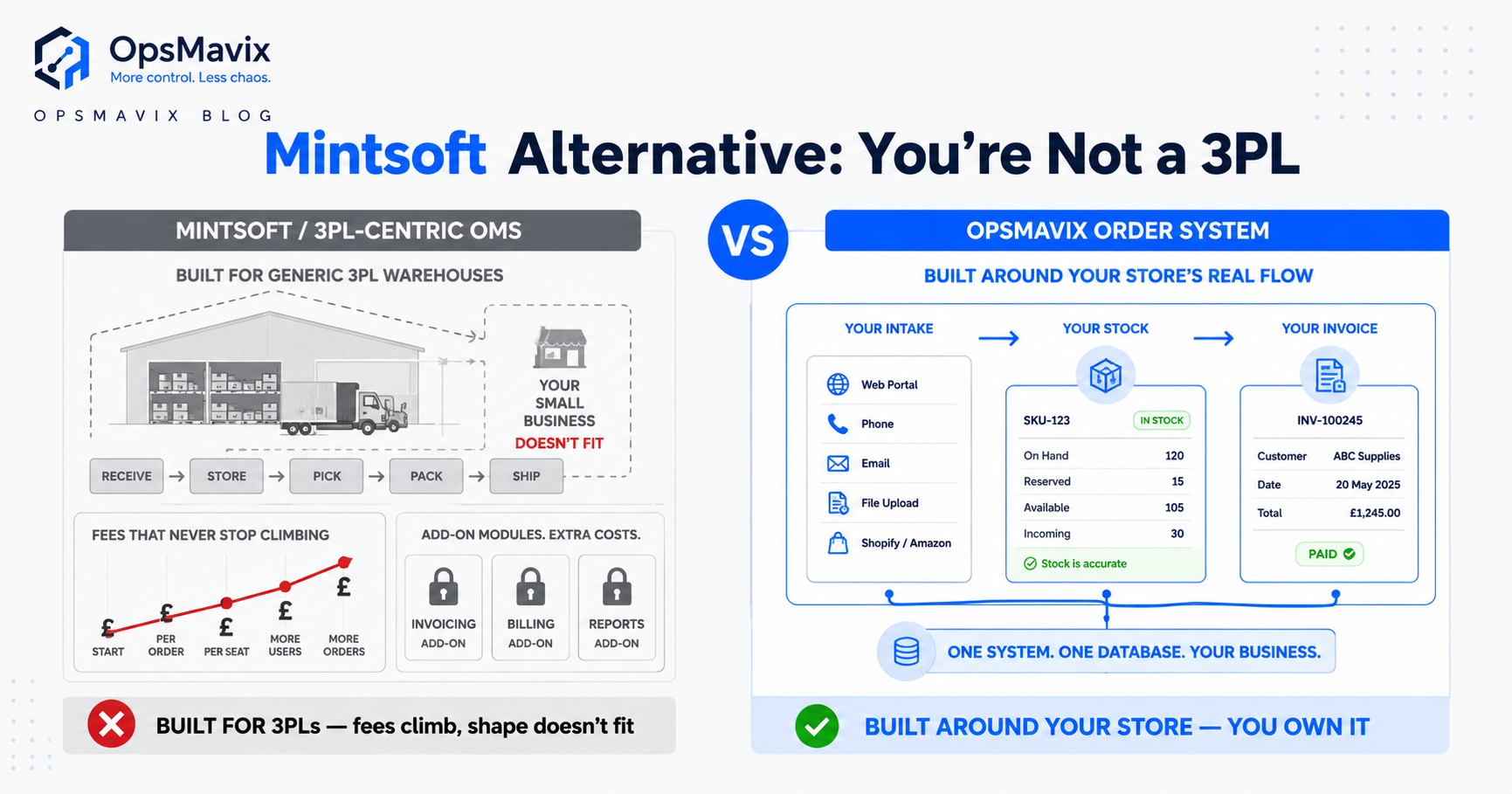
The best Mintsoft alternative depends on one thing: are you a 3PL, or do you just run like one in your head? Mintsoft is a UK cloud order and warehouse system (now part of the Access Group) built largely for third-party logistics providers and multichannel sellers — it packages order management, stock sync and warehouse fulfilment into one product. If your operation fits that template, it does a real job. You start looking for an alternative when you’re not a 3PL, your order flow has quirks the product has no field for, and the per-order pricing starts taxing the growth you wanted. The alternative isn’t another packaged OMS. It’s a system built around how you actually take orders and move stock — that you own outright.
This post covers where Mintsoft genuinely fits, when you’ve outgrown it, and what a built-for-you system changes. The re-keying problem underneath a lot of order chaos has its own deep-dive in how to stop re-keying orders by hand; this is the platform-versus-custom layer above it.
Key Takeaways
- Mintsoft is strong out of the box for 3PLs and multichannel sellers whose flow fits its order-and-warehouse template.
- You outgrow it when you’re not a 3PL, your order intake or fulfilment has quirks the product can’t hold, and you keep spreadsheets to cover the gaps.
- Per-order or per-seat pricing on packaged platforms tends to climb with volume — you can end up paying more for doing better.
- A built-for-you system is shaped to your channels and order flow, keeps one true stock figure, and is owned by you — no creep, no rug-pull.
- Don’t switch on principle. Move only when the workarounds and fees cost more, month after month, than building the right thing once.
When Mintsoft Is the Right Call (the honest bit)
Be fair to Mintsoft: it does a genuine job. It gives 3PLs and multichannel sellers a packaged way to take orders across marketplaces, keep stock synced, and run warehouse pick-and-ship from one place. If you’re a logistics provider billing clients for storage and fulfilment, that’s much of what it’s built around, and a custom build would be reinventing a wheel that already turns. If you’re a multichannel seller whose channels, stock rules and dispatch fit the standard shape, it’s enough — and replacing working software is its own kind of leak.
You look for an alternative when that fit isn’t there. The tell is simple: the product handles the general case but fights you on the specifics — a customer-specific price tier it has no clean home for, a bundle that draws from three SKUs, an order that arrives by email or phone instead of a tidy marketplace feed. One wholesale operator described the gap on a packaged tool plainly: “inventory management is really annoying without this feature. If not resolved we are moving to software that can.” When the missing feature is your normal operation, you’ve outgrown the template — not the category.
1You’re Not a 3PL — So You’re Paying for a Shape You Don’t Have
A platform built around 3PL workflows assumes a model: client accounts, billing for storage and pick-fees, fulfilment as the product you sell. A wholesaler or own-brand seller doesn’t run that way. You take orders off faxes, photos of handwritten notes, emails and phone calls, and you need them entered once, accurately, against your own pricing — not billed back to a logistics client. Bend a 3PL-shaped tool to that and you spend your time fitting the operation to the software instead of the other way round.
The wholesale wound underneath this is the rekey, not the warehouse. Operators describe still “manually inputting order data onto QuickBooks invoices” off “faxes, photos of handwritten orders, and emails with inaccurate item numbers,” where “on a telephone you can still hear wrong amounts.” A 3PL OMS doesn’t fix that intake — it assumes the order already arrived clean and structured. A system built around how you actually take orders kills the rekey at the source. That’s the whole point of a wholesale order management system.
2The Platform Was Never the Problem — the Drift Is
Packaged multichannel tools list and sync what you configure, and for a stable channel mix that holds for a long time. But people don’t go hunting for a Mintsoft alternative because listing broke. They go hunting because the stock figure drifts — the sync lags, two channels both sell the last unit, and the number on Shopify quietly disagrees with the count on the shelf. The platform isn’t the complaint; the divergence around it is.
Sellers describe the wound directly: “inventory numbers change for no reason — phantom stock,” serious enough in one case to leave an “$80k value difference that cannot be explained.” A packaged tool can’t fix that when the sync itself is the thing drifting. One true figure that every channel reads from, decremented the instant anything sells — that’s the fix, and it’s the spine of multichannel inventory automation.
3You’ve Started Keeping Side-Spreadsheets to Cover the Gaps
This is the clearest sign you’ve outgrown a packaged platform. It assumes a standard shape — order in, sync, pick, ship. Your operation has its own quirks: a customer on a special price tier, a bundle drawn from three SKUs, a pre-order that shouldn’t decrement yet, an order channel the product has no setting for. So you bend the process to fit the tool, then patch the rest with a spreadsheet on the side.
Every side-spreadsheet is a tax you pay forever and a fresh place for the number to drift. And the platform’s own answer is often to upsell you into a tier built for someone bigger — sellers describe add-ons as “ridiculous and only solution for large businesses.” A system built around your shape leaves nothing to work around, at a size that fits the business you actually run.
4The Hidden Cost Is Per-Order Creep and Lock-In, Not the Headline Price
A packaged platform’s price looks fine until your fulfilment depends on it. Then the real risk isn’t the monthly fee — it’s how the fee scales. Per-order and per-seat pricing means the better you do, the more you pay, and sellers describe the feeling exactly: being “punished for growing.” You wanted a system that rewards scale; you got one that taxes it. Always check how a platform prices against volume before you commit, not after.
There’s a sharper version too. A platform you don’t control can change underneath you — bought, repriced, or retired. Operators who lived through a tool being sunset describe it as something that “invalidates two years worth of work,” announced by little more than a banner. For an order desk, that’s your customer pricing, channel history and fulfilment data tied to a decision you didn’t make. A built-for-you system flips it: no per-order creep, no surprise hike for selling more, and nothing a vendor can switch off, because you own it. The honest framing of where this sits is in B2B order management for wholesalers.
5What a Built-For-You System Covers
A custom system isn’t a stripped-down OMS — it’s built around how you genuinely take orders and move stock. Orders entered once, off whatever they arrive on, validated against your real catalogue so wrong item numbers and amounts can’t slip through. Customer-specific price tiers built into the flow, not held in someone’s head under pressure. One true stock figure every channel reads from, so a sale anywhere updates the count everywhere and you stop overselling what you don’t have. A fulfilment view that matches your warehouse, not a generic 3PL template. And the data complete and live, so reconciliation isn’t built on a partial import.
The difference from off-the-shelf is that nothing has to be bent to fit. Where a packaged platform makes you choose between its way and a spreadsheet, a built-for-you system treats every channel, every price tier and every odd case as a movement against one shared number. If overselling across marketplaces is the sharpest pain, how to stop overselling on Shopify, Amazon and eBay covers that specific fix.
Mintsoft vs a Built-For-You System
| Mintsoft (packaged 3PL/multichannel OMS) | Built-for-you system | |
|---|---|---|
| Core job | Order, sync and fulfil, 3PL/multichannel template | The same — shaped to your channels, pricing and flow |
| Order intake | Assumes structured marketplace feeds | Built around fax, email, phone, portal — entered once |
| Stock sync | Real-time until it lags; channels can diverge | One true figure every channel reads from |
| Odd cases (tiers, bundles) | Workarounds or unsupported | Built the way you actually run them |
| Pricing | Per-order / per-seat — climbs as you grow | Fixed build (£3k–£25k range), you own it |
| Lock-in / sunset | Vendor controls it | You hold it; nothing to switch off |
| Best fit | 3PLs and stores that fit the template | Businesses patching gaps with spreadsheets |
FAQ
What is the best Mintsoft alternative?
There isn’t one best answer — it depends on whether your problem is “I need a standard 3PL/multichannel platform” or “the product doesn’t fit how I actually take orders and move stock.” If you’re a 3PL or a seller whose flow fits the template, another packaged tool in that class may do. If you’re not a 3PL, you’re re-keying orders, your stock drifts between channels, and per-order fees climb as you grow, a system built around your flow — with one true stock figure and orders entered once — addresses the real cause.
How is a built-for-you system different from Mintsoft?
A packaged OMS gives you a standard way to take orders, sync stock and fulfil, and you fit your process to it. A built-for-you system is shaped to your actual channels, pricing tiers, intake and fulfilment, keeps one shared stock figure every channel reads from, and is owned by you — so there’s no per-order creep and no vendor that can sunset it. The difference shows up most in the specifics a template can’t bend to.
Is a built-for-you system more expensive than Mintsoft?
On the headline number, a packaged platform is cheaper to start. The honest comparison is total cost over a few years. Per-order and per-seat pricing climbs as you grow, and a platform that oversells, drifts, or gets repriced can cost far more over time than building the right system once and owning it. For a business the platform genuinely fits, switching may not be worth it — we’d say so.
Will it stop overselling across channels?
Yes — that’s a core reason to build one. Every channel reads from one shared count that decrements the instant anything sells, so you can’t confirm an order for stock another channel already took. Packaged tools promise this with real-time sync, but the gap reopens whenever the sync lags; a single shared figure removes the lag as a failure point.
How do I know I’ve outgrown a packaged platform?
The tells: you keep spreadsheets alongside it for price tiers, bundles or odd order channels; your stock figure drifts between channels and the shelf; you’re still re-keying orders the product can’t take cleanly; and the pricing rises faster than the value as you grow. Those are signs your operation has outgrown the template, not that you’re running it badly.
How OpsMavix Can Help
OpsMavix builds wholesale order management and multichannel inventory systems shaped to how you actually take orders and move stock — orders entered once off fax, email, phone or a portal, validated so wrong amounts can’t ship; customer price tiers built into the flow; one true stock figure mirrored live across every channel so you can’t sell what you don’t have. There’s nothing a vendor can switch off or charge you more for as you grow, because you own it.
If you’ve outgrown a packaged 3PL-style platform but you’re not ready for an enterprise system, that middle ground is exactly what we build. Book an Operations Leak Audit and we’ll map where your order intake, stock sync and fulfilment break down today, what it’s costing you, and whether a built-for-you system is genuinely worth the move.