
Inventory Write-Offs: When, How, and How to Have Fewer
An inventory write-off removes stock from your books once it can no longer be sold — lost, damaged, obsolete or stolen. Most guides stop at the accounting entry. This one joins the entry to the operational causes and, more usefully, to how you have fewer write-offs next year.
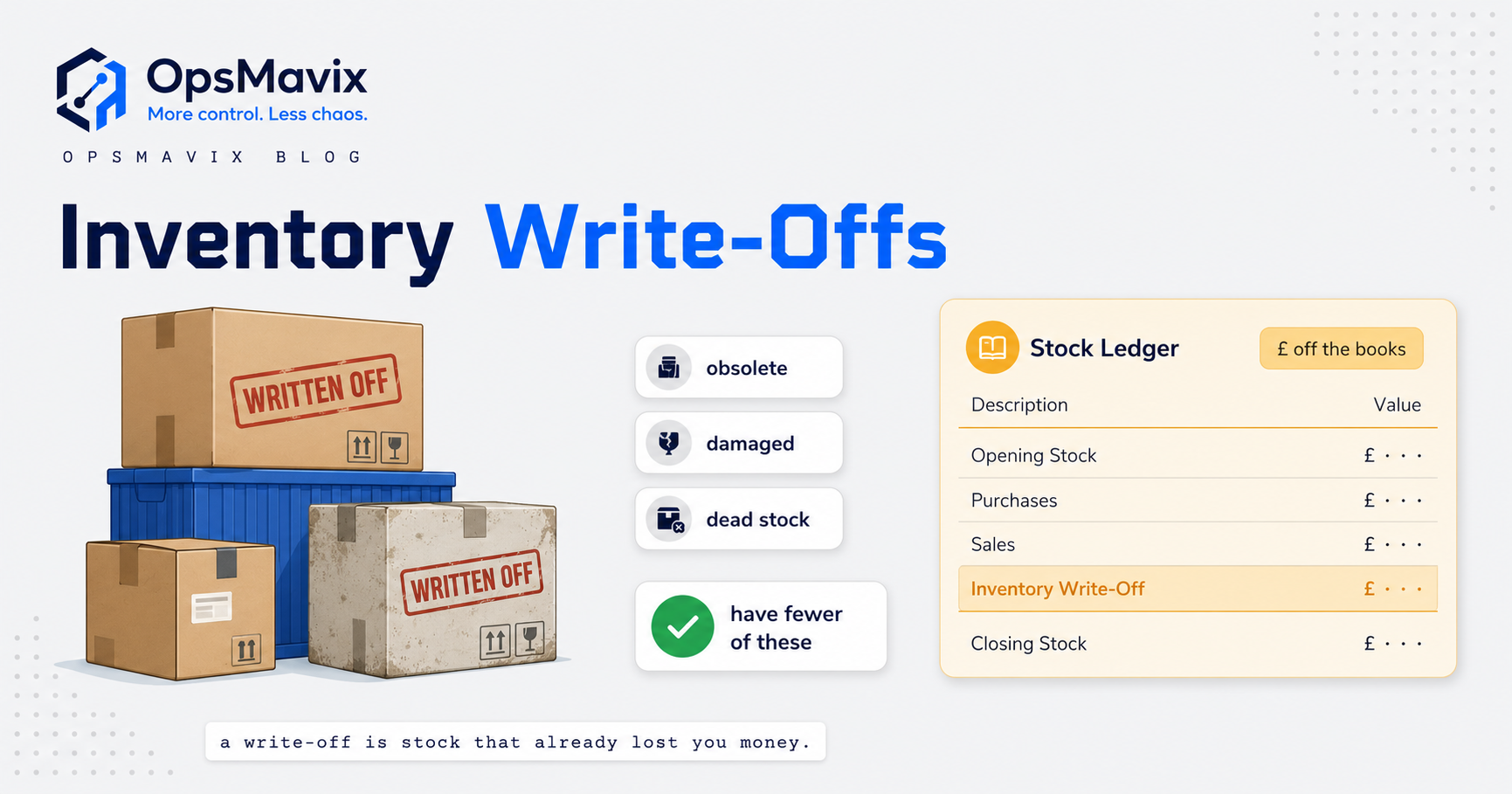
Quick summary: An inventory write-off is an accounting entry that removes the value of stock from your books once it can no longer be sold — because it is lost, damaged, expired, obsolete, or stolen. You reduce the inventory asset and record the same amount as an expense, which lowers profit for the period. A write-off is the full removal of value; a write-down is a partial reduction when stock is still worth something but less than its cost. The accounting is the easy part. The expensive part is why the write-off happened — dead stock, damage, obsolescence and shrinkage are operational failures, and the point of this guide is how to have fewer of them next year.
Every business that holds stock will write some of it off. That is normal. The problem is not the occasional write-off; it is the business that treats write-offs as an unavoidable line in the accounts rather than a symptom to be diagnosed. The accounting entry is trivial — two lines in a ledger. What it represents is money you already spent on stock that will never come back as a sale. This page explains what a write-off is, how it differs from a write-down, the treatment in plain terms (confirm the specifics with your accountant), the operational causes behind each type — and then the part the accounting sites skip: how to reduce the number.
Contents
- What an inventory write-off actually is
- Write-off vs write-down: the difference that matters
- The accounting treatment in plain terms
- A £ worked example
- The four operational causes of write-offs
- Why write-offs are a symptom, not the disease
- How to have fewer write-offs
- When you should write off sooner, not later
- How an owned system shrinks the write-off line
- FAQ
What an inventory write-off actually is
An inventory write-off is the formal recognition that stock you are carrying as an asset has lost all its value and will never be sold. When that happens, you remove its cost from your inventory balance and book the same amount as an expense.
The logic is straightforward. Stock sits on your balance sheet as a current asset because it is expected to become cash — you bought it to sell it. The moment that expectation dies, the asset is a fiction. Accounting rules do not let you carry stock at a value you can no longer realise, so you write it off: the asset goes down, and the lost value hits the profit and loss account as an expense in the period you recognise it.
Stock qualifies for a write-off when it can no longer be sold at all. Common triggers:
- It is gone — lost, stolen, or unaccounted for after a count.
- It is damaged beyond sale and cannot be repaired or discounted.
- It has expired — past its use-by, shelf-life, or regulatory date.
- It is obsolete — superseded, discontinued, or no longer wanted, with no realistic buyer at any price.
The key phrase is no realistic value left. If the stock is still worth something — you could clear it at a discount, sell it as a second, or return it — that is not a write-off. That is a write-down, and the distinction changes both the accounting and what you do next.
Write-off vs write-down: the difference that matters
These two terms get used interchangeably, and they should not be. The difference is simply how much value is left.
| Write-down | Write-off | |
|---|---|---|
| What it means | Reduce the stock’s carrying value to what it is now worth | Remove the stock’s value entirely |
| Value remaining | Some — it can still be sold, just for less | None — it cannot be sold at any price |
| Typical trigger | Market price fell, mild damage, slow-moving, end-of-line | Expired, destroyed, stolen, fully obsolete |
| Accounting effect | Partial expense; stock stays on the books at the lower value | Full expense; stock leaves the books |
| What you do next | Discount and clear it | Dispose of it |
The rule underneath both is the same principle: stock is carried at the lower of cost and net realisable value. Net realisable value (NRV) is what you could actually get for it, minus the costs of selling it. If NRV drops below cost but stays above zero, you write it down to NRV. If NRV hits zero, you write it off.
A worked distinction: you bought 100 units at £20 each. Demand collapsed and the most you can now sell them for is £8 each. That is a write-down — you reduce the carrying value from £20 to £8 per unit and expense the £12 difference. Now suppose those same units are food that has passed its expiry date. NRV is zero. That is a write-off — the full £20 per unit is expensed and the stock is gone.
Getting this right matters because a write-down preserves an option — you can still recover £8 a unit — whereas a write-off closes it. Businesses that skip the write-down stage and jump straight to writing stock off often throw away money that was still recoverable. The discipline of clearing slow lines at a discount before they become worthless is the heart of good dead stock management, and it is the single cheapest way to keep the write-off line small.
The accounting treatment in plain terms
Keep this general — the exact entries, thresholds, and tax treatment depend on your accounting standards and jurisdiction, so confirm the specifics with your accountant. But the shape is simple enough to understand without one.
A write-off removes the stock’s value from the asset side and records it as an expense:
- Reduce inventory (the current asset on the balance sheet) by the cost of the written-off stock.
- Record an expense of the same amount — either to cost of goods sold, or to a dedicated “inventory write-off” or “obsolete stock” expense line.
The net effect: your inventory balance falls, and your profit for the period falls by the same amount. No cash moves — you already spent the cash when you bought the stock — but the loss is now recognised.
A write-down works the same way, for the partial amount: reduce inventory by the difference between cost and NRV, and expense that difference.
Two points worth knowing:
- Many businesses run a provision (allowance) for obsolete or slow-moving stock rather than waiting for each item to become worthless. Instead of a single dramatic write-off at year-end, they set aside an estimated reserve as stock ages, and adjust it over time. This smooths the impact and forces the business to look at ageing stock regularly rather than discovering a pile of dead inventory once a year.
- The tax position is not automatic. Whether and when a write-off is deductible, and what evidence you need (disposal records, count adjustments, approvals), varies. Do not assume; ask your accountant.
The mechanics are genuinely this simple. Which is exactly why they are the least interesting part of the story. The ledger entry is the funeral. The question worth your attention is what killed the stock.
A £ worked example
A wholesaler runs a year-end stock count and review. Three situations come up.
Situation one — obsolete stock, full write-off. They are still carrying 400 units of a product line the manufacturer discontinued 18 months ago. No customer wants it; it cannot be returned. Cost was £15 a unit.
| Item | Amount |
|---|---|
| Units | 400 |
| Cost per unit | £15 |
| Write-off | £6,000 |
The full £6,000 is expensed and the stock leaves the books.
Situation two — slow-moving stock, write-down. They hold 300 units of a seasonal line bought at £22 that they can now only realistically clear at £9 each.
| Item | Amount |
|---|---|
| Units | 300 |
| Original cost per unit | £22 |
| Net realisable value per unit | £9 |
| Write-down per unit | £13 |
| Write-down | £3,900 |
£3,900 is expensed now; the stock stays on the books at £9 a unit (£2,700), and clearing it recovers real cash.
Situation three — shrinkage, discovered at count. The physical count is 120 units short of what the system says across several fast lines, average cost £11.
| Item | Amount |
|---|---|
| Units missing | 120 |
| Average cost per unit | £11 |
| Write-off (shrinkage) | £1,320 |
Total hit to profit this period: £6,000 + £3,900 + £1,320 = £11,220. Every pound of it is cash the business already spent. None of it is coming back as a sale. And all three situations were preventable to some degree — which is the whole point.
The four operational causes of write-offs
Every write-off traces back to one of four operational failures. Name the cause and you can attack it.
1. Dead stock and obsolescence
Stock you bought that stopped selling — superseded by a newer version, discontinued, out of season, or simply over-ordered and never cleared. This is the largest write-off category for most stock-holding businesses because it accumulates silently. Nothing alerts you that a line has stopped moving; it just sits there, ageing, until a count or a review surfaces it. By then it is often worthless. Obsolescence is a forecasting and purchasing failure that only becomes visible at the write-off stage.
2. Damage
Stock ruined in handling, storage, or transit — crushed, dropped, water-damaged, mishandled in the warehouse. Some damage is genuinely unavoidable. A lot of it is not: poor storage, overstacking, bad slotting, or handling stock more times than necessary. Damage is a warehouse-process failure.
3. Expiry and shelf-life
For food, cosmetics, pharmaceuticals, chemicals and anything date-sensitive, stock that passes its date is an automatic write-off. This is almost always a rotation failure — first-in-first-out not enforced, so newer stock gets picked while older stock ages out behind it — combined with over-ordering relative to how fast the line actually sells.
4. Shrinkage
Stock that is simply gone — theft (internal or external), miscounting, receiving errors, unrecorded breakages, or units picked but never deducted. Shrinkage shows up as the gap between what the system says you have and what the count finds. It is a control failure, and it is the one most businesses under-measure because they only discover it at the count, long after they can trace what happened. Tightening it is a matter of preventing stock discrepancies at the point they occur — receiving, picking, and counting — rather than reconciling the damage after the fact.
Why write-offs are a symptom, not the disease
Here is the mindset shift the accounting-focused guides never make. A write-off is not an event. It is the final line of a story that started months earlier, and by the time you write the stock off, every chance to save the money has already passed.
Consider the obsolete-stock write-off. The money was lost the day you over-ordered a line that was about to be discontinued. It became unrecoverable somewhere over the following year, as the stock aged past the point where any discount would move it. The write-off at year-end is not the loss — it is the acknowledgement of a loss that happened long before, quietly, while nobody was looking at the ageing.
That is why treating write-offs as an accounting problem is a trap. The accountant records the entry correctly and the number is right, but nothing changes, so next year produces the same pile. The write-off is downstream of the real problem, which is always one of: you bought stock you did not need, you could not see it ageing in time to clear it, or you lost track of what you actually had.
Fixing the accounting cannot fix any of those. Fixing the operations can. Which means the useful question is never “how do we write this off?” — it is “why did we have to, and what would have caught it sooner?”
How to have fewer write-offs
This is the part that pays for itself. Each lever below attacks one of the four causes upstream, before the value is gone.
Get ageing visibility — see stock getting old before it dies
The single highest-leverage change. Most write-offs happen because nobody saw the stock ageing until it was too late to act. If you can see, at any moment, which lines have not moved in 30, 60, 90, 180 days and how much capital is tied up in each, you can act while the stock still has value — discount it, bundle it, return it, or stop reordering it. Ageing visibility turns a future write-off into a present write-down you can actually recover cash from. This is the operational core of dead stock management: the earlier you see a line dying, the more of your money you keep.
Prioritise by value with ABC analysis
Not every line deserves the same attention. A handful of products usually represent most of your inventory value, and those are where a write-off hurts most. ABC analysis sorts your stock by value so you watch the A-items — high-value lines — most closely, review them most often, and never let an A-item drift into obsolescence unnoticed. It concentrates your prevention effort where the pounds are.
Buy to actual demand, not to gut feel
Over-ordering is the root cause of obsolescence and much expiry. If purchasing is driven by rough estimates, round-number orders, or supplier minimums rather than by how fast each line actually sells, you will routinely buy more than you can clear — and the surplus ages into a write-off. Tighter demand forecasting and reorder rules that reflect real sell-through keep the incoming volume matched to what will actually leave. You cannot write off stock you never over-bought.
Enforce rotation for anything date-sensitive
For perishable and dated stock, first-in-first-out is the whole game. If your process guarantees the oldest stock is always picked first, expiry write-offs collapse. This is a slotting and picking-discipline problem — the warehouse has to make the oldest stock the easiest to pick, not the hardest.
Count regularly so shrinkage is caught early
Shrinkage that is discovered once a year is untraceable and unfixable. Cycle counting — counting a slice of stock continuously rather than everything once a year — surfaces discrepancies while they are small and recent enough to investigate. Catching a shrinkage pattern in week two lets you fix the process that caused it; finding it eleven months later just tells you to write it off.
Watch turnover as your early-warning number
Inventory turnover tells you how fast stock converts to sales. A line whose turnover is falling is a line heading toward the write-off pile. Tracking turnover per line — and especially watching it drop — is a leading indicator of obsolescence. Slowing turnover is the alarm that goes off before the stock dies, if you are set up to hear it.
When you should write off sooner, not later
A counter-intuitive point: sometimes the right move is to write off faster. Businesses cling to dead stock because writing it off “makes the numbers look bad” this period — so they leave worthless stock on the books, inflating the inventory asset and pretending the value is still there.
That is worse, not better. Carrying dead stock at full value:
- Overstates your inventory and your profit — the balance sheet claims value that does not exist.
- Costs you real money to hold — the space, handling, and capital tied up in worthless stock are ongoing expenses.
- Hides the problem — as long as it is on the books at cost, nobody confronts the purchasing decision that created it.
Recognising a loss you have already taken is not making things worse; it is stopping the pretence. The honest move is to write off obsolete stock promptly, clear the space, and — critically — feed the reason back into purchasing so the same over-order does not repeat. A write-off you learn from is cheap. A write-off you hide and repeat is the expensive kind.
How an owned system shrinks the write-off line
The prevention levers above all depend on one thing: seeing what is happening to your stock in time to act. That is precisely what spreadsheets fail at. A spreadsheet does not tell you a line has stopped moving. It does not flag stock approaching its expiry date. It does not surface a turnover figure that has been falling for three months. All of that information exists in your data — it is just invisible until someone manually goes looking, which they never do until the write-off is already unavoidable.
An owned operations system — right-sized for a business that has outgrown spreadsheets and disconnected tools — makes the invisible visible by default:
- Ageing is tracked automatically. Every line carries its days-since-last-sale, so slow and dead stock surface while there is still time to clear it, not at year-end.
- Expiry dates drive alerts. Date-sensitive stock flags before it expires, and picking enforces oldest-first rotation instead of relying on someone remembering.
- Reordering reflects real sell-through, so you stop over-buying the lines that turn into next year’s obsolescence.
- Counts reconcile continuously, so shrinkage is caught small and recent enough to trace to a cause.
- Turnover and slow-mover reports run themselves, turning the leading indicators of a write-off into something you see weekly, not annually.
The write-off entry stays trivial — it always was. What changes is how often you have to make one, and how much value is left on the table when you do. The goal is not zero write-offs; some stock will always spoil, break, or go out of fashion. The goal is a write-off line that shrinks year over year because the operational causes behind it are being caught upstream, while the stock is still worth something.
FAQ
What is an inventory write-off?
An inventory write-off is an accounting entry that removes the value of stock from your books once it can no longer be sold — because it is lost, damaged, expired, obsolete or stolen. You reduce the inventory asset and record the same amount as an expense, which lowers profit for the period. No cash moves; you already spent it when you bought the stock. The write-off simply recognises that the value is gone.
What is the difference between a write-off and a write-down?
A write-down is a partial reduction: the stock is still worth something, just less than its cost, so you reduce its carrying value to what you could now realistically get for it (its net realisable value). A write-off is the full removal: the stock is worth nothing and cannot be sold at any price, so its entire value is expensed and it leaves the books. Both follow the same rule — stock is carried at the lower of cost and net realisable value.
How do you account for an inventory write-off?
In general terms, you reduce the inventory balance on the balance sheet by the cost of the written-off stock, and record the same amount as an expense — either within cost of goods sold or on a dedicated write-off line. Many businesses also run a provision for obsolete stock, setting aside a reserve as stock ages rather than waiting for a single year-end write-off. The exact entries and the tax treatment depend on your accounting standards and jurisdiction, so confirm the specifics with your accountant.
What causes inventory write-offs?
Four operational causes: dead stock and obsolescence (over-ordering or lines that stop selling), damage (poor handling or storage), expiry (rotation failures on date-sensitive stock), and shrinkage (theft, miscounting, receiving and picking errors). Each is an upstream failure that only becomes visible at the write-off stage — which is why the fix is operational, not accounting.
How can I reduce inventory write-offs?
Attack the causes upstream: get ageing visibility so you see stock slowing down while it can still be cleared at a discount; prioritise your highest-value lines with ABC analysis; buy to actual demand rather than gut feel; enforce first-in-first-out rotation on dated stock; and cycle count so shrinkage is caught early. Tracking inventory turnover per line gives you an early warning — a falling turnover is a line heading for the write-off pile.
Sources
- IFRS — IAS 2 Inventories — the “lower of cost and net realisable value” measurement principle underlying write-downs and write-offs.
- GOV.UK — Business Income Manual: valuation of stock — HMRC guidance on stock valuation; confirm the specifics of any write-off’s tax treatment with your accountant.