
Food Manufacturing Inventory Management Software: A Practical Guide
Generic inventory apps track quantities. Food manufacturing needs lot genealogy, shelf-life logic, allergen control and recall-ready records — the things spreadsheets and off-the-shelf stock tools quietly can't hold. This guide covers what good looks like feature by feature, and how a right-sized, owned system delivers food-grade traceability without a full ERP.
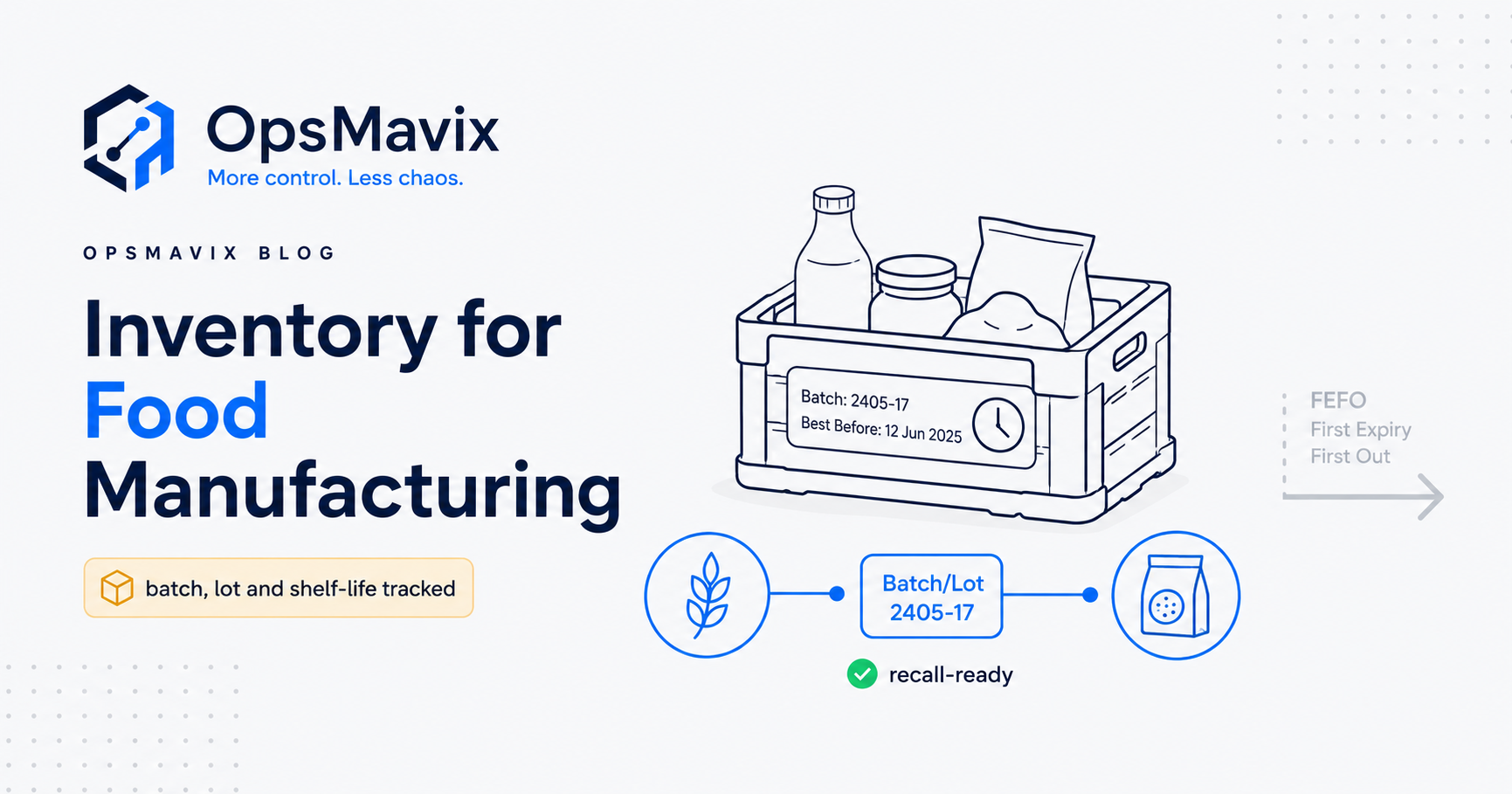
Food manufacturing inventory management software is stock software that also carries the things food makers are legally and practically on the hook for: which raw lots went into which finished batch, when everything expires, what allergens are present, and the paper trail to prove it in a recall. That last part is why generic inventory tools break here — they count units well, but they don’t hold lot genealogy or expiry logic, and in food those aren’t nice-to-haves, they’re the job.
Quick summary: Food manufacturing inventory management software tracks stock by lot and expiry — not just by quantity — so a maker can trace every finished batch back to its raw ingredients, rotate by shelf life, control allergens, and produce recall-ready records on demand. Under UK food law, operators must be able to withdraw affected product one step forward and one step back through the supply chain (Food Standards Agency), which is exactly the traceability a generic stock app can’t produce.
Contents
- Why generic inventory tools break for food
- Batch and lot traceability (recall-ready)
- Shelf life and FEFO rotation
- Allergen control
- Recipe, BOM and yield
- Supplier and goods-in capture
- Compliance records that hold up
- Spreadsheet vs generic app vs food-grade system
- A worked example: a recall at 9am
- What good looks like: a feature checklist
- Right-sized, not a heavy ERP
- FAQ
Why Generic Inventory Tools Break for Food
A general inventory app models the world as SKUs and quantities: 400 units of product X, sell some, buy more. That’s fine for a business that buys finished goods and resells them — but food manufacturing breaks it in three places at once.
First, a food maker doesn’t sell what they buy — they buy ingredients and make products, so a plain quantity count can’t answer “which flour went into this batch of bread.” Second, every physical unit has a clock on it: two identical yoghurt pots aren’t interchangeable if one expires Friday and one expires next month. Third, the same ingredient carries a legal payload — allergens, country of origin, a supplier lot — that must follow it to the finished label. A quantity is a number. A food lot is a number plus a genealogy plus an expiry plus a risk profile, and generic tools only store the first part.
The result is predictable. Makers run the stock count in an app, then run the real record — batch sheets, expiry tracking, allergen matrices, goods-in logs — on paper or in a second spreadsheet beside it. The two drift, and the drift only becomes visible on the worst possible day. For the wider category and where a food-grade system sits within it, see our guide to FMCG stock management.
Batch and Lot Traceability (Recall-Ready)
This is the feature everything else hangs off. Lot traceability means every finished batch records exactly which raw-material lots were consumed to make it, and every raw lot records which finished batches it ended up in — genealogy that runs both directions. When a supplier flags a contaminated ingredient lot, you need to answer two questions in minutes, not days: which of my finished batches contain it, and where did those batches ship? That is forward and backward trace, and it is the difference between recalling three pallets and recalling a month of production because you can’t prove which was affected.
Regulation is tightening around exactly this. In the US, the FDA’s Food Traceability Rule (FSMA Section 204) requires firms handling foods on its Food Traceability List to keep enhanced lot-level records and produce them to the FDA — the rule mandates capturing Key Data Elements at Critical Tracking Events and, historically, an electronic sortable record within 24 hours of a request (FDA). The compliance date was extended to 20 July 2028 (Federal Register), but the direction of travel is one way, and UK makers who export are already in scope. Domestically, the bar is the same in spirit: one step back, one step forward, fast. A deeper treatment of the mechanics lives in our batch and lot tracking guide.
Shelf Life and FEFO Rotation
Food inventory has a clock, so the rotation rule that fits most warehouses — FIFO, first in first out — is the wrong one here. Food needs FEFO: first expired, first out. The stock you ship next should be the stock that expires soonest, which isn’t always the oldest by receipt date (a supplier can deliver short-dated product late). A food-grade system stores an expiry or best-before date against every lot, picks and suggests by expiry, and flags stock approaching its date before it becomes a write-off.
That last point is money, not just compliance. WRAP puts total UK food waste at around 10.7 million tonnes in 2021, with food manufacturing responsible for a significant share of it — and a large proportion of manufacturing waste is avoidable rather than unavoidable trim (WRAP). A meaningful slice of that avoidable waste is short-dated stock nobody flagged in time. Expiry-aware rotation turns that from a monthly surprise into a daily prompt, and the waste that does still happen gets recorded cleanly instead of vanishing from the count.
Allergen Control
The UK regulates 14 named allergens, and a food business must be able to say — accurately, every time — which of them is present in a product (Food Standards Agency). That obligation runs from the ingredient lot through the recipe to the finished label. A generic inventory tool has nowhere to put an allergen attribute, so allergen control ends up as a separate spreadsheet matrix maintained by hand — which means it’s accurate right up until an ingredient is reformulated or a supplier changes their spec and nobody updates the sheet.
A food-grade system attaches allergen data to the ingredient record, rolls it up automatically through the recipe to the finished product, and can warn when a batch is scheduled on a line after a different-allergen product without a cleandown recorded. The FSA is also clear that precautionary “may contain” labelling should be used only where cross-contamination genuinely can’t be controlled — which you can only justify if your system knows what shares a line with what.
Recipe, BOM and Yield
A recipe is a food maker’s bill of materials: the quantities of each ingredient that go into a standard batch, plus packaging. But food adds two wrinkles a standard bill of materials doesn’t always model. The first is yield and loss — you put 100kg of raw ingredient in and get 92kg of finished product out, because of trim, evaporation, cooking loss or spillage. If your system assumes 100kg in equals 100kg out, your stock, your costing and your ordering are all quietly wrong.
The second is catch-weight — many food items are priced and stocked by weight but handled as units (a wheel of cheese, a side of salmon), and the two don’t map cleanly. A system that understands recipes with real yield factors gives you an honest cost per batch, an honest deduction of ingredients when a batch is booked, and an honest finished-goods count. That, in turn, is what lets the ingredient lots flow into the batch record automatically — making traceability a by-product of the work, not a second job done afterwards.
Supplier and Goods-In Capture
Traceability is only as good as its first record: the moment ingredients arrive. Goods-in is where the lot number, supplier, quantity, temperature check and expiry date get captured — or lost. If that capture is a paper delivery note filed in a drawer, the genealogy is broken before production even starts, because the finished batch can point back to “flour” but not to “flour, lot 4471, from supplier Y, received 3 June, use by 2 December.”
A food-grade goods-in step records the supplier lot against your internal lot at receipt, ideally by scanning, so every subsequent movement inherits it. It’s also where quality gates live — reject on temperature, on damaged packaging, on a missing certificate — before bad stock enters the system. This is standard goods-receiving discipline sharpened for food: capture the lot cleanly at the door, or lose the trace before production even starts.
Compliance Records That Hold Up
The difference between a food maker who passes an audit calmly and one who dreads it is usually whether the records are a by-product of the work or a separate chore. When lot capture, recipe consumption, expiry, allergen roll-up and cleandowns all happen inside one system as production runs, the audit trail already exists. When they live on paper and in spreadsheets, the audit trail has to be assembled — and assembled records have gaps.
Under UK food law, an operator that places unsafe food on the market must withdraw it, inform consumers where it’s reached them, and notify the authorities — and must have the traceability to do so quickly (Food Standards Agency). Certification schemes such as BRCGS go further and expect a documented, tested traceability system. “We could reconstruct it from the batch sheets given a day” is not what any of these ask for.
Spreadsheet vs Generic App vs Food-Grade System
Here is the honest comparison for a small-to-mid food maker.
| Capability | Spreadsheet | Generic stock app | Food-grade system |
|---|---|---|---|
| Quantity on hand | Manual, drifts | Yes | Yes |
| Lot genealogy (forward + back) | By hand, slow | No | Yes, automatic |
| Expiry per lot / FEFO picking | Columns, manual | Rarely | Yes |
| Allergen roll-up to product | Separate matrix | No | Yes |
| Recipe with yield/loss | Formulae, fragile | Sometimes (BOM) | Yes |
| Supplier lot at goods-in | Paper note | Partial | Yes, at scan |
| Recall in minutes | No | No | Yes |
| Audit trail | Reconstructed | Thin | Built-in |
| Cost to run | “Free” + risk | Subscription | Owned, right-sized |
The spreadsheet is free until the day it isn’t. The generic app fixes the quantity problem and leaves every food-specific problem untouched. The gap between the middle column and the right one is the whole reason this software category exists.
A Worked Example: A Recall at 9am
A supplier emails at 9am: a batch of an ingredient — say a spice lot — may be contaminated, lot code 4471. Two makers of the same size respond very differently.
Maker A runs stock in a generic app and everything else on paper. They pull delivery notes to find when lot 4471 arrived, guess which production days used it, then work forward through dispatch notes to find which customers might have affected product. By lunchtime they still aren’t sure, so they recall six weeks of product to be safe — thousands of units and a credibility hit that costs far more than the actual contamination footprint.
Maker B runs a food-grade system. They search lot 4471: it returns the three finished batches that consumed it, the quantities, and the customers and dispatch dates those batches shipped to. Recall notices go to four customers for a defined quantity by mid-morning, with a sortable record ready if the authority asks. Same incident, same ingredient — one recall is surgical, the other is a shotgun. The difference is whether the genealogy was captured as the work happened.
What Good Looks Like: A Feature Checklist
When you assess any option — off-the-shelf or built for you — this is the food-specific checklist worth scoring against:
- Lot-level everything: stock held and moved by lot, not just by SKU.
- Two-way genealogy: one click from a raw lot to every finished batch, and back.
- Expiry on every lot with FEFO picking and expiry-approaching alerts.
- Allergen attributes on ingredients that roll up to the finished product automatically.
- Recipes with yield/loss factors and, where relevant, catch-weight handling.
- Supplier lot captured at goods-in, ideally by scan, with quality gates.
- Recall search that returns affected batches and destinations in minutes.
- Records built in, so the audit trail is a by-product, not a project.
- One stock figure the whole operation reads from, so counts don’t drift.
If a tool can’t do the first three, it isn’t food inventory software regardless of what the marketing says — it’s a stock counter with a food skin.
Right-Sized, Not a Heavy ERP
The usual answer to this list is a full food ERP — and for a large, multi-site processor, that can be the right call. But plenty of makers are stuck in the middle: outgrowing spreadsheets and a generic app, not looking for the cost and admin weight of a process-manufacturing ERP. That middle is where most of the pain, and most of the avoidable spend, actually sits.
An owned, right-sized operations system targets exactly the food-grade capabilities above and nothing you don’t need — reading from one stock figure the whole business trusts. You own it outright: no per-lot fees, no module you’re renting but not using, nothing a vendor can switch off. For where this fits alongside broader automation, see our fully automated inventory system guide.
FAQ
What’s the difference between food inventory software and normal inventory software?
Normal inventory software tracks quantities by SKU. Food inventory software tracks by lot and expiry, so it can trace every finished batch back to the raw ingredient lots it was made from, rotate stock by shelf life (FEFO), roll allergens up from ingredients to the finished label, and produce recall-ready records. Those food-specific capabilities are exactly what generic tools lack.
Do small food manufacturers really need lot traceability?
Yes. UK food law requires any operator to withdraw unsafe product and trace it one step back and one step forward, regardless of size (Food Standards Agency). A small maker without lot genealogy faces the same legal duty as a large one but has to meet it manually — which usually means over-recalling because they can’t prove which units are affected.
Can I do this in a spreadsheet?
For a while, and badly. A spreadsheet can hold lot columns and expiry dates, but it can’t reliably link raw lots to finished batches both directions, it drifts from your actual stock count, it has no audit trail, and it collapses under time pressure — which is precisely when a recall demands it works. It’s the tool most makers outgrow first.
Is FEFO better than FIFO for food?
For perishable food, yes. FIFO ships the oldest stock by receipt date; FEFO ships the soonest-to-expire, which isn’t always the oldest if a supplier delivered short-dated product late. FEFO minimises expiry write-offs and keeps the freshest possible product moving to customers.
Do I need a full ERP for food traceability?
Not necessarily. A large multi-site processor may, but many small-to-mid makers sit between spreadsheets and ERP — where a right-sized, owned system delivers lot traceability, FEFO, allergen roll-up, recipes with yield and recall search without the cost and implementation weight of a full food ERP.
How OpsMavix Can Help
OpsMavix builds right-sized inventory automation systems for food makers stuck between spreadsheets and a heavy ERP. That means lot capture at goods-in, recipe-driven consumption with real yield, FEFO rotation with expiry alerts, allergen roll-up to the finished product, and a recall search that returns affected batches and destinations in minutes — all reading from one stock figure the whole business trusts, and all owned by you rather than rented per lot.
If your stock count and your food records live in two places that quietly disagree, start by seeing the number. Book a Free Operations Leak Audit and we’ll map where food-grade traceability is missing today, what a slow recall or a short-dated write-off costs you now, and whether a right-sized system is the honest fit for how you make things.
Sources
- Food Standards Agency — Food incidents, product withdrawals and recalls: https://www.gov.uk/guidance/food-incidents-product-withdrawals-and-recalls
- Food Standards Agency — Allergen guidance for food businesses: https://www.gov.uk/government/publications/allergen-guidance-for-food-businesses
- FDA — FSMA Final Rule on Additional Traceability Records for Certain Foods (Section 204): https://www.fda.gov/food/food-safety-modernization-act-fsma/fsma-final-rule-requirements-additional-traceability-records-certain-foods
- Federal Register — Traceability records compliance date extension (to 20 July 2028): https://www.federalregister.gov/documents/2025/08/07/2025-14967/requirements-for-additional-traceability-records-for-certain-foods-compliance-date-extension
- WRAP — Food Surplus and Waste in the UK, Key Facts (Nov 2023): https://www.wrap.ngo/sites/default/files/2023-11/WRAP-Food-Surplus-and-Waste-in-the-UK-Key-Facts-Nov-2023.pdf