
Food and Beverage Manufacturing Software: Running the Production Floor, Not Just the Ledger
Most tools sold as food and beverage manufacturing software are really accounting or stock ledgers with a food label. This guide is about the other job — running the production floor: recipes and BOMs, batch runs, yield and waste, shelf life and quality checks on the line. It's written for makers who are outgrowing spreadsheets and disconnected tools.
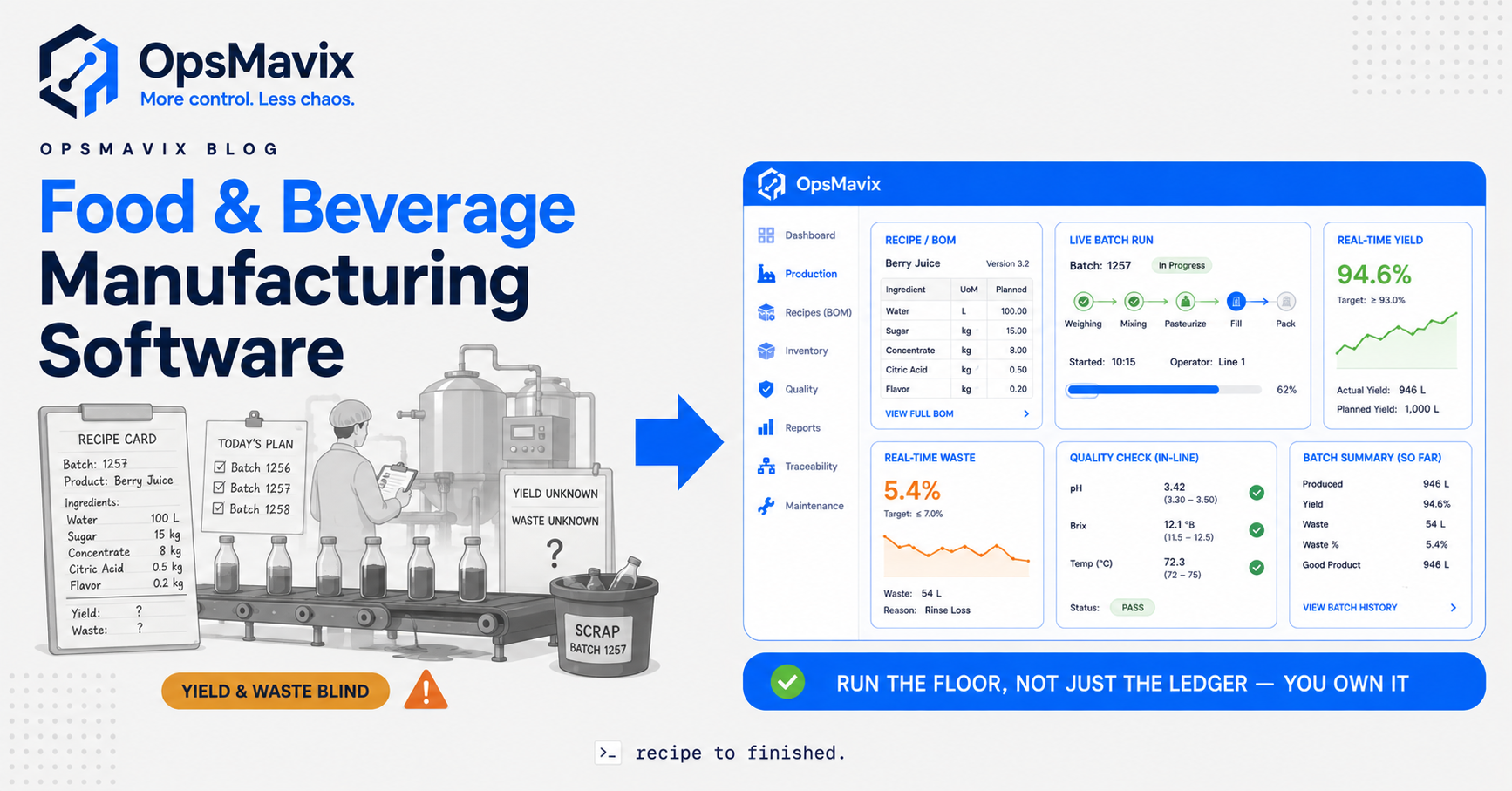
Food and beverage manufacturing software is the system that runs the production floor: it holds your recipes and bills of materials, plans and records batch runs, tracks how much you actually made against how much you should have made, watches shelf life, and captures the quality checks that happen on the line. It is not the same thing as accounting software with a food skin on it. The ledger tells you what a batch cost after the fact. The floor system tells you what happened while it was being made — and that is where the money leaks.
Most makers reading this already run something. A stock app, a shared spreadsheet of recipes, a whiteboard for the day’s runs, a clipboard of quality checks by the mixer. The pain is not that you have no software. It’s that the software you have counts finished units well and understands almost nothing about the act of production itself: the yield you lost, the batch that ran short, the ingredient lot that went into three products, the pallet that’s now two days from its best-before date.
Quick summary: Food and beverage manufacturing software should manage recipes and BOMs, run and record batch production, track yield and waste, and enforce shelf-life and quality checks against live stock of raw and finished goods. That production layer matters because the sector is enormous and the losses are real: UK food manufacturing generated an estimated 1.94 million tonnes of food waste in 2021 — around 18% of the UK’s post-farm-gate food waste — even after a 9.2% fall since 2018, according to WRAP. Much of that is yield and process loss that a floor-level system is built to see and shrink.
Contents
- What food and beverage manufacturing software actually does
- Recipe and BOM management: the spine of production
- Batch runs, yield and waste tracking
- Shelf life and quality checks on the line
- Off-the-shelf tool vs full ERP vs owned system
- Integrations and why ownership matters
- A worked example: a 400-litre run that quietly lost 6%
- FAQ
- How OpsMavix can help
- Sources
What Food and Beverage Manufacturing Software Actually Does
Food and drink is the UK’s largest manufacturing sector — around £37bn of gross value added and roughly 486,500 jobs across more than 12,000 businesses, per the Food and Drink Federation — and most of those businesses are makers, not giants. Strip away the marketing and there are two very different jobs hiding under one label. The first job is the ledger: costing, invoicing, stock valuation, the numbers your accountant needs. Plenty of tools do that, and if that’s genuinely all you need, an accounting package with light stock features may be enough. The second job is running the floor, and it is a different animal.
The floor job answers questions the ledger can’t. What are we making today and in what order? Do we have the raw lots to make it, and are any of them short-dated? When the run finishes, how much did we actually get versus what the recipe says we should have got — and if there’s a gap, where did it go? Which finished lot came from which raw lots, so that if a supplier flags a problem next week we can trace it in minutes? Did the line operator sign off the temperature, the weight, the seal check? A ledger records the outcome. The floor system records the process, and the process is where quality, waste and traceability are won or lost.
This is the split most buyers get wrong. They compare “food ERP” products on price and feature lists, pick one, and six months later the mixer, the packing line and the QA lead are still on paper because the shiny system was built for the office, not the shop floor. The right question isn’t “which product has the most features.” It’s “which system will the people actually making the product use, on the day, without fighting it.” For the broader production picture beyond food specifically, our guide to a production management system covers the same fault line across other industries.
Recipe and BOM Management: The Spine of Production
Everything on the floor hangs off the recipe — or in manufacturing terms, the bill of materials. A recipe in a food and beverage system is more than a list of ingredients. It’s a scalable formula: quantities per batch size, expected yield, sub-recipes (a sauce that goes into three finished products), packaging as part of the BOM, and the process steps and standards that turn inputs into a sellable unit.
Get this layer right and a lot follows automatically. Scale a 200-litre batch to 350 and the system recalculates every ingredient, tells you whether you hold enough of each raw lot, and reserves them so two runs don’t quietly claim the same stock. Change a supplier’s pack size and the costing updates. Version the recipe and you keep a history, so when a customer says “this tastes different from last month,” you can see exactly what changed and when.
The blind spot here is versioning and reality drift. In a lot of food businesses the “official” recipe lives in one place and the real recipe — the tweaks the head of production actually uses, the substitution they make when an ingredient’s short — lives in someone’s head. When that person is on holiday, the batch comes out wrong. A proper recipe/BOM layer captures the real formula, controls who can change it, and makes the current version the one thing everyone works from. It’s also the foundation for costing that’s honest, because you can’t cost a product accurately if you don’t know what genuinely goes into it.
Batch Runs, Yield and Waste Tracking
This is the section that pays for the whole system. A batch run is a single act of production: this recipe, this quantity, on this date, consuming these specific raw lots, producing this finished lot. A floor system creates the run, backflushes the ingredients out of stock as they’re consumed, and — critically — records the actual output.
That last number is where yield and waste live. The recipe says a 400kg batch of a product should yield 380kg of packed finished goods after normal process loss. If today’s run yielded 358kg, you lost 22kg somewhere: trim, spillage, a mis-weigh, an over-fill on the line, a rejected sub-batch. On a spreadsheet, that variance is invisible — you just have less finished stock than you expected and no idea why. In a floor system, every run posts its actual-versus-expected yield, and the pattern becomes obvious: this product line consistently loses 5%, that operator’s runs are tight, this ingredient’s variability is dragging output.
Waste tracking turns that from a number into an action. When yield loss is categorised — process trim, quality reject, expiry write-off, over-production — you can see which category is bleeding and go after it. Given that UK food manufacturing throws off nearly two million tonnes of waste a year, even a one or two percentage-point yield improvement across a product range is real money that goes straight to the bottom line. You cannot fix what you cannot see, and a stock count alone shows you the shortfall without ever showing you the cause. Tracking raw and finished stock together, run by run, is where that visibility comes from — the same discipline our inventory automation system brings to businesses that don’t manufacture but still lose stock to blind spots.
Shelf Life and Quality Checks on the Line
Food and drink has a clock on it, and that changes two things about how the software has to behave.
First, rotation. The default warehouse rule — FIFO, first in first out — is wrong for perishable product. Food needs FEFO: first expired, first out. The stock you ship or consume next should be whatever expires soonest, which isn’t always the oldest by receipt date because a supplier can deliver short-dated goods late. A floor system stamps a best-before or use-by date on every lot, drives picking and consumption by expiry, and flags stock approaching its date while there’s still time to use or sell it rather than write it off. That directly attacks the expiry-write-off slice of waste.
Second, quality on the line. In food and beverage, quality control isn’t a lab report that arrives later — it’s checks that happen during the run: ingredient weights, cook or fermentation temperatures, pH, viscosity, metal detection, seal integrity, allergen changeover cleans between products. A production system captures those checks against the batch as it’s made, so a run can’t be marked complete without its sign-offs, and every finished lot carries proof it was made to standard. When a retailer or the FSA asks, the record exists because the system made capturing it part of the job rather than a separate clipboard nobody has time to fill in. For the stock-and-traceability side of this in more depth, see our guide to inventory management software for the food industry.
Off-the-Shelf Tool vs Full ERP vs Owned System
There are three honest ways to buy this, and the right one depends entirely on how messy your floor already is and how fast you’re growing. Be fair to all three — the cheapest thing that closes your real leak is the right answer.
| Cheap / generic tool | Full food ERP | Right-sized owned system | |
|---|---|---|---|
| Best for | Small maker, one or two products, simple runs | Large multi-site manufacturer with complex compliance | Growing maker outgrowing spreadsheets, not looking for ERP scale |
| Recipe/BOM | Basic or bolted on; little versioning | Deep, rigid, configured by consultants | Modelled around your actual formulas and scaling |
| Yield & waste | Usually absent — counts stock, not process | Full but heavy; you adapt to its model | Built around the losses that actually hurt you |
| Line quality checks | Rarely; stays on paper | Comprehensive, complex to configure | Exactly the checks your product and auditors need |
| Implementation | Days | 6–18 months, disruptive | Weeks, phased around production |
| Cost shape | Low monthly per seat | High licence + per-seat/module forever | One build you own; expand when ready |
| You bend to it? | Somewhat | Heavily — reshape process to fit | No — it’s built around your floor |
| Ceiling | Outgrown fast | Very high | Expandable, up to a full ERP later |
The generic tool is genuinely fine until you outgrow it — don’t over-buy before you have to. The full ERP does everything, but you pay for it in money, in a long disruptive implementation, and in bending your production to its assumptions and paying per seat and per module forever. The owned system sits in the middle: built around how your floor actually runs, live in weeks not quarters, and yours to expand as you grow. If you’re deciding between these, our manufacturing production tracking page walks through what a right-sized floor system looks like in practice.
Integrations and Why Ownership Matters
A production floor system is not an island. It needs to talk to the tools around it: accounting for costing and invoicing, e-commerce or wholesale order channels so demand flows into your run plan, weighing scales and label printers on the line, and often a customer’s EDI or a retailer portal. The value of the floor data multiplies when it connects — a batch run that automatically updates finished stock, which updates what you can promise a wholesale customer, which triggers the next production plan.
This is where ownership stops being a philosophical point and becomes a practical one. With a generic tool, you integrate with whatever it happens to support, and when it doesn’t support your scale or your retailer’s portal, you’re stuck. With a full ERP, integrations exist but are gated behind modules, consultants and change requests, and the vendor’s roadmap is not your roadmap. With an owned system, the integrations are built to your reality and the code is yours — when a new sales channel appears or a customer demands a specific data feed, you extend the system instead of waiting for a vendor or paying for another module. You’re not renting access to your own operational data. That matters most in food, where the traceability and compliance records the system holds are the thing that protects the business on its worst day, and you never want those held hostage by a subscription.
A Worked Example: A 400-Litre Run That Quietly Lost 6%
Illustrative — not a claim about a specific client.
A drinks maker in the Midlands runs a range of cold-pressed juices. Small team, growing fast, wholesale into farm shops and a couple of regional retailers. Recipes live in a spreadsheet, the day’s runs on a whiteboard, quality checks on a clipboard by the bottling line. Revenue is up, but margins feel thinner than they should and nobody can say exactly why.
They put a right-sized floor system in over about six weeks, phased so production never stopped. Recipes and BOMs get modelled with proper yields. Every batch run now records raw lots consumed and actual finished output. Within a month the pattern is undeniable: their flagship 400-litre run is yielding 6% below recipe, consistently. On paper, at roughly £2.20 a litre finished value and around three of those runs a week, that’s about 24 litres lost per run, near £53 a run, close to £160 a week, and roughly £8,000 a year bleeding out of one product line alone — invisible before because the spreadsheet only ever showed a slightly-short finished count.
The cause turns out to be a combination of an over-cautious filter changeover and an over-fill on the bottling line. Both are fixable in a fortnight once they’re visible. Add the shelf-life flags now catching short-dated stock before it becomes a write-off, and the quality sign-offs that finally live against each batch instead of a clipboard, and the system pays for itself off the yield fix on one product before you even count the others. The numbers here are illustrative, but the shape is not: yield loss you can’t see is the most common leak on a food and beverage floor, and it hides in plain sight.
FAQ
Is food and beverage manufacturing software the same as a food ERP?
No, though they overlap. A food ERP is a broad business system covering finance, procurement, stock and often production. “Food and beverage manufacturing software” in the sense this guide means it is specifically the production-floor layer — recipes, batch runs, yield, quality. Some ERPs include a strong floor module; many are really accounting-first with production bolted on. Judge by whether the people on the line will actually use it, not by the feature list.
We’re small — can’t we just use spreadsheets and a stock app?
For a while, yes, and there’s no shame in it. Spreadsheets are a perfectly rational starting point. You’ve outgrown them when the floor and the office numbers keep drifting, when yield loss is invisible, when a recipe change breaks a batch because it lived in someone’s head, or when a customer asks for traceability you can’t produce quickly. That’s the outgrowing point — not a fixed revenue number.
How is yield tracking different from just counting stock?
A stock count tells you that you have less finished product than expected. Yield tracking tells you why: it compares what a batch actually produced against what the recipe says it should have, run by run, and categorises the loss. Counting shows the symptom; yield tracking shows the cause, which is the only thing you can act on.
Do we have to change how we work to fit the software?
With a full ERP, largely yes — you reshape your process around its model. With a generic tool, you’re limited to what it does. A right-sized owned system is built the other way around: it’s modelled on how your floor actually runs today, then extended as you grow. You shouldn’t have to bend a working production process to fit a vendor’s assumptions.
Will it handle traceability and compliance records?
That’s a core reason to have one. A floor system links every finished lot to the raw lots that made it, captures the quality checks and sign-offs during the run, and holds it all in one place — so forward-and-backward trace and audit records come out in minutes rather than a panicked afternoon with the clipboards.
How OpsMavix Can Help
OpsMavix builds right-sized, owned operations systems for food and beverage makers who’ve outgrown spreadsheets but aren’t ready to bend their business around a full ERP. We start with your floor as it actually runs — the recipes, the batch runs, the yield and waste, the shelf-life and quality checks — and build the system around that, live in weeks, phased so production never stops, and yours to expand up to a full ERP if and when you get there. Before any of that, we find where the money is leaking. Book a Free Operations Leak Audit
Sources
- WRAP — Urgent action needed at scale to tackle food waste — UK food waste totals and the food-manufacturing share (1.94 million tonnes in 2021, ~18% of post-farm-gate waste; down 9.2% since 2018).
- Food and Drink Federation — Sector’s £37bn contribution report — scale of UK food and drink manufacturing: £37bn GVA, 486,500 jobs across 12,195 businesses, ~24% of UK manufacturing turnover.