
ERP Software for Food Manufacturing: The Food-Specific Features Generic Systems Get Wrong
ERP software for food manufacturing lives or dies on batch traceability, shelf-life and recall speed, yet generic systems handle all three badly. If you're outgrowing spreadsheets and disconnected tools, here's how to get food-grade control without the bloat.
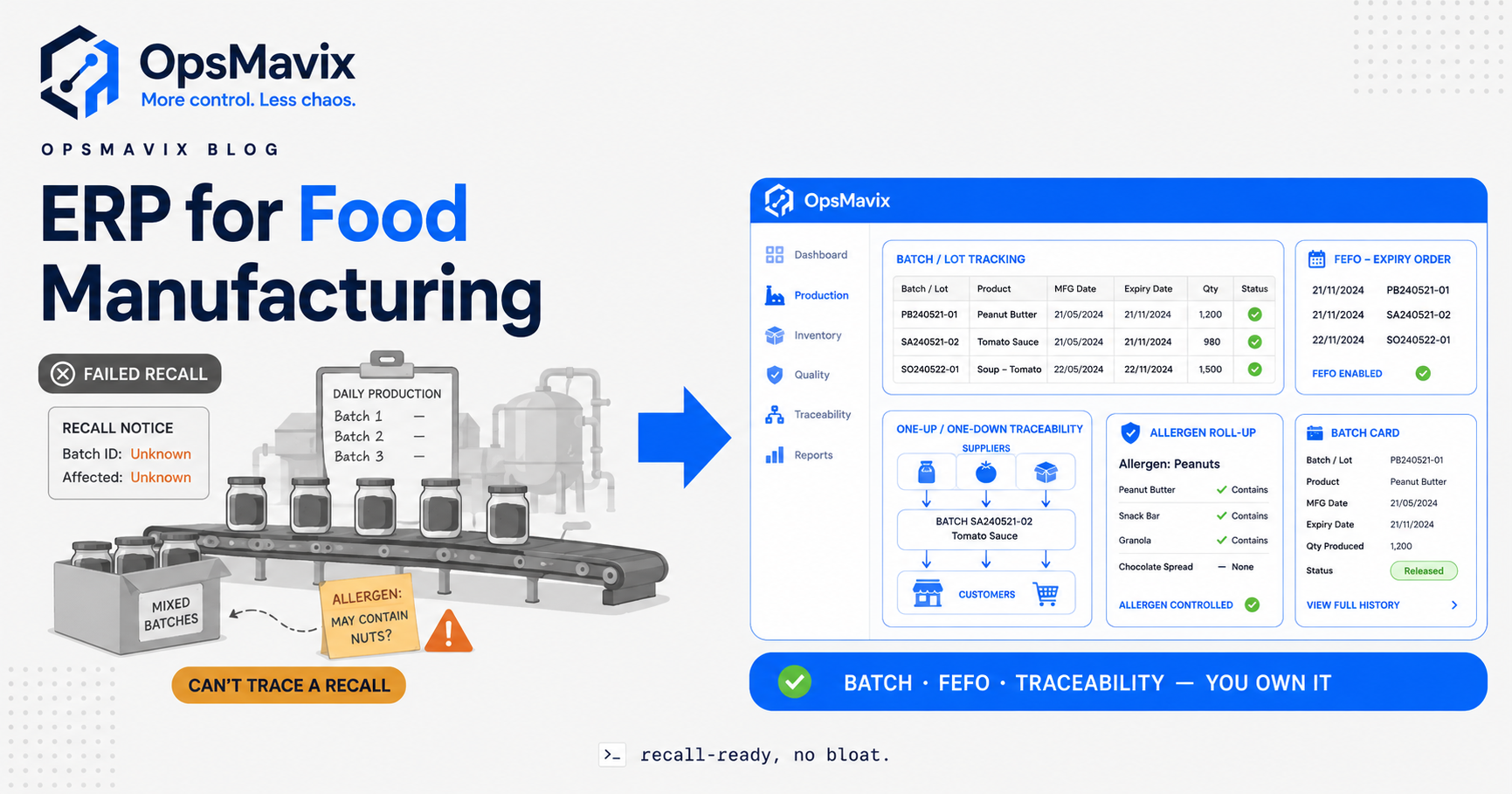
Ask any food manufacturer what keeps them up at night and it’s rarely “we need better accounting software.” It’s the phone call. The supplier notice that a batch of an ingredient is contaminated, and the sudden, cold question: which of our products used it, which customers got them, and can we prove it fast enough to matter? If the answer lives in three spreadsheets, a WhatsApp thread and someone’s memory, you don’t have traceability. You have a liability.
ERP software for food manufacturing is meant to solve exactly this. In theory it ties your recipes, ingredients, production runs, stock, orders and compliance records into one system so you can trace any finished product back to its raw materials and forward to your customers. In practice, most of the ERP systems sold to food businesses were built for general manufacturing and bolted on the food features afterwards. They handle bills of materials and purchase orders fine. Batch genealogy, shelf-life rotation, allergen segregation and a one-hour mock recall? That’s where the cracks show.
Quick summary: Food traceability isn’t a nice-to-have; it’s the single most common reason UK food gets pulled from shelves. A study of Food Standards Agency and Food Standards Scotland data found that of 1,036 recalls issued over a five-year period, 597 involved allergens — more than half of all recalls, with undeclared or mislabelled ingredients the leading cause. Any ERP you buy for a food factory has to make that class of failure structurally hard, not merely possible to document after the fact.
Contents
- What food-manufacturing ERP actually does
- The food-specific must-haves generic ERP gets wrong
- The blind spot: paying for bloat, missing the recall
- Generic tool vs full ERP vs right-sized owned system
- Integrations and why ownership matters
- A worked example: the ingredient that went everywhere
- FAQ
- How OpsMavix can help
- Sources
What food-manufacturing ERP actually does
Strip away the marketing and a food ERP is trying to keep one chain of facts unbroken: this delivery of flour, from this supplier, on this date, went into these production batches, which became these finished pallets, which shipped to these customers on these orders. Get that chain right and everything else becomes possible. Recall in minutes instead of days. Accurate yield costing. Shelf-life you can actually enforce. Audit evidence you can print on demand.
A capable system pulls together the pieces most food businesses currently run separately. Ingredient goods-in with lot capture and supplier certificates. Recipe and formulation management, including versions and yields. Production scheduling and batch records. Stock control that understands expiry, not just quantity. Sales orders, despatch and the customer-side of traceability. And the compliance layer sitting over all of it — allergen data, quality checks, temperature logs, the paperwork an auditor asks for.
The point isn’t the modules. It’s that the data flows through them without being re-keyed or reconciled. Every manual hand-off between systems is a place the traceability chain can snap. That’s the real job. Everything else is plumbing.
The food-specific must-haves generic ERP gets wrong
General-purpose manufacturing ERP assumes you’re making things out of countable parts that don’t expire. Food breaks nearly every one of those assumptions. Here’s what a food system genuinely has to do, and where generic platforms tend to disappoint.
Batch and lot traceability, both directions. Every ingredient lot in, every production batch, every finished lot out — all linked. You need backward trace (what went into this product) and forward trace (where did this ingredient end up). Generic ERP often tracks lots as an optional field rather than an enforced spine, so it’s easy to receive stock or book production without a lot number and quietly break the chain.
One-up, one-down in an hour. UK and EU food law requires you to identify your immediate supplier and immediate customer for any product. A mock recall — pick a lot, list every affected customer and quantity — should take minutes. If your “ERP” needs an analyst to build a query, it fails the only test that counts on a bad day.
FEFO and shelf-life. First-Expired-First-Out, not First-In-First-Out. Stock has to be picked and consumed by expiry date, with alerts before it turns. Systems that only model quantity-on-hand will happily tell you that you have 400 units in stock while half of them expire on Thursday.
Allergen control. Allergens must travel with the ingredient, roll up automatically into every recipe that uses it, and drive both labelling and line-changeover rules. Given that mislabelled allergens are the top cause of UK recalls, “we manage allergens in a separate spreadsheet” is the exact gap that gets a product pulled.
Recipe, formulation and yield. Real recipes scale, substitute, and lose weight during processing. You need versioned formulations, actual-vs-theoretical yield, and costing that reflects what a batch really consumed — not a static BOM that pretends 10kg in becomes 10kg out.
BRCGS / FSA-ready records. BRCGS audits, FSA inspections and major retailer requirements all want evidence: traceability tests, CCP logs, supplier approvals, complaint trails. The system should generate this as a by-product of running the factory, not as a scramble the week before the audit.
None of these are exotic. They’re the baseline for making food safely and legally. The trouble is that generic ERP treats them as add-ons, and the food-specific platforms that do them properly are often heavy and expensive. That gap is the whole story. It’s the same tension we cover in our guide to inventory management software for the food industry — the features you can’t skip versus the platform weight you don’t want.
The blind spot: paying for bloat, missing the recall
Here’s the uncomfortable pattern. A growing food manufacturer outgrows spreadsheets, gets quoted for a full food ERP, and the number comes back at six figures over a two-year implementation. So they either sign up for years of consultancy and per-seat licensing, or they retreat to a cheaper generic tool that doesn’t really understand food and paper over the gaps with — you guessed it — more spreadsheets.
Both routes leave the same blind spot: the traceability chain still has manual joints. A recall event doesn’t care how much you paid. It cares whether the link between that ingredient lot and your despatch records is intact and queryable right now. Plenty of food businesses running expensive ERP still can’t complete a mock recall in an hour, because the expensive part went into finance and MRP while the shop floor kept using paper batch sheets that never made it into the system.
Recalls are getting more consequential, not less. Food-industry analysis of 2024 found that while the number of recall events stayed broadly flat, the number of products recalled per event was 2.5 times higher than in 2023, driven by contamination that rippled across dozens of brands and hundreds of products. When one ingredient problem can touch hundreds of SKUs, the value of clean, instant traceability goes up sharply. The cost of a broken chain does too.
Generic tool vs full ERP vs right-sized owned system
There’s no single right answer here — it depends on your size, complexity and how close you are to a recall-critical operation. Be honest about which you are. A single-line bakery doing local wholesale has very different needs from a multi-site chilled-ready-meals manufacturer supplying supermarkets.
| Capability | Generic / cheap off-the-shelf tool | Full food ERP | Right-sized owned system |
|---|---|---|---|
| Batch & lot traceability | Basic or optional; easy to skip a lot number | Comprehensive, enforced | Enforced on the flows you actually run; built to your process |
| FEFO & shelf-life | Often quantity-only; expiry as a manual field | Full FEFO, alerts, quarantine | FEFO where it matters, without unused modules |
| Allergen roll-up & labelling | Usually a separate spreadsheet | Built in, drives labels | Built in, matched to your product range |
| Mock recall speed | Manual, hours to days | Minutes, if fully adopted | Minutes, by design |
| Fit to how you work | You adapt to the tool | You bend the business to the ERP | The system is built around your process |
| Implementation | Days to weeks | 6–24 months, consultants | Weeks to a few months, staged |
| Cost model | Low monthly, per seat | High licence + per-seat/module, ongoing | Fixed build; you own it, expand later |
| Ownership | Rented; vendor controls roadmap | Rented; locked to vendor ecosystem | Yours — code, data, and roadmap |
| Room to grow | Hit a ceiling, then rip-and-replace | Vast, but you pay for all of it | Expandable, up to a full ERP if you get there |
Read the table honestly. If a cheap tool closes your real leak, use it — we’d tell you so. The generic option is genuinely fine until you outgrow it. The full ERP is the right call for large, complex, multi-site operations that will use most of what they’re paying for. The right-sized owned system exists for the large middle: businesses that need food-grade traceability and shelf-life control now, but don’t need — and can’t justify — a two-year enterprise rollout to get it.
Integrations and why ownership matters
A food ERP never lives alone. It has to talk to your accounting package, your label printers and weigh-scales, EDI feeds for supermarket customers, temperature and CCP monitoring, your warehouse or courier despatch, and often a B2B ordering portal. The quality of those connections decides whether the system saves time or just relocates the manual work.
This is where ownership stops being an abstract principle. With a rented platform, an integration that isn’t on the vendor’s roadmap either doesn’t happen or costs a change-request fee and a wait. When your biggest retail customer changes its EDI spec, you’re at the back of a queue. When you own the system, that integration is a task, not a negotiation — you decide the priority, and the data stays in your control rather than hostage to a licence you have to keep renewing to keep reading your own history.
Ownership also protects the asset you’re really building: the traceability record itself. Years of batch genealogy and supplier data are extraordinarily valuable and, in a dispute or audit, irreplaceable. You want that living in a system you control, exportable and yours, not trapped in a vendor’s database you rent by the seat. This is the same ownership logic we lay out in the broader ERP software for the manufacturing industry guide, and it matters even more when the data is food-safety evidence.
A worked example: the ingredient that went everywhere
The following is illustrative — not a claim about a specific client.
A Midlands sauce and condiment manufacturer runs three production lines, around 120 SKUs, and supplies both independent retailers and one regional supermarket group. Turnover roughly £6m. They’d outgrown spreadsheets two years earlier and were quoted £140,000 plus around £3,000 a month in licences for a full food ERP, with an 18-month implementation. They stalled, and kept limping along with a generic inventory tool plus paper batch sheets.
Then a supplier flagged a possible contamination in a spice blend. The team spent two full days cross-referencing paper batch records against despatch notes to work out which finished products were affected and which customers had them. They ended up recalling far more than necessary — because they couldn’t prove which lots were clean, they pulled everything that might have used the blend. Estimated cost of the over-recall, in scrapped stock, haulage and lost trust with the supermarket buyer: around £38,000. The near-miss on the audit that followed was worse.
A right-sized owned system was scoped to fix exactly this. Enforced lot capture at goods-in, allergen and ingredient roll-up into every recipe, FEFO stock control, and one-click backward/forward trace tied to despatch records. Build cost came in around £22,000, delivered in stages over about ten weeks, integrated with their existing accounting and label printers. The next time a supplier notice came in, the affected-customer list was on screen in under fifteen minutes, and the recall was surgical — the specific lots, nothing more.
The numbers are illustrative, but the shape is real: the cost of not having clean traceability, paid in a single bad week, often dwarfs the cost of building the system that prevents it. And they got there without the six-figure ERP or the two-year wait.
FAQ
Do I really need a full ERP for food manufacturing?
Often, no. If you’re a large, multi-site operation that will use finance, MRP, HR and full supply-chain modules, a full food ERP earns its cost. But many growing manufacturers only need food-grade traceability, shelf-life and allergen control — a fraction of what a full ERP charges for. A right-sized owned system delivers those specific capabilities without the licensing and implementation weight.
Can a generic ERP handle food traceability if we configure it carefully?
Sometimes, to a point. The risk is that generic systems treat lot numbers, expiry and allergens as optional fields rather than enforced rules, so the chain breaks the first time someone’s in a hurry. If the platform lets you book production without a lot number, your traceability is only as good as your most rushed shift. Food-specific enforcement is the difference that matters.
How fast should a mock recall be?
Best practice, and what serious retail customers and BRCGS auditors expect, is a full trace — every affected lot and customer — inside an hour, ideally within minutes. If your current setup can’t manage that, treat it as the priority gap, because it’s the one that turns a supplier notice into a crisis.
What about BRCGS and FSA audit requirements?
A good food system produces audit evidence as a by-product of daily operations: traceability tests, CCP and temperature logs, supplier approvals, complaint records. The goal is that when an auditor asks, you print it, rather than reconstructing it from paper the night before. Owning the system means you can shape those records to exactly what your certification and customers require.
We’re a small manufacturer — is spreadsheets-plus-a-cheap-tool ever fine?
Yes, until it isn’t. For a small, single-line operation with a handful of SKUs and local customers, a cheap tool plus disciplined process can genuinely work. The signals you’ve outgrown it: recalls or mock recalls that take hours, allergen data living in a separate file, expiry write-offs creeping up, or a supermarket customer demanding traceability you can’t produce on demand.
How OpsMavix can help
We build right-sized, owned operations systems for food manufacturers who are outgrowing spreadsheets but not looking — or not willing — to spend two years and six figures on a full ERP. We start by finding where your operation actually leaks: the broken traceability joints, the manual reconciliation, the shelf-life write-offs, the recall you couldn’t run fast enough. Then we build the smallest system that closes those leaks properly — enforced batch traceability, FEFO, allergen roll-up and recall-in-minutes — integrated with the tools you already use and owned outright by you, expandable later if you ever do need a full platform. You can also see how we approach the shop-floor side of this in our manufacturing production tracking work. Start with the free audit: Book a Free Operations Leak Audit
Sources
- Anaphylaxis UK — Allergens dominate UK food recalls, finds study — analysis of FSA and Food Standards Scotland data: 597 of 1,036 recalls over five years involved allergens, more than half of all recalls.
- Food Manufacture — UK food recall trends and lessons from 2024 — 2024 recall analysis: allergen labelling errors the top cause, and products recalled per event 2.5 times higher than 2023.