
ChemInventory Alternative: A Chemical Inventory Built Around Your Lab
A packaged lab tool catalogues your chemicals. It rarely fits the batch, expiry and compliance reality around them. Here's when ChemInventory is the right call, when you've outgrown it, and what a built-for-you chemical inventory does that a template can't.
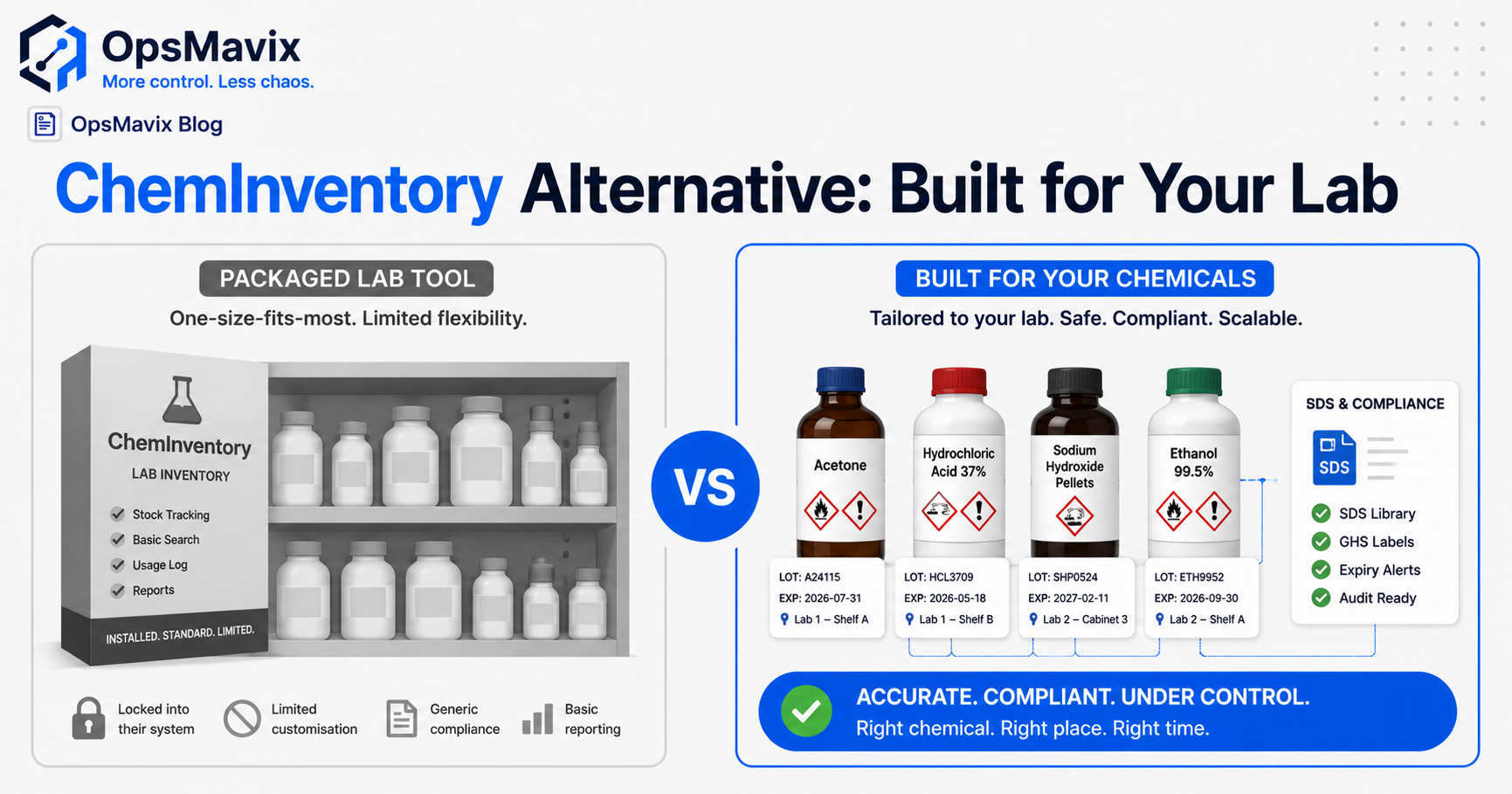
The best ChemInventory alternative depends on what’s actually broken. If you only need a searchable register of containers with SDS sheets and locations, another packaged lab tool will do the same job. If your chemicals feed production, your batches need lot-and-expiry traceability, and your compliance lives in three other systems, the alternative isn’t a different cataloguing app — it’s a custom chemical inventory built around how your material really moves, that ties into the rest of your operation and that you own.
Most people searching for a ChemInventory alternative have hit the same wall. The register works. The mess is everything around the register: a chemical that exists on the shelf, in a batch record, and in a separate spreadsheet, with three different quantities. Expiry dates nobody chases until an audit. Hazard data the floor can’t see at the point they need it. This post covers when a packaged lab tool is the right call, when you’ve outgrown it, and what a built-for-you system changes.
Key Takeaways
- A packaged lab tool catalogues chemicals. It rarely fixes the workflow around the catalogue — batches, production draw-down, compliance, reordering.
- You’ve outgrown off-the-shelf when your real process needs workarounds and side-spreadsheets to fit someone else’s template.
- A custom chemical inventory ties the register to batch-and-lot traceability, expiry, and the production that consumes the material — one figure, not three.
- The deeper win isn’t more features. It’s ownership: no per-seat creep, no sunset, no vendor able to switch off the system your compliance now runs on.
- Don’t rip out a tool that works. Switch only when the leak costs more than the migration.
When a ChemInventory Alternative Actually Makes Sense
ChemInventory does one thing well: it gives a lab a searchable register of containers, with locations, SDS links, hazard classes and expiry fields. For a single lab that needs to know what we have and where it is, that is genuinely enough, and a custom build would be overkill. You look for a ChemInventory alternative when the register stops being the whole job — when the chemicals are inputs to something, and that something lives outside the tool.
That’s the line. A cataloguing app answers “what’s on the shelf.” A growing chemical operation needs to answer “what’s on the shelf, in which batch, against which order, before which expiry, with which hazard control” — and have one number, not a register figure that quietly disagrees with the batch record and the production sheet. One operations manager put the core wound plainly: “We would consistently oversell items we didn’t even have on hand — the stock never matches the system, and I’m running a million messy spreadsheets for the warehouse.” Swap “warehouse” for “stores cupboard” and the chemical version is identical: the register says yes, the shelf says the drum’s empty, and the side-spreadsheet says something else again.
1The Register Was Never the Real Problem
A packaged lab tool catalogues what you log. For a stable, single-lab setup that can be fine for years. But people don’t go hunting for a ChemInventory alternative because the cataloguing broke. They go hunting because everything attached to the register is held together by hand — the batch a solvent went into, the order it was consumed against, the expiry that needs chasing before a run, the reorder nobody owns.
The register isn’t the complaint. The disconnected reality around it is. A cataloguing tool can’t fix that, because the gaps live in the workflow, not the list. This is the same pattern we see across stock-holding businesses, where stock discrepancies creep in the moment inventory is tracked across disconnected places — and a chemical store is a stock-holding business with hazard data and expiry bolted on.
2You’ve Started Keeping Side-Spreadsheets to Cover What It Won’t Do
This is the clearest sign you’ve outgrown off-the-shelf. Packaged tools assume a standard shape: container in, container out, fields filled. Your operation has its own quirks. Decanting one drum into ten working bottles. A batch that consumes part of a lot and returns the rest. A solvent that’s also a regulated precursor. A reorder rule tied to lead time, not a fixed threshold. So you bend your process to fit the tool, then patch the gap with a spreadsheet on the side.
Every side-spreadsheet is a tax you pay forever, and a fresh place for the number to drift. It’s the exact trap manufacturers describe when a rigid tool “forced [them] to change almost every procedure because [it] only has ‘One’ way of doing things” — you either contort the lab to the software or keep a shadow system. A chemical inventory built around your shape leaves nothing to work around.
3Chemicals Don’t Live in One Place — They Move Through Batches and Production
A register watches containers. A real chemical operation watches material flowing through lots, into batches, out into product, with quantities decrementing at every step. A standalone catalogue doesn’t know that 4L of a reagent was drawn into Batch 0612 this morning, so the register figure and the batch record diverge until a count, an audit, or a near-miss surfaces it.
A custom chemical inventory treats every draw-down as a movement against one shared figure — receipt, decant, batch consumption, disposal — so the quantity in the register is the quantity the batch record consumed. That’s where this connects to genuine traceability: the same engine that tells you what’s on the shelf can answer “which finished batches used lot 7741, and which customers received them” if a recall ever lands. That’s a different discipline from cataloguing, and it’s exactly what we cover in batch-and-lot tracking — a sibling problem this post deliberately leans on rather than repeats.
4Compliance and Hazard Data Belong In the Workflow, Not a Separate Tab
SDS links, hazard classes and expiry dates are only useful at the moment someone needs them — at the point of use, at reorder, at audit. In a packaged tool they tend to sit in the register, away from where the work happens, so the floor doesn’t see the control they need and expiry gets chased reactively. The result is the same dread manufacturers describe: the silent ball-drop, “jobs that fall off the plan and only get noticed when a customer calls,” except here it’s an expired reagent in a batch or a missing control surfacing in an audit.
A built-for-you system puts the compliance data where the decision is: expiry alerts before a run, hazard class on the picking view, SDS one tap from the container, a clean audit trail of who used what, when, against which batch. Not a separate compliance tab somebody has to remember to update — the same record, doing double duty.
5The Hidden Cost Is Lock-In, Not the Licence Fee
A packaged tool’s price looks fine until your compliance and traceability depend on it. Then the real risk isn’t the monthly fee — it’s that you don’t own the system your operation now runs on. Plenty of operators have been burned exactly this way before: a previous platform was sunset “by a banner on the vendor’s website,” which “invalidates two years worth of work” and forced a scramble to find a replacement. For a lab, that’s two years of chemical history and audit trail held hostage to a pricing decision you don’t control.
That’s the quiet case for building. When the system is yours, there’s no per-seat creep as the lab grows, no surprise hike, and no vendor who can switch off the tool your audits depend on. You’re not renting your compliance layer; you hold it. The honest question isn’t which lab app to buy — it’s whether you need an operations system or a full ERP, and for most chemical SMBs the answer sits in the middle.
6When NOT to Switch (the Honest Bit)
Be fair to ChemInventory: it’s a focused, well-scoped tool, and for a lot of labs it’s the right call. Replacing working software costs real money and time — migration, retraining, the risk of a bad month while compliance data moves. So don’t switch on principle. If your problem is genuinely “I need a searchable register with SDS and locations” and nothing important is being patched by hand, keep it. Adding complexity you don’t need is its own kind of leak, and a custom build for a single static lab is overkill.
The switch earns its place when the maths tips — when side-spreadsheets, batch divergence, reactive expiry chasing, manual compliance prep, and the dread of a vendor pulling the rug cost you more, month after month, than building the right thing once. Our view is plain: pick the alternative when staying the same costs more than the fix, not before. Then move once, onto a system that won’t make you do this again in two years. If you want the general version of that decision, custom inventory systems walks the build-vs-buy line in more depth.
ChemInventory vs a Custom Chemical Inventory
| ChemInventory (packaged lab tool) | Custom chemical inventory (built for you) | |
|---|---|---|
| Core job | Searchable container register, SDS, locations, expiry fields | Register plus the workflow around it — batches, production, compliance |
| Batch / lot traceability | Limited; lives outside the register | Built in — material draw-down ties to batch and finished product |
| Expiry & hazard | Stored in the tool, away from point of use | Surfaced at use, reorder and audit; alerts before a run |
| Production / order link | Standalone — no link to what consumed the chemical | Decrements one shared figure as batches consume material |
| Side-spreadsheets | Common, to cover what the template won’t do | None — the system matches your shape |
| Ownership | Rented; subject to pricing and sunset | You own it outright — no per-seat creep, no rug-pull |
| Best fit | Single lab needing “what we have and where” | Chemicals feeding production, batches, and real compliance |
FAQ
What is the best ChemInventory alternative?
There isn’t a single best one — it depends on whether your problem is cataloguing or the workflow around the catalogue. If you only need a searchable register with SDS, locations and expiry, another packaged lab tool may be fine. If your chemicals feed batches and production, your traceability needs to survive an audit, and you’re keeping side-spreadsheets to cover gaps, a custom chemical inventory built around your actual flow is the alternative that addresses the real cause.
How is a custom chemical inventory different from a lab register?
A register answers “what do we have and where.” A custom chemical inventory answers that and ties the figure to batch-and-lot draw-down, expiry alerts at the point of use, hazard data on the working views, and the production or orders that consume the material — all against one shared number instead of a register figure, a batch record and a spreadsheet that disagree. You also own it, so no vendor can sunset your compliance history.
Is a custom system more expensive than ChemInventory?
The licence is cheaper to start for a packaged tool. The honest comparison is total cost. A tool that needs constant side-spreadsheets, lets batch quantities diverge, forces reactive expiry chasing, or gets discontinued can cost far more over time than building the right system once and owning it. We’d only recommend the switch when the ongoing leak outweighs the build — for a static single lab, it usually doesn’t.
Can a custom build handle batch and lot traceability for recalls?
Yes — that’s a core reason to build rather than catalogue. The same engine that tracks containers can record which lot went into which batch and which customer received the finished product, so a recall question becomes a query, not a forensic exercise across spreadsheets. We cover the discipline in detail in batch-and-lot tracking.
How do I know I’ve outgrown a packaged lab tool?
The tells: you keep spreadsheets alongside the register, your batch records and the register hold different quantities, expiry gets chased reactively instead of flagged before a run, and your team builds workarounds for cases the tool won’t handle. Those are signs the workflow has outgrown the template, not that you’re cataloguing badly.
How OpsMavix Can Help
OpsMavix builds custom inventory systems shaped to how your material actually moves — receipt, decant, batch consumption, disposal — so every draw-down updates one live figure the shelf, the batch record and the audit trail all agree on. Expiry and hazard data sit where the work happens, lot traceability is built in for when a recall question lands, and there’s nothing a vendor can switch off, because you own it.
If you’ve outgrown a packaged lab tool but you’re not ready for a six-figure enterprise platform, that middle ground is exactly what we build. Book an Operations Leak Audit and we’ll map where your chemical inventory and compliance break down today, what it’s costing you, and whether a custom system is genuinely worth the move.