
3PL Inventory Reconciliation: US Ecommerce Brand Guide
Stop your 3PL count and Shopify stock drifting apart. A US guide to 3PL inventory reconciliation: receipts, adjustments, daily checks and a worked USD example.
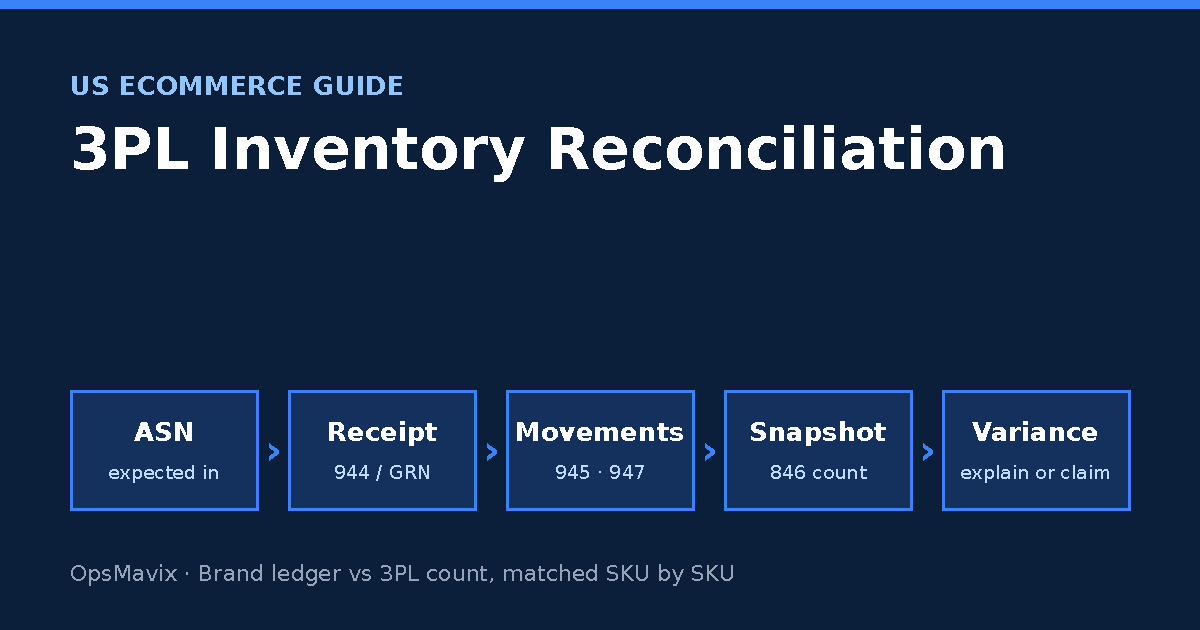
3PL inventory reconciliation is the routine check that your own stock record and your third-party logistics (3PL) warehouse’s count still agree, SKU by SKU, and that every difference has a cause: a short receipt, a damaged unit, a late return, a timing cut-off or genuine loss. For a US ecommerce brand that sells on Shopify or Amazon but ships from a 3PL, it is the difference between selling stock that exists and promising orders you cannot fill.
Most brands only notice the problem when a customer order fails or the quarterly invoice includes a shrink write-off nobody can explain. This guide is about catching drift earlier. If you are mapping the wider process of one stock pool across channels, start with OpsMavix eCommerce inventory automation, which is the service this workflow sits inside.
What 3PL inventory reconciliation actually compares
A 3PL usually sends you two kinds of information. The first is a snapshot: how many units of each SKU it says it holds right now, sometimes split by status (available, damaged, on hold). The second is a stream of transactions: what it received, shipped, restocked and adjusted.
Many brands only look at the snapshot and push it straight into Shopify. That keeps the storefront aligned with the warehouse, but it hides why a number changed. If 40 units disappear between Monday and Tuesday, the snapshot alone cannot tell you whether they were shipped, damaged, miscounted or never received.
Reconciliation rebuilds the expected on-hand figure from the transactions and compares it with the snapshot:
Expected on hand = opening balance
                 + units received (per 3PL receipt)
                 + returns restocked to sellable
                 - units shipped (per 3PL shipment confirmation)
                 - adjustments reported by the 3PL (damage, found, lost)

Variance = 3PL snapshot - expected on hand
A zero variance means the warehouse’s count is explained by the transactions it reported. A non-zero variance means something happened that nobody recorded, or something was recorded on the wrong date or SKU.
The records you need from your 3PL
Ask for these as structured data (EDI, API or a scheduled file) rather than PDF reports. Many US 3PLs that work with retailers already use the X12 EDI warehouse transaction sets, so it is worth knowing the names when you read a 3PL’s integration guide.
| Record | What it tells you | Common X12 equivalent |
|---|---|---|
| Advance ship notice (ASN) from your supplier | What should arrive, by SKU and quantity | 856 (or a supplier packing list) |
| Warehouse receipt confirmation | What the 3PL actually counted in | 944 Warehouse Stock Transfer Receipt Advice |
| Shipping order you send | Which orders the 3PL should ship | 940 Warehouse Shipping Order |
| Shipment confirmation | What actually left, by order and SKU | 945 Warehouse Shipping Advice |
| Inventory adjustment advice | Changes in quantity or status (damage, cycle-count corrections) | 947 Warehouse Inventory Adjustment Advice |
| Inventory snapshot | Current on-hand by SKU, sometimes by status | 846 Inventory Inquiry/Advice |
You do not need EDI to reconcile. A daily CSV with the same fields works, as long as every line carries a SKU, quantity, date and a reference you can trace (receipt number, order number or adjustment reason). What you cannot reconcile is a total with no transactions behind it.
If your business also receives retailer EDI orders, our guide to EDI order processing for wholesale distributors covers the sales side of the same standards.
Why brand and 3PL counts drift apart
Receiving differences
The supplier’s ASN says 1,000 units; the 3PL counts 960. If your system books the ASN quantity as received, you are 40 units “long” from day one. Always book the 3PL’s confirmed receipt, and track the ASN difference separately as a supplier claim.
Unreported adjustments
Cycle-count corrections, damaged units moved to a hold location and units found during a recount all change the snapshot. If the 3PL does not send a matching adjustment record, the snapshot moves and your ledger does not.
Returns stuck in limbo
A returned parcel may be received but not yet inspected. Some 3PLs add it back to sellable stock immediately, others only after grading. If your ledger assumes one and the warehouse does the other, the variance appears and disappears as returns are processed. Our returns management guide covers grading and restock decisions in more depth.
Timing cut-offs
The snapshot is taken at 6:00 a.m. Eastern; the last shipment file covers orders up to midnight Pacific. Orders shipped between those times show up as a temporary variance that clears the next day. Agree a single cut-off time and time zone with your 3PL, in writing.
SKU and unit-of-measure mapping
A case of 12 booked as 1 unit, or a variant SKU mapped to the wrong parent, produces large variances that look like theft. Check mapping before you raise a loss claim. The wider list of causes is in our article on types of stock discrepancies.
A daily and monthly reconciliation workflow
Daily: check the movers
- Import the previous day’s receipts, shipment confirmations, returns and adjustments.
- Rebuild expected on hand for SKUs that moved.
- Compare with the morning snapshot.
- Flag any SKU with a variance outside your agreed tolerance and an active listing.
- Hold the channel quantity for flagged SKUs at the lower of the two figures until someone has looked.
The fifth step matters. Pushing the higher number to Shopify or Amazon is how phantom stock turns into oversold orders. If you already use channel buffers, our guide to setting a safety buffer per channel explains how buffers interact with sync delays; a buffer is not a substitute for finding the variance.
Weekly: work the exception list
Group open variances by type (receiving, adjustment, returns, timing, mapping, unexplained). Send the 3PL one list with SKU, quantity, dates and the transaction references you used, rather than a stream of individual emails.
Monthly: close the period
At month end, every SKU should be either reconciled, explained with an agreed cause, or logged as an unexplained loss. Unexplained losses are what you compare against any inventory-accuracy or shrink allowance in your warehouse agreement. Contract terms vary widely, so check the actual wording of your agreement for allowances, claim windows and evidence requirements rather than assuming an industry standard.
Exporting the month’s adjustments also gives your accountant a cleaner basis for inventory valuation than a single year-end correction.
Worked US example: one SKU, one month
Hypothetical example, all amounts in USD. A skincare brand ships from a single 3PL. For one SKU with an assumed landed cost of $22 per unit, the month looks like this:
| Movement | Units | Source record |
|---|---|---|
| Opening balance (reconciled last month) | 500 | Last month’s close |
| Supplier ASN quantity | 1,000 | 856 / packing list |
| Units the 3PL confirmed received | 960 | 944 receipt |
| Units shipped to customers | 620 | 945 shipment confirmations |
| Returns restocked to sellable | 15 | Returns file |
| Damage adjustment reported by 3PL | -8 | 947 adjustment |
| Expected on hand | 847 | 500 + 960 + 15 - 620 - 8 |
| 3PL month-end snapshot | 839 | 846 snapshot |
| Variance | -8 | 839 - 847 |
Two separate issues come out of this:
- Supplier short shipment: 1,000 - 960 = 40 units, or 40 × $22 = $880, to raise with the supplier using the ASN and the 3PL’s receipt record. This is not the 3PL’s variance.
- Unexplained warehouse variance: 8 units, or 8 × $22 = $176, to investigate with the 3PL. It might be an unrecorded damage, a mis-pick sent on another order, or a timing issue that clears next month.
If the brand had simply copied the 3PL snapshot into Shopify, the storefront would be correct, but the $880 supplier claim and the $176 warehouse question would both have been invisible. If it had booked the ASN quantity instead, it would have believed it held 887 units and could have sold 48 units it did not have.
These figures are illustrative assumptions, not benchmarks or client results.
When phantom stock becomes a customer problem
Overselling is not only an inconvenience. The Federal Trade Commission’s Mail, Internet, or Telephone Order Merchandise Rule requires sellers to have a reasonable basis for any shipping time they state, or to be able to ship within 30 days if they state none. If you cannot ship on time, the FTC’s business guide says you must seek the customer’s consent to the delay, tell them they can cancel for a full refund, and refund promptly if the order is cancelled.
Reconciliation will not make you compliant on its own, but stock figures you can explain are part of having a reasonable basis for the delivery promises your storefront makes. Talk to a qualified adviser about how the rule applies to your own order flow.
How the 3PL count reaches Shopify
Shopify lets a 3PL connect as a fulfillment service. Shopify’s developer documentation for the FulfillmentService object describes an inventoryManagement setting for whether the fulfillment service tracks inventory and sends updates to Shopify, with Shopify periodically fetching stock levels from the service’s callback endpoint or the service submitting quantities through the API. Shopify also creates a location for the fulfillment service.
In practice, that means the 3PL’s number can overwrite the quantity at that location on a schedule. Decide which system is the authority for the sellable quantity at each location, and whether a flagged variance should block or delay that update. If you also sell on Amazon, the same question applies to FBA versus merchant-fulfilled stock; see our guide to Amazon inventory management.
Once the update path is agreed, monitor it. Our Shopify inventory sync monitoring guide covers alerts for stale or failed stock updates.
Spreadsheet, 3PL portal or connected system?
| Approach | Fits when | Watch out for |
|---|---|---|
| Spreadsheet from 3PL exports | Under a few hundred active SKUs, one 3PL, weekly checks | Manual imports, formulas breaking, no audit trail of who changed what |
| 3PL’s own portal reports | You trust the 3PL’s data and only need visibility | It shows the 3PL’s view; it will not reconcile against your records or your supplier’s ASN |
| Inventory or OMS app with 3PL connector | Standard flows, supported 3PL, modest exceptions | Whether it imports adjustments and receipts, or only the on-hand total |
| Connected custom workflow | Several 3PLs or channels, custom claim rules, finance needs a clean month-end | Build and maintenance cost, and the 3PL’s data quality still limits the result |
Whichever route you choose, test it with real records before you rely on it. Ask the provider to load one month of your 3PL’s receipts, shipments and adjustments and show the variance by SKU. If it can only display the snapshot, it is a sync tool, not a reconciliation tool.
If you run the warehouse side yourself, the needs are different; our article on 3PL inventory management software is written for fulfilment providers.
Implementation checklist
- Agree the snapshot cut-off time and time zone with the 3PL.
- Get receipts, shipments, returns and adjustments as line-level data with references.
- Map every SKU and unit of measure once, and test a case-pack SKU explicitly.
- Set a variance tolerance by SKU value or velocity, not one number for everything.
- Decide whether flagged SKUs hold the channel quantity at the lower figure.
- Keep supplier receiving claims separate from 3PL variances.
- Record who resolved each variance, the cause and the date.
- Close each month with a list of reconciled, explained and unexplained SKUs.
- Re-check your warehouse agreement for allowance and claim-window wording.
Costs and limitations
The main cost is time: someone has to work the exception list, and a 3PL has to send clean data. A connected system reduces the import and matching work, but it cannot fix missing adjustment records or a 3PL that only reports totals. Budget for an initial clean-up of SKU mapping and opening balances; reconciling from an unreconciled starting point just carries old errors forward.
Be realistic about benefits, too. Finding an $880 supplier short shipment is cash you can claim. Faster detection of unexplained variance protects customer orders, but staff time saved is capacity, not automatically a cash saving.
Frequently asked questions
How often should a brand reconcile with its 3PL?
Daily for SKUs that moved and are listed for sale, and a full close monthly. Low-volume catalogs may manage with weekly checks, provided channel quantities do not run ahead of the warehouse in the meantime.
Should Shopify show my number or the 3PL’s number?
Pick one authority per location and document it. Many brands let the 3PL’s snapshot drive the sellable quantity but hold flagged SKUs at the lower of the two figures until the variance is explained.
Is a small variance normal?
Some timing variance is expected around cut-offs and returns. What matters is whether it clears and whether the unexplained remainder stays within what your agreement and margins can absorb.
Do I need EDI to reconcile with a 3PL?
No. Structured files or an API with the same fields work. The essential part is line-level transactions with references, not the transport format.
Can OpsMavix connect to my 3PL?
That depends on what data your 3PL can provide. We scope the connection after reviewing a sample of your 3PL’s receipts, shipments and adjustments, and we will tell you if the data is not good enough to reconcile against.
Make your 3PL count explainable
A 3PL snapshot tells you what the warehouse believes. Reconciliation tells you why it believes it, and what to claim when the numbers do not add up. Start with your top 50 SKUs by sales, one month of transactions and a single agreed cut-off.
If your Shopify stock, 3PL reports and supplier ASNs live in separate places, talk to OpsMavix about eCommerce inventory automation. For brands that also hold stock in their own warehouse, our inventory automation system covers multi-location stock in one place. Bring one month of your 3PL’s exports and send us an enquiry.
Sources and further reading
- FTC: Business Guide to the Mail, Internet, or Telephone Order Merchandise Rule — shipping-time, delay-notice and refund requirements; reviewed 25 October 2026.
- Shopify developer documentation: FulfillmentService object — inventory tracking and fulfillment service locations; reviewed 25 October 2026.
- X12 947 Warehouse Inventory Adjustment Advice (Stedi reference)
- X12 944 Warehouse Stock Transfer Receipt Advice (Zenbridge reference)
- X12 846 Inventory Inquiry/Advice (Stedi reference)
- X12 940 Warehouse Shipping Order and 945 Warehouse Shipping Advice (Stedi references)
The workflow, tolerances and USD figures in this article are practical suggestions and hypothetical examples, not legal advice, benchmarks or client results. The cover is an OpsMavix diagram.
Keep reading

Getting value from OpsMavix? Add us as a preferred source on Google — you'll see more of our operations content in your AI Overviews, AI Mode and Search.