
Returns Management: Handling the Stock That Comes Back
A returns management system is how you handle stock coming back — the reverse flow most operations run on email and memory. Raising an RMA, receiving and inspecting the return, deciding restock or repair or scrap, syncing good stock, refunding fast, and reading return-rate patterns. Here's how growing businesses stop returns leaking stock and cash.
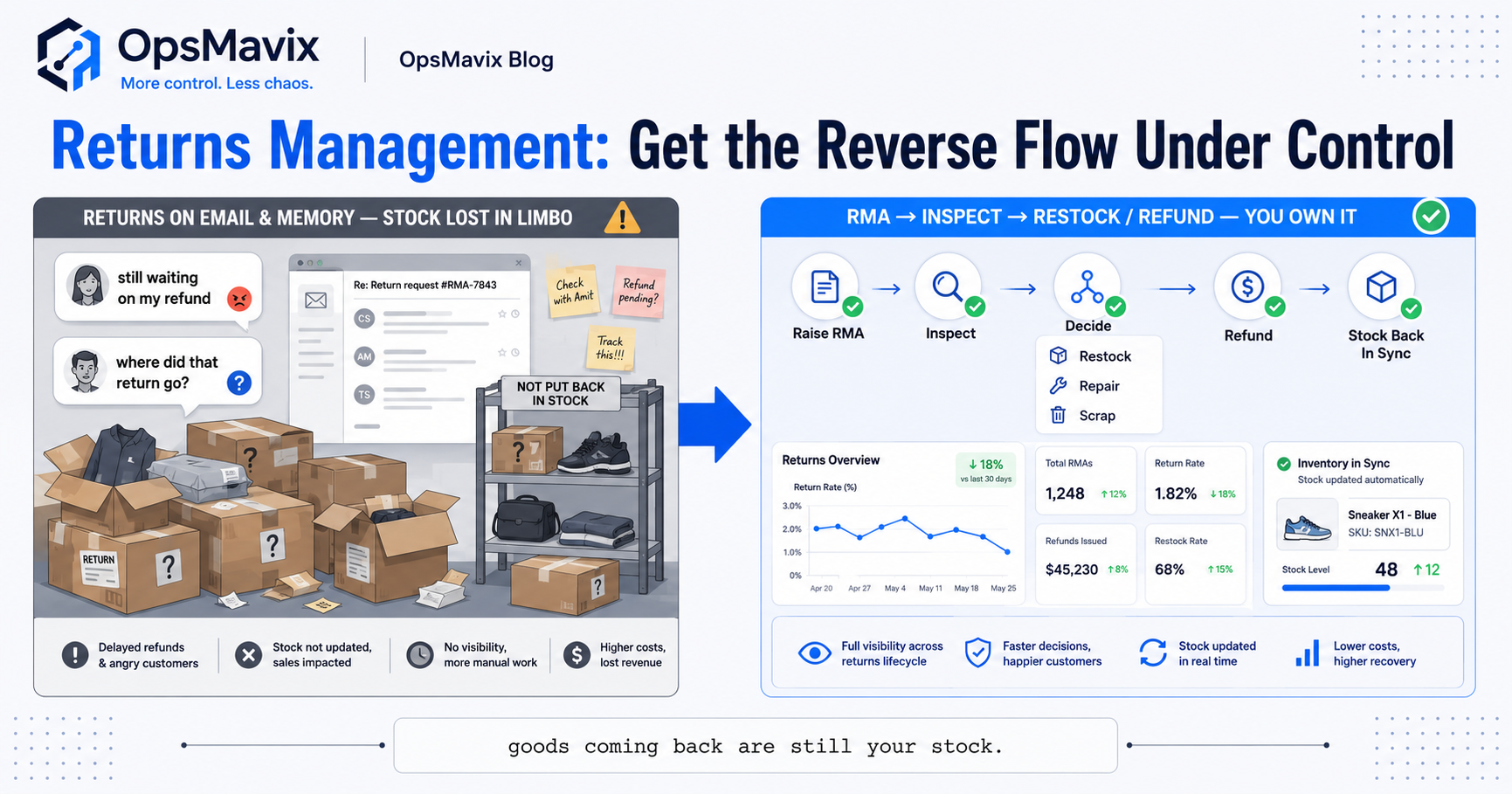
A returns management system is how you handle stock coming back the other way — a customer sends something back, and you have to raise an RMA, receive it, inspect it, decide what happens to it, and settle the money. It’s the reverse of everything a normal order does. Where fulfilment pushes stock out and takes cash in, a return pulls stock back and pays cash out, and every step has to run backwards without dropping the item, the refund, or the stock count. An RMA — a return merchandise authorisation — is simply the ticket that tracks one returned item through that whole reverse journey, from the moment the customer asks to send it back to the moment it’s either back on the shelf or written off.
Most growing businesses have a tight forward process and almost nothing for the reverse one. Returns get handled on email threads and someone’s memory: a customer emails asking to send something back, someone says “yeah, send it,” a box turns up days later that nobody can match to the conversation, it sits on a desk, and the refund goes out whenever someone remembers. The stock never gets added back, or gets added back damaged, and nobody can tell you how much value is sitting in that returns pile right now. This post is about the reverse flow — the opposite direction to backorder management, which deals with forward orders you can’t yet fill. Returns are the goods already sold, coming home.
Key Takeaways
- A returns management system runs the reverse flow — RMA, receive, inspect, decide, restock, refund — the mirror image of a normal order, and the part most businesses never built.
- An RMA is the authorisation and tracking ticket for one returned item; without it, a box arrives with no idea what it is, whose it is, or why it’s back.
- Inspection is the fork: the same returned item can be restocked, repaired, or scrapped, and that single decision changes both your stock and your cost.
- Good stock only helps you if it’s synced back into inventory the moment it passes inspection — a return sitting uncounted is stock you own but can’t sell.
- A refund or credit tied to the RMA means the money settles when the goods and inspection say so, not on a customer’s chasing email.
- Return-rate patterns are free product and supplier intelligence — a spike on one line is telling you something, if anyone’s reading it.
1The Reverse Flow Nobody Builds
Every business builds a forward process because you can’t take money without one. You capture the order, pick it, ship it, invoice it. The reverse — a customer sending goods back — gets handled by whoever’s nearest the inbox, because returns feel like an exception rather than a process. So they run on email and goodwill, and they leak in exactly the places a real process would catch.
The reverse flow has the same number of steps as the forward one, just backwards, and each step can fail. Authorise the return (or don’t, and get flooded with unexpected boxes). Receive it and match it to the customer (or don’t, and stare at an unlabelled parcel). Inspect it (or don’t, and restock something broken). Sync the stock (or don’t, and undercount). Refund (or don’t, and get chased). A returns management system is simply the discipline of running each of those steps on purpose instead of hoping the email thread holds it together.
This is the specialised sibling of your wider B2B order management picture. Order management assumes goods flowing out to a customer. Returns management starts precisely where that assumption reverses — the goods are coming back, and the system has to run in the other direction without losing the thread.
2The RMA: Authorise Before the Box Turns Up
The single change that fixes the most returns chaos is raising an RMA before the goods move. An RMA — return merchandise authorisation — is a ticket created the moment a customer asks to return something: it records what’s coming back, whose it is, the original order, the reason, and what they’re owed. It travels with the parcel (a reference on the box or the paperwork) so when it lands, you know instantly what it is instead of guessing.
Without an RMA, the return starts blind. A box arrives with no reference, someone has to reverse-engineer which customer and which order it belongs to from the contents, and half the time it sits unmatched for days while that detective work waits for a quiet moment. With an RMA, the parcel scans or matches to an open ticket the second it hits goods-in, and the whole reverse flow has something to hang on. One operations lead we spoke to described their old returns as “a shelf of mystery boxes” — the fix wasn’t more staff, it was refusing to let anything come back without a number attached.
The RMA is also where you set the rules up front: is this return in policy, inside the window, the customer’s fault or yours? Deciding that at authorisation — not when the box is already on your desk and the customer’s already annoyed — is what keeps returns from becoming arguments.
3Receiving and Inspecting the Return
Once the box arrives, receiving a return is the mirror of your goods receiving process — except instead of matching to a purchase order, you’re matching to an RMA, and instead of trusting the condition, you’re assessing it. The return lands, you match it to its ticket, and then the real work starts: inspection. Because a returned item, unlike a fresh delivery, is an unknown. It could be pristine, unopened, and instantly resaleable. It could be used, damaged, or missing parts. It could be the wrong thing entirely, sent back by mistake.
Inspection is what turns that unknown into a decision, and it can’t be skipped or rushed. Restock something that’s actually scuffed and you’ll ship it to the next customer as new, earning a second return and a worse review. Scrap something that was perfectly fine and you’ve thrown away good margin. The inspector’s job is to grade the return honestly — resaleable, repairable, or dead — and record it against the RMA so the next step is driven by fact, not by a tired guess at the end of a Friday.
For a wholesale or ecommerce operation handling volume, this is where a written grading standard earns its keep. “Good enough to resell” can’t mean whatever the person holding the item thinks it means today. A consistent inspection standard is what makes the restock-or-scrap decision defensible and repeatable instead of a coin-flip that quietly costs you either way.
4The Decision: Restock, Repair, Scrap, Refund
Inspection feeds the fork that defines returns management: what actually happens to this item? There are four common answers and they cost wildly different amounts. Restock — it’s as-new, it goes back into sellable inventory and you recover full value. Repair or refurbish — it needs work before it can sell again, so it carries a cost but salvages most of the value. Scrap or write off — it’s dead, and you record the loss cleanly instead of pretending it’s still an asset. And separately, the money: refund, replace, or credit the customer.
The mistake is treating these as one decision. Whether the customer gets their money back is a customer-service and policy question. Whether the item goes back on the shelf is a stock-and-quality question. Tangle them together and you get the worst outcomes — refunding but binning a perfectly good item, or restocking junk to avoid “wasting” it. A returns system keeps the two decisions linked to the same RMA but distinct: the refund can go out on policy while the item’s physical fate is decided on its condition.
5Getting Good Stock Back Into Sync
A return that passes inspection as resaleable is only worth something if it actually re-enters your sellable inventory — at the right location, at the right count, right away. This is the step that quietly leaks the most, because it’s invisible: the item’s physically back, the customer’s refunded, everyone’s moved on, and nobody actually incremented the stock figure. Now you own units you can’t sell because your system doesn’t know they exist. That’s dead capital hiding in plain sight.
Syncing good returns back in is where returns management meets multi-location inventory head-on. The item has to land in a specific, known location — ideally back in its normal pick face, not a returns limbo shelf that never gets counted — and the live stock figure has to move the moment it’s graded resaleable. If your returns pile and your sellable stock are two different worlds, you’ll be buying more of something you already have sitting in a box three feet away, and reordering against numbers that are wrong by exactly the size of your returns backlog.
6Refunds and Credits Without the Chasing
The money side of a return is where customer trust is won or lost, and where a lot of operations quietly bleed goodwill. When a refund or credit is tied to the RMA, it settles on a clear trigger — goods received and inspected, or received alone, depending on your policy — instead of on whoever shouts first. The customer isn’t left chasing an email asking where their money is, because the RMA already knows the return arrived and what they’re owed.
The alternative is the state most growing businesses actually live in: refunds processed manually, from memory, whenever someone gets to the inbox. Some go out fast, some go out slow, a few go out twice, and the occasional one never goes out at all until the customer chases hard enough. That inconsistency is what turns a returning customer — who might well have bought again — into a one-star review about how hard it was to get their money back. A returns system makes the refund a consequence of the process reaching its settled point, not a favour someone remembers to do.
7Reading Return-Rate Patterns
The last thing a returns system gives you that email and memory never can: the pattern. When every return is a ticket with a reason code, you can finally see the shape of your returns instead of just feeling swamped by them. A single product line returning far more than the rest is telling you something specific — a sizing problem, a misleading listing, a quality issue from one supplier batch, a packaging fault damaging things in transit. That’s product and supplier intelligence you already paid to collect, sitting unread in a hundred separate email threads.
Handled inside a proper returns system, reason codes aggregate: this SKU, this supplier, this reason, this month. Now a returns spike becomes an action — change the listing, challenge the supplier, adjust the packaging, pull the line. Our view at OpsMavix is that most businesses treat returns purely as a cost to minimise. They’re also a feedback channel. The forward order tells you what customers want; the return tells you where the product, the description, or the supplier is failing them. One of those is worth reading closely.
Put it in pounds. Before: returns run on email, boxes go unmatched for days, good stock sits uncounted on a limbo shelf, refunds go out late and sometimes twice, and nobody can say what the returns pile is worth — so a chunk of recoverable stock quietly ages into a write-off it never needed to be. After: every return is an RMA, matched at the door, inspected to a standard, graded stock synced straight back into sellable inventory, refunds settled on trigger, and every reason code feeding a pattern you can act on. The volume of returns hasn’t changed. What’s changed is how much value you recover from each one instead of losing it to your own reverse flow.
FAQ
What is a returns management system?
A returns management system is the process and software that handles stock coming back from customers — the reverse of a normal order. It covers raising an RMA to authorise the return, receiving and inspecting the item, deciding whether to restock, repair, or scrap it, syncing good stock back into inventory, and settling the refund or credit. It’s the reverse-flow half of order management, and it’s the part most growing businesses run on email and memory rather than a real process.
What is an RMA and why do I need one?
An RMA (return merchandise authorisation) is a ticket raised the moment a customer asks to return something. It records what’s coming back, whose it is, the original order, the reason, and what they’re owed, and it travels with the parcel. Without one, a returned box arrives unlabelled and someone has to work out which customer and order it belongs to before anything can happen. The RMA is what lets a return match to a known ticket at the door instead of sitting as a mystery box.
How do I decide whether to restock or scrap a return?
Through inspection, against a consistent grading standard. A returned item is an unknown until someone assesses it: resaleable as-new goes back into sellable stock, repairable carries a refurbishment cost but salvages most of the value, and genuinely dead stock gets written off cleanly. The important thing is that “good enough to resell” is a written standard, not a tired guess, so the same condition always gets the same decision instead of costing you value in both directions.
How is returns management different from backorder management?
They’re opposite directions. Backorder management handles forward orders you’ve accepted but can’t yet fulfil because stock isn’t available — goods you owe going out. Returns management handles goods already sold that are coming back in. One pushes stock towards the customer and waits on supply; the other pulls stock back and has to inspect, decide, restock, and refund. A growing operation needs both, but they’re separate reverse-and-forward problems.
Why does returned stock so often go missing from my inventory?
Because syncing good returns back into sellable stock is an invisible step that’s easy to skip. The item’s physically back and the customer’s refunded, so everyone moves on — but nobody actually increments the stock figure or puts the item back in its pick face. It ends up on a returns shelf the counts never reach, so you own units you can’t sell and reorder stock you already have. The fix is grading resaleable returns straight back into a known location and moving the live figure at that moment.
How OpsMavix Can Help
Most returns pain isn’t a returns-volume problem — it’s a reverse-flow you never built. Boxes arrive unmatched, inspection is a Friday-afternoon guess, good stock never makes it back into the count, refunds go out late or twice, and nobody can say what the returns pile is worth. OpsMavix builds custom internal systems that run returns as a real process: an RMA raised before the goods move, matched at goods-in, inspected to a standard, graded stock synced straight back into sellable inventory at a known location, refunds settled on trigger, and every reason code feeding a return-rate pattern you can actually act on. Sized for growing businesses past spreadsheets but nowhere near needing a full ERP.
We start by finding where value leaks out of your reverse flow — the unmatched boxes, the uncounted resaleable stock, the refunds that turn returning customers into bad reviews — and then build only what closes those gaps, around your products, your policy, and the way your goods-in bench already works. Not an off-the-shelf module you bend your process around; a returns system that fits how you already sell and receive. Book a Free Operations Leak Audit.