
EDI Order Processing for Wholesale Distributors: US Guide
Turn retailer EDI purchase orders into accurate picks, acknowledgments and ship notices. A US distributor guide to 850-to-810 workflows, exceptions and costs.
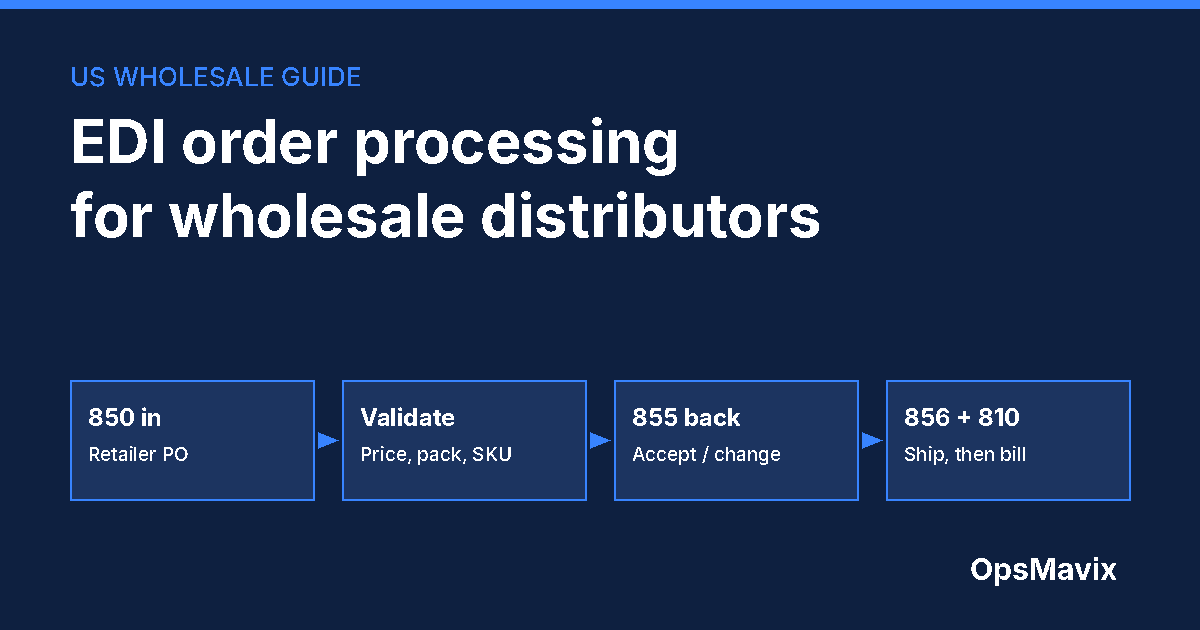
EDI order processing is the work that happens between a retailer’s electronic purchase order arriving and your correct shipment, ship notice and invoice going back. For a US wholesale distributor, the EDI provider usually handles the format and the connection; your order workflow still has to check every line against your prices, pack sizes and stock before anyone promises or picks anything.
Most problems blamed on “EDI” start after translation. A purchase order lands cleanly, but the item cross-reference is out of date, the case quantity is read as eaches or the price on the PO does not match your agreed price list. The acknowledgment goes back as if all is well, and the mismatch surfaces at the dock or as a deduction on the remittance.
EDI order processing in 30 seconds
- The X12 standards used across US retail and distribution define the documents: the 850 purchase order, 855 purchase order acknowledgment, 856 ship notice/manifest and 810 invoice are the core set for most supplier flows.
- Your EDI provider or translator converts those documents into data your systems can read. It does not know whether a price is wrong or a pallet is short.
- Validation belongs in the order workflow: item mapping, units of measure, price, ship dates, stock and the trading partner’s rules.
- The 856 ship notice should describe what physically left the building, case by case or pallet by pallet, not a copy of the original order.
- Retailers set their own compliance requirements and can deduct from invoices when documents or labels do not match. Each partner’s guide decides the detail.
If orders already arrive cleanly but your team still re-keys them, checks them by hand or chases mismatches after shipping, the problem is usually the handoff into order management. That is the area a wholesale order management system is built to address, alongside the EDI provider you already use.
How the core EDI documents fit together
X12 publishes a supply chain transaction flow that shows how these documents relate. In plain terms:
| Document | Who sends it | What it is for | What usually goes wrong |
|---|---|---|---|
| 850 Purchase Order | Retailer or buyer | Places the order: items, quantities, prices, ship-to, dates | Partner item codes or units not mapped to your item master |
| 855 PO Acknowledgment | Supplier | Confirms acceptance, changes or rejections line by line | Sent automatically before stock and price are checked |
| 860 / 865 change documents | Buyer / seller | Request or acknowledge changes to an existing order | Change applied to the order but not to the pick already released |
| 856 Ship Notice/Manifest | Supplier | Describes what shipped and how it is packed | Built from the order instead of the scanned cartons |
| 810 Invoice | Supplier | Bills for goods shipped | Invoices ordered quantities or a price the buyer did not expect |
| 997 Functional Acknowledgment | Receiver of a document | Confirms a document was received and could be processed | Treated as business approval, which it is not |
Not every partner uses every document, and partners can publish their own implementation guides with required segments and timing. Always work from the guide your customer issues, not from a generic template.
Step 1: Map the partner’s order to your own records
A retailer’s 850 may identify products by its own item number, a UPC or GTIN, your vendor part number or a combination. Your order system needs one reliable cross-reference per trading partner so every line resolves to exactly one of your items.
Check the unit of measure on every line
Units are the quietest source of costly errors. If a PO line reads 40 CA (cases) and your item master stores eaches with 12 per case, the order is 480 units. A mapping that drops the unit code could create an order for 40 units, or the reverse could multiply a single-unit order by a case quantity.
Store the pack hierarchy against the item, including inner packs where they matter, and convert explicitly on intake. Our guide to wholesale pack size management covers how to keep cases, cartons and eaches consistent from order to pick list.
Stop unmapped lines rather than guessing
An unknown item code should create a visible exception with the original partner reference, not a line silently matched to the nearest SKU. The exception queue needs an owner and a time target, because the 855 is waiting on it.
Step 2: Validate price, dates and stock before acknowledging
Where a partner uses the 855, it should reflect what you will actually ship. That makes the checks before the 855 more important than the speed of sending it.
Compare the PO price with the agreed price
Compare each line’s price with the cost or price agreed for that partner and date. Where they differ, decide in advance who resolves it, whether the line can be accepted at the PO price while the difference is raised, and whether the invoice will follow the PO or the agreement. The answer is commercial, not technical, so write it down per partner.
Check stock and promise dates honestly
Check available stock after existing reservations, not the on-hand figure alone. If you cannot fill a line in full by the requested date, the partner’s rules decide whether you accept a lower quantity, backorder, substitute or reject. Use the 855 to say so before shipping, rather than letting the shortage appear on the 856.
Where you do carry a shortfall forward, the same allocation discipline described in our backorder management guide applies: fair allocation, a real promise date and a clear trigger to replenish.
Respect other holds
A clean EDI order can still need a credit decision. Keep credit restrictions separate from data validation so releasing one does not clear the other, as covered in our sales order credit hold guide.
A worked US dollar example
The figures below are invented to show the workflow. They are not real retailer terms, typical deduction amounts or an OpsMavix customer result.
A retailer sends an 850 with three lines:
| Line | Item | Ordered | PO price per case | Line value |
|---|---|---|---|---|
| 1 | SKU A, 12 eaches per case | 40 cases | US$216.00 | US$8,640.00 |
| 2 | SKU B, 6 eaches per case | 25 cases | US$90.00 | US$2,250.00 |
| 3 | SKU C, 24 eaches per case | 10 cases | US$132.00 | US$1,320.00 |
| PO total | US$12,210.00 |
Validation finds two issues:
- Price: the agreed price for SKU B is US$94.00 per case. At 25 cases, the PO is US$100.00 below the agreement (25 × US$4.00).
- Stock: only 6 cases of SKU C are available for the requested ship date, so 4 cases (US$528.00 at the PO price) cannot ship on time.
Line 1 converts correctly to 480 eaches for picking. Under this example partner’s rules, the supplier acknowledges Line 1 in full, accepts Line 2 at the PO price while raising the difference with the buyer, and acknowledges Line 3 as 6 cases with the balance backordered.
If the shipment then leaves as acknowledged, the shipped value at PO prices is US$8,640.00 + US$2,250.00 + US$792.00 = US$11,682.00. The 856 lists the cartons actually scanned, and the 810 bills the 6 cases of SKU C that shipped, not the 10 ordered.
The point of the example is the sequence. Each decision is made once, recorded against the order and carried through to the acknowledgment, the pick, the ship notice and the invoice.
Step 3: Build the ship notice from what was packed
The 856 ties the order to the delivery. X12 describes it as the transaction that “ties the order to the delivery process”, and retailers can use it to plan receiving and match labeled cartons to the order.
That only works when the ship notice matches the physical shipment. Practical rules:
- Generate the 856 from scan or pack confirmation, not from the order lines.
- Record the carton or pallet hierarchy your partner requires, typically shipment, order, pack and item levels.
- Use the serial shipping container code (SSCC) on each logistics label where the partner requires it. GS1 US describes the SSCC as an 18-digit identifier assigned to a logistics unit such as a case or pallet.
- Send the notice within the partner’s required window, which their guide states.
- Hold the invoice until the shipment is confirmed, so the 810 can only bill what shipped.
Step 4: Handle changes and exceptions without losing the thread
Buyers change orders. An 860 change request may arrive after picking has started; a phone call may agree a substitution that never reaches the EDI record. Your workflow should show, per order, the original request, every accepted change and the version currently released to the warehouse.
If a change arrives after release, the warehouse needs a clear instruction: stop, amend or proceed. The same principle applies to manual amendments, and it is the gap that causes a ship notice to describe one version of the order while the truck carries another.
Step 5: Measure the exceptions, not just the volume
Useful measures include:
- percentage of 850s that need manual intervention, by reason;
- time from 850 receipt to 855 sent;
- lines acknowledged in full versus changed or rejected;
- 856 notices sent after the partner’s window or corrected after sending;
- deductions received by reason code, and how many were disputed successfully.
Review the reasons monthly. A recurring price mismatch on one partner is a master data or agreement problem; a recurring carton mismatch is a packing process problem. Neither is solved by sending documents faster.
What it costs: a simple way to size the problem
EDI providers, translators and integration platforms price in different ways, including per trading partner, per document or by volume tier. Ask for the pricing model in writing, including set-up per new partner, testing, mapping changes and support. Those prices vary too much by provider and volume to quote a typical figure honestly here.
On the operations side, size the manual effort first. As a hypothetical example, a distributor receives 120 EDI orders a week and 15% need manual checking: 18 orders. At 12 minutes each, that is 216 minutes, or 3.6 hours a week. At an assumed loaded staff cost of US$32 per hour, that is US$115.20 a week, or US$5,760 over 50 working weeks.
That figure is staff capacity, not guaranteed savings. The larger cost is often the deductions, short-ship disputes and lost partner trust that come from documents not matching shipments, so track those separately with real data from your remittances.
Implementation options and their limits
| Option | Fits when | Watch for |
|---|---|---|
| Web-based EDI portal with manual entry | Few partners and low order volume | Re-keying every order into your own system |
| EDI provider integrated with your existing ERP or accounting system | Your current system already holds prices, stock and pack data well | Integration covering documents but not validation or exceptions |
| Full ERP with built-in EDI module | You are replacing core systems anyway | Long projects and configuration that still needs partner mapping |
| EDI provider plus a focused order workflow built around your process | Orders translate correctly but checks, exceptions and pack-to-ASN steps are manual | Clear scope for which system owns prices, stock and the ship notice |
Whichever route you choose, test it with your own partner’s documents, including an order with a unit-of-measure conversion, a price mismatch, a partial line and a change after release. The manual re-keying problem does not disappear just because the order arrived electronically; it moves to wherever validation happens.
Questions to ask before you sign
- Which system holds the partner item cross-reference, and who maintains it?
- Does the 855 wait for price and stock validation, or send automatically on receipt?
- Is the 856 generated from scanned cartons or from the order?
- How are 860 changes applied to orders already released to the warehouse?
- What happens, and who is told, when a document fails to send?
- What does adding a new trading partner cost and how long does testing take?
FAQ
What is EDI order processing?
It is the end-to-end handling of an electronic purchase order: receiving the 850, validating it against your items, prices and stock, acknowledging it with an 855, picking and packing, sending the 856 ship notice and invoicing with an 810.
Does an EDI provider check my prices and stock?
Generally the provider translates and transmits documents and may check that they meet the format and the partner’s mapping rules. Business checks, such as whether the price matches your agreement or stock is available, normally depend on your order and inventory systems.
Is a 997 the same as an order acknowledgment?
No. A 997 functional acknowledgment confirms that a document was received and could be processed. The 855 is the business response that accepts, changes or rejects order lines.
Why do retailers deduct for ASN errors?
Retailers that receive against ship notices rely on them to match the cartons that arrive. Their supplier compliance requirements define what is expected and what deductions may apply. Read each partner’s guide for the specific rules.
Can a small distributor automate EDI without replacing its ERP?
Often, yes. Many distributors connect an EDI provider to an existing system and add validation and exception handling around it. Whether that works depends on how reliably your current system holds item, price, stock and pack data.
Does OpsMavix provide EDI translation?
This guide does not assume so. OpsMavix’s wholesale service describes connected order handling, stock checks and despatch built around how you work, and connecting to existing tools. If you trade by EDI, include your current provider and partner requirements in the scoping discussion so the integration is defined explicitly.
Conclusion
EDI makes orders arrive faster and in a standard shape. It does not make them right. The distributors who avoid deductions and disputes treat every electronic order as something to validate, acknowledge honestly, pack accurately and invoice from what actually shipped.
Start by mapping one partner’s flow from 850 to 810, listing every manual check and every place a mismatch has cost you in the last quarter. That list is the specification for whatever you automate next.
How OpsMavix can help
If EDI orders reach you but your team still re-keys them, checks prices by hand or rebuilds ship notices from spreadsheets, look at the order workflow rather than the transport layer. Explore wholesale order management built around your operation and contact OpsMavix with one recent EDI order, the acknowledgment you sent and any deduction that followed.
That gives the scoping conversation a concrete test: can the system catch the mismatch before the 855, carry the decision through to the pick and build the ship notice from what was packed?
Sources and further reading
- X12: Supply Chain Transaction Flow. Official overview of the 850, 855, 860, 865, 856, 810 and 997 transaction sets and how they relate.
- X12: Transaction Sets. The standards body’s list of transaction sets.
- GS1 US: Serial Shipping Container Codes (SSCC). How the 18-digit SSCC identifies logistics units and links to ship notices.
- SPS Commerce: Vendor Compliance Checklist. A provider’s overview of retailer compliance requirements and chargebacks; check each retailer’s own guide for binding terms.
- OpsMavix: Wholesale order management. Current service information.
All dollar figures are hypothetical and labeled as such. Trading partner requirements vary; your customer’s implementation guide takes precedence over any general description here. Published 23 October 2026.
Keep reading

Getting value from OpsMavix? Add us as a preferred source on Google — you'll see more of our operations content in your AI Overviews, AI Mode and Search.