
Time-Phased Order Point (TPOP): Reordering for Lumpy Demand
A time-phased order point (TPOP) swaps one static reorder level for a forward, week-by-week view of projected demand, on-hand and planned receipts — the same logic behind DRP. It earns its keep when demand is lumpy or seasonal, where a flat reorder point either stocks out or over-orders. When you need it, and when a basic ROP is the right call.
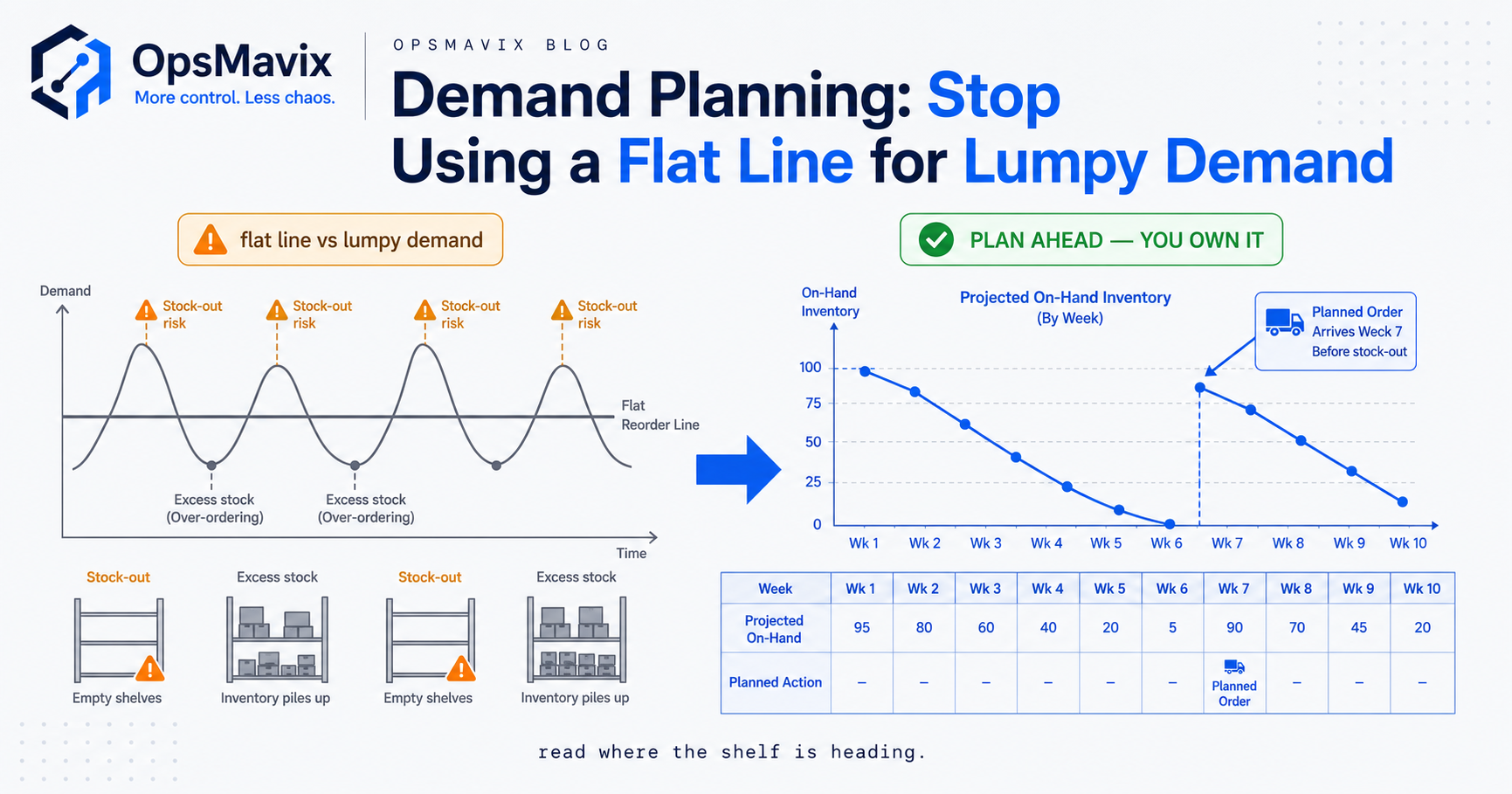
A time-phased order point (TPOP) is a reordering method that replaces a single fixed reorder level with a forward, week-by-week projection of what a line’s stock will actually do. Instead of one static number that says “reorder at 140,” it lays demand, on-hand stock and planned receipts across future time buckets, projects the running balance forward, and plans an order the moment that balance is set to dip below zero (or below your safety stock). It’s the same logic that drives distribution requirements planning — you’re not reacting to today’s shelf level, you’re reading where the shelf is heading.
The reason this matters is that a flat reorder point assumes demand rolls in at a steady, average rate, and plenty of lines don’t behave that way. A line that sells in big irregular bursts, triples every November, or empties overnight when a promotion lands breaks the “average daily demand” assumption in both directions — stocking out on the peaks, over-ordering through the troughs. A time-phased order point handles that by looking ahead at the actual shape of demand rather than smoothing it into one figure.
Key Takeaways
- A time-phased order point projects demand, on-hand and planned receipts across future time buckets, then plans an order when projected on-hand is set to go negative — a forward view, not a static trigger.
- It’s the right tool for lumpy, seasonal or promotional demand, where a single average-based reorder point either runs dry on the peaks or piles up stock in the troughs.
- TPOP is time-phased planning at single-line scale — the same time-bucketed maths DRP runs across a whole network, used to time one item’s orders.
- For steady demand, a basic reorder point is simpler and correct — most SMEs don’t need TPOP, and reaching for it there just adds moving parts.
- The output isn’t only “order now” — it’s when future orders fall due, so you can see receipts weeks out and warn suppliers early.
- Spreadsheets choke on the time-bucketed logic; the maths is trivial for a system that re-projects every line daily off live sales and open POs.
1. What a Time-Phased Order Point Actually Is
Take one line and lay the next twelve weeks out as columns. In each week you record three things: the demand you expect, any planned receipts already on their way (open purchase orders with a due date), and the resulting projected on-hand — last week’s balance, minus this week’s demand, plus this week’s receipts. Run that forward across all twelve buckets and you see where the stock level is heading, not just today’s figure.
The trigger is the moment that projected on-hand is due to drop below zero — or below safety stock, if you want a cushion. Count back from that week by the supplier’s lead time and you have the week to place the order. That forward view is the whole difference: a classic reorder point only knows the present, while a time-phased one plans for a demand spike in week nine back in week six, before the shelf gives any sign of trouble.
2. Why a Static Reorder Point Fails on Lumpy Demand
The classic reorder point formula — average daily demand × lead time, plus safety stock — is a good, honest tool, and for most lines it’s the right one. But it rests on one assumption: that demand arrives at a roughly steady rate. The moment demand is lumpy, seasonal or promotion-driven, that cracks, and the reorder point starts making expensive mistakes in both directions.
Picture a line that averages 20 units a week, but the “average” is a lie: it sells nothing for three weeks, then 80 in one week when a trade customer places a bulk order. A reorder point tuned to 20 a week sits comfortably above its trigger the day that 80-unit order lands, and you stock out mid-order. Through the quiet weeks, that same average keeps pulling stock in for demand that isn’t coming, so you carry cover you don’t need. The line is either short or overstocked almost all the time.
Seasonal lines fail for a related reason: a static reorder point is only correct for the demand rate it was set at. Set it for summer and it’s wrong by November; re-tune it for the peak and it’s wrong again by January, and on a busy catalogue that re-setting is exactly the job that never gets done. Getting the demand picture right is its own discipline — see demand forecasting for a small business — but even a good forecast is wasted if the reorder logic flattens it back into one number.
3. How Time-Phasing Works, Step by Step
Start with an opening on-hand of 100 units, and a lumpy demand pattern of 10, 60, 5, 5, 70 across five weeks rather than a flat 30. Walk the balance forward and that 100 becomes 90 after week one (100 − 10), 30 after week two (90 − 60), 25, 20, then −50 after week five (20 − 70). That negative in week five is the signal — the week you run out. If supplier lead time is two weeks, count back: the order must release in week three, sized to clear the shortfall and top back up to target. (Illustrative figures — the point is the mechanic, not the numbers.)
Add safety stock and the trigger simply moves up — you plan the order when the projection would breach the safety-stock line, not zero; how to calculate safety stock covers sizing that buffer. Do it across every bucket and you have the whole forward schedule of orders, not just the next one.
4. TPOP vs the Classic Reorder Point, Side by Side
The two methods answer the same question — when do I reorder — from opposite directions. A classic reorder point is a level: one number the live quantity is checked against, right only for the rate it was set at. A time-phased order point is a projection: a forward balance across time buckets, planned in advance, that absorbs demand however unevenly it arrives. And where a reorder point gives one output — “buy now” — TPOP gives a schedule: order now, plus the future orders with their release dates. That’s worth real money on long-lead lines: you see an order you’ll place two months out and warn the supplier today, rather than discovering it the week it’s already too late.
The trade-off is honest. A reorder point needs almost nothing — an average, a lead time, a buffer — and anyone can maintain it. TPOP needs a per-bucket demand picture, live open-PO data with due dates, and a system to re-project as reality moves. On a steady line that machinery buys you nothing; on a lumpy or seasonal one it’s the difference between planning ahead and lurching between stockout and overstock. For the basic version, see how a reorder point system works — TPOP is the upgrade you reach for only when demand stops behaving.
5. Where TPOP Sits Relative to MRP and DRP
Time-phasing isn’t a niche invention — it’s the same engine that runs material requirements planning and distribution requirements planning. All three lay demand, supply and stock out across time buckets and net them off; the difference is what drives the demand. In MRP it’s dependent — a build schedule explodes through a bill of materials into component requirements, week by week. In DRP it flows up a distribution network from the branches that sell. TPOP applies that identical maths to a single independently-demanded line, where demand comes straight from customer sales rather than a parent assembly.
So a time-phased order point is best understood as time-phased planning at its simplest — a single line — where DRP scales the same logic across a distribution network. If you’re planning components against a production plan you’re in MRP territory; if you’re stocking finished goods or bought-in lines whose demand you forecast directly, and that demand is lumpy, TPOP gives you the same forward planning without the bill-of-materials apparatus — the right rung between a flat reorder point and a full MRP run. Which is why you don’t need to buy an MRP suite for a handful of seasonal lines; you point the projection logic at those lines and leave the rest alone.
6. When You Actually Need TPOP — and When You Don’t
Be honest about your demand first. If a line sells at a fairly steady clip week to week — a staple, a consumable — a basic reorder point is simpler, cheaper to run and every bit as correct; time-phasing there gains nothing and only adds maintenance. Most lines in most SME catalogues are like this, and most businesses with steady demand should not touch TPOP — saying otherwise is selling complexity you don’t need.
You reach for a time-phased order point when demand stops being steady in a way a reorder point can’t smooth over. The clear signals: strong seasonality, where the right stock level in the peak is nothing like the trough; lumpy demand, where sales arrive in big irregular bursts; known future events — a promotion, a contract, a trade show — that bend demand on a date you already know; and long lead times, where you must commit to orders well before the demand that justifies them shows up.
7. The Tooling Reality: Why Spreadsheets Choke on This
The maths behind a time-phased order point is genuinely simple — subtraction, addition, a running total. What’s hard is doing it live, across every line, off data that keeps changing. A spreadsheet holds the grid for one line beautifully; scale it to a real catalogue and it falls apart. The buckets have to update as sales land, the receipts have to track open POs and their shifting due dates, and the whole projection has to re-run whenever anything changes — and nobody re-keys that by hand across hundreds of lines, so the sheet goes stale within days. A stale projection is worse than a stale reorder point: an out-of-date reorder point is wrong about today, but an out-of-date time-phased projection is wrong about the next three months, and confidently so. Every order it suggests is built on fiction.
A system doesn’t have that problem. It reads sales as they happen, knows every open PO and due date, and re-projects each line’s forward balance automatically — flagging the lines that will go negative and drafting the orders to prevent it, with release dates. That’s the sort of thing a right-sized inventory automation system is built to do — precisely the work a spreadsheet can hold in theory but never keeps current in practice.
FAQ
What is a time-phased order point (TPOP)?
A reordering method that projects a line’s stock forward across future time buckets — usually weeks — instead of checking it against one static level. In each bucket you net expected demand against on-hand and planned receipts to get a projected balance. When that balance is set to drop below zero (or below safety stock) in a future bucket, the method plans an order, timed by lead time to land before the shortfall. It’s a forward, dated plan rather than a live “you’re low now” alarm.
How is TPOP different from a normal reorder point?
A normal reorder point is a single fixed level, correct only for the average demand rate it was set at. A time-phased order point projects the balance forward and plans orders in advance, so it copes with demand that arrives unevenly — seasonal peaks, lumpy bursts, known promotions. The reorder point is simpler and right for steady lines; TPOP is for when demand won’t sit still. See how a reorder point system works for the basic version.
Is a time-phased order point the same as MRP or DRP?
It’s the same time-bucketed maths. MRP time-phases dependent demand — components netted against a production schedule through a bill of materials. DRP time-phases replenishment across a distribution network. TPOP applies that identical netting to a single, independently-demanded line — the same logic at single-line scale, without the bill of materials. If you’re planning components against a build schedule, you want MRP instead.
Do most small businesses actually need TPOP?
No — and it’s worth being blunt about that. If your demand is reasonably steady, a basic reorder point is simpler, cheaper and just as correct; time-phasing gains you nothing but maintenance. TPOP earns its place only on lines with strong seasonality, lumpy demand, known future events or long lead times. For most catalogues the pattern is a mix: plain reorder points on the steady majority, TPOP on the handful of awkward lines where a flat level can’t cope.
How OpsMavix Can Help
OpsMavix builds custom inventory systems for businesses stuck between spreadsheets and a full ERP, with reordering logic shaped to how each line actually sells. Steady lines get a plain reorder point; seasonal, lumpy or long-lead lines get a proper time-phased projection, re-run daily off your live sales and open purchase orders, flagging the weeks a line will go negative and drafting the orders — with release dates — to prevent it. The system decides which method each line needs, so you’re not maintaining a grid or bending your buying to fit a tool that understands only one shape of demand.
If a few of your lines are stocked out every peak and overstocked every lull, that’s demand your current reorder logic can’t read, and it’s costing you at both ends of the season. Book a Free Operations Leak Audit and we’ll map which lines need time-phasing, which are fine on a simple reorder point, and what the swing is costing you right now.
Keep reading
Getting value from OpsMavix? Add us as a preferred source on Google — you'll see more of our operations content in your AI Overviews, AI Mode and Search.