
Stock Replenishment: Methods Compared for UK SMEs
How stock replenishment works, the main methods side by side, and a worked GBP example showing why periodic review needs more safety stock.
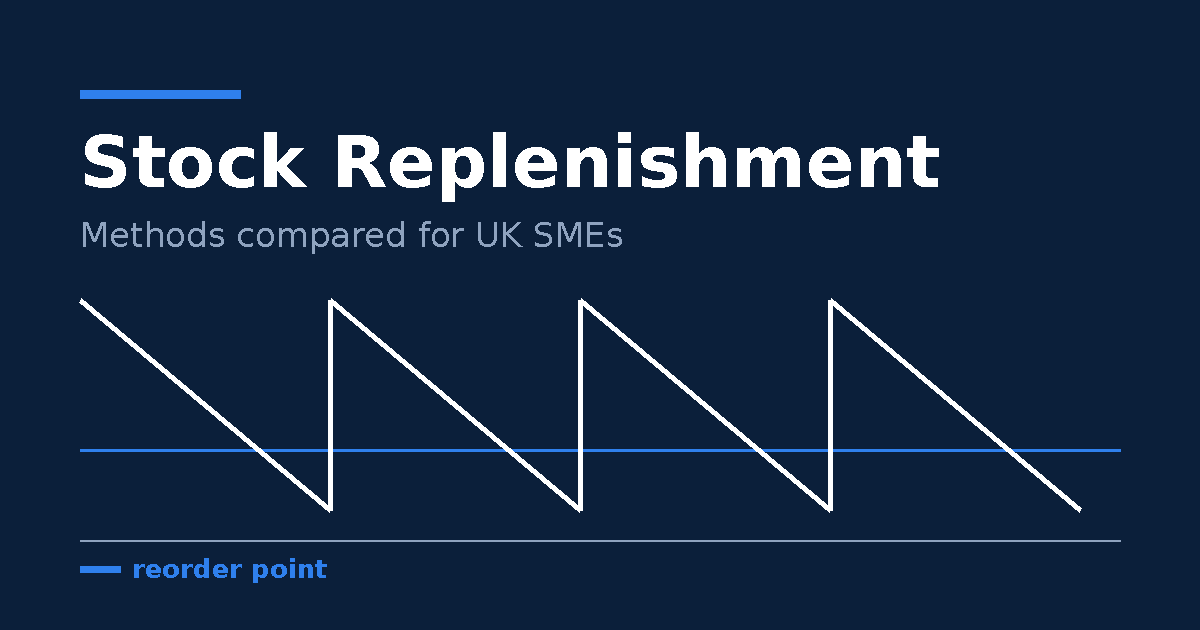
Stock replenishment is the routine that decides when you reorder each product and how much you bring in, so the shelf never runs dry and cash is not tied up in stock that will not sell for months. Every business that holds stock already has a replenishment method. For many UK SMEs it is a buyer’s gut feel and a spreadsheet, which works until the range, the suppliers or the sales channels grow.
This guide compares the main replenishment methods side by side, shows when each one fits, and runs one product through three of them with real arithmetic, so you can see what the choice costs. If you want the rules to run themselves across every line, our inventory automation system builds them into an owned stock system with live reorder suggestions.
What is stock replenishment?
Stock replenishment is the process of moving stock from a supplier (or from a reserve location) to where it is sold or used, at the right time and in the right quantity. It answers two questions for every SKU:
- When do we reorder? This is the trigger.
- How much do we order? This is the quantity rule.
Every method below is just a different pair of answers to those two questions.
It helps to separate two kinds of replenishment that often get mixed up:
- Supplier replenishment: raising purchase orders so stock arrives from outside the business. This is what this guide covers.
- Internal replenishment: moving stock from reserve racking or a back room to the pick face or shop floor. That has its own triggers and priorities, which our pick face replenishment guide covers in detail.
The building blocks every method uses
Whatever method you pick, it runs on the same four numbers per SKU. If these are wrong, no method will save you.
| Input | What it means | Where it comes from |
|---|---|---|
| Demand rate | Average units sold or used per day or week | Sales and despatch history, ideally excluding one-off orders |
| Lead time | Time from raising the order to stock being sellable | Purchase order and goods-received dates, not the supplier’s quote |
| Demand variability | How much demand swings around the average | The standard deviation of weekly sales |
| Safety stock | Extra buffer that covers swings in demand and late deliveries | Calculated from variability, lead time and the service level you want |
The last one is where most of the money sits. Our safety stock calculation guide walks through the formula per line; the short version is that safety stock grows with demand variability and with the length of time you are exposed to it.
One more term matters: inventory position. It is stock on hand, plus stock already on order, minus stock already committed to customer orders. Triggers should be checked against inventory position, not the physical count on the shelf, or you will reorder the same shortfall twice while the first order is still on its way.
The main stock replenishment methods compared
Academic inventory courses describe the two classic policies in a compact notation. MIT’s logistics lecture notes define (s,Q) as “continuous, order Q when IP ≤ s” and (R,S) as “periodic, order up to S every R” time periods, where IP is inventory position (MIT OpenCourseWare, ESD.260J lecture 12). The everyday methods below map onto those policies.
| Method | When to order (trigger) | How much to order | Best for | Watch out for |
|---|---|---|---|---|
| Reorder point (s,Q) | Inventory position falls to the reorder point | A fixed quantity, such as a case or pallet multiple | Steady sellers you can check continuously | A fixed quantity can leave you short after one big order |
| Min/max (s,S) | Inventory position falls to the minimum | Enough to get back up to the maximum | Lines with lumpy order sizes; simple to explain to buyers | Min and max set once and never reviewed |
| Periodic review (R,S) | A fixed review day, such as every other Monday | Enough to reach the order-up-to level | Suppliers with set delivery days; combining many lines on one PO | Needs more safety stock, because it covers review period plus lead time |
| Demand-driven / pull (kanban, two-bin) | A physical or electronic signal when a container empties | One container or card quantity | Low-value, high-use parts and consumables | Breaks if cards or bins are not returned |
| Forecast-led (time-phased) | Projected stock falls below safety stock in a future week | The forecast gap for the coming periods | Seasonal or promotional lines | Only as good as the forecast |
| Vendor-managed inventory | The supplier monitors your stock and refills | Agreed with the supplier | Consumables where one supplier covers the range | You hand control and data to the supplier |
Reorder point
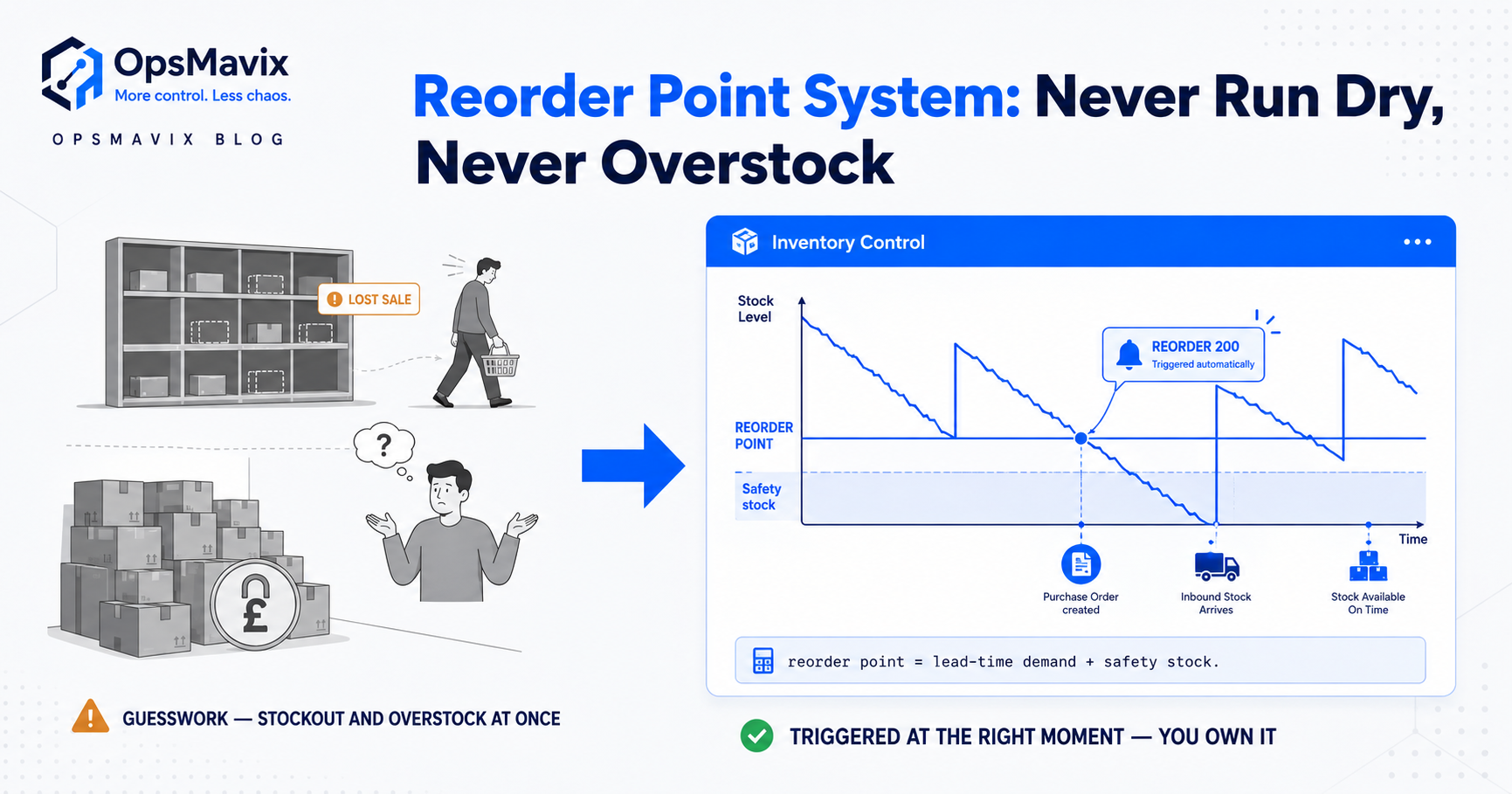
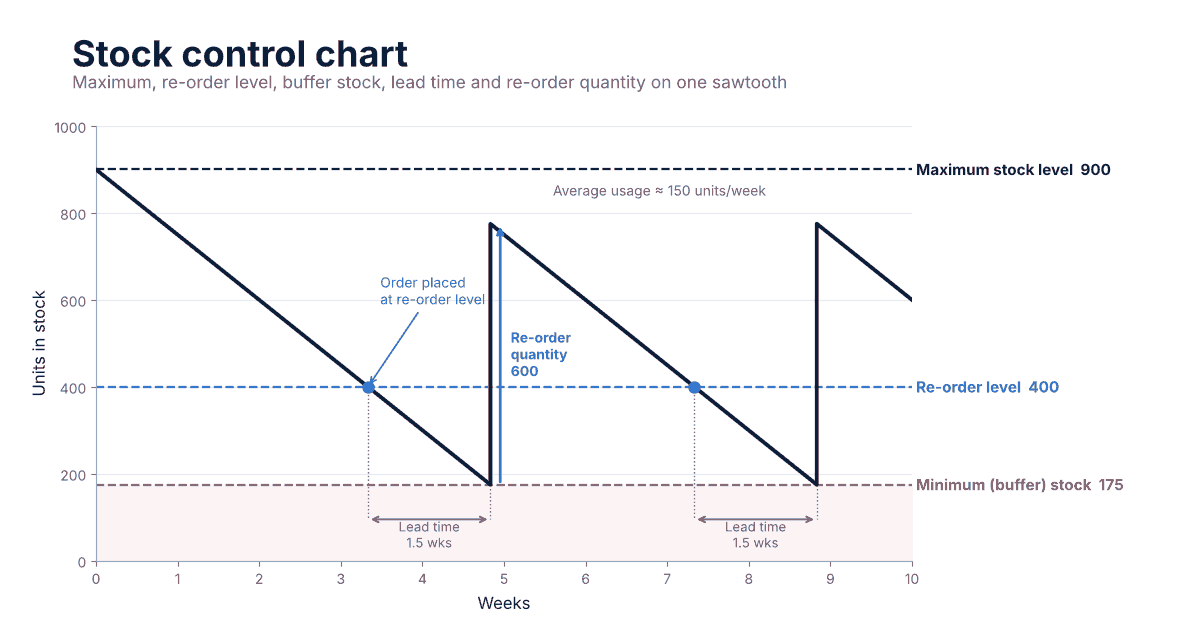
The reorder point is average demand over the lead time plus safety stock. When inventory position reaches it, you order a fixed quantity. It is the most common rule in stock software because it reacts the moment stock moves. Our reorder point system guide covers setting and maintaining it.
Min/max
Min/max uses the same trigger, but orders whatever it takes to return to a maximum. If a trade customer takes 200 units in one go and drops you well below the minimum, min/max orders more to compensate, where a fixed-quantity reorder point would not. The min/max inventory system guide has the full formula.
Periodic review
Here you look at each line on a set day and order up to a target level. It suits UK wholesalers who place a weekly or fortnightly order with each supplier to fill a pallet or meet a carriage-paid minimum. The trade-off is buffer: between reviews nobody is watching, so the target must cover demand over the review period plus the lead time. The MIT notes set the order-up-to level as expected demand over R + L plus a safety factor times the standard deviation over R + L.
Pull methods: kanban and two-bin
Pull methods replace calculation with a signal. When the first bin empties, that bin is the order. They are cheap and visual, and they work well for fasteners, packaging and other consumables. They suit steady, predictable use; they struggle with lumpy or seasonal demand.
Forecast-led and vendor-managed
Forecast-led methods plan week by week against expected demand. They earn their place on seasonal ranges, where a flat reorder point either stocks out in the peak or leaves you overstocked after it. Vendor-managed inventory puts the supplier in charge of refilling. It saves admin, but you are relying on their data and their incentives.
Worked example: one SKU, three methods
Hypothetical example, GBP. All figures are assumptions for illustration, not client data.
A UK wholesaler sells a boxed product with these numbers:
- Average demand: 200 units a week
- Demand variability: standard deviation of 50 units a week
- Supplier lead time: 2 weeks
- Target service: a safety factor of 1.65, roughly a 95% chance of not running out in a replenishment cycle (assuming demand is roughly normally distributed)
- Unit cost: £6.50
- Order quantity under the reorder point method: 400 units (about two weeks’ sales)
Safety stock scales with the square root of the time you are exposed, assuming weekly demand is independent from week to week.
Method 1: reorder point
- Safety stock over the 2-week lead time: 1.65 × 50 × √2 = 116.7, so 117 units
- Reorder point: (200 × 2) + 117 = 517 units
- Order: 400 units each time inventory position reaches 517
Method 2: min/max
- Minimum: 517 units (the same trigger)
- Maximum: 517 + 400 = 917 units
- A large trade order drops inventory position to 480. Min/max orders 917 − 480 = 437 units, where the reorder point method would still order 400 and start the next cycle 37 units lower.
Method 3: periodic review every 2 weeks
- Exposure period: review period plus lead time = 2 + 2 = 4 weeks
- Safety stock over 4 weeks: 1.65 × 50 × √4 = 165 units
- Order-up-to level: (200 × 4) + 165 = 965 units
- On review day inventory position is 560, so the order is 965 − 560 = 405 units
What the choice costs
Average stock is roughly half a typical order plus safety stock.
| Reorder point | Periodic review (2 weeks) | |
|---|---|---|
| Typical order | 400 units | About 400 units (2 weeks’ demand) |
| Safety stock | 117 units | 165 units |
| Average stock held | 200 + 117 = 317 units | 200 + 165 = 365 units |
| Value at £6.50 a unit | £2,060.50 | £2,372.50 |
For one SKU, checking only once a fortnight costs about 48 extra units, or £312 of stock, at the same service level. Across 500 similar lines that pattern adds up quickly. Against that, periodic review lets you consolidate lines onto one fortnightly PO per supplier, which can earn better carriage terms and save buyer time. Neither is wrong; the point is to make the trade-off on purpose, line by line.
How to choose a replenishment method
A practical way to decide is to start from the product and the supplier, not the software.
| If the line is… | Start with | Why |
|---|---|---|
| A fast, steady seller with reliable supply | Reorder point | Least buffer for the service level |
| Sold in unpredictable lump sizes, such as trade orders | Min/max | Orders more after a big drop |
| From a supplier with fixed delivery days or order minimums | Periodic review | Groups lines into one PO per cycle |
| A low-value consumable used on the shop floor | Two-bin or kanban | No calculation, a visible signal |
| Seasonal or promotional | Forecast-led | A flat trigger cannot see the peak coming |
| Slow-moving, high-value | Reorder point with low or no safety stock, or order to customer demand | Every unit of buffer is expensive |
Most businesses end up with a mix. ABC analysis is a good way to set it: give A lines (highest annual usage value) tight, frequently reviewed rules, and let C lines run on simple min/max or two-bin.
Common replenishment mistakes
- Triggering on shelf stock, not inventory position. Orders already placed are ignored, so the same shortfall is ordered twice.
- Using the supplier’s quoted lead time. Measure it from your own purchase order and goods-received dates; the real figure is usually longer and more variable.
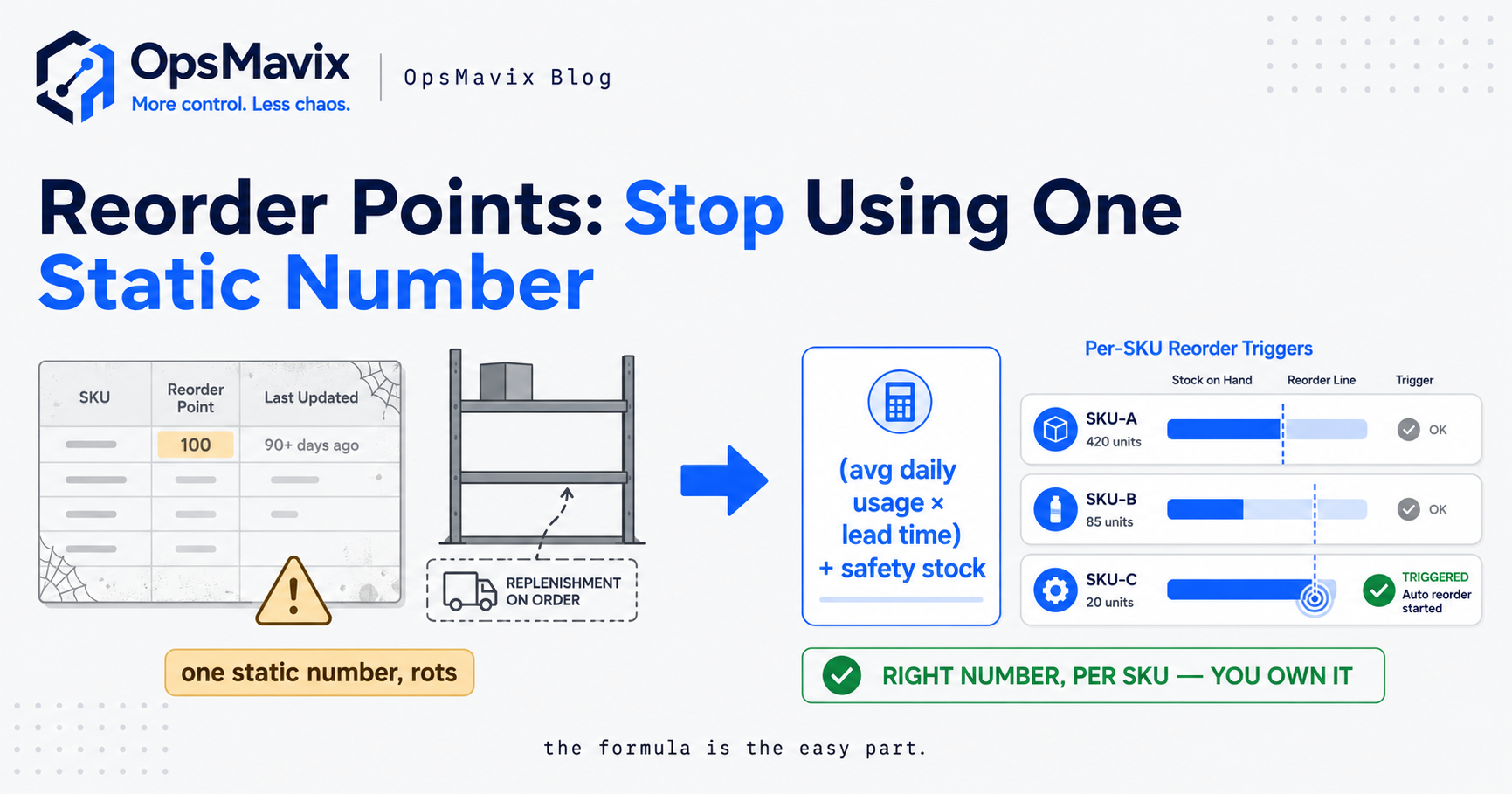
- Setting levels once and never revisiting them. Demand and lead times drift. Levels set two years ago quietly overstock some lines and starve others.
- One blanket rule for every SKU. “Four weeks of everything” overstocks slow lines and underprotects fast ones.
- Ignoring channel commitments. For online sellers, stock promised on marketplaces needs to be netted off before the trigger runs; our ecommerce inventory automation keeps channel stock and reorder levels in one place.
- No review of exceptions. Automatic suggestions still need a buyer to check new lines, discontinued lines and anything that has just had an unusual order.
When a spreadsheet stops coping
A spreadsheet can run replenishment for a few hundred lines with one buyer. It starts to struggle when:
- stock on order and customer commitments live in different files, so inventory position is a guess;
- several people place orders and nobody can see what is already inbound;
- you want different methods for different lines;
- levels need recalculating every month from fresh sales and lead-time data.
At that point the method matters less than whether the numbers behind it are live.
FAQ
What is stock replenishment in simple terms?
It is the process of reordering stock before it runs out, so you can keep selling without holding more than you need. It sets when to reorder each product and how much to order.
What is the difference between a reorder point and min/max?
Both trigger at the same low level. A reorder point orders a fixed quantity each time. Min/max orders whatever it takes to get back up to a maximum, so the quantity changes with how far stock has fallen.
Why does periodic review need more safety stock?
Because stock is only checked on review days. The buffer must cover demand over the review period plus the lead time, not just the lead time. In the worked example above, that meant 165 units of safety stock instead of 117.
How often should I review replenishment levels?
Recalculate when demand or lead times change noticeably. Many businesses review fast movers monthly and slow movers quarterly. A system that recalculates from live data removes the need to remember.
Is kanban a replenishment method?
Yes. Kanban and two-bin are pull methods: an empty container or a card is the order signal. They work best for low-value, frequently used items with steady consumption.
Can replenishment be fully automated?
The calculation and the purchase-order suggestion can be. Most businesses still have a buyer approve the suggestions, especially for new, seasonal or high-value lines.
How OpsMavix Can Help
OpsMavix builds owned, fixed-price stock and order systems for UK wholesalers, distributors, manufacturers and online sellers who have outgrown spreadsheets but do not need a full ERP. For replenishment that means inventory position calculated live from stock, open purchase orders and customer commitments, a method set per line (reorder point, min/max or periodic review), lead times measured from your own receipts, and a daily list of suggested purchase orders for a buyer to approve. No per-seat fees.
See our inventory automation system, our wholesale order management system for trade order commitments, or tell us how you reorder today.
Sources
- MIT OpenCourseWare, ESD.260J Logistics Systems, lecture 12 (inventory policies), reviewed 30 October 2026.
The demand, lead time, cost and service-level figures in the worked example are hypothetical. The cover is an OpsMavix graphic.
Keep reading
Getting value from OpsMavix? Add us as a preferred source on Google — you'll see more of our operations content in your AI Overviews, AI Mode and Search.