
Scrap and Rework Tracking: Turning Wasted Material Into Root-Cause Fixes
Scrap and rework tracking means logging every binned or fixed part with a reason code at the moment it happens, so you can see where and why parts fail. Most shops only find out from the month-end material variance. Here's how to capture scrap and rework on the floor, cost it properly, and turn the data into fixes instead of a number nobody can explain.
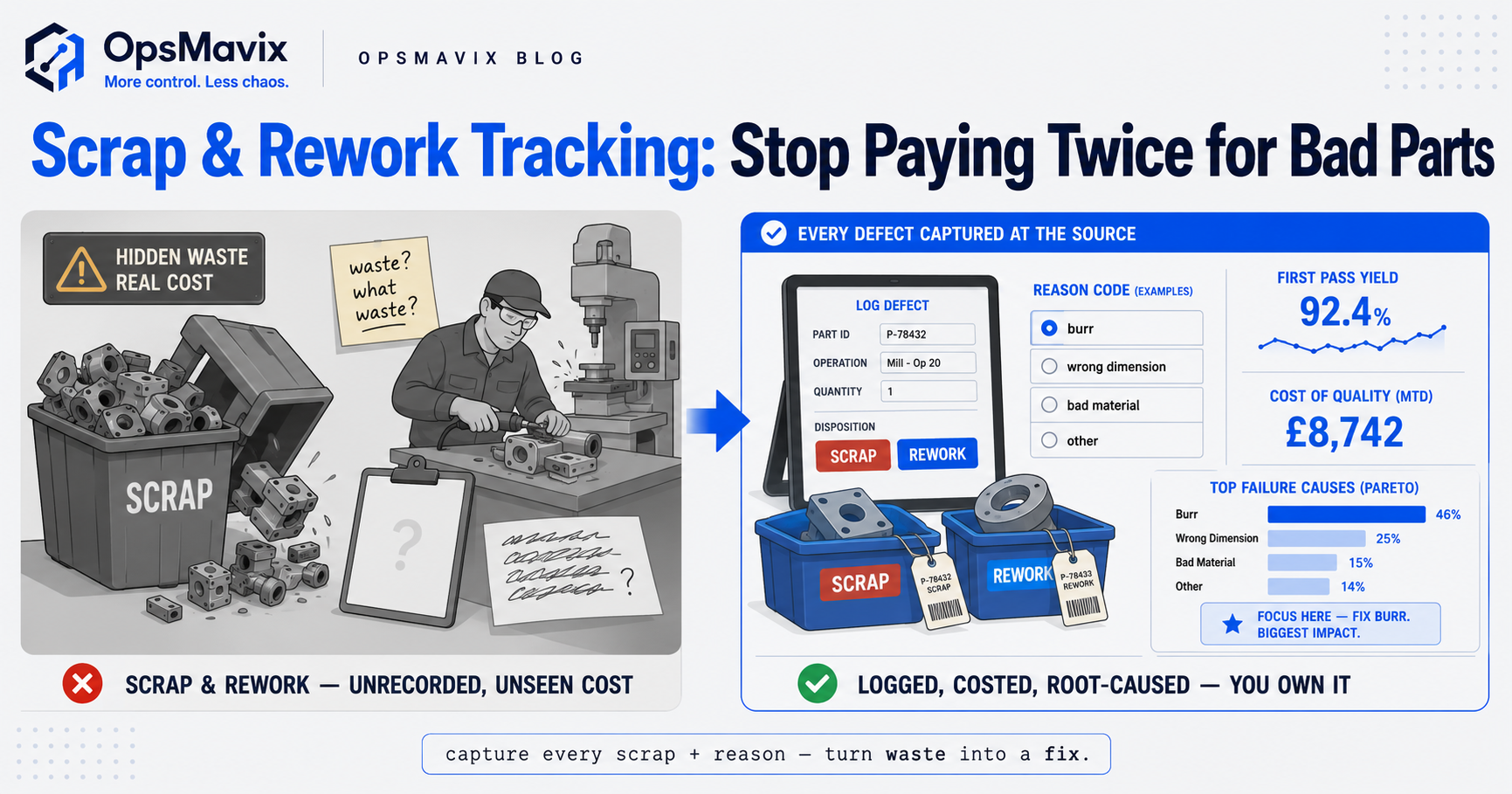
Scrap and rework tracking is the practice of recording every part you bin or fix at the moment it happens, tagged with a reason code that says why — so the loss stops being an anonymous shortfall and becomes something you can trace, cost, and prevent. Scrap is a part you throw away. Rework is a part you save by doing extra work on it. Both cost money you already spent, and both are usually invisible until it’s far too late to ask what caused them.
The quiet damage is that scrap and rework tend to disappear into no record at all. An operator pulls a bad part off the line, drops it in a red bin, and reaches for the next one — that’s the entire event. Nobody logs which operation ruined it, which machine, which shift, or which batch of material. At month-end the accountant sees a material variance that doesn’t reconcile, someone shrugs and calls it “the usual scrap,” and the reason the parts failed dies on the floor where it happened. You paid for the loss twice: once in wasted material, and again in never learning what to fix.
Key Takeaways
- Scrap and rework tracking means logging each binned or fixed part with a reason code at the point of failure — not reconstructing it from a variance weeks later.
- Scrap vs rework are two different losses: scrap is material gone for good, rework is labour and machine time spent rescuing a part that should have been right the first time. Track them separately or you’ll misread both.
- Reason codes are the whole game. A count of scrapped parts tells you nothing; a count tagged by cause, operation, and machine tells you where to point your effort.
- Cost of quality is bigger than the scrapped material — add the labour, the machine time, and the reworked hours, and the true number is usually a multiple of what shows up in stock.
- First-pass yield — the share of parts made right the first time, with no rework — is the honest measure of how well a process actually runs.
- A right-sized custom system captures scrap and rework inside the job the operator is already doing, so the reason gets logged in seconds and someone can act on the pattern.
1. What Scrap and Rework Tracking Actually Captures
Scrap and rework tracking answers three questions for every part that goes wrong: what happened to it, where did it fail, and why. “What happened” splits into two buckets — scrapped (binned, unrecoverable) or reworked (fixed at a cost). “Where” ties the failure to a specific operation, machine, and job. “Why” is the reason code: burr, wrong dimension, tool mark, contamination, operator setup error, bad incoming material, and so on. Miss any one of the three and the record can’t do its job.
The point isn’t to build a museum of defects. It’s that scrap without a reason is just a shrinking stock figure, and a shrinking stock figure gives you nothing to act on. The same twelve scrapped housings mean one thing if they all failed on the same fixture at setup, and something completely different if they trickled in one at a time across three shifts and four machines. Same count, opposite fixes. The reason code is what separates them.
2. Scrap vs Rework — Why You Must Keep Them Apart
Scrap and rework fail in opposite directions, and lumping them together hides both. Scrap is a clean loss: the material is gone, and the cost is whatever you’d sunk into that part up to the moment it died. Rework is sneakier — the part survives, so it never shows up as a loss in stock, but you’ve spent extra labour, extra machine time, and often extra material saving it. A shop with “low scrap” and heavy rework can look efficient on paper while quietly burning hours no one is counting.
Rework is the loss that hides best because it feels like recovery. The operator fixed it, the part shipped, everyone moved on — victory, apparently. But a part that needs rework is a part your process didn’t make right, and the time spent rescuing it is capacity you’ll never get back. If your rework queue is a permanent fixture with its own bench and its own person, that’s not a safety net; that’s a second factory you’re running to undo the first one’s mistakes.
Keeping the two apart also changes the maths. Scrap you cost at material-plus-work-so-far. Rework you cost at the labour and machine time to fix, plus the delay it pushes onto everything behind it. Blend them into one “quality cost” bucket and you lose the ability to tell whether your problem is parts you’re throwing away or parts you’re endlessly patching — which need entirely different responses.
3. Reason Codes: The Difference Between Data and a Guess
A reason code is a short, fixed list of causes an operator picks from the instant a part goes wrong. The discipline is keeping the list short and real. Fifty codes and people will pick the first plausible one every time; five well-chosen codes that match how your parts actually fail will get chosen honestly, because choosing is quick and the options fit. The codes should come from your floor, not a textbook — the language operators already use for the failures they actually see.
The failure mode to avoid is the “other” trap. Give people a catch-all and, on a busy line, everything becomes “other,” because “other” is the fastest button to press. One quality manager we spoke to described opening their first year of scrap data and finding two-thirds of it filed under a single miscellaneous code — technically a record, practically useless. The fix wasn’t more discipline from operators; it was fewer, sharper codes that made the honest answer also the easy one.
Reason codes only earn their keep when they’re paired with context the system already knows — the job, the operation, the machine, the shift, the material batch. The operator picks the “why”; the system supplies the “where” and “when” for free. That pairing is what lets you later ask “which machine produces most of our dimensional scrap on the night shift” and get an answer instead of a shrug.
4. Cost of Quality — The Number That’s Always Bigger Than You Think
Cost of quality is the full price of getting things wrong, and the mistake nearly everyone makes is counting only the scrapped material. The material is the visible tip. Under it sits the labour that went into the part before it failed, the machine time it occupied, the rework hours spent on the parts you saved, the inspection time, and the knock-on delay to every job queued behind the mess. Count only the metal in the bin and you’ll under-price the problem badly enough to keep tolerating it.
Put a concrete frame on it. A machined bracket scrapped at final inspection didn’t waste £8 of aluminium — it wasted the bar stock, twenty minutes of spindle time, two prior operations of labour, the inspector who caught it, and the slot on the machine that could have made a good one. The £8 material line is real, but the loss is closer to £60 once you count the work that died with the part. Scrap fifteen of those in a week and the “small scrap problem” is a four-figure monthly hole nobody put on a report.
This is where OpsMavix takes a contrarian line: chasing a lower scrap count is the wrong target. A shop can cut its scrap count by quietly reworking more parts — the count drops, everyone’s pleased, and the real cost of quality rises because rework is more expensive per part than binning it. Cost, not count, is the number that keeps you honest. If you’re not costing rework, you’re not measuring quality; you’re measuring how good you are at hiding it.
5. First-Pass Yield and Where Parts Actually Fail
First-pass yield — sometimes called first-time-right — is the share of parts that come out good the first time, with no rework and no scrap. It’s a blunt, honest number: of everything a process attempted, how much did it get right without a second try. A high scrap rate and a high rework rate both drag it down, which is exactly why it’s useful — it refuses to let rework hide the way a raw scrap count does.
The value of tracking yield by operation is that it points a finger. A finished part might pass final inspection, but if it needed a touch-up at operation three every single time, your first-pass yield at that station is quietly awful and your rework bench is carrying it. Yield measured only at the end of the line tells you the part shipped. Yield measured per operation tells you which station is manufacturing your problems — and that’s the one worth an engineer’s afternoon. This is the quality dimension that feeds into broader production monitoring system work, but on its own it’s the fastest way to find the operation that’s costing you the most.
A machine-shop owner described watching first-pass yield climb after they started logging scrap by operation rather than by part — not because anyone worked harder, but because the data finally pointed at one worn fixture that had been quietly ruining setups for months. The fixture had always been the cause. Nobody could see it until the reason codes stacked up in one place with one station’s name on them.
6. Turning Scrap Data Into Root-Cause Fixes
Logging scrap is only step one; the payoff is what the accumulated data lets you ask. Once every failure carries a reason, an operation, a machine, and a batch, patterns you could never see from the shop floor start to surface. Most of your scrap cost almost always concentrates in a handful of causes and a handful of stations — but you can only find that concentration if the data is captured consistently enough to add up. Scattered notes and month-end guesses never stack into a pattern.
The workflow that actually pays off is dull and repeatable: pull the reasons costing the most, pick the top one, find the root cause, fix it, and watch that reason code shrink on next month’s data. Then take the next one. It’s unglamorous, and that’s the point — you’re not chasing a heroic quality initiative, you’re closing one leak at a time and confirming each fix held. A manufacturing execution system that captures scrap at the point of work is what makes this loop possible, because the data is trustworthy enough to bet an engineering fix on.
The reason most quality-improvement drives fizzle isn’t lack of effort — it’s that the data underneath was too thin to prove a cause or confirm a fix. If you can’t show that dimensional scrap on machine four dropped after you changed the fixture, you can’t defend the time you spent, and the next fix gets deprioritised. Good scrap data is what turns “we think this helped” into “this reason code fell 40% and stayed down.”
7. Capturing It On the Floor Without Slowing Anyone Down
None of this works if logging a scrap costs the operator thirty seconds and a walk to a shared PC. The single biggest determinant of whether scrap and rework tracking survives contact with a real shift is how fast it is to log at the point the part fails. If it’s a paper form filled in later from memory, you get fiction. If it’s a terminal at the station where a scrap is two taps — reason code, done — you get truth, because the honest path is also the fastest one.
Capture has to live inside the job the operator is already on. The system should already know the part, the operation, and the machine because the operator is booked onto that job; all they add is the reason and the count. Rework gets its own quick path — log the fix and the time it took — so the labour is captured instead of vanishing into “normal work.” The moment tracking becomes a separate chore competing with the actual work, it loses, and you’re back to the red bin and the shrug. This is one facet of a full manufacturing production tracking setup, where scrap, downtime, and output are all captured in the same flow instead of three disconnected systems.
Worth saying once and moving on: scrap and rework feed the Quality factor inside the broader OEE monitoring picture, so good scrap capture improves that composite number for free. But scrap and rework tracking earns its place on its own — you don’t need to compute OEE to benefit from knowing exactly where and why your parts fail.
FAQ
What’s the difference between scrap and rework?
Scrap is a part you can’t recover — it goes in the bin, and you lose the material plus whatever work went into it. Rework is a part you save by doing extra work on it — the part survives and ships, but you’ve spent additional labour and machine time fixing something that should have been right the first time. They’re different costs and need tracking separately, because a shop can lower its scrap count by reworking more parts while its true cost of quality quietly rises.
Why not just track scrap in the accounts as a material variance?
Because a variance tells you the total went wrong, not why. By the time an accounting figure surfaces at month-end, the reason a part failed — which machine, which operation, which shift — is long gone. Variance is a symptom; reason-coded scrap logged at the point of failure is the diagnosis. You need the second one to actually fix anything.
How many reason codes should we use?
Fewer than you’d think. A short list of five to ten codes that match how your parts actually fail beats a long taxonomy every time, because operators on a busy line will pick honestly from a short list and default to “other” on a long one. Build the list from the language your floor already uses, review it after a month of data, and cut anything that never gets chosen or gets over-chosen.
What does cost of quality actually include?
More than the scrapped material. It includes the labour and machine time sunk into a part before it failed, the rework hours spent rescuing salvageable parts, inspection time, and the delay that scrap and rework push onto every job behind them. The scrapped material is usually the smallest line in the total, which is exactly why counting only material under-prices the problem.
How quickly can we start tracking scrap on the floor?
Faster than a full quality system, because you’re capturing one thing well rather than everything at once. If operators are already booked onto jobs, adding a two-tap scrap and rework log at the station is a small addition, and you’ll have your first trustworthy reason-code data within weeks. The bottleneck is almost never the technology — it’s agreeing the reason-code list and making the entry fast enough to survive a real shift.
How OpsMavix Can Help
We build the scrap and rework capture into the system your operators already touch, so logging a failure is two taps at the station — reason code, count, done — instead of a form filled in later from memory. The system already knows the job, the machine, and the operation, so the operator only adds the “why.” Behind that, you get scrap and rework costed properly — material, labour, and machine time — first-pass yield by operation, and the reason-code patterns that show you which station is manufacturing your losses. It’s part of a wider manufacturing production tracking build, not a bolt-on dashboard nobody opens.
Our view is blunt: if your scrap lives in a bin and your rework lives on a bench, you’re paying for both twice and learning from neither. The fix isn’t a bigger quality department — it’s capturing the reason at the moment the part fails, costing it honestly, and closing one leak at a time until the bin gets lighter. If you want to see what your scrap and rework are really costing before you spend a penny fixing it, Book a Free Operations Leak Audit.
Keep reading

Getting value from OpsMavix? Add us as a preferred source on Google — you'll see more of our operations content in your AI Overviews, AI Mode and Search.