
GainSeeker Alternative: When You Need Real SPC vs a Custom Quality System
GainSeeker is dedicated SPC and quality-analytics software, and for heavy statistical work it earns its place. But a lot of manufacturers don't need a full statistics suite — they need quality checks tied to jobs and production, in one place. Here's how to tell which side of that line you're on, and what a right-sized custom system does that a standalone SPC tool can't.
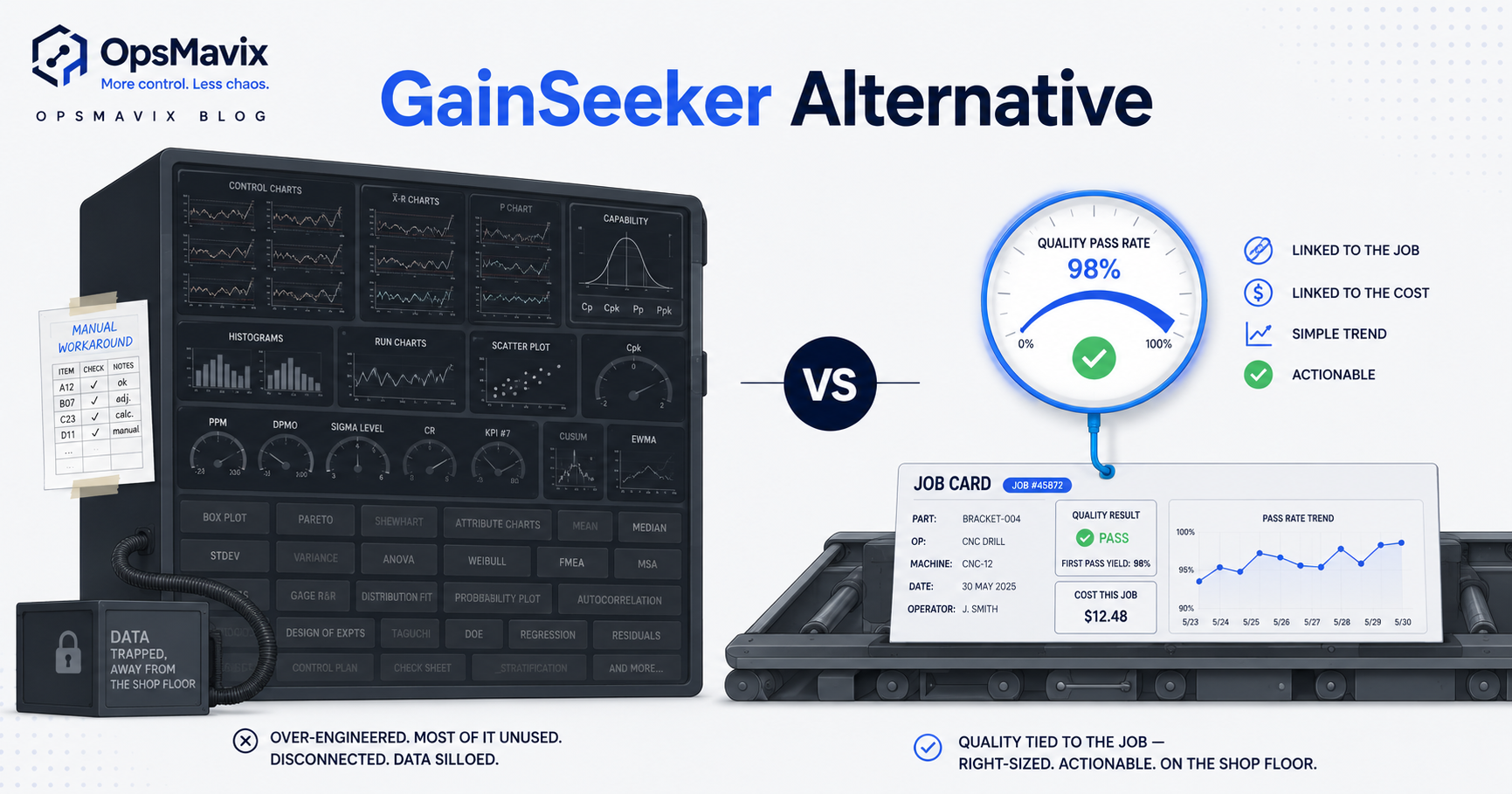
The right GainSeeker alternative depends on one question: do you need deep statistical process control, or do you need quality data that lives next to your production? GainSeeker is dedicated SPC and quality-analytics software — built for serious statistical work on quality data. If your business genuinely runs on control charts, capability studies and the kind of analysis a real SPC engine exists to do, buy the dedicated tool; a general system won’t match it, and you shouldn’t ask it to. But many small and mid manufacturers reach for SPC software when what they actually need is simpler: quality checks recorded against the job that produced them, visible alongside everything else on the floor. If that’s you, a right-sized custom system that tracks quality and production together usually fits better than a statistics suite you’ll mostly leave switched off.
This post is the build-versus-buy version of that decision: when dedicated SPC is the right call, the signs you’re outgrowing the fit, and what a custom quality system covers instead. For the wider “do I need a shop-floor system at all” question, the manufacturing execution system explainer covers that layer.
Key Takeaways
- GainSeeker is dedicated SPC / quality-analytics software — strong when you genuinely need deep statistical process control.
- Buy the dedicated tool if your work is statistics-heavy: control charts, capability indices, formal analysis your business actually runs on.
- The common mismatch: paying for statistical depth you never use, when you mostly need quality checks tied to jobs and production.
- A standalone SPC tool can leave quality data trapped away from the rest of the shop floor — separate from jobs, costs and order status.
- A right-sized custom system records quality against the job, in the same place as production, so a failed check connects to the work that caused it.
- The decision isn’t “SPC good, custom bad” — it’s matching the tool to how statistical your quality work really is.
What GainSeeker Is Built For
GainSeeker sits in the SPC and quality-analytics category — software whose core job is the statistical side of quality. Statistical process control is a real discipline: tracking a process with control charts to tell normal variation from a genuine shift, running capability studies, holding a rigorous record of quality data over time. Tools built for it are built to do that well, and a general-purpose system isn’t going to out-analyse a dedicated statistics engine. Be fair to the category: when the statistics matter, the dedicated tool is the right tool.
The question isn’t whether SPC software is good. It’s whether the depth it offers maps to the depth your quality work actually needs. That’s where a lot of manufacturers get the decision wrong — they buy the discipline’s flagship and then use a fraction of it.
1. When Dedicated SPC Is the Right Buy (the honest bit first)
Some shops should buy the dedicated tool and not look back. If you’re in regulated, high-volume, or tight-tolerance work where statistical process control is part of how you actually run — customers or auditors expect capability indices, you act on control-chart signals, variation analysis genuinely drives decisions on the line — then SPC depth isn’t overkill, it’s the job. A right-sized general system can record quality checks, but it won’t replace a real statistics engine, and pretending otherwise would cost you.
So the first honest filter is simple: if you can point to statistical analysis your business runs on — not “would be nice,” but “we use this weekly and decisions hang on it” — lean toward the dedicated tool. The mistake in the other direction is just as real as buying too much. Don’t under-buy a capability you genuinely depend on.
2. The Common Mismatch: Paying for Stats You Never Use
Here’s the failure mode that sends most manufacturers looking for an alternative. They feel a quality problem — checks done on paper, results in a folder, no easy way to see if a part or process is drifting — and conclude they need SPC software. They buy a statistics suite, switch on a sliver of it, and pay for the rest forever. The depth that justifies the tool is the depth they never touch.
It’s the same trap manufacturers describe with rigid production tools that turn out heavier than the shop: “be prepared to still have manual input… despite paying high dollars.” A full SPC platform aimed at a shop that mostly needs “did this job pass its checks, and if not, why” is depth in the wrong place. You’re carrying a statistics engine to answer a question that was never really statistical. The cost isn’t only the licence — it’s the setup, the training on features you’ll skip, and a tool the floor finds heavier than the problem warranted.
3. The Hidden Cost: Quality Data Trapped Away From the Floor
The deeper problem with a standalone SPC tool isn’t the unused depth — it’s where the data ends up. Quality lives in one system; jobs, costs, stock and order status live in others. So a failed check sits in the quality tool, disconnected from the work order that produced it, the material lot it came from, and the customer waiting on it. You can analyse the quality data beautifully and still not be able to answer the question that matters on the floor: which job, which batch, what now.
That’s the same blind spot manufacturers feel running the whole shop on disconnected tools. As one production manager told us, “the entire shop is run from my head” — and a quality system that can’t see jobs or production just adds another island to keep in your head. A scrap spike means more if you can see it landed on a specific run of a specific part for a specific customer. Split across tools, quality becomes a report you read after the fact instead of a signal you act on while the job’s still on the floor. This is the same argument behind real-time production tracking: data is worth most where the work is, not in a separate system you open later.
4. What a Right-Sized Custom Quality System Covers
A built-for-you system isn’t a watered-down SPC tool — it’s quality scoped to how your shop actually checks work, recorded in the same place as production. Checks captured against the job that produced them, on a screen simple enough that the floor will actually use it. Pass and fail visible the moment it happens, not at the end of the shift. A failed check tied to the work order, the material, and the operation it came from, so the cause isn’t a guess. Scrap and rework counted as they occur, feeding true job costing — so a job that quietly lost money on rework shows up before it ships, not after.
The point is the join. Quality, production and cost in one system means a failed check isn’t an isolated data point — it’s connected to the job, the batch and the bill. You get the quality visibility you were chasing with SPC software, plus the context a standalone tool can’t give you because it can’t see the rest of the shop. For the production side of that picture, see our production tracking system; if monitoring equipment loss is the sharper pain, OEE monitoring covers that adjacent angle.
5. The Signs You’re Outgrowing a Standalone SPC Tool
You can usually feel the mismatch before you can name it. A few honest signals that a dedicated SPC tool is the wrong fit for where you are:
- You bought it for the analytics and use almost none of them — the control charts sit there while you mostly log pass/fail.
- The quality data never lines up with production, so every “which job did this affect” question becomes a manual cross-reference.
- The floor finds it fiddly and quietly goes back to paper, which is the real tell: “people who struggle using a computer, so simpler the better.”
- You’re paying for statistical depth your customers and auditors don’t actually ask you to produce.
- The thing you really wanted — quality checks tied to jobs, scrap tied to cost — is exactly what the SPC tool wasn’t built to do.
If most of those land, the issue isn’t the software’s quality; it’s the match. You reached for a statistics tool to solve a visibility-and-connection problem. The fix is a system shaped to that problem, not a deeper version of the wrong one.
6. Build vs Buy: Matching the Tool to How Statistical You Really Are
The decision comes down to one axis: how statistical is your quality work, honestly. Heavy on real SPC — capability studies, control-chart signals you act on, analysis the business runs on — buy the dedicated tool, because a custom build won’t and shouldn’t try to replace a statistics engine. Light on statistics but heavy on disconnection — checks on paper, results in a folder, quality cut off from jobs and costs — a right-sized custom system fits better, because your actual problem is the join, not the maths.
The mistake both ways is buying for the category’s reputation instead of your reality. Under-buy and you’re missing analysis you genuinely depend on. Over-buy and you’ve got a statistics suite gathering dust while your real problem — quality data trapped away from production — sits unsolved. Switch on the maths, not the marketing. If you’re in the gap between “outgrowing spreadsheets” and “needs a full quality platform,” the honest move is usually a system built around your floor, connecting quality to the jobs and stock you already track. The inventory automation angle covers the stock side of that same join.
GainSeeker (dedicated SPC) vs a Right-Sized Custom System
| Dedicated SPC Tool | Right-Sized Custom System | |
|---|---|---|
| Built for | Deep statistical process control | Quality checks tied to jobs and production |
| Strongest when | Statistics-heavy, regulated, tight-tolerance work | You mostly need quality joined to the floor |
| Quality data | Powerful analysis, in its own system | Recorded against the job, beside production and cost |
| Statistical depth | Full SPC engine | As much as you’ll actually use, no more |
| Risk | Paying for depth you never switch on | Won’t replace a true statistics engine |
| Fit to your shop | Generic; you adapt to it | Built around how your floor checks work |
| Ownership | Licensed, ongoing | Owned outright, maintained for you |
| Right when | Your quality work genuinely runs on statistics | Your problem is disconnection, not deep maths |
FAQ
Is GainSeeker an SPC tool or a full quality system?
GainSeeker sits in the SPC and quality-analytics category — its core strength is the statistical side of quality, the control-chart and capability-study work that statistical process control exists to do. Whether that’s the right fit depends on how statistical your quality work genuinely is. If your business runs on that analysis, the dedicated tool is built for it. If you mostly need quality checks tied to jobs and production, a right-sized custom system usually fits the actual problem better.
When should I choose dedicated SPC software over a custom build?
When your quality work is genuinely statistics-heavy — regulated, high-volume or tight-tolerance work where capability indices and control-chart signals drive real decisions on the line, and customers or auditors expect them. That’s exactly what dedicated SPC tools are for, and a general system won’t replace a real statistics engine. Don’t under-buy a capability you actually depend on weekly. The custom route fits when your problem is connection and visibility, not deep maths.
Why do manufacturers outgrow standalone SPC tools?
Usually because they bought for analytics they barely use, while their real problem — quality data sitting apart from jobs, costs and order status — goes unsolved. A failed check in a separate quality system isn’t connected to the work order, material lot or customer it relates to, so it becomes a report you read later instead of a signal you act on now. The tool isn’t bad; it’s aimed at a statistical problem you may not actually have.
Can a custom system give me quality tracking without full SPC?
Yes — that’s the point of a right-sized build. It records quality checks against the job that produced them, ties failures to the work order, material and operation, and counts scrap and rework into true job costing, all in the same place as production. It won’t out-analyse a dedicated statistics engine, and isn’t meant to. If you need pass/fail visibility, traceability and quality joined to cost rather than deep statistical analysis, that’s the capability worth building.
Is a custom quality system cheaper than SPC software?
It depends on what you’d actually use. If you’d switch on the full statistical depth of an SPC tool, the dedicated tool earns its cost. If you’d use a sliver of it, you’re paying for depth that sits idle while your real problem stays unsolved — and a right-sized system scoped to quality-plus-production, built from a fixed scope and owned outright, often works out better over a few years. Compare against the capabilities you’ll genuinely use, not the feature list.
How OpsMavix Can Help
OpsMavix builds right-sized quality and production tracking systems for manufacturers who need quality data joined to their floor — not a statistics suite they’ll mostly leave switched off. We build the part you’ll actually use: quality checks captured against the job, failures tied to the work order, material and operation that caused them, scrap and rework feeding true estimate-versus-actual job costing, all in one system beside production and stock. It’s shaped to how your shop already checks work and connected to the tools you already run, owned outright with no per-seat fees and nothing a vendor can switch off. If your quality work genuinely runs on deep SPC, we’ll tell you to buy the dedicated tool — that’s the honest answer.
If you’re not sure whether you need real SPC software or a system that ties quality to your jobs, start by seeing where the floor actually leaks. Book a Free Operations Leak Audit and we’ll map where quality, production visibility and job costing break down today, what it’s costing you, and which is the genuine fit for the shop you run now.
Keep reading
Getting value from OpsMavix? Add us as a preferred source on Google — you'll see more of our operations content in your AI Overviews, AI Mode and Search.