
Retail Supply Chain Software: What Retailers Actually Need
Retail supply chain management software promises to control stock across stores and online, from supplier to shelf. But most retailers are sold a generic SCM platform when what they really need is one stock truth across every channel. Here is what to look for and the cheaper, owned way to get it.
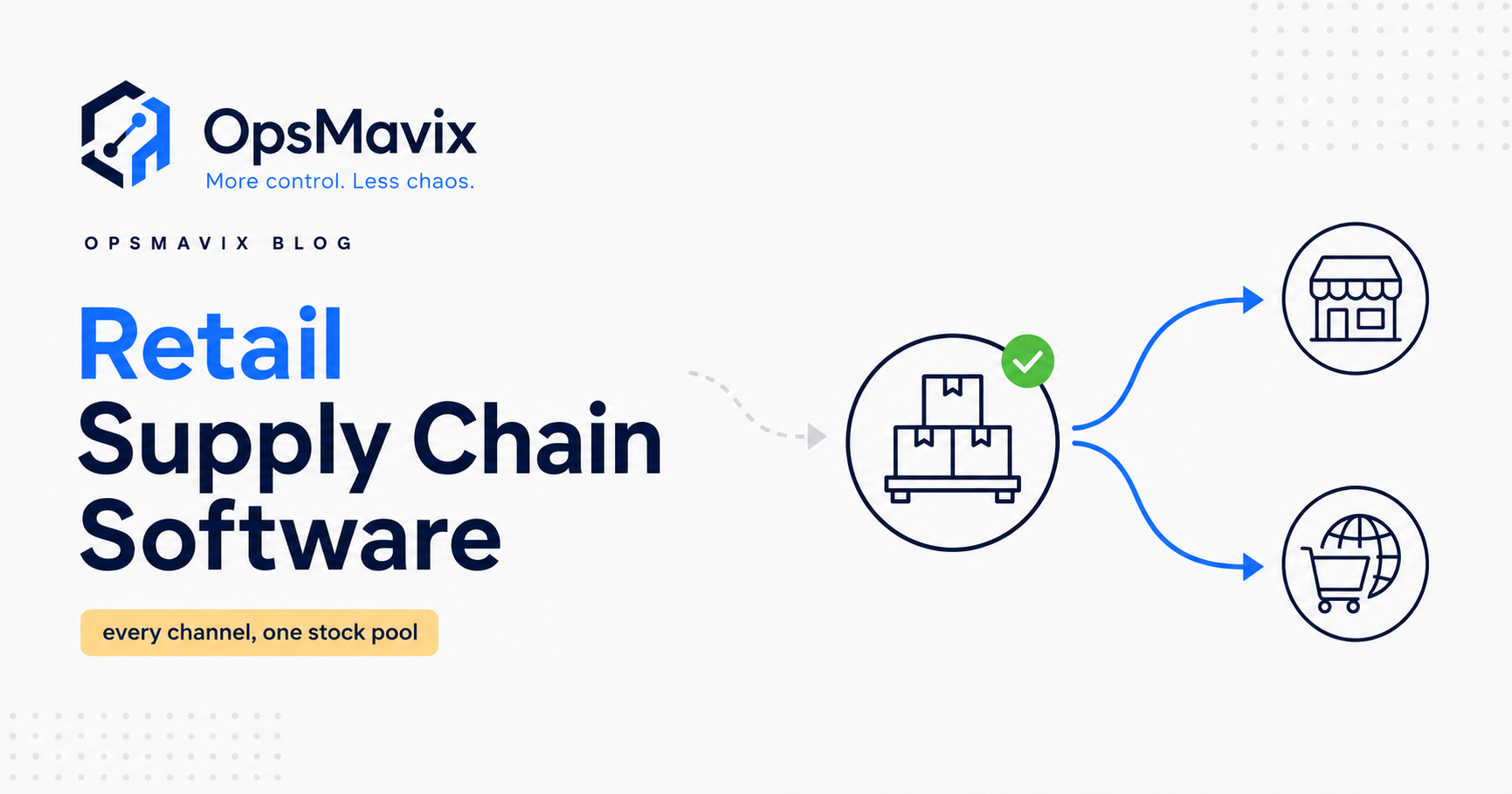
Retail supply chain management software is the system a retailer uses to plan, order, move and track stock from suppliers, through distribution centres, into stores and out through every sales channel — so that what customers can buy online matches what is actually on the shelf, and neither channel runs out or drowns in overstock. Done well, it keeps one accurate picture of stock everywhere at once. Done badly, it becomes another expensive tool that still lets you sell something you cannot ship.
Quick summary: Retail is now a genuinely omnichannel business — 28.3% of UK retail sales were made online in December 2025 (ONS) — yet many retailers still run store stock and web stock as two separate worlds. A full SCM platform is built for very large chains with global sourcing, and most independent and mid-market retailers only ever use a fraction of it; the real problem to solve is keeping one stock truth across channels, not owning the biggest system on the market.
Contents
- What retail supply chain management software actually is
- Why retail is different from generic supply chain management
- The core capabilities retailers actually need
- Omnichannel stock: the one-stock-truth problem
- Replenishment and DC-to-store flow
- Demand sensing for seasonality and promotions
- Supplier management for retail
- Generic SCM platform vs right-sized owned system (table)
- A worked example: omnichannel replenishment
- What “right-sized and owned” means for a retailer
- How to choose without getting oversold
- FAQ
What retail supply chain management software actually is
Supply chain management is the coordination of every activity that moves a product from primary supplier to the point of sale, with the aim of matching supply to demand across the whole chain (CIPS). Retail supply chain management software is that idea turned into a working system: purchasing and replenishment, inbound goods, warehouse or distribution-centre stock, store allocation, and the stock feed that sits behind your tills and your website.
The point of any such system is a single source of truth. When a customer buys the last unit in a store, that should be reflected online within moments; when a promotion clears three months of stock in a weekend, the reorder should already be moving. That is the promise. Whether a retailer needs a heavy, dedicated SCM platform to get it is a separate question — and it is the one most vendors skip.
If you want the broader landscape first, our pillar guide to supply chain management software covers the general category before you narrow down to retail.
Why retail is different from generic supply chain management
A generic SCM platform is usually built around a manufacturer or distributor: raw materials in, finished goods out, a handful of large B2B customers. Retail breaks several of those assumptions.
- Many small transactions, not a few big ones. You are selling ones and twos to thousands of customers, not pallets to a distributor. Demand is noisier and harder to forecast.
- The same unit sells through several channels. One stock keeping unit (SKU) can sell in a store, on your website, on a marketplace and via click-and-collect — sometimes the same physical unit is promised to two of them at once.
- Location matters enormously. A size 10 boot selling out in one store while another has six on the shelf is a solvable problem — but only if you can see both.
- Seasonality and promotions dominate. A generic weekly forecast is useless when Black Friday, a heatwave or a school-holiday spike can move a week’s demand into a day.
This is why “just buy an SCM platform” so often disappoints retailers. The platform is technically capable, but it is shaped for a different business, and the parts a retailer most needs — live omnichannel stock and fast local replenishment — are bolted on rather than built in.
The core capabilities retailers actually need
Strip away the vendor feature lists and a retail supply chain comes down to a short list of jobs that must be done well:
One accurate stock position, everywhere. Across stores, warehouse or DC, website and marketplaces, at SKU and location level, updated in near real time.
Replenishment that respects each location. Reordering from suppliers and allocating to stores based on what each location actually sells, not a flat average.
Demand awareness. Some way to lift forecasts for known events — seasons, promotions, weather-sensitive lines — instead of blindly repeating last week.
Supplier and purchase-order control. Knowing what is on order, when it lands, and whether the supplier is reliable enough to plan around.
Fulfilment logic across channels. Deciding which location ships an online order, and reserving stock so you never sell what you cannot deliver.
Everything else a platform sells you is either supporting detail or capacity you may never use.
Omnichannel stock: the one-stock-truth problem
This is the single biggest issue in retail supply chains, and the one that generic tools handle worst.
The failure looks like this: the website sells from one stock number, the tills sell from another, and the two only reconcile overnight — or worse, weekly. So the site keeps selling a jacket that the shop floor sold this morning, and a customer gets a “sorry, out of stock” email a day later. That is overselling, and it quietly erodes trust and margin. We cover the mechanics of stopping it in how to prevent overselling.
The fix is not more channels of stock data — it is one stock position that every channel reads from and writes to. When a unit sells anywhere, available-to-sell drops everywhere. When a return comes back, it is available again. For retailers with more than one shop plus a website, this quickly becomes a multi-location inventory problem: you need stock visible per location, not just a single company-wide total, so you can promise online orders against real, findable units.
Retailers that operate this way sell more of what they own and disappoint fewer customers — the whole point of omnichannel. Retailers that don’t end up either padding safety stock everywhere (overstock) or running thin to be safe (stockouts). Both cost money.
Replenishment and DC-to-store flow
Replenishment is where a retail supply chain either hums or seizes up. Two flows matter:
Supplier to DC/warehouse. Reordering from suppliers so the central stock never runs dry — driven by reorder points that reflect real sell-through and supplier lead times, not gut feel.
DC/warehouse to store. Allocating that central stock to the locations that will actually sell it. A city-centre store and a retail-park store rarely sell the same mix, and pushing an equal split to both guarantees one runs out while the other marks down.
Good replenishment is boring on purpose: it quietly keeps the right units in the right place before anyone notices they were low. The failure mode is the opposite — reacting to empty shelves and angry managers, then over-ordering to compensate, then marking down the excess. That cycle is where retail margin goes to die, and in a market where the cost of retail crime alone reached £4.2 billion in the BRC’s latest survey (British Retail Consortium), there is very little slack left for self-inflicted waste on top.
Demand sensing for seasonality and promotions
“Demand sensing” sounds like a buzzword, and in enterprise software it often is. For most retailers it means something concrete and achievable: adjust what you expect to sell for the things you already know are coming.
- Seasonality. Barbecues, coats, school uniforms, Christmas lines — these are predictable in shape even if the exact size varies. A system that carries last year’s seasonal curve forward beats a flat weekly average every time.
- Promotions. If you are running 20% off a range, demand for it will spike and demand for its full-price neighbours may dip. Replenishment needs to know the promotion is happening, or it will either starve the offer or overstock the alternatives.
- Known local events. A store near a stadium, a festival, or a university has demand patterns a national average will never capture.
You do not need machine learning to do this usefully. You need your replenishment logic to be able to take a signal — “this line is on promotion for two weeks”, “this is a summer range” — and act on it. Most spreadsheet setups can’t, because nobody has time to re-model the sheet every time a promotion changes.
Supplier management for retail
Stock only flows if suppliers deliver. Retail supplier management is less about deep contracts and more about reliability and timing: which suppliers hit their lead times, which slip, which short you on quantity, and how that should change what you order and when. If a supplier reliably lands two weeks late, your reorder point has to account for it — otherwise every “on time” plan is fiction.
A right-sized system tracks open purchase orders, expected dates, and what actually arrived versus what was ordered, so you can plan around reality rather than the supplier’s promises. We go deeper on this in supplier order management software.
Generic SCM platform vs right-sized owned system
| Dimension | Generic SCM platform | Spreadsheets + separate channels | Right-sized owned system |
|---|---|---|---|
| Built for | Large chains, global sourcing | Nobody in particular | Your specific retail model |
| Omnichannel stock | Add-on, often near-real-time only after integration work | Manual, reconciled overnight at best | One stock truth across store + online by design |
| Replenishment | Powerful but heavy to configure per location | Manual, error-prone | Location-aware, tuned to your sell-through |
| Seasonality/promos | Capable, needs specialist setup | Re-modelled by hand each time | Built into the reorder logic you asked for |
| Cost | High licence + implementation + ongoing | “Free” but leaks margin daily | Fixed-scope build, then it’s yours |
| Ownership | You rent it, you’re locked in | You own a mess | You own the system and the data |
| Time to value | Months to embed | Immediate but never improves | Weeks, scoped to your real pain |
The honest position: if you are a large multi-region chain sourcing globally, a full platform may genuinely be the right tool. Most independent and mid-market UK retailers are not that business, and they end up paying enterprise prices to use a slice of the features while the omnichannel basics still don’t quite work.
A worked example: omnichannel replenishment
A homeware retailer runs three shops and a website. A popular £45 floor lamp sells across all four channels.
Before — two separate worlds. Store stock and web stock are separate numbers, reconciled overnight. On Saturday, the flagship store sells its last two lamps by lunchtime. The website, reading yesterday’s number, keeps taking orders all afternoon. By Monday, four online customers get cancellation emails, and the buyer — seeing the website “sold out” — panics and orders 200 more from the supplier. Two of the three shops are already overstocked on that line. Net result: cancelled orders, annoyed customers, and £3,000 of lamps that will end up marked down.
After — one stock truth plus location-aware replenishment. Every channel reads one available-to-sell number per location. When the flagship sells its last unit, online availability for that fulfilment point drops immediately; the website offers delivery from the DC or click-and-collect from another shop that still has stock. Replenishment sees the flagship’s sell-through rate, not a company average, and triggers a transfer from the overstocked branch plus a modest top-up order sized to real demand — not a panic 200. No cancellations, no marked-down pile, and the customer who wanted the lamp gets it.
The difference isn’t a cleverer forecast. It’s that stock is visible in one place and the reorder respects each location. That is the whole game, and it is achievable without an enterprise platform.
What “right-sized and owned” means for a retailer
OpsMavix is not an SCM vendor and we don’t resell a platform. We build a right-sized operations system that keeps one stock truth across your channels and does the specific replenishment your business actually needs — and then you own it. That means:
- One stock position behind your stores, website and marketplaces, so available-to-sell is always real.
- Replenishment tuned to your locations and lead times, not a generic model you have to fight.
- Promotion and seasonal signals built into the reorder logic, because you told us how your year actually runs.
- No per-seat licence trap. It’s your system and your data; you’re not renting access to your own operation.
If you’re not sure whether your problem is a “system” problem at all, what is an operations system is a good place to start, and the ecommerce inventory automation service page shows the omnichannel version of this in practice.
How to choose without getting oversold
Three questions cut through most vendor pitches:
- Does it give me one stock truth across every channel, in near real time? If omnichannel is an “integration project” bolted on later, treat that as the core work, not a footnote.
- Can replenishment respect each location and each promotion? A flat, company-wide forecast is not fit for retail.
- What do I actually own at the end? A system you own beats a platform you rent, especially when the rent scales with your growth.
If the answer to any of these is fuzzy, you are being sold capacity you may never use.
FAQ
What is the difference between retail supply chain software and an inventory system?
An inventory system tracks what you have and where. Retail supply chain software goes wider: it also plans replenishment from suppliers, allocates stock to stores, and coordinates fulfilment across channels. In a small retailer the two overlap heavily; the distinction matters most when you add locations and channels.
Do I need a full SCM platform if I only have a few shops and a website?
Usually not. Full platforms are built for large chains with global sourcing. A few shops plus a website mainly needs one accurate stock position across channels and sensible, location-aware replenishment — which a right-sized owned system delivers without enterprise cost or complexity.
How does this stop overselling online?
By making every channel read and write to one stock position. When a unit sells in a shop, online availability drops immediately, so the website never promises a unit that isn’t there. The mechanics are covered in how to prevent overselling.
Can a right-sized system handle promotions and seasonality?
Yes — that’s a design requirement, not a premium feature. The reorder logic takes signals like “this line is on promotion” or “this is a summer range” and adjusts, so you don’t have to re-model a spreadsheet by hand every time a promotion changes.
How long does it take to get one stock truth across channels?
Far less than a full platform rollout. Because the build is scoped to your specific channels and pain, it’s usually a matter of weeks rather than the months an enterprise implementation takes to embed. The exact timeline comes out of the audit.
How OpsMavix Can Help
Most retailers don’t have a software problem — they have a “two separate worlds” problem, where store stock and online stock never quite agree and margin leaks out through cancelled orders, panic reorders and markdowns. OpsMavix builds a right-sized operations system that keeps one stock truth across your stores, website and marketplaces, with replenishment tuned to your locations, lead times, promotions and seasons. It’s scoped to what you actually need, delivered under a delivery guarantee, and — critically — you own it. No enterprise licence, no lock-in, no paying for features you’ll never touch. Book a Free Operations Leak Audit.