
Quoting Software Best Practices: Win More, Leak Less Margin
Quoting software best practices come down to one idea — good quoting is a discipline, not a document. Quote from current costs instead of memory, keep line items consistent, control versions and expiry, put a rule on discounts, and close the loop from quote to job to estimate-vs-actual so the next quote is sharper. The software only matters insofar as it enforces those habits. Here's the practice, step by step.
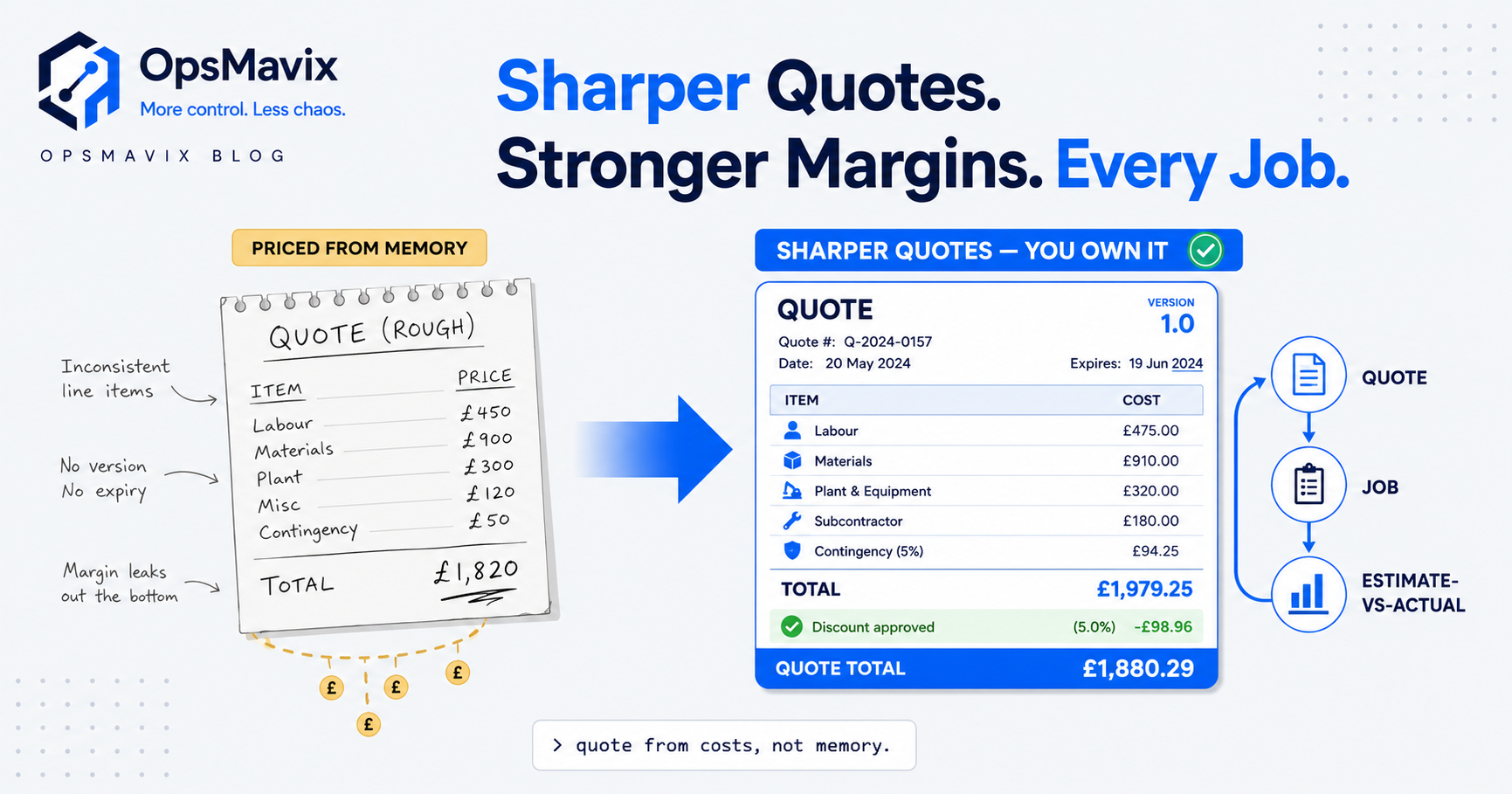
Quoting software best practices start from an uncomfortable admission: most quotes leak margin, and the software isn’t what fixes it — the habits it enforces are. Good quoting is a discipline, not a document. Quote from real costs instead of last year’s memory, keep line items consistent so two people price the same job the same way, control versions and expiry dates, put a rule on discounts, and close the loop from quote to job to estimate-vs-actual so every quote sharpens the next one. A tool that enforces those things earns its place; one that just makes a prettier PDF changes nothing.
That distinction matters because the money leaks long before anyone touches the work. Price a job too low and you’ve locked in a loss the day you win it — no amount of tight delivery claws it back. Price it inconsistently, with different people using different rates, and you never know why one job made money and the next one bled. The number that decides whether a job is worth doing gets set in the least disciplined five minutes of the process, from memory, under time pressure. Fix the discipline and the software question mostly answers itself.
Key Takeaways
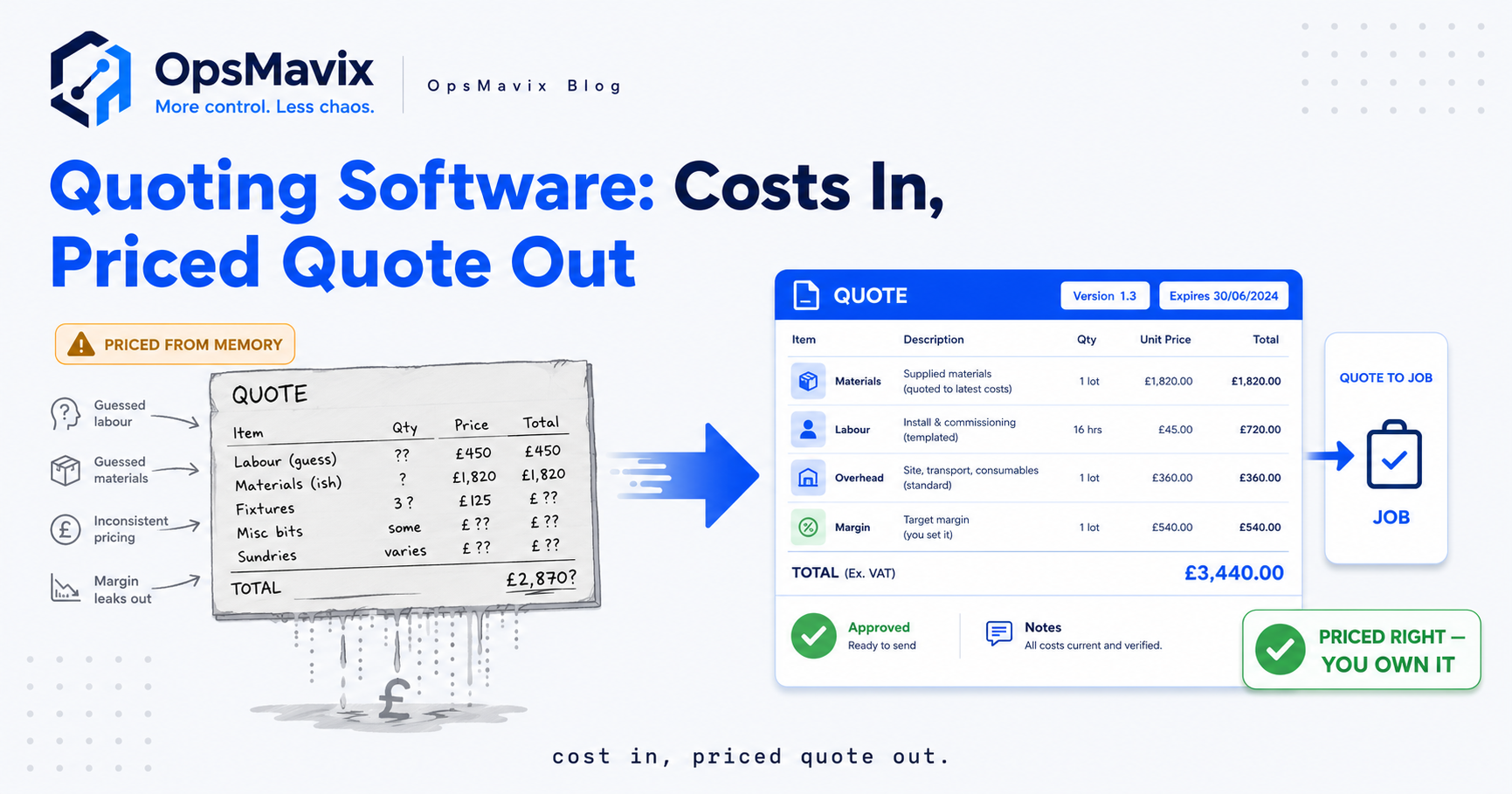
- Quote from current costs, not memory. A quote built on last year’s material price or a rate stuck in someone’s head is a loss you haven’t noticed yet.
- Consistency beats cleverness. Templated line items mean the same job gets priced the same way whoever writes it — margin stops swinging for reasons no one can explain.
- Control versions and expiry. Every revision kept, every quote dated “valid until” — so a negotiation doesn’t erase the original scope and a stale price can’t bite you later.
- Put a rule on discounts. Below a set margin, a quote needs a second signature. Discretion given to everyone under deadline is margin given away quietly.
- Close the loop. Won quote flows into the job with no re-keying; actuals flow back against the quote they came from. That estimate-vs-actual gap makes the next quote right.
- Volume decides whether you need a tool. A handful of standard jobs a month runs fine on a clean, disciplined template — a tool nobody updates is worse than a good habit.
Quote From Current Costs, Not Last Year’s
The most common way a quote leaks margin isn’t a maths error — it’s a stale input. Steel quoted at last year’s price. A fitting rate of £45 an hour because that’s the number stuck in someone’s head, while the loaded cost crept to £52 months ago. Nobody’s wrong on purpose. The numbers just drift, and every quote drifts with them.
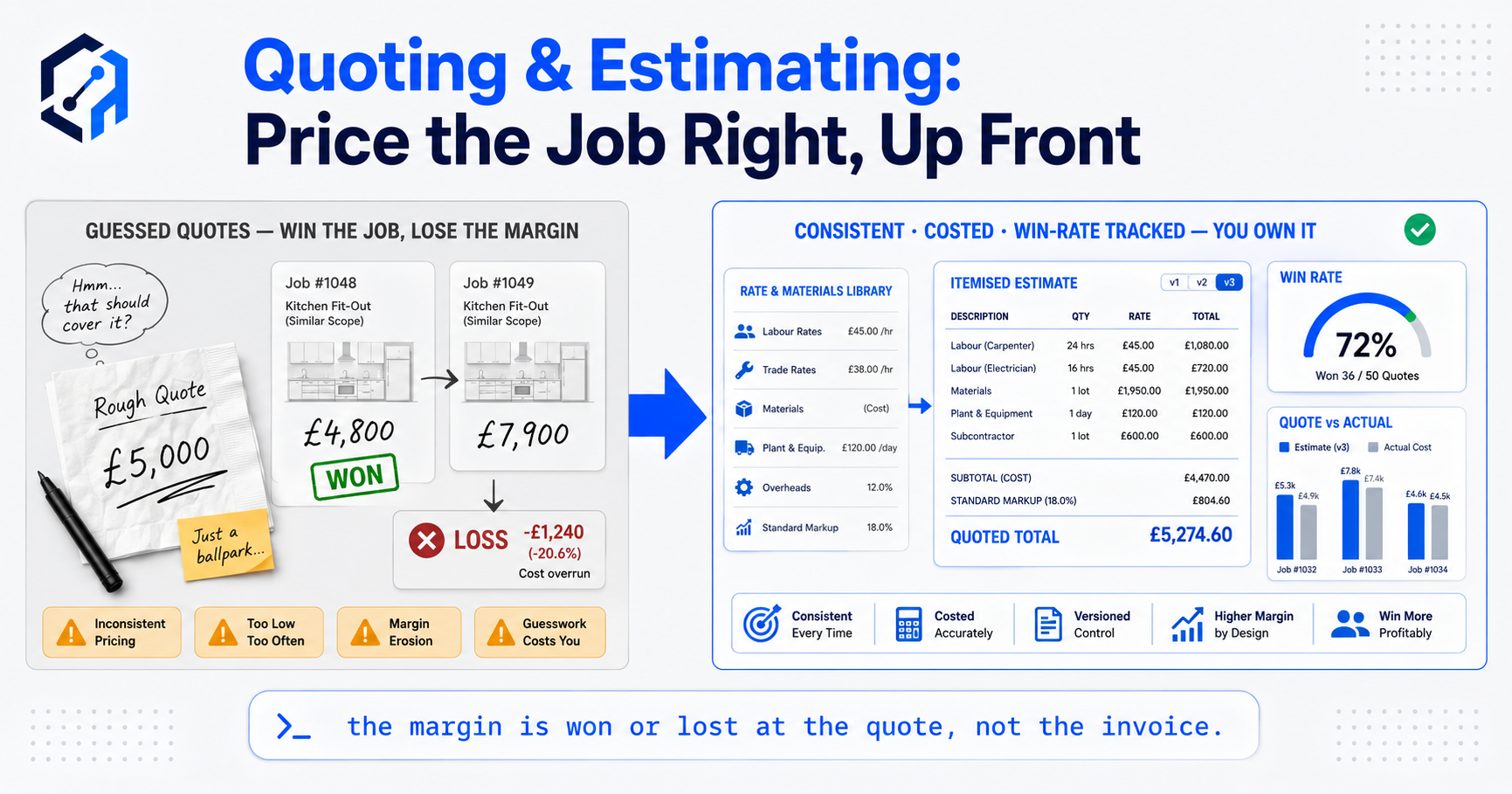
The practice is to pull every price from one live source and never from recall. Labour rates by role, materials at real landed cost, standard sub-costs — held in one place, updated once, used by every quote after. One estimator described finding three different hourly rates for the same job type across three quotes sent the same week by the same small team, none matching what the work cost. That’s not a discipline failure; it’s the absence of a shared source of truth. Update a material cost once and every new quote inherits it — stale pricing has nowhere to hide.
Keep Line Items Consistent and Templated
A job type you quote often should never be rebuilt from a blank page. Start from blank and two things happen: it takes longer, and someone forgets a cost — the site setup, the delivery, the first-fix materials a template would have listed. The quiet under-quotes almost always come from omission, not from a wrong price.
Templated line items fix both at once. The usual scope, the typical labour, the standard exclusions live in a template you start from and adjust rather than reassemble. Faster to produce, harder to forget a cost, and — the part that compounds — consistent in what it includes: when the same job type always carries the same line items, two estimators land on comparable numbers, and you can finally compare quote to quote. The same logic taken finer-grained is micro-estimating: standard units priced the same way every time.
Control Versions and Set an Expiry
Quotes get negotiated. The client wants two options, asks for a bit off, grows the scope mid-conversation. Overwrite one file each time and the history vanishes — you end up with a document called final, no idea what the original scope or price was, and the answer to “was the extra unit in this price?” living in a phone call nobody logged.
The practice is two-part. First, version control: keep every revision as its own record. This matters most in negotiation, because it forces price and scope to move together — drop the price and the version shows the scope that came out to match. Without it, the number gets cut and the scope quietly doesn’t, and you deliver the original job for the discounted price. Second, expiry: every quote carries a “valid until” date. A price built on this month’s costs shouldn’t be honoured six months later when steel has moved — but if nothing says so, clients will hold you to it. The expiry is your clean, professional reason to re-price stale quotes instead of absorbing increases you never agreed to.
Put a Rule on Discounts and Margin Floors
Discounting is where profit is given away with a smile. A cost is not a price — the gap between them is your markup, the most negotiated and least governed number in the process. Leave it to each estimator’s discretion under deadline and the same job gets marked up 40% one week and 15% the next. The client who pushes hardest, not the job that costs most, ends up setting the margin.
The practice is a margin floor with an approval rule. Set the minimum margin each job type must clear. Above it, the estimator has room to move; below it, the quote needs a second signature before it goes out — not distrust, but making the expensive decision deliberate instead of a reflex under pressure. When the quote calculates margin live and flags anything under the floor before it can be sent, the leak closes at the point it happens.
Close the Quote-to-Job Handoff — No Re-Keying
Winning the quote isn’t the finish line; it’s the handoff, and it’s where a clean quote gets corrupted. The moment a client says yes, everything you priced needs to become everything you deliver — and re-typing it into a separate job sheet is where that breaks. Someone mis-keys a quantity, and the priced scope drifts from the delivered scope before the job even starts, so the number you quoted and the work you’re doing already disagree on day one.
The practice is to carry the won quote straight into the job intact — the line items you priced become the tasks and materials the job runs on, nothing re-entered. And that’s the real payoff: because the job inherits the estimate, job costing can hold actual cost against the exact figure you quoted, line for line. Re-key the scope into a fresh system and that comparison is already broken — you’re measuring actuals against a retyped approximation.
Close the Loop: Estimate vs Actual
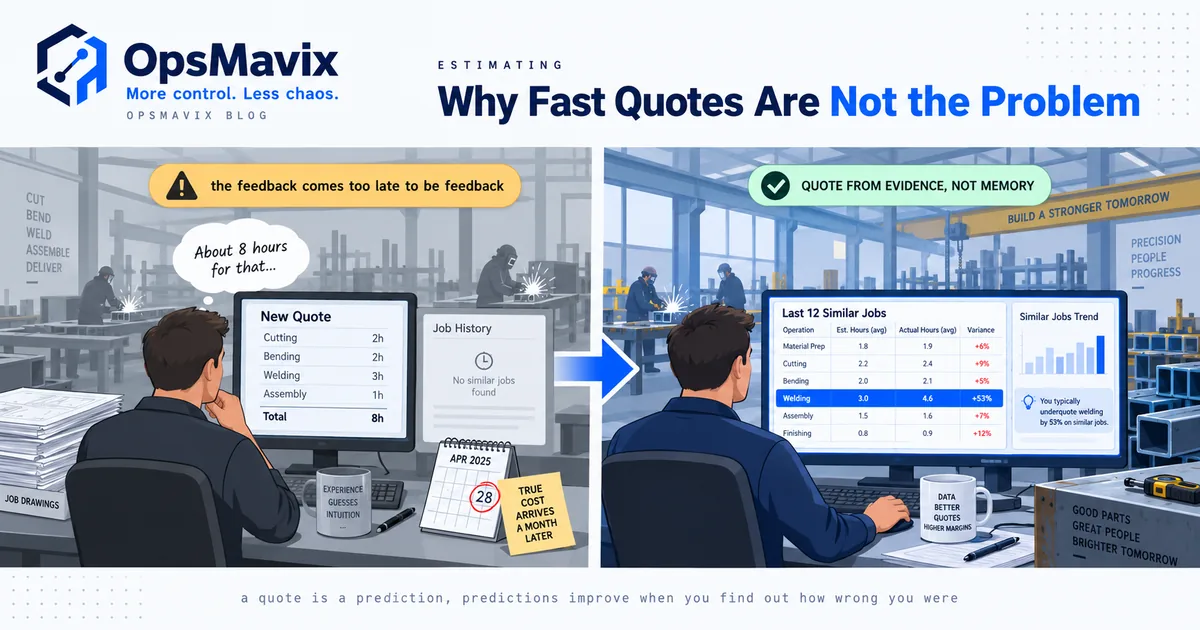
The most valuable practice in quoting is also the one almost nobody does: compare what you quoted against what the job actually cost, on the same job type, every time. You quoted 60 hours and £3,000 of materials; it took 82 hours and £3,600. That gap is the most useful number in the system — it tells you your estimate for that kind of job was wrong by a known amount, so the next one should be quoted higher.
Fed back consistently, those corrections sharpen the library and the templates themselves: this job type always eats more finishing time than the template assumes; this customer’s jobs always run long because the spec keeps changing. That’s how a static price list becomes a pricing system that learns, and the same discipline lets you track project profitability without spreadsheets. The reason so few close the loop is mechanical: most setups store the quote in one place and the actuals in another and never introduce them. The value is entirely in the join. Track win rate alongside it and you learn what the market pays: winning nine in ten means you’re probably too cheap; one in ten means you’re pricing yourself out.
Quote Fast — a Slow Quote Loses on the Clock
Speed is a pricing practice, not just a courtesy. In a lot of trades the first credible quote to land wins a meaningful share of jobs before the competitors even reply — the client has a problem now, and the business that responds while it’s fresh earns trust the slower ones never get. A quote that takes three days loses jobs you’d have won on merit, purely on the clock.
Model it roughly and the cost is stark. Quote 40 jobs a month, and if a same-day quote converts even ten points better than a three-day one, that delay costs you several jobs a month — not to a better price, but to a faster reply. Speed and discipline aren’t in tension: the same structure that makes a quote accurate — templates, a live rate library — is what makes it fast. The fast accurate quote wins the job the slow one was still drafting.
What the Tooling Should Actually Enforce — and When You Don’t Need It
Software earns its place only by enforcing the practices above, not by producing a nicer document. Judge any quoting tool against a short list: does it pull every price from one live source, template line items, keep versions and stamp an expiry, flag a sub-floor margin before the quote can leave, and carry a won quote into the job with no re-keying? A tool that does those enforces discipline. Generic software often forces your estimate into its own structure until people build side-spreadsheets to do the real calculation and type the answer back in — and a tool people work around is worse than none.
Be honest about scale, though. A business quoting a handful of standard jobs a month does not need software. Good habits in a clean, current template — one source for prices, consistent line items, a version per revision, a margin you don’t undercut, five minutes checking each finished job against what you quoted — beat any tool nobody updates. The failure mode for small volume isn’t a missing feature; it’s a system that sits stale while everyone goes back to the spreadsheet.
The case for a right-sized system shows up when volume, team size or complexity makes the discipline impossible to hold by hand. Then a system built around how you actually price keeps the practices enforced at scale and surfaces win rate and estimate-vs-actual patterns on a project operations dashboard. For a fuller walk through the buying decision, the quoting and estimating software guide covers what to look for.
FAQ
What are the most important quoting best practices?
Five, in order of impact. Quote from current costs held in one live source, never from memory. Keep line items consistent with templates so nothing gets forgotten. Control versions and set an expiry on every quote. Put a margin floor and an approval rule on discounts. And close the loop — carry won quotes into jobs without re-keying, then compare quoted against actual. The software matters only insofar as it enforces those habits.
How do I quote more accurately?
Right inputs and closed feedback. Right inputs means every rate and material price is current and pulled from one shared source, not half-remembered — stale inputs, not maths errors, cause most under-quotes. Closed feedback means checking every finished job against its quote: estimate 60 hours, take 82, and that gap tells you your estimate for that job type is wrong by a known amount. Do it consistently and your estimates calibrate instead of repeating the same optimistic guess.
Do I need quoting software, or is a spreadsheet enough?
It depends on volume and team size. A business quoting a handful of standard jobs a month can quote well from a clean, disciplined template — a tool nobody updates is worse than a good habit. You need a system when the discipline becomes impossible by hand: several people quoting, prices moving often, too many jobs to check against actuals. Then software earns its place by enforcing the practices at scale.
Why put an expiry date on a quote?
Because a price built on this month’s costs shouldn’t be honoured six months later when materials have moved. Without a stated “valid until” date, clients will hold you to an old number and you’ll feel obliged to comply. It’s a single field that closes a real and common leak: the quote accepted long after your costs outran the price on it.
How OpsMavix Can Help
OpsMavix builds quoting into the systems businesses use to run the day — shaped around how you actually price, so the practices get enforced instead of hoped for. Prices pulled from one live rate and materials library, templated line items for the jobs you quote often, versioning and expiry on every quote, a margin floor that flags a sub-floor discount before it goes out, and won quotes that flow straight into jobs with nothing re-keyed. Win rate and estimate-vs-actual gaps surface on a project operations dashboard, so the loop closes on its own and each quote gets sharper than the last.
If you quote a handful of standard jobs a month, take the habits and skip the tool. But once several people are quoting from memory, discounting at their own discretion, and never checking a quote against what the job cost, the leaks compound faster than any single win recovers. That’s the point where the discipline needs a system to enforce it. Book a Free Operations Leak Audit.
Keep reading
Getting value from OpsMavix? Add us as a preferred source on Google — you'll see more of our operations content in your AI Overviews, AI Mode and Search.