
Job Shop Quoting and Estimating Software: Why Fast Quotes Are Not the Problem
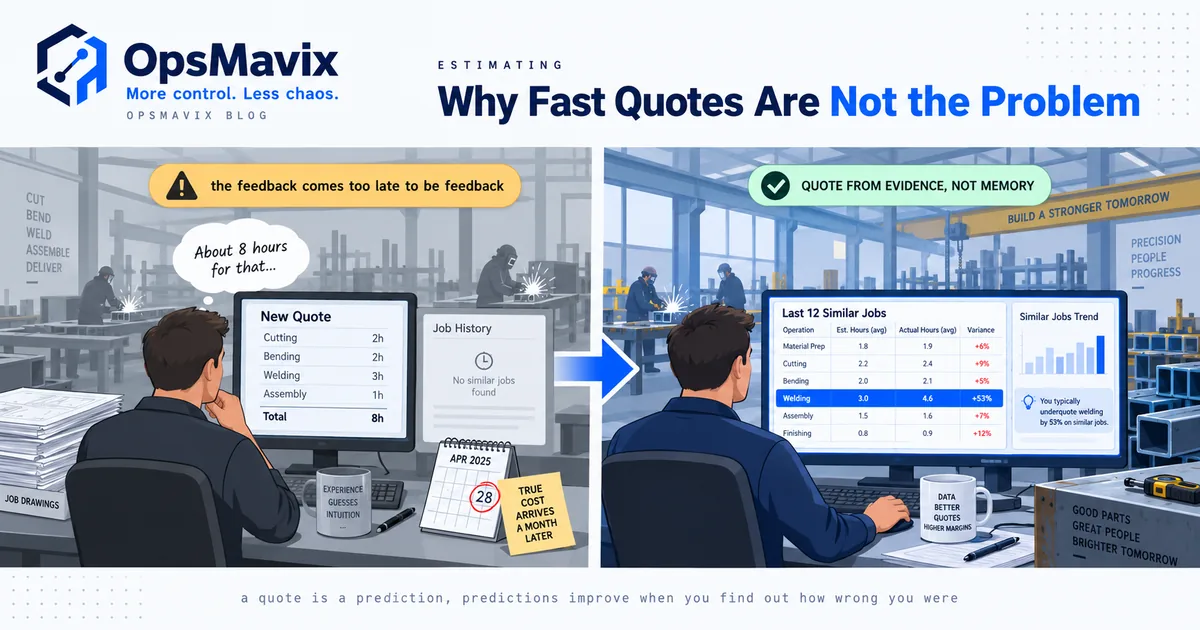
Every quoting tool sells speed. Speed is rarely the constraint. The constraint is that your estimator is guessing, because nobody ever told them what last year's jobs actually took. Fix that and the speed follows.
Job shop quoting and estimating software helps a machine or fabrication shop turn a drawing into a priced quote, by deriving cost from part geometry, from a library of costed operations, or from what comparable jobs actually took. Some tools also run the request for quote itself: intake, versions, follow-up and conversion to an order.
There is a specific conversation that happens in fab shops and machine shops, usually in the week after a big job ships, and it goes like this. Somebody works out that the job took longer than quoted. Everyone agrees the estimator needs to be more careful. Nothing changes. Six weeks later the same conversation happens about a different job.
The reason it repeats is that the diagnosis is wrong. The estimator is not careless. The estimator is guessing, because nobody has ever put in front of them what the last twelve similar jobs actually took.
Why do job shop quotes keep coming in under the actual cost?
Job shop quotes keep coming in under the actual cost because the feedback loop is broken: nobody puts what comparable jobs actually took, operation by operation, in front of the estimator, so the same error gets repeated instead of corrected. A quote is a prediction. Predictions get better when the predictor finds out how wrong they were, quickly and specifically. That is the entire mechanism.
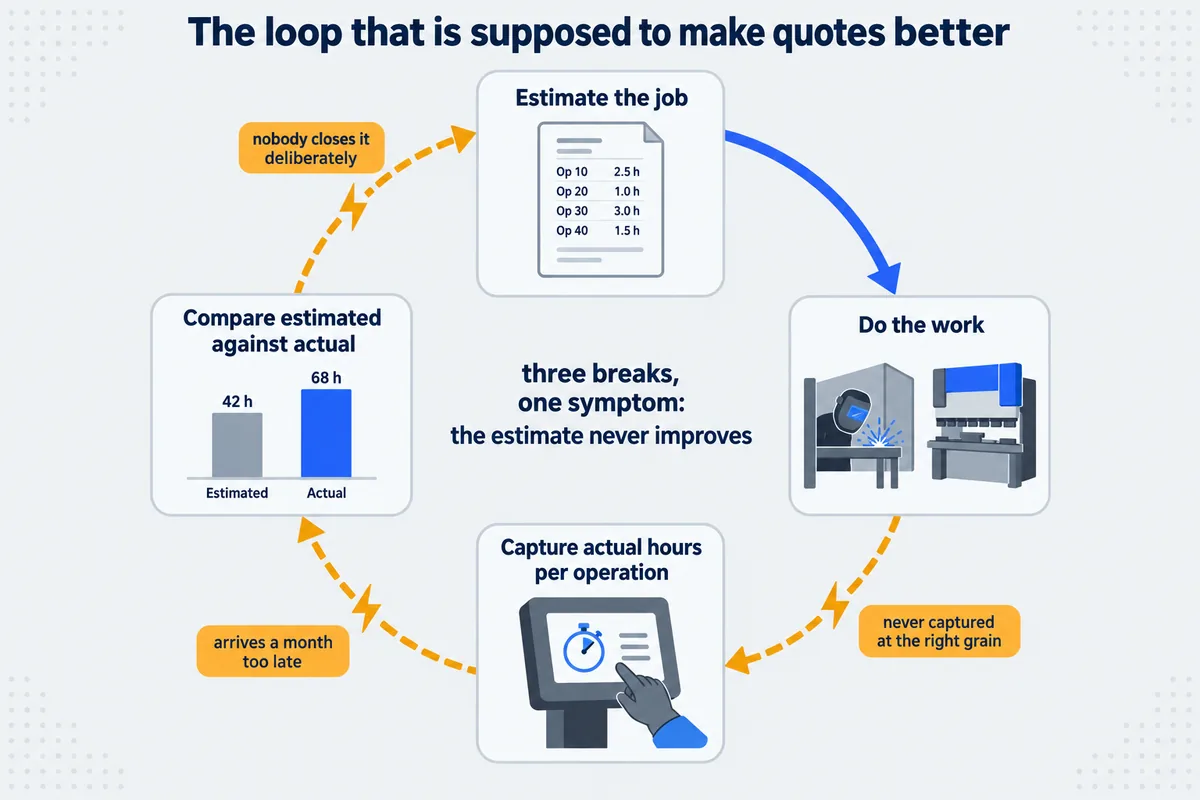
In most job shops the loop is broken in three places at once.
The actuals are never captured at the right grain. The shop knows the job took roughly three weeks. It does not know that the fit-up took eleven hours against four quoted, while the welding came in under. So the correction, if anyone makes one, is applied to the whole job as a fudge factor rather than to the operation that was actually wrong.
The feedback arrives too late to be feedback. If you learn a job lost money when the accounts close a month later, that is a post-mortem. The estimator has quoted forty more jobs since.
Nobody closes the loop deliberately. Even where the data exists, there is rarely a moment in the week where somebody puts estimated against actual in front of the person who estimates.
Buy the fastest quoting tool in the world and all three of those remain true. You will produce wrong numbers faster, and more consistently, which is worse rather than better, because consistency makes the error invisible.
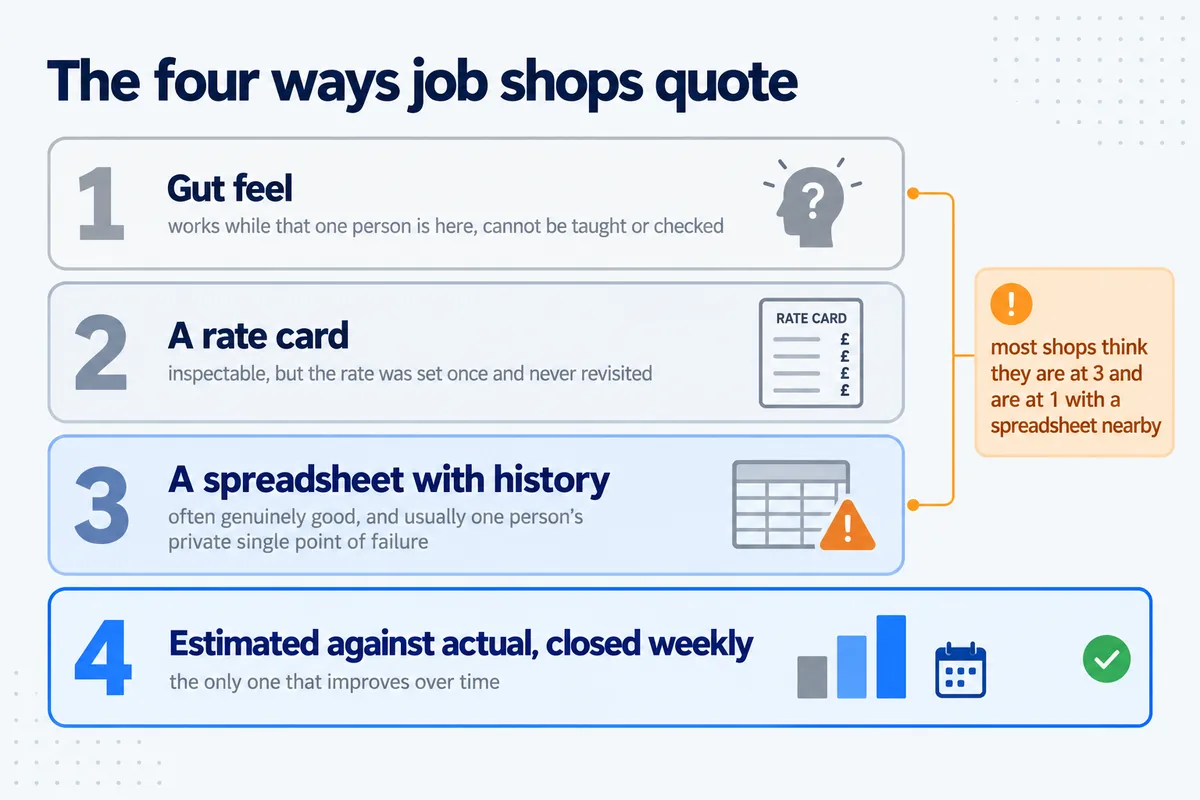
The four ways job shops quote, ranked by how much they cost you
Recognise your own shop here.
One. Gut feel. An experienced person looks at the drawing and names a number. This works, genuinely, while that person is present and while the work resembles work they have done. It fails silently when they retire, when work shifts, and when they are busy. It cannot be taught and it cannot be checked.
Two. A rate card. Hours estimated per operation, multiplied by a shop rate. Better, because it is inspectable. But the rate is usually set once, from a calculation nobody can find, and never revisited against reality.
Three. A spreadsheet with history. Someone has built a workbook with past jobs in it. This is often genuinely good, and it is also usually one person’s private system, unversioned, and a single point of failure. When it becomes somebody’s full-time job, it has already failed.
Four. Estimated against actual, closed weekly. Quotes are built from operation-level history, and every completed job feeds back within days. This is the only one that improves over time.
Almost every shop believes it is at three and is actually at one with a spreadsheet nearby.
What does job shop quoting software actually do?
Job shop quoting software does one of four quite different jobs: estimating from part geometry, estimating from a cost model, managing the request-for-quote workflow, or capturing actual costs and feeding them back into the next estimate. This market is often presented as one category. It is at least three, solving different problems, and buying the wrong one is expensive.
Geometry-driven estimating. Reads a CAD file or a flat pattern, extracts features like bends, holes, cut length and punch hits, and derives cycle time from geometry. Genuinely powerful when your work is a repeatable process across varying parts, such as sheet metal or CNC machining. Weak when a large share of the cost is fit-up, finishing or site work that geometry cannot see.
Cost model estimating. Builds a cost from a library of operations, feeds and speeds, material and overhead. Strong for machining and repeatable process work. Its accuracy depends entirely on whether the model is calibrated against your shop, which brings you straight back to actuals.
RFQ workflow and quote management. Handles the front end: getting requests in, tracking versions, chasing, presenting the quote professionally, converting to an order. Solves a real and different problem, which is that quotes get lost and follow-up does not happen. It has nothing to say about whether the number is right.
Job costing with feedback. Not usually sold as quoting software at all, which is why it gets missed. Captures actuals at the operation and puts estimated against actual in front of the estimator. This is the one that fixes the loop.
Most shops with a quoting problem buy the first or third, because those are the ones marketed at them, when their actual constraint is the fourth.
The tools, and what each one publishes
| tool | what it is mainly | pricing published |
|---|---|---|
| Paperless Parts | RFQ workflow plus geometry-driven analysis, sheet metal and machining | No, quote only |
| Costimator (MTI Systems) | Cost model estimating, long-established | No, quote only |
| KipwareQTE (Kentech) | Cost estimating and quoting, in development since 1986 | Partly |
| Machine Research | AI-driven estimating from 3D CAD for CNC and precision | No, quote only |
| Micro Estimating | Precision estimating and quoting | No, quote only |
| Tempus Tools | Fabrication quoting, laser-cutting oriented | Partly |
| Global Shop Solutions | Estimating inside a full manufacturing ERP | No, quote only |
| OpsMavix | Quoting built on your own captured actuals, inside a system you own | Yes, band published from £3,000 |
Checked September 2026. Most of this market quotes rather than publishes, so verify directly.
Two observations worth having before you take demos.
Almost nobody in this market publishes a price, which means the number is set by what you look like you can pay. Knowing that changes how you walk into the room.
The good geometry tools are genuinely good at what they do. If you cut sheet metal and quote from DXF files all day, a tool like Paperless Parts or Tempus Tools removes real work and we would not pretend otherwise. The question is not whether they work. It is whether estimating speed is your binding constraint.
The tools worth shortlisting
Taken one at a time, here is what each tool is and the problem it is actually built to solve. None of them publishes a fixed number for a shop your size, so treat the shortlist as a set of demos to book rather than a price comparison.
Paperless Parts
Paperless Parts is a quoting platform for custom manufacturers, combining request-for-quote intake and workflow with geometry-driven analysis of uploaded CAD and 2D files. It handles the front end of quoting, including versions, internal collaboration and sending the quote out professionally, alongside cost estimation for processes such as machining, sheet metal and fabrication. It suits shops that receive a high volume of enquiries and lose time and work in the handling of them, rather than shops whose numbers are simply wrong.
Costimator
Costimator, from MTI Systems, is a long-established cost estimating system built on time standards and a structured cost model, aimed at machining, fabrication and assembly work. It produces an estimate from process data rather than from somebody’s recollection of a similar job, which makes the basis of the number inspectable and defensible to a customer. It suits shops prepared to calibrate the model against their own operations, and it is sold through a quoted process.
KipwareQTE
KipwareQTE is a machining and fabrication cost estimating and quoting package from Kentech, part of a wider Kipware toolset that has been in development since the 1980s. It builds estimates from operations, materials and shop rates, and it is pitched at smaller shops rather than at enterprise deployment. It suits a machine shop that wants a straightforward estimating tool it can run itself, without an implementation project and a consulting engagement attached to it.
Machine Research
Machine Research offers automated estimating for CNC and precision manufacturers, analysing 3D CAD models to derive machining processes and cycle times rather than relying on an estimator’s judgement part by part. It is aimed squarely at geometry-driven work, where most of the cost sits in the machining itself. It suits precision shops quoting many similar-but-different parts, and it is a weaker fit wherever fit-up, finishing or site work carries a large share of the cost.
Micro Estimating
Micro Estimating provides estimating and quoting software for precision manufacturing, machining and fabrication, building a cost from operations, materials and shop-specific rates. It suits manufacturers who quote frequently and want a detailed, structured estimating basis that lives in a system rather than in one person’s spreadsheet. The practical test is the same as for any cost-model tool: how much calibration against your own actual hours it needs before the numbers are trustworthy.
Tempus Tools
Tempus Tools makes browser-based quoting software for fabricators, best known for quoting laser and profile cutting from uploaded DXF files, with nesting-aware cut time and material usage feeding the price. It is narrow by design and quick at the thing it does. It suits a cutting-led shop quoting many small jobs straight from drawings, and it is not intended to cover the whole estimating problem of a mixed fabrication business with heavy fit-up and finishing content.
Global Shop Solutions
Global Shop Solutions puts estimating inside a full manufacturing ERP, alongside scheduling, inventory, shop floor data collection and accounting. Because the estimate lives in the same system as the job that follows it, actual hours can inform the next quote without a separate integration, which is the loop most standalone quoting tools leave open. It suits manufacturers who want one vendor across the business, and it is a considerably larger purchase and implementation than a quoting tool alone.
What do you need before quoting software will help?
Before quoting software will help, you need time captured at the operation, estimates stored in the same shape as that capture, and a weekly moment where somebody puts the two side by side. Whichever you buy, these three things determine whether the money does anything. They are also, awkwardly, mostly free.
One. Time captured at the operation, not the job. Set-up separately from run. Logged by the person doing it, on the floor, in gloves, in under five seconds. If it takes longer than that, it will not happen, and everything downstream is fiction.
Two. The estimate stored in a comparable shape. If you quote in whole-job hours and capture in operations, you cannot compare them. The estimate has to be broken into the same operations you capture against, or the loop cannot close.
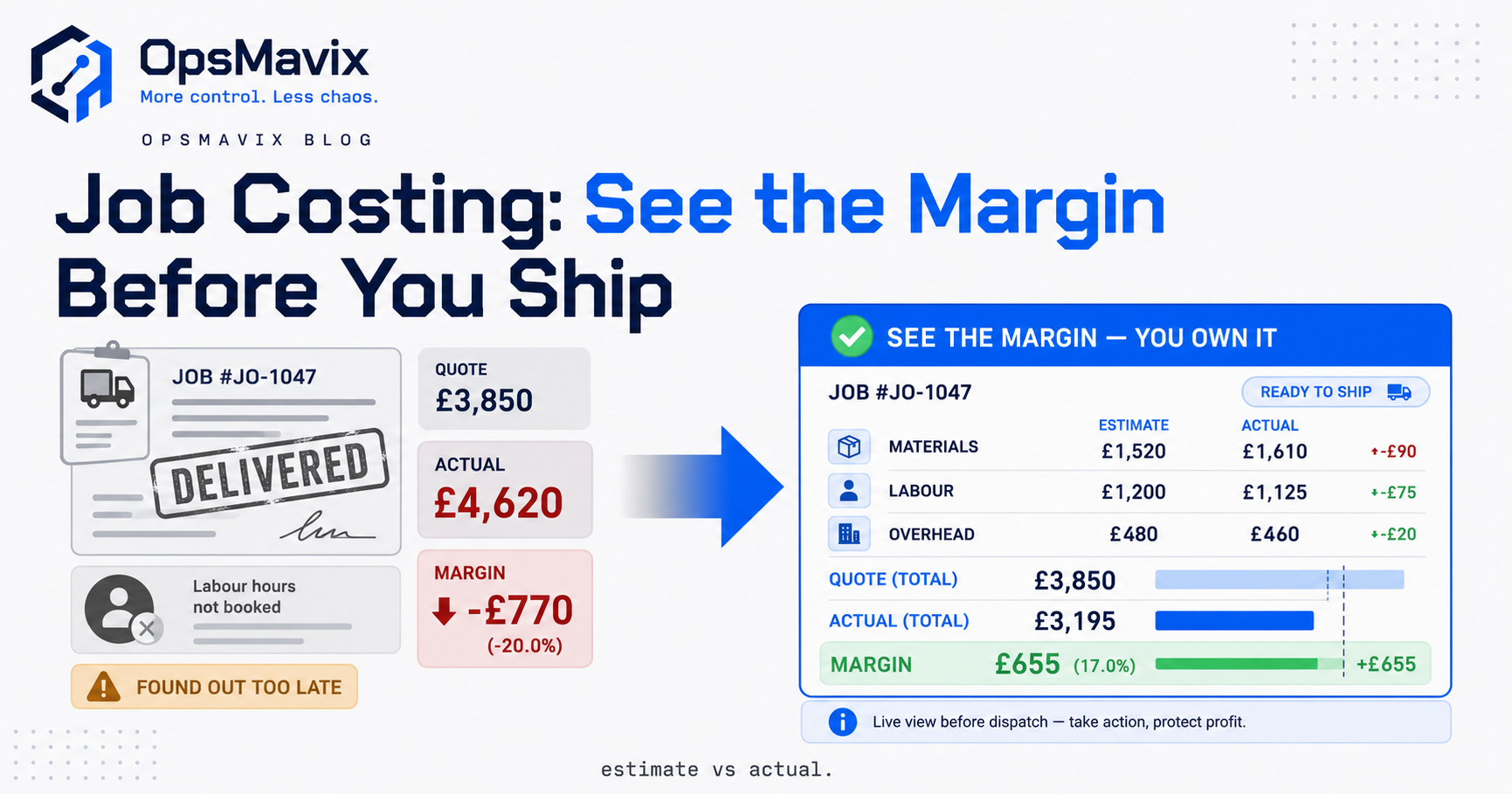
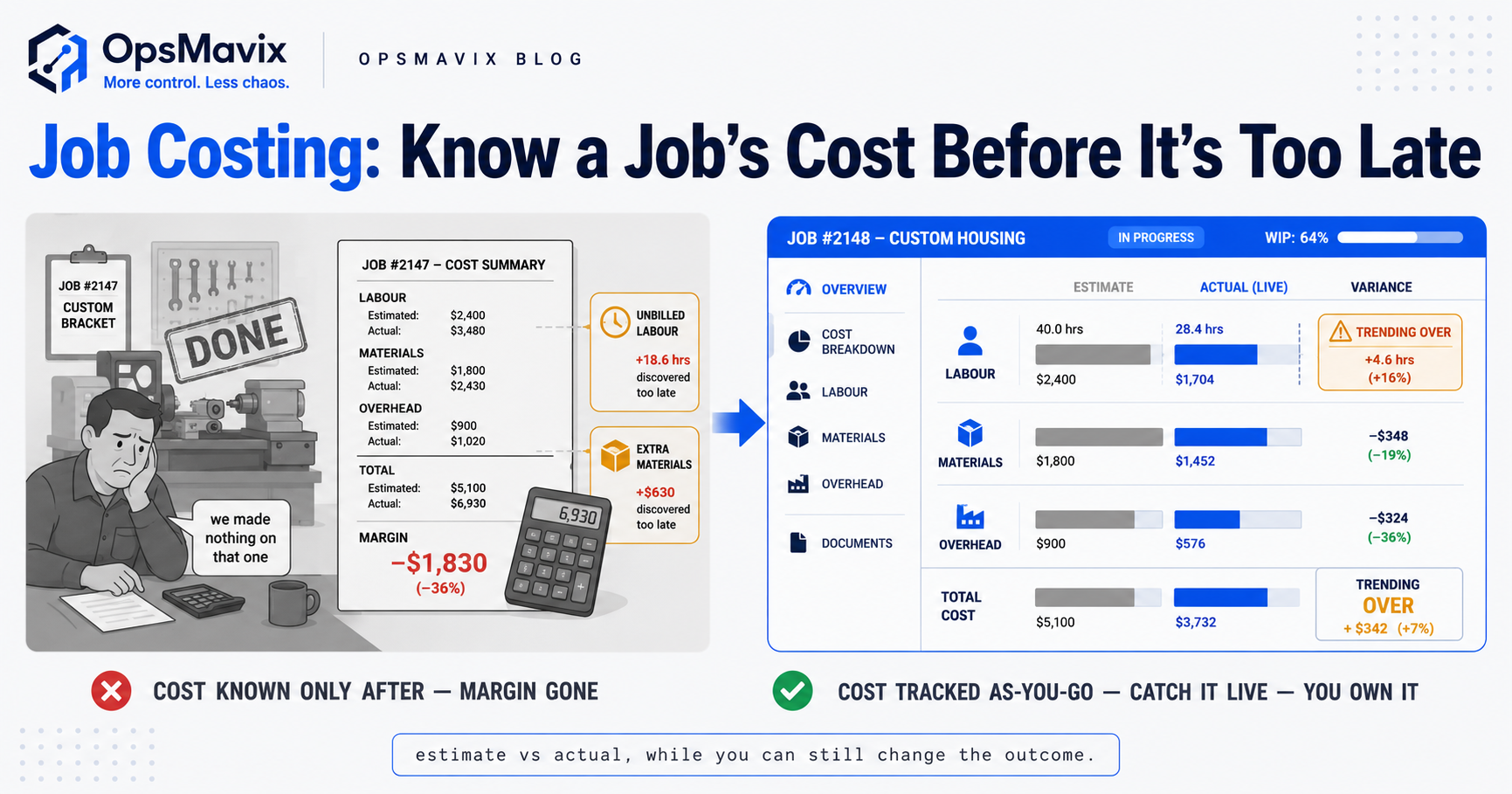
Three. A weekly moment where somebody looks. Estimated against actual, by operation, for everything that shipped that week, in front of the person who estimates. Fifteen minutes. This is the entire intervention and it requires no software licence at all, only the data from step one.
A shop that does those three with a decent spreadsheet will out-quote a shop with expensive software and none of them. We have watched that happen.
What 2,324 reviews say about buying any of this
We collected 2,324 public reviews of 19 inventory and ERP systems that UK product businesses run, and coded all 840 negative reviews by what the customer was complaining about. The method and rule set are published, so the work is checkable.
| what the complaint was about | share of negative reviews |
|---|---|
| Support quality or responsiveness | 50.1% |
| Functionality gaps | 28.8% |
| Reliability and bugs | 21.2% |
| What sales promised versus what arrived | 18.8% |
| Integrations | 18.7% |
| Price increases | 16.7% |
| Contract and cancellation terms | 16.0% |
| Implementation and onboarding | 13.7% |
Grouped: relationship complaints reach 75.0% of negative reviews, product complaints 53.9%, and 31.7% of unhappy customers never criticise the software at all.
Two of those rows matter especially when you are buying an estimating tool.
“What sales promised versus what arrived” at 18.8%. Estimating tools are sold on accuracy, and accuracy claims are the easiest thing in the world to demonstrate on a sample the vendor chose. Insist on running the trial against your own last twenty completed jobs, where you already know the actual hours. If the tool cannot be tested that way, that is the answer.
“Integrations” at 18.7%, rising to 23.1% among UK reviewers. A quoting tool that does not push the accepted quote into whatever runs your floor just moved the re-typing rather than removing it. Ask specifically what happens at the moment a quote is won.
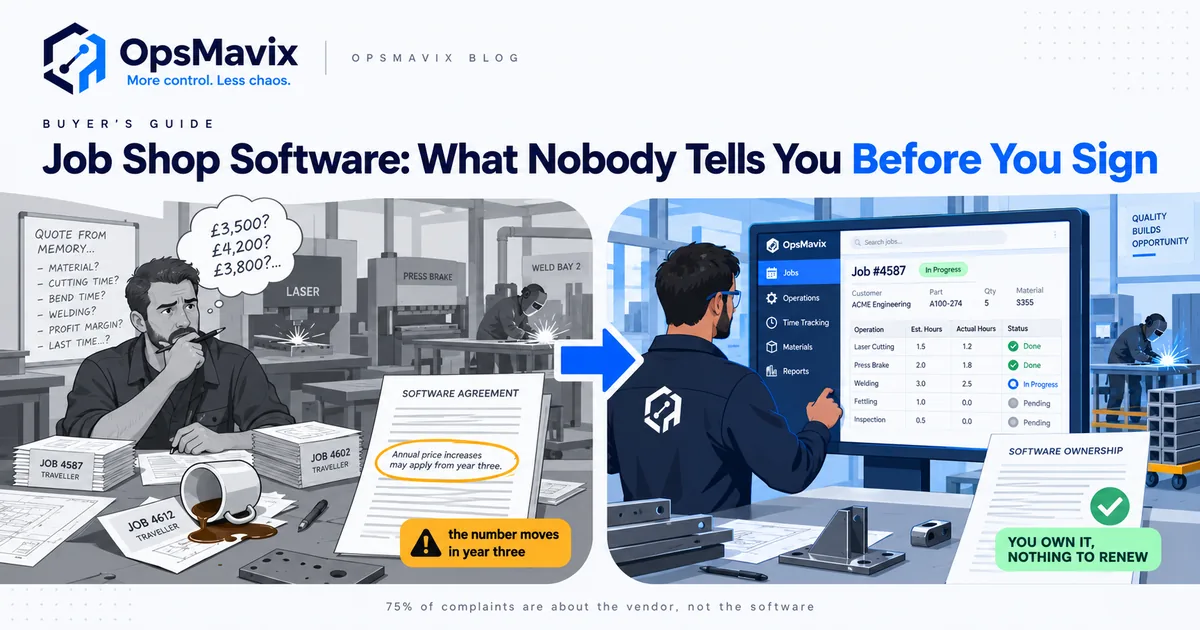
And the finding that should shape the contract rather than the demo: reviewers mentioning several years of use complain about price and contract terms 57.9% of the time, against 33.2% for newer customers. Ask about the increase cap and the notice period before you sign, not in year three.
The margin arithmetic nobody runs
Here is the calculation that decides whether any of this is worth doing, and it takes ten minutes.
Take your last twenty completed jobs. For each, write down what you quoted in hours and what it actually took. If you cannot fill in the second column, stop: you have just found your real problem, and no quoting tool solves it.
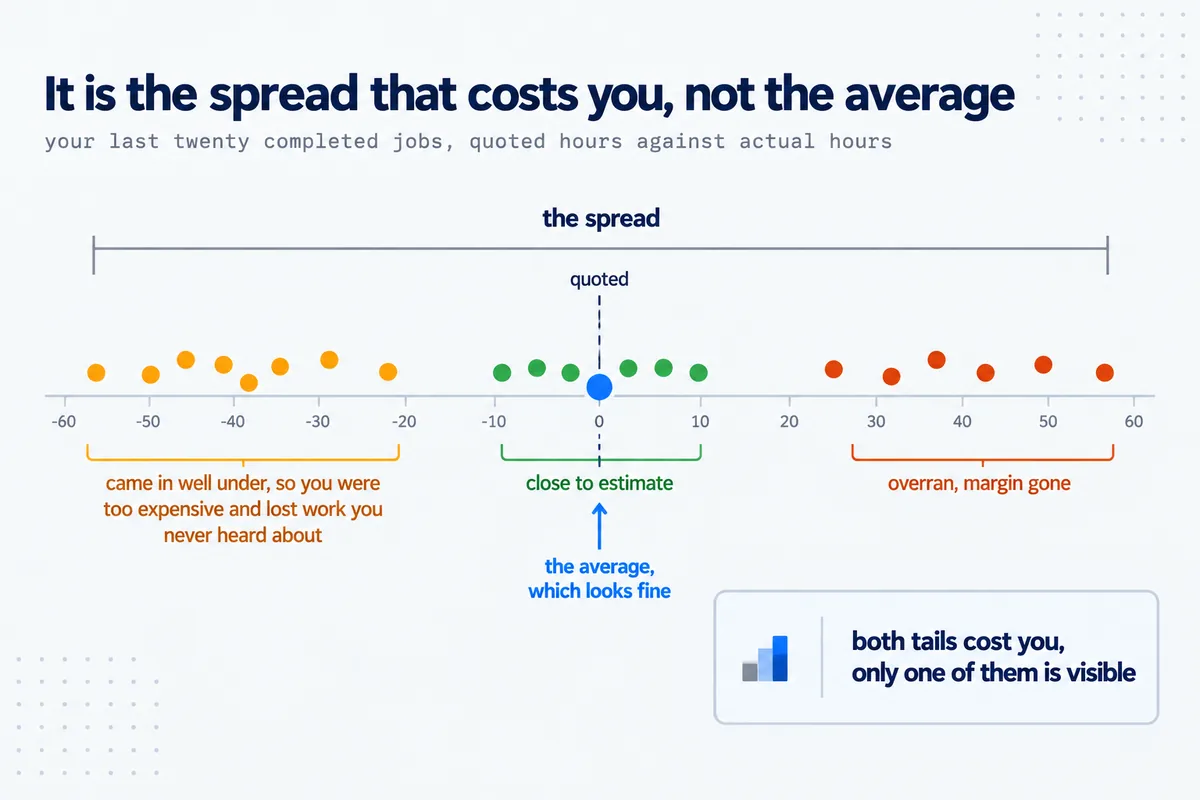
If you can fill it in, work out the spread. Not the average, the spread. Most shops discover something like this: roughly a third of jobs come in near the estimate, a third come in well under, and a third overrun badly. The average looks acceptable, which is exactly why nobody investigates.
The two-thirds that miss are both costing you. The overruns eat margin directly. The ones that come in well under cost you differently and more quietly: you were too expensive, so some of those quotes never became jobs at all, and you never found out why you lost them.
That spread, not the average, is what closing the loop narrows. And it is worth noticing that you cannot even run this calculation without operation-level actuals, which is the same prerequisite as everything else on this page.
When should you buy a quoting tool?
You should buy a quoting tool when estimating throughput is genuinely the constraint, when your work is geometry-driven and repeatable in process, or when the request-for-quote process itself is leaking work. Buy one when:
- Estimating throughput is genuinely the constraint. You are turning down RFQs, or quoting late and losing work to whoever answered first.
- Your work is geometry-driven and repeatable in process. Sheet metal from DXF, CNC from 3D models. The geometry tools earn their money here.
- You already have operation-level actuals. Then a quoting tool amplifies something real instead of formalising a guess.
- The RFQ process itself is leaking. Requests lost in inboxes, no version control, no follow-up. That is a workflow problem and workflow tools fix it.
When should you fix the feedback loop instead?
You should fix the feedback loop instead when you cannot say what your last twenty jobs actually took, because until those actuals exist there is nothing accurate for a quoting tool to work from.
- You cannot fill in the actual-hours column for your last twenty jobs. Nothing else matters until you can.
- Your cost is in fit-up, finishing, rework or site work rather than in machine cycles. Geometry cannot see any of that, so a geometry tool will quote the visible half of your cost confidently and the invisible half not at all.
- Your estimator is one person’s memory. Software does not transfer that. Captured history does, and it keeps working after they retire.
- The bill would grow with the shop. Per-user pricing on a tool the floor should be using is a tax on exactly the behaviour you want.
What we build for this is deliberately unglamorous: capture at the operation, estimate stored in the same shape, and estimated against actual in front of the estimator while the job is still warm. Inside a system you own outright, so the records and the history stay yours.
A worked example: twenty jobs, and what the numbers actually tell you
The calculation described above is worth doing properly, because the shape of the result usually surprises people. Here is what it looks like with the arithmetic filled in, using a pattern typical of a fabrication shop quoting in operation hours.
Take twenty completed jobs. For each, record quoted hours and actual hours, broken into operations. Suppose the totals come out like this.
| quoted hours | actual hours | variance | |
|---|---|---|---|
| Seven jobs near estimate | 812 | 831 | +2.3% |
| Six jobs overran | 604 | 892 | +47.7% |
| Seven jobs came in well under | 745 | 519 | -30.3% |
| All twenty | 2,161 | 2,242 | +3.7% |
Look at the bottom row first, because that is the number most shops see. Total actual hours came in 3.7% over quoted. That is close enough that nobody investigates, and the conclusion is “our estimating is broadly fine”.
Now look at the three rows above it. Only seven of twenty jobs were actually estimated well. The other thirteen were wrong in opposite directions and cancelled each other out in the average. The average was hiding two separate problems that happen to net off.
The overruns are the visible cost. Six jobs consumed 288 hours nobody quoted for. At any sensible shop rate that is a large number, and it comes straight off the bottom line.
The underruns are the invisible cost, and they are usually the bigger one. Seven jobs were quoted 226 hours heavier than they needed. You won those, so they look like successes. What you cannot see is the set of similar jobs you quoted the same way and lost, because you were the expensive one. Those never appear in any report because losing a quote generates no record in most shops. That is the leak nobody can point at.
Now break the thirteen misses down by operation instead of by job, which is the step that makes this actionable. In shop after shop the same thing appears: the variance is not spread evenly. One or two operations carry most of it. Fit-up is the usual culprit in fabrication, because it is the operation most sensitive to drawing quality and part accuracy, and the one an estimator has the least feel for. Machining and cutting tend to estimate well because they are geometry-driven and repeatable.
That is the whole payoff of the exercise. You do not come out of it with a vague sense that estimating needs to improve. You come out with a specific finding like “we underquote fit-up by roughly 40% on anything with more than twelve parts”, which is correctable next week, by one person, without buying anything.
Two practical notes on running it. Use jobs that finished at least a month ago so the actuals are settled. And do not average away part quantities: normalise to hours per part or per assembly where you can, or a couple of large jobs will dominate the picture.
What to test during a trial, and how to make the vendor prove it
Estimating tools are sold on accuracy, and accuracy is the easiest thing in the world to demonstrate on a sample the vendor chose. Our review data puts “what sales promised versus what arrived” at 18.8% of negative reviews, so this is not a hypothetical concern.
There is one test that cuts through all of it.
Give them your last twenty completed jobs and ask the tool to quote them. You already know the answers. Compare the tool’s estimate against your recorded actuals, operation by operation. Any vendor confident in their product will engage with this. Any vendor who deflects to a curated sample has answered your question.
Watch for four specific things while you do it.
How much configuration was needed to get a good result. If the tool needed extensive calibration against your shop to match your actuals, that is fine and normal, but it means the accuracy is coming from your data rather than their algorithm. That changes the value of the product and, more importantly, tells you the tool is useless until you have the actuals, which brings you back to capture.
What it does with the operations geometry cannot see. Ask specifically how it estimates fit-up, finishing, handling, and anything that happens on site. Geometry-driven tools are excellent at the machining and cutting portion and often silent on the rest. If half your cost is in the part they do not model, a confident number on the other half is dangerous rather than useful.
What happens the moment a quote is won. Integrations appear in 18.7% of negative reviews and 23.1% among UK reviewers. If the accepted quote does not flow into whatever runs your floor as a job with a routing, you have moved the re-typing rather than removed it, and you have introduced a second place where the estimate lives.
Whether the loop closes inside the tool. Ask whether actual hours flow back and update the estimating basis automatically, or whether somebody has to do that by hand. Most quoting tools are one-directional. That is not a scandal, but it means the tool will keep producing the same wrong number consistently unless a human maintains it.
Finally, ask the two contract questions before signing rather than in year three: what is the contractual cap on annual price increases, and what is the notice period. Reviewers citing several years of use complain about price and contract terms 57.9% of the time against 33.2% for newer customers, and nobody negotiates well from inside year three.
FAQ
Will quoting software make our quotes more accurate?
Only if it is calibrated against your actual hours. On its own it makes quotes faster and more consistent, which is valuable but different. Consistency without accuracy means you are wrong the same way every time, which is harder to spot than being wrong randomly.
How long before we see the benefit of closing the loop?
You need enough completed jobs for patterns to appear, so realistically one to three months depending on job length. The first thing that usually shows up is not a general inaccuracy, it is one specific operation being systematically underquoted, and correcting that one thing often pays for the exercise.
Can we do this with a spreadsheet?
The comparison, yes, and you should start there. The capture is where spreadsheets fail, because the data has to come off the floor from people who are busy. If you can get operation-level time into a spreadsheet reliably, you do not need us for the analysis part.
How much does job shop quoting software cost in the UK?
Most of this market quotes rather than publishes, so it depends on headcount and negotiation. Get the increase cap and the notice period in writing before you sign. Our own builds start at £3,000, fixed before work begins.
Does this replace our ERP?
Not necessarily, and often it should not. If your ERP handles purchasing and finance adequately, the gap is usually floor capture and the estimate-versus-actual view. Adding that is a smaller and safer project than replacing a working ERP.
What about AI estimating from CAD files?
Genuinely useful for CNC and precision work where geometry drives most of the cost. Test it against jobs you have already completed rather than against the vendor’s samples. And be honest about how much of your cost is geometry and how much is fit-up, finishing and site work, because that ratio decides the answer.
Our estimator says every job is different, so history will not help.
Every job being different is true and it is also the reason the history helps. You are not looking for an identical job. You are looking for the hours per operation on jobs of similar complexity, so that the estimate is anchored to something rather than produced from scratch each time. The estimator is usually right that no two jobs match and wrong that this makes the data useless.
Should we quote in hours or in money?
Quote in hours per operation, then apply the rate. Two reasons. Hours are what you can actually measure on the floor, so the feedback loop closes against them. And separating hours from rate means that when your costs change you adjust one number rather than re-estimating everything.
How do we set the shop rate?
Carefully, and more often than you do now. Most shops set a rate once from a calculation nobody can locate and then leave it while wages, energy and overhead all move. A rate that is two years stale will make even a perfectly estimated job unprofitable, and no quoting tool will tell you, because the tool trusts the rate you gave it.
What about quoting for rush jobs and rework?
These are the two categories that most reliably destroy margin and most reliably go unmeasured. If rush work displaces scheduled work, its true cost includes the disruption, not just its own hours. If rework is not captured as its own operation, it silently inflates the actuals on the original job and teaches your estimator the wrong lesson: that the job was hard, when actually it was done twice.
Do we need to capture material as well as labour?
Yes, but the priority ordering matters. Material costs are usually already visible through purchasing, so most shops know them approximately. Labour is the one that is invisible, and it is where the estimating error concentrates. Start with hours per operation and add material precision after.
How many jobs before the history is useful?
Enough to see a pattern per operation rather than per job, which in practice tends to be a few dozen completed jobs. You will get the first useful finding much earlier than that, because a systematic bias in one operation shows up quickly once you are looking at it broken down.
What if our people log time inaccurately?
They will at first, and the fix is usually design rather than discipline. Time gets logged badly when logging is slow, when it happens at the end of the day from memory, or when people suspect the data is being used to judge them individually. Make it take seconds at the operation, make it happen as work starts and stops, and show the floor something useful back from it.
Can we just add a percentage to every quote instead?
It is what most shops do, and it is why the underruns exist. A flat uplift makes you uncompetitive on the jobs you estimate well and still does not cover the ones you systematically underquote. It treats a spread problem as an average problem, which is precisely the mistake this article is about.
About this article, and its limits
Written by Martin Gjini at OpsMavix, September 2026.
We sell one of the options. OpsMavix builds custom operations systems and full ERP solutions for UK product businesses, and we are the last row in the table. That is why the section naming when to buy a quoting tool instead names real products and real reasons.
The review dataset covers 19 inventory and ERP systems, not quoting tools specifically. Paperless Parts, Costimator, KipwareQTE, Machine Research and Tempus Tools are not in it. What it describes is how buyers of operations software are treated after they sign, which we think generalises, but it is an inference.
We have not published named customer results. Our case studies are anonymised at the clients’ request and carry no outcome claims we cannot evidence. Several comparison pages in this market quote improvement percentages with no named customer and no documentation. We are not doing that in reverse.
The full dataset and coding rules are at what actually goes wrong with inventory and ERP software. There is an anonymised fabrication shop case study showing job costing built this way, and a clickable demo that needs no sign-up.
Keep reading
Getting value from OpsMavix? Add us as a preferred source on Google — you'll see more of our operations content in your AI Overviews, AI Mode and Search.