
Quoting and Estimating Software: Pricing the Job Right, Up Front
Quoting and estimating software builds a consistent, accurate price for a job before you win it — pulling from a shared rate and materials library, applying standard markups, and versioning every quote. It's how you stop under-quoting on hope, keep pricing consistent across whoever's quoting, and close the loop between what you quoted and what the job actually cost. Here's how it works.
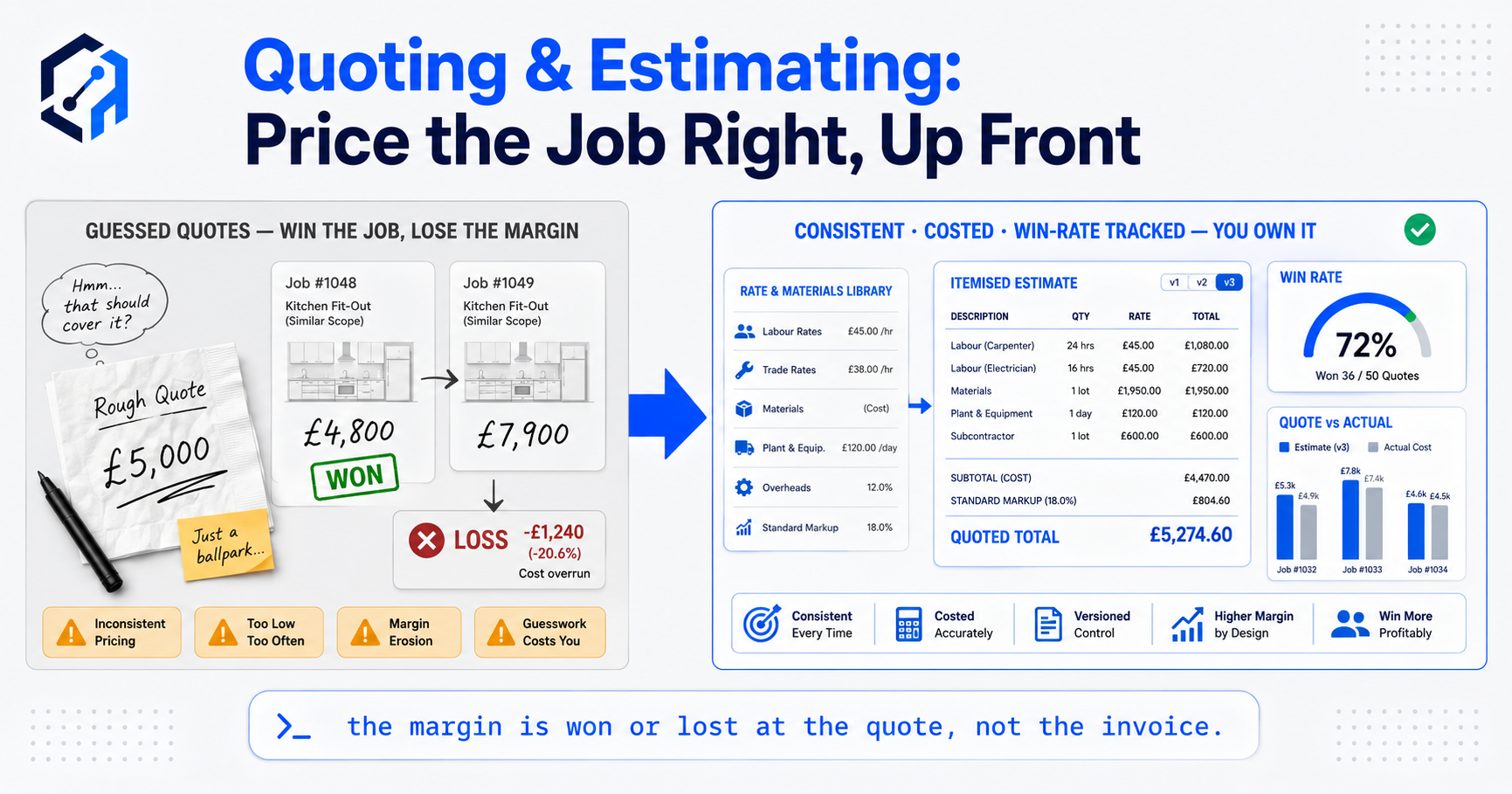
Quoting and estimating software is the tool that builds a consistent, accurate price for a job before you commit to it — pulling labour rates and material costs from a shared library, applying your standard markups, and holding the whole thing as a versioned quote you can send, revise and turn into a job. Not a blank spreadsheet someone rebuilds from scratch every time. One place where every quote gets priced the same disciplined way, whoever’s writing it.
The money leaks at the quote, long before anyone touches the work. Price a job too low and you’ve locked in a loss the day you win it — no amount of tight delivery claws that back. Price it inconsistently, with different people using different rates and different guesses, and you never really know why one job made money and the next one bled. Most growing businesses quote from memory and a gut feel for “what we usually charge,” then wonder why margin swings wildly from job to job. The number that decides whether a job is worth doing gets set in the least disciplined five minutes of the whole process.
Key Takeaways
- Quoting and estimating software builds a consistent price up front from a shared rate and materials library — not a guess someone types into a fresh spreadsheet each time.
- Standard markups and templates mean every quote is priced the same disciplined way, whoever writes it — so margin stops swinging job to job for no reason.
- Versioning keeps every revision of a quote, so a “can you do it for less?” negotiation doesn’t quietly erase the original scope and price.
- Turning a won quote into a job carries the priced scope straight into delivery — no re-keying, nothing lost between sales and the shop floor.
- Win-rate tracking tells you which quotes convert at which price, so you learn what the market actually pays instead of guessing.
- What a job actually costs as it runs is job costing; the margin after is project profitability. This post is about pricing it right before you start.
1. What Quoting and Estimating Software Actually Does
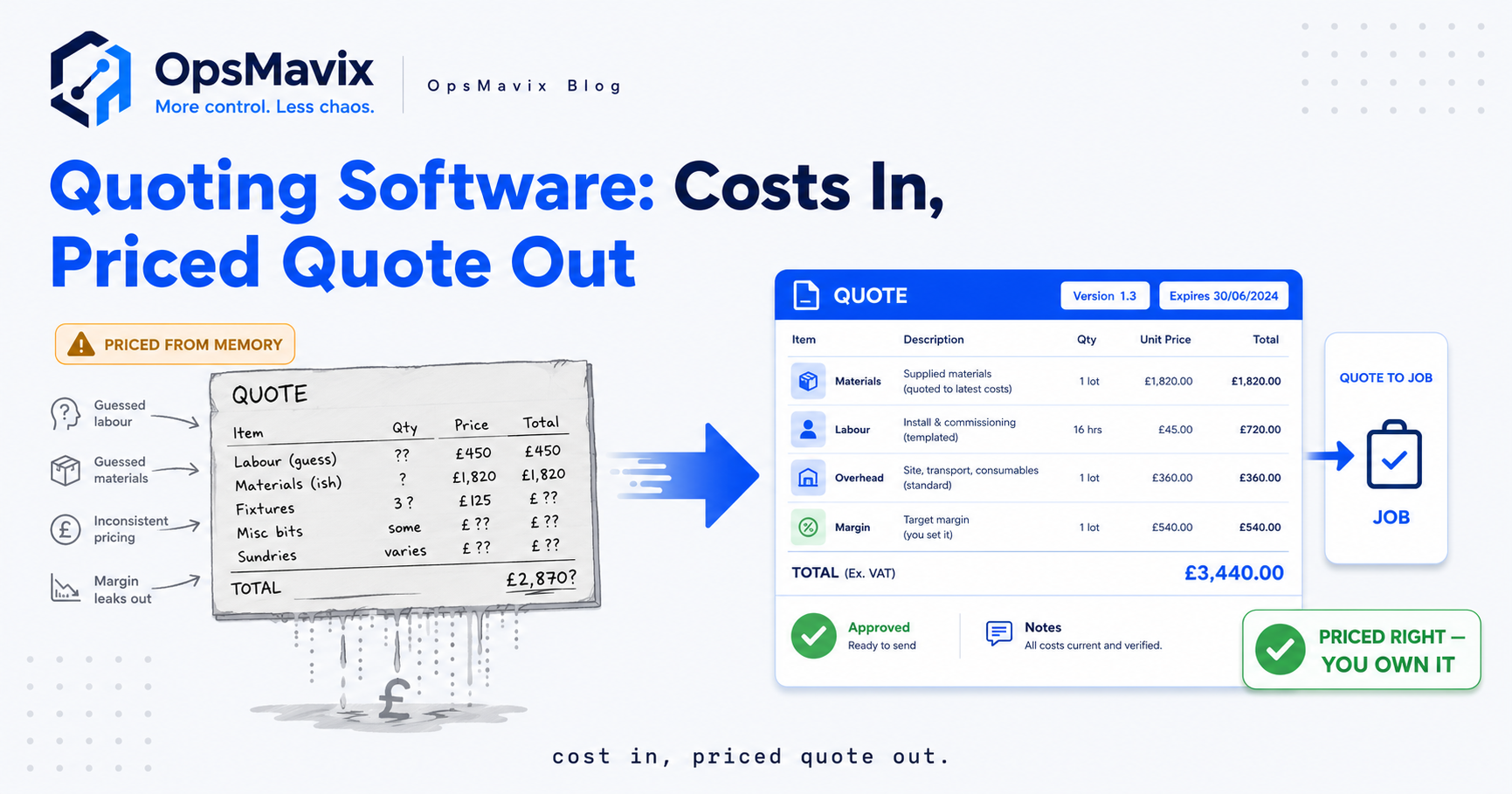
An estimate is a build: you take the scope of a job, break it into the labour and materials it needs, price each piece, add your markup, and arrive at a number you’re willing to stand behind. Quoting and estimating software is the machinery that does that build the same way every time — so the price reflects real rates and real material costs, not whatever felt right on the day.
The distinction that matters up front: this is the price you set before you win the work, not the cost you track while you do it. Estimating decides what to charge. Costing, later, tells you what it actually took. They share a lot of the same data — labour rates, material prices — but they answer opposite questions at opposite ends of the job. Estimating is the bet. Costing is checking whether the bet paid.
Get the build disciplined — rates from a library, markups applied by rule, scope captured as line items — and a quote stops being an act of hope. It becomes a repeatable calculation you can trust, defend to a client, and compare against what actually happened later.
2. The Rate and Materials Library: One Source of Truth for Prices
Everything sound about a quote traces back to one thing: the numbers you build it from being right and shared. A rate and materials library is that source — your labour rates by role or task, your material costs at real landed prices, your standard sub-costs — held in one place, so every quote pulls from the same figures instead of whatever someone half-remembered.
Without it, prices rot quietly. One estimator quotes steel at last year’s price. Another charges £45 an hour for fitting because that’s the number stuck in their head, while the actual loaded cost crept to £52 months ago. Nobody’s wrong on purpose — the numbers just drift, and every quote drifts with them. One estimator we spoke to described finding three different hourly rates for the same job type across three quotes sent the same week, all by the same small team. None of them matched what the work actually cost.
A shared library kills the drift. Update the steel price once and every new quote uses it. Nudge a labour rate and the change flows into every estimate built after. The library is what makes “consistent pricing” more than a slogan — it’s the single place the truth lives, and quoting from it is what stops margin leaking before a job even starts.
3. Standard Markups and Quote Templates: Consistency by Default
A cost is not a price. The gap between them is your markup — the margin that covers overhead, risk and profit — and it’s where a lot of quiet under-quoting happens. Add too little and you win jobs that don’t pay. Leave it to each estimator’s gut and the same job gets marked up 40% one week and 15% the next, with no one able to say why.
Standard markups make the margin a rule, not a mood. Different rules for different job types if you need them — a rush job carries more, a big repeat client maybe less — but a rule either way, applied automatically, not re-decided under time pressure on every quote. The estimator builds the scope; the system applies the margin. The number that protects your profit stops depending on who’s tired that afternoon.
Templates do the same for scope. A job type you quote often shouldn’t be rebuilt from a blank page every time — its usual line items, its typical labour, its standard exclusions live in a template you start from and adjust. Faster to produce, harder to forget a cost, and consistent in what it includes. A contractor described cutting quote time from an afternoon to twenty minutes just by templating their three most common job types — and, more to the point, they stopped forgetting to price the site setup that a blank-page quote always left off.
4. Versioning: Every Revision, Nothing Quietly Lost
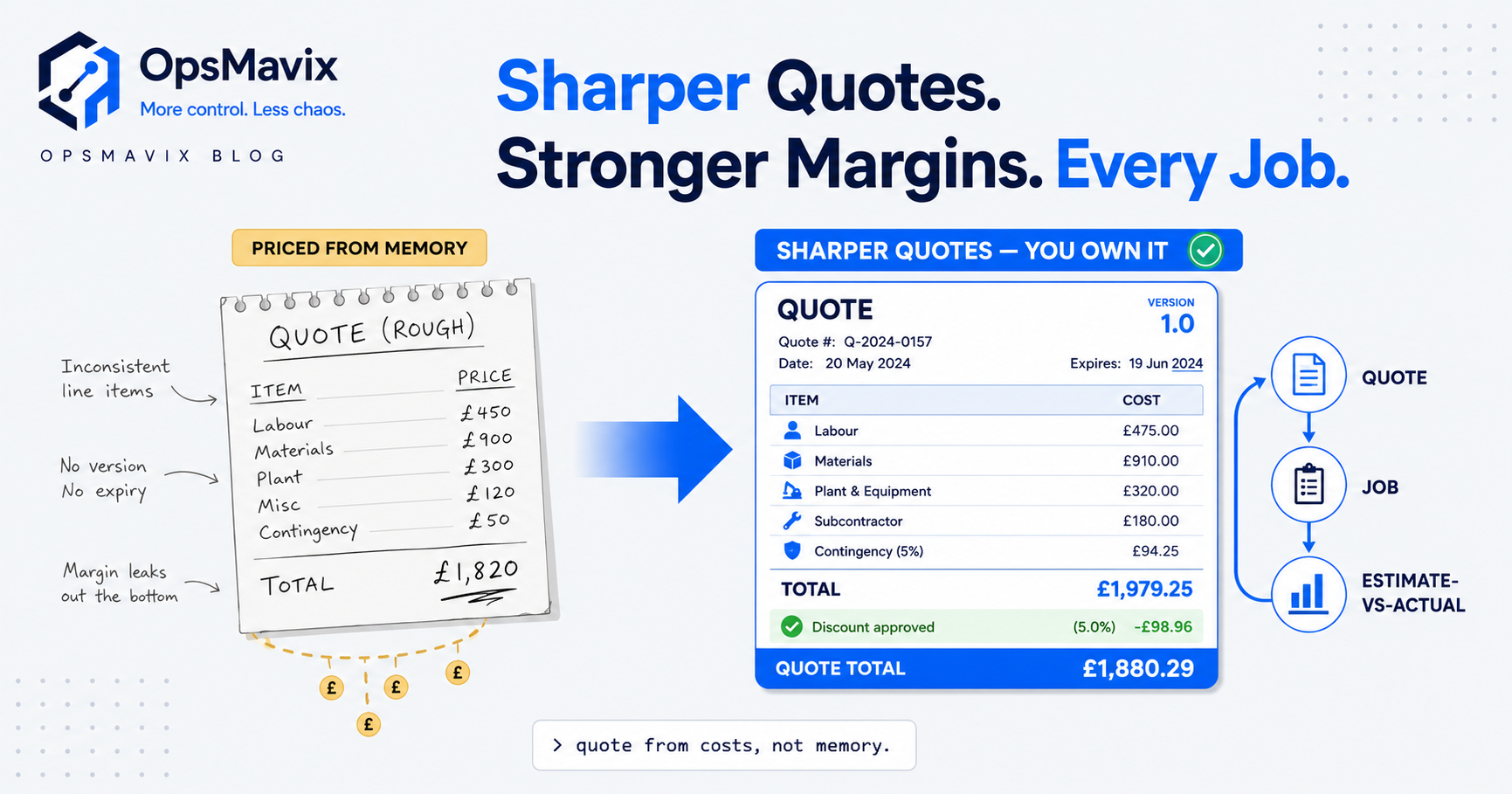
Quotes change. The client wants two options. They ask for a bit off the price. The scope grows mid-negotiation. Handle that in a spreadsheet you overwrite each time, and the history vanishes — you end up with one file called final and no idea what the original scope or price was before three rounds of “can you sharpen it.”
Versioning keeps every revision as its own record. V1 at full scope and price. V2 with the client’s cut. V3 when they added a section back. Each one preserved, so you can see exactly what changed between them and what you agreed to in the end. When the job starts and someone asks “was the extra unit in this price?”, the answer is in the version history, not in anyone’s memory of a phone call.
It matters most in the negotiation. When a client pushes for a lower number, versioning makes the trade explicit: drop the price, and here’s the scope that came out to match. Without it, price gets cut and scope quietly doesn’t — you agree to the lower number and still deliver the original job, eating the difference. The version is the receipt that keeps price and scope moving together instead of the client keeping the scope and taking the discount too.
5. Turning a Won Quote Into a Job
The quote isn’t the finish line — winning it is the handoff. The moment a client says yes, everything you priced needs to become everything you deliver: the scope, the line items, the materials, the labour you estimated. Do that by re-typing it into a job sheet or a separate system and two things go wrong — someone mis-keys a quantity, and the priced scope drifts from the delivered scope before the job even starts.
Turning a won quote straight into a job carries the whole thing across intact. The line items you priced become the tasks and materials the job runs on. Nothing re-entered, nothing dropped in translation. Sales and the shop floor are working from the same numbers, because they’re literally the same numbers — the ones you quoted.
This is also what makes the next stage honest. Because the job inherits the estimate, job costing can hold actual cost against the exact figure you quoted, line for line. Re-key the scope into a fresh system and that comparison is already corrupted — you’re measuring actuals against a retyped approximation, not the real quote. The clean handoff is what lets you eventually answer “did we quote this right?” with data instead of a shrug.
6. Win-Rate and the Quote-to-Actual Feedback Loop
A quote that goes out and is never looked at again teaches you nothing. The businesses that price well close two loops. First: win rate — which quotes convert, at what price, for which job types. Track that and you stop guessing what the market pays. If you win 8 in 10 at your current number, you’re probably leaving money on the table. If you win 1 in 10, you’re pricing yourself out or quoting the wrong work. The pattern only shows up if you’re recording outcomes against quotes, not sending and forgetting.
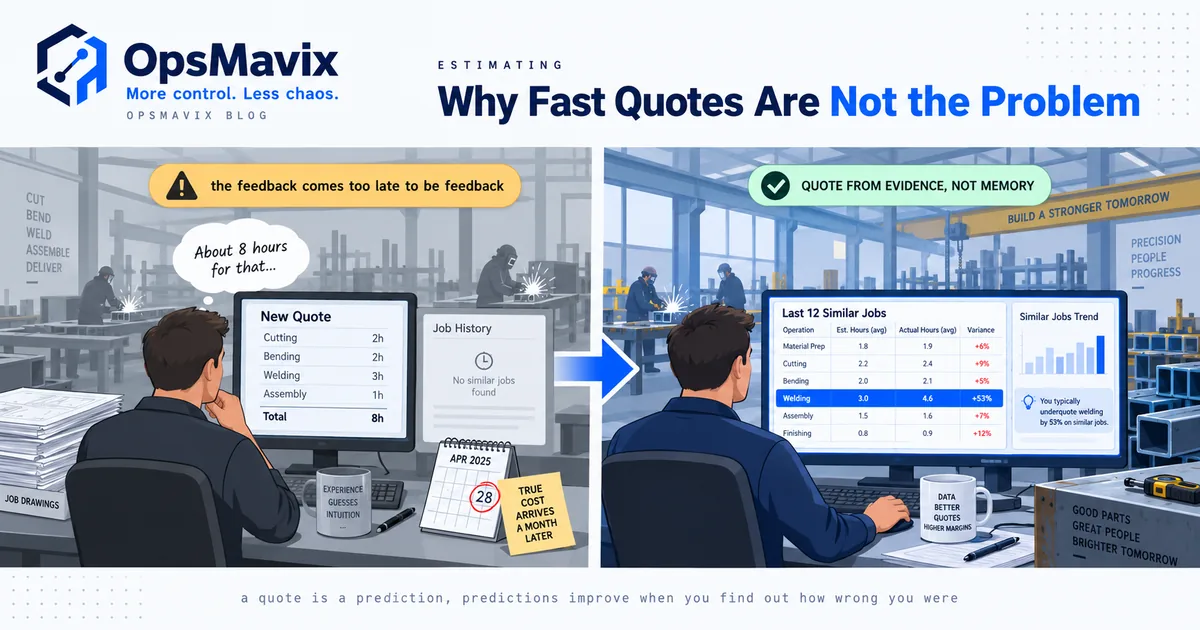
Second, and this is the one almost nobody closes: quoted vs actual. You quoted a job at 60 hours and £3,000 of materials. It took 82 hours and £3,600. That gap is the single most useful number in the whole system, because it tells you your estimate for that kind of job was wrong by a known amount — and the next one like it should be quoted higher. Feed enough of those corrections back and the library sharpens itself: this customer’s jobs always run long because their spec keeps changing, this job type always eats more finishing time than the template assumes, this material’s real cost outran the quote months ago.
Off-the-shelf tools rarely close this loop — they store the quote in one place and the actuals in another and never introduce them. The value is entirely in the join. Actuals sitting next to the estimate they came from, on the same job type, is what turns a static price list into a pricing system that learns.
7. Build vs Buy: Estimating Shaped to How You Price
Generic quoting tools assume everyone prices the same way, and few trades do. Yours might quote by the square metre, by the assembly, by the day, or by a mix that shifts per job. Off-the-shelf software forces your estimate into its structure — its markup logic, its idea of a line item, its rate categories — and estimators end up with side spreadsheets to make the real calculation, then typing the answer back in. A quoting tool people work around is worse than none: it looks like discipline and delivers guesswork.
A right-sized system prices the way you actually price. Your rate library, your markup rules, your job templates, your quote layout — built around your logic, not bent to fit someone else’s. And because it’s yours, the loop closes on its own: won quotes flow into jobs, actuals flow back against the quotes they came from, and win rate and margin patterns surface on a project operations dashboard beside everything else you run the day on. For the businesses in the gap — outgrowing spreadsheets and disconnected tools — that’s the difference between a price list and a pricing system that gets sharper every job.
FAQ
What is quoting and estimating software?
Quoting and estimating software builds a consistent, accurate price for a job before you win it — pulling labour rates and material costs from a shared library, applying your standard markups, and holding the result as a versioned quote you can send, revise and turn into a job. Instead of rebuilding a price from a blank spreadsheet every time, every quote gets priced the same disciplined way, whoever writes it. It’s about setting the right number up front, so you stop locking in losses at the quote stage.
How is estimating different from job costing?
Timing and direction. Estimating sets the price before the work, based on what you expect a job to take. Job costing tracks actual cost during the work, as labour and materials land against the job. Estimating is the bet; costing checks whether the bet paid. They share data — the same rates and material prices — but answer opposite questions at opposite ends of the job. Good estimating and good costing feed each other: the actuals from costing tell you whether your estimate was right, so the next quote is sharper.
How does quoting software keep pricing consistent across a team?
Through a shared rate and materials library plus standard markup rules. Every estimator pulls labour rates and material costs from the same source instead of their own memory, so the numbers can’t drift person to person. Markups are applied as a rule by job type rather than re-decided on each quote, and common jobs start from templates so scope and inclusions stay consistent. The result: the same job priced by two different people lands at the same number, and margin stops swinging for reasons no one can explain.
Why does quote versioning matter?
Because quotes get negotiated, and without versioning the history disappears. Each revision — full scope, the client’s requested cut, the added section — is kept as its own record, so you can see exactly what changed and what you finally agreed. It matters most when a client pushes for a lower price: versioning makes the scope trade explicit, so you don’t quietly drop the number while still delivering the original job. It’s the receipt that keeps price and scope moving together.
What is the quote-to-actual feedback loop?
It’s the comparison between what you quoted a job at and what it actually cost once delivered. If you quoted 60 hours and it took 82, that gap tells you your estimate for that job type was wrong by a known amount — and the next similar quote should reflect it. Fed back consistently, these corrections sharpen your rate library and templates over time, so estimates stop being hope and start being calibrated. Most tools never close this loop because they keep quotes and actuals in separate places; the value is in joining them.
How OpsMavix Can Help
OpsMavix builds custom quoting and estimating into the systems businesses use to run the day — priced the way you actually price, not bent to fit generic software. Your rate and materials library as the single source of truth, standard markups applied by rule, templates for the jobs you quote often, and full versioning so no negotiation quietly erases the original scope. Won quotes turn straight into jobs with nothing re-keyed, and win rate and quote-to-actual gaps surface on a project operations dashboard beside the rest of your operation — so your pricing gets sharper with every job instead of repeating the same guesses.
If your quotes come from memory and a feel for “what we usually charge,” you’re locking in losses at the quote stage on some jobs and pricing yourself out of others — and you can’t tell which, because no two are priced the same way. That blind spot compounds on every job you win at the wrong number. Book a Free Operations Leak Audit.
Keep reading
Getting value from OpsMavix? Add us as a preferred source on Google — you'll see more of our operations content in your AI Overviews, AI Mode and Search.