
Multi-Modal vs Voice-Directed Picking: A Warehouse Method Decision Guide
Multi-modal vs voice-directed picking comes down to one choice — do you want a single hands-free voice mode, or voice plus scan plus screen so pickers switch to whatever's fastest and safest per task. But that's the last decision, not the first. Voice, multi-modal, RF, pick-to-light and paper all sit on top of the same thing: the stock and order data underneath. Get that wrong and no picking method saves you. Here's when each one fits, the trade-offs nobody tells you, and the layer that actually decides whether any of them work.
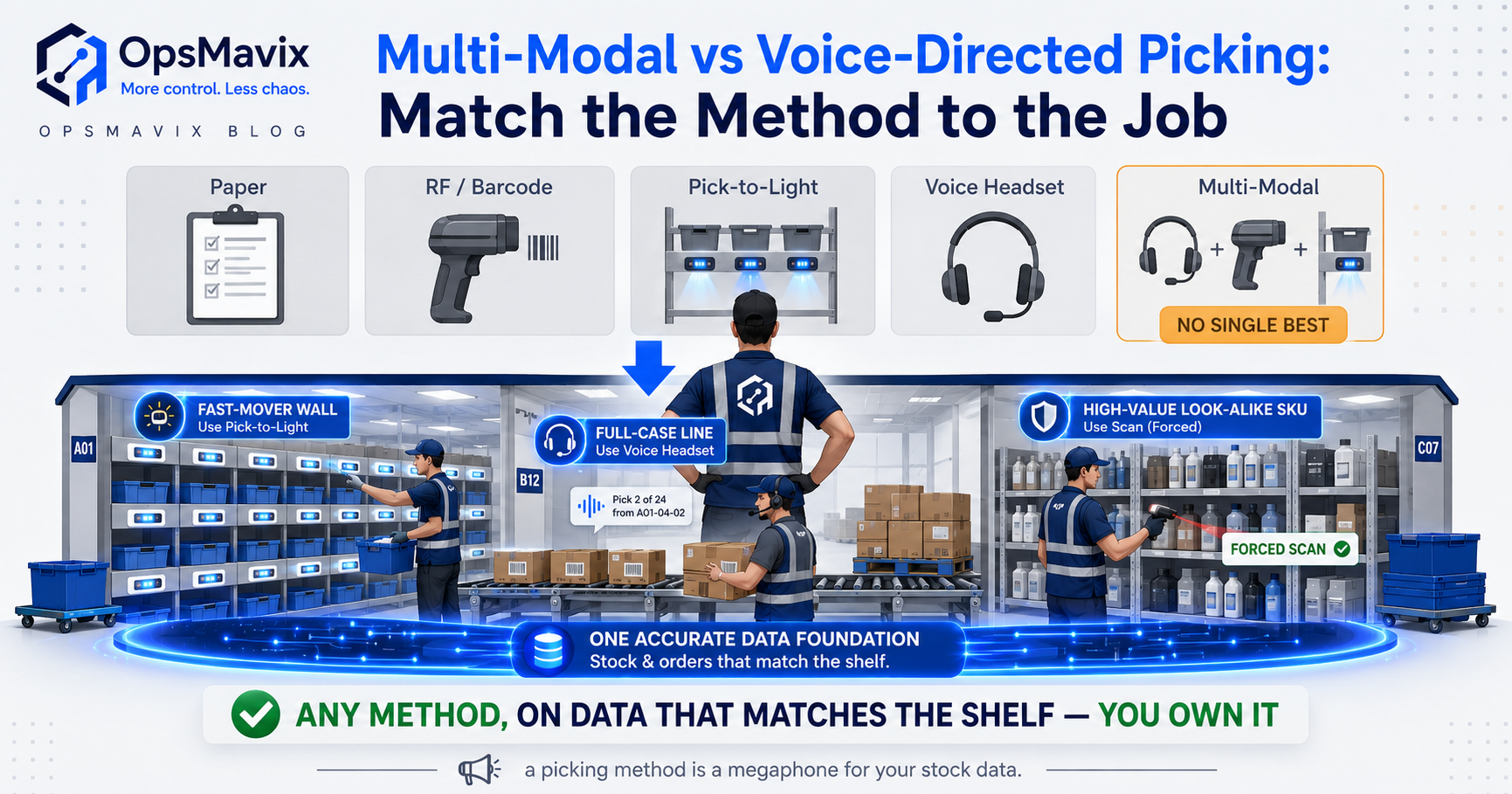
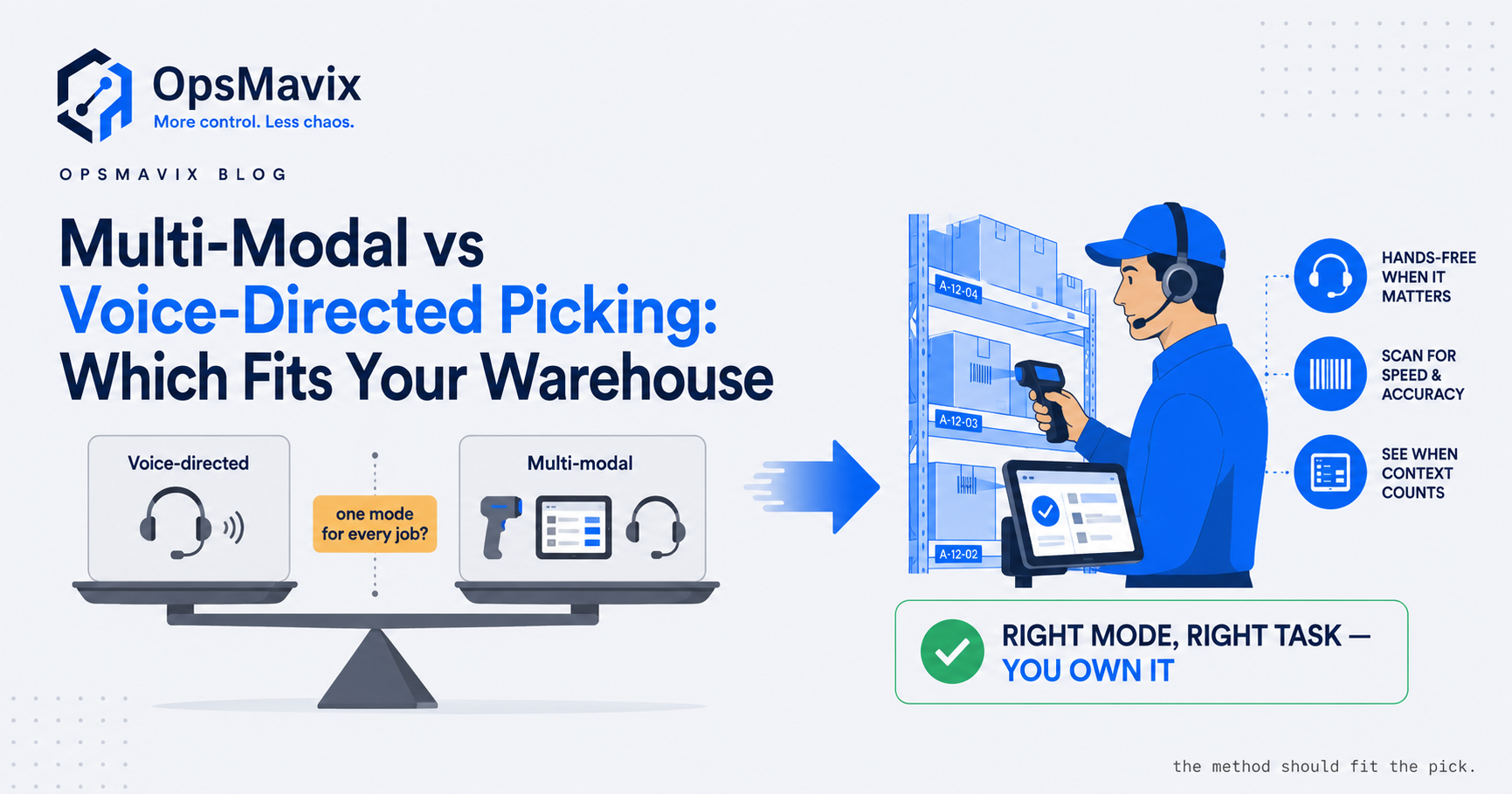
Multi-modal vs voice-directed picking comes down to one question: do you want your pickers locked to a single spoken mode, or free to switch between voice, barcode scan, and a screen depending on the task in front of them? Voice-directed picking gives one hands-free, eyes-free channel — the system talks, the picker talks back. Multi-modal keeps the voice but adds scanning, touch, and visual confirmation in the same workflow, so a picker uses whichever is fastest and most accurate for that moment. Multi-modal usually wins on verification and flexibility; pure voice wins on simplicity and cost. That’s the headline. The rest of this guide is why the headline is the least important part of the decision.
Because before you pick a picking method, you’re choosing between five: paper, RF/barcode scanning, pick-to-light, voice-directed, and multi-modal. Each fits a different shape of warehouse. And all five run on the same foundation — the stock and order data feeding them. Choose the wrong method and you lose some throughput. Choose the wrong data layer and none of the methods work at all.
Key Takeaways
- Voice-directed picking is one hands-free, eyes-free mode; multi-modal combines voice with scanning, touch and screen so pickers switch to whatever’s fastest and safest per task.
- Multi-modal typically wins on accuracy and verification because it can force a scan confirmation; pure voice wins on cost, training simplicity and pure hands-free speed.
- The five real options are paper, RF/barcode, pick-to-light, voice, and multi-modal — the right one depends on order profile, pick density, throughput and error cost, not on which is “most advanced.”
- Accuracy and throughput trade against each other: adding verification steps raises accuracy and costs seconds; the right balance depends on what a mispick actually costs you.
- No picking method fixes bad underlying data — if the system says a bin holds stock it doesn’t, voice will confidently send a picker to an empty shelf.
- A right-sized system models your locations, orders and pick logic so any method sits on numbers that match the shelf — the layer that decides whether the hardware pays off.
The Five Picking Methods at a Glance
Before the deep comparison, the shape of the field. Each method is a way to answer the same two questions for a picker — what do I grab, and where is it — and a way to confirm they grabbed the right thing.
| Method | How it directs | Hands/eyes | Best for | Weakness |
|---|---|---|---|---|
| Paper | Printed pick list | Both occupied | Very low volume, tiny catalogue | Slow, error-prone, no live confirmation |
| RF / barcode | Handheld scanner + screen | One hand busy | Mixed operations, the practical baseline | Look-down time, one hand tied up |
| Pick-to-light | Lit displays on bins | Eyes on lights | Dense, fast, high-volume zones | Fixed to locations, costly to re-lay-out |
| Voice-directed | Spoken instructions via headset | Both free | High-volume, repetitive, hands-free picking | One channel; verification is spoken, not scanned |
| Multi-modal | Voice + scan + screen combined | Flexible | Mixed tasks needing high verification | More device, more cost, more to configure |
The instinct is to read that table top-to-bottom as “worst to best.” It isn’t. Paper still beats a headset in a two-person stockroom. The right method is the one that fits your order profile — not the one furthest down the list.
Multi-Modal vs Voice-Directed Picking: The Core Difference
Voice-directed picking runs one channel. A picker wears a headset, the system reads out a location and quantity, the picker confirms by speaking a check digit back, and moves on. Both hands and both eyes stay free the whole time — which is exactly why high-volume operations reach for it. No looking down at a screen, no scanner to hold. For a fast-moving line of similar picks, that hands-free, eyes-free rhythm is hard to beat. Our deep-dive on voice-directed picking covers how the workflow and check-digit confirmation actually run.
Multi-modal keeps that voice channel but stops treating it as the only option. In the same workflow, a picker can scan a barcode to confirm the exact item, glance at a screen showing an image of the product, or tap a touch input — and the system chooses, or the picker chooses, the best mode for the task. Picking twelve identical cartons off a pallet? Stay on voice. Picking one of five near-identical SKUs where a mispick ships the wrong part to a customer? Force a barcode scan so the system verifies the item, not just the picker’s word for it.
That’s the real divide. Voice trusts the picker’s spoken confirmation. Multi-modal can demand a hard verification — a scan that physically proves the right item was picked — wherever the cost of being wrong is high. That’s why multi-modal tends to report higher accuracy: it removes the “I said the right check digit but grabbed the wrong box” failure that pure voice can’t catch.
When Each Method Actually Fits
Paper — only the smallest operations
If two people pick a handful of orders a day from a catalogue they know by heart, paper is fine and everything else is overhead. Paper breaks the moment volume or SKU count grows past what a person can hold in their head — no live stock check, no confirmation, and every mispick discovered at packing or, worse, by the customer. If you’re reading a picking-method comparison, you’ve probably already outgrown it.
RF / barcode — the practical baseline
Handheld scanners with a screen are where most growing warehouses land, and for good reason. Scanning gives hard verification on every pick, works with the barcodes you already have, and is cheap to train. The cost is ergonomic: one hand is always holding the device, and the picker looks down at a screen between picks — “look-down time” that adds up across thousands of picks. For a mixed operation that isn’t running extreme volume, RF is often the honest answer, and a good warehouse picking solution is frequently just RF done properly on top of clean data.
Pick-to-light — dense, fast, fixed zones
Lights on the bins, picker follows the glow, presses to confirm. Blazing fast in a high-volume zone with stable, dense locations — think a batch-pick wall or a fast-mover area. The catch is that it’s fixed to the physical layout: re-slotting or expanding means re-wiring, and it only pays off where throughput per square metre is genuinely high. Great for the fast 20% of SKUs; overkill for the long tail.
Voice-directed — high-volume, hands-free, repetitive
Voice earns its place where hands-free and eyes-free directly translate to speed and safety: full-case picking, cold storage where gloves make screens miserable, or any high-volume line of broadly similar picks. Training is quick, the workflow is simple, and the picker never looks down. Its limit is verification — the confirmation is spoken, so it’s only as good as the picker’s honesty and attention on the item itself.
Multi-modal — mixed tasks, high verification, real complexity
Multi-modal fits the warehouse that doesn’t do one thing. Some zones want voice, some picks need a forced scan, some need an image on screen because the SKUs look identical. If your error cost is high — regulated goods, expensive parts, customers who churn after one wrong shipment — the ability to demand hard verification exactly where it matters is worth the extra device and configuration. It’s the most flexible and usually the most accurate, at the highest cost and complexity.
The Accuracy vs Throughput Trade-Off Nobody Frames Honestly
Every verification step you add makes picking more accurate and slightly slower. A forced scan catches the wrong-item mispick voice would miss — and costs a second or two per pick. Across a shift, those seconds are real throughput. So the honest question isn’t “which method is most accurate?” It’s “how much accuracy do I need to buy, and what does a mistake cost me?”
A mispick on a £4 consumable that a customer shrugs off is a rounding error. A mispick on a £400 part that triggers a return, a re-ship, a support call and a shaken customer relationship is not — and there, paying seconds per pick for a forced-scan verification is obviously worth it. The method decision is really a cost-of-error decision. Fast-and-loose where errors are cheap; verified-and-deliberate where they’re expensive. Multi-modal exists precisely so you can set that dial differently in different zones instead of picking one compromise for the whole building.
The OpsMavix POV: The Method Isn’t the Leak — The Data Underneath Is
Here’s the contrarian bit, and it’s the one that saves people money. Voice, multi-modal, pick-to-light — they’re all confident narrators of whatever the system tells them. If the system says bin A-12 holds forty units and it actually holds none, voice will cheerfully send a picker to an empty shelf, and multi-modal will let them scan an item that was never supposed to be there. The picking hardware doesn’t know the data is wrong. It just executes it, faster.
One warehouse manager we spoke to described the real state of things before any of this: “the stock never matches the system, and I’m running a million messy spreadsheets for the warehouse.” Drop a £30k voice or multi-modal rollout on top of that and you’ve bought a very fast, very confident way to pick from numbers that lie. The mispicks don’t disappear — they get automated.
So the first decision isn’t voice versus multi-modal. It’s whether your locations, quantities and orders are trustworthy enough for any directed-picking method to stand on. Do the picks in your system match the shelf? Does receiving update stock the moment goods land? Do orders flow into pick logic cleanly, or get re-keyed between a marketplace, a spreadsheet and the floor? Fix that layer and even plain RF gets fast and accurate. Skip it and the fanciest headset in the building is picking from fiction.
A Concrete Scenario: The Wholesale Distributor Choosing a Headset
A mid-size wholesale distributor — a few thousand SKUs, growing order volume, pickers walking a bigger warehouse every quarter — decides RF scanning is too slow and prices a voice-directed rollout. On paper it’s the upgrade: hands free, faster walking, no look-down time. Then the audit finds the real leak. Half their mispicks aren’t from the picking method at all — they’re from stock records that drift because receiving is logged in a spreadsheet hours after goods arrive, and because the same SKU sits in two bins the system only knows about one of. Voice would have picked faster from those broken numbers, not more accurately.
The fix that moved the number wasn’t the headset. It was closing the data loop first — receiving that updates stock on the dock, one record per location that matches the shelf, orders flowing straight into pick logic without a re-key — the kind of thing an inventory automation system and a tight wholesale order management system exist to do. Once the data was honest, plain RF picking hit the accuracy they wanted, and voice became a genuine throughput upgrade on top rather than an expensive lipstick on a broken process. The order of operations was the whole win.
FAQ
What is the difference between multi-modal and voice-directed picking?
Voice-directed picking uses a single mode — the system speaks instructions through a headset and the picker confirms by voice, keeping both hands and eyes free. Multi-modal picking keeps that voice channel but combines it with barcode scanning, touch input and a visual screen in the same workflow, so the picker uses whichever mode is fastest and most accurate for each task. The practical upshot: multi-modal can force a hard scan verification where a mistake is expensive, which voice-only can’t, so it typically reports higher accuracy at a higher cost and complexity.
Which picking method is the most accurate?
Multi-modal approaches that force a barcode scan on high-risk picks tend to be the most accurate, because the system physically verifies the item rather than trusting a spoken confirmation. But accuracy isn’t free — every verification step costs a little throughput. The right level of accuracy depends on what a mispick costs you: cheap, forgiving items don’t justify the same verification as expensive or regulated ones. Just as important, no method is accurate if the underlying stock data is wrong.
Is voice-directed picking worth it for a small warehouse?
Sometimes, but often not first. Voice earns its cost in high-volume, repetitive, hands-free picking. A smaller or mixed operation frequently gets more from well-run RF scanning on clean data than from a voice rollout — and if stock records don’t currently match the shelf, fixing that returns far more than any hardware. Buy the headset when your data is honest and your volume justifies hands-free speed, not before.
Do I need to replace my WMS to change picking methods?
Not necessarily. Picking method is a layer on top of your stock and order data. What matters is whether that data is accurate and whether it flows cleanly into pick logic. A right-sized warehouse management setup built around how you actually receive, store and pick can support RF today and voice or multi-modal later, without ripping everything out — provided the foundation is right.
Can one warehouse use more than one picking method?
Yes, and most efficient ones do. A dense fast-mover zone might use pick-to-light, full-case lines might use voice, and mixed or high-value picks might use scan verification. That’s the whole idea behind multi-modal — different tasks want different tools. The requirement is a single source of truth underneath, so every method picks from the same accurate stock and order data.
How OpsMavix Can Help
OpsMavix doesn’t sell you a headset. We build the layer that decides whether any picking method pays off — the stock and order system underneath. Most warehouses stuck choosing between voice and multi-modal are solving the wrong problem: the mispicks come from data that drifts, from receiving logged late, from the same SKU in two bins the system half-knows about, from orders re-keyed between a marketplace, a spreadsheet and the floor.
We build right-sized custom systems for warehouses outgrowing spreadsheets and not looking for a six-figure enterprise WMS — an inventory automation system where the number always matches the shelf, and a wholesale order management system that flows orders straight into clean pick logic. Get that right and voice, multi-modal or RF all become genuine upgrades. You own it outright — no per-head licence, nothing a vendor can switch off.
If you’re weighing picking methods, start one layer down. Book a Free Operations Leak Audit and we’ll map where your picking actually leaks today — the mispicks, the phantom stock, the re-keyed orders — what it’s worth to close, and whether a new picking method or a cleaner data layer is the honest fix for how your warehouse runs now.
Keep reading
Getting value from OpsMavix? Add us as a preferred source on Google — you'll see more of our operations content in your AI Overviews, AI Mode and Search.