
Voice Directed Picking System: How Pick-by-Voice Works
A voice directed picking system reads order locations and quantities into a picker's headset and has them speak check-digits back to confirm — hands-free, eyes-free, no paper sheet. Here's plainly how pick-by-voice works, its honest pros and cons, when it's actually worth it, and the part nobody sells you: voice is only as accurate as the stock system feeding it.
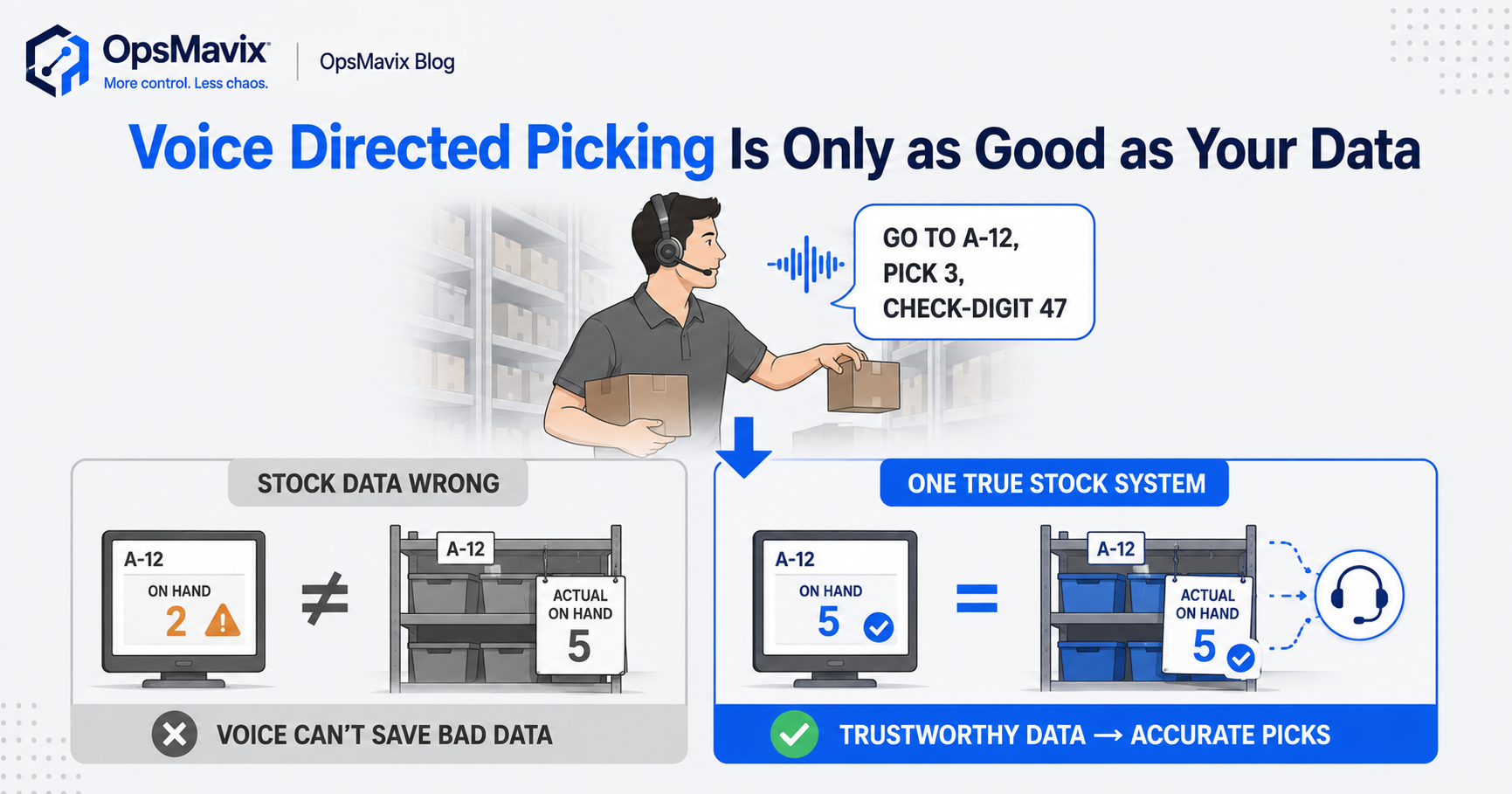
A voice directed picking system is a hands-free way to pick orders: the picker wears a headset, the system speaks the next location and quantity into their ear, they walk to the bin, and they read a short check-digit aloud to confirm they’re in the right place and have grabbed the right amount. No paper pick sheet, no screen to look at, no scanner to hold — eyes and hands stay on the stock. It’s an interface, not a strategy. And that’s the part that matters most: a voice system is only as accurate as the inventory data it reads out, so a clean spoken workflow on top of a wrong stock count just lets you pick the wrong thing faster, with confidence.
This post explains pick-by-voice plainly — how the headset, the voice app and the check-digits work — then the honest benefits, the real cautions (accents, noise, setup, low volume), and how to decide if it’s worth it. We won’t rehash picking methods or the case for scanners; that ground is covered in our warehouse picking solution guide. This one is about voice, and the data layer underneath it that decides whether it works at all.
Key Takeaways
- Pick-by-voice is hands-free, eyes-free picking: the system speaks the location and quantity, the picker speaks a check-digit back to confirm. No paper, no screen, no held scanner.
- The honest wins are real but specific: spoken confirmation cuts certain mis-picks, hands and eyes stay free for the work, paper disappears, and some operations onboard new pickers faster.
- The honest cautions are just as real: it needs reliable underlying stock data, it has upfront setup and tuning, it rarely pays off at very low volume, and accents plus warehouse noise need handling.
- Voice is an interface on top of your stock system, not a fix for it. Garbage in, garbage out — if the count or location it reads is wrong, the picker confirms a wrong pick perfectly.
- The leak to close first is bad stock data. A trustworthy operations system makes any picking method — voice, scan or paper — work; without it, voice just adds polish to the error.
1What a Voice Directed Picking System Actually Is
Strip away the marketing and pick-by-voice is simple. The picker wears a headset with a microphone, connected to a small wearable device or a phone running a voice app. That app talks to your warehouse or inventory system, pulls the next task, and reads it out: an aisle, a bin location, and how many to pick. The picker walks to the bin, and instead of scanning or ticking a sheet, they read aloud a short check-digit printed on the shelf — a couple of digits that prove they’re standing at the right location. The system confirms, tells them the quantity, they pick it, say the count back, and it moves them to the next line.
That’s the whole loop: listen, walk, confirm by voice, pick, confirm by voice, repeat. The picker never looks at a screen or holds anything — both hands and both eyes stay on the job of finding and grabbing stock. It’s a conversational interface over the same picking workflow you’d run any other way, which is exactly why the quality of what it says depends entirely on the system behind it.
2How Pick-by-Voice Actually Works on the Floor
Walk through a single pick. The headset reads the first task: “Aisle four, bay twelve.” The picker walks there. To prove they’re at the right bin, they read the check-digit on the shelf label aloud — say, “two-seven.” If they went to the wrong bay, the digit won’t match and it stops them before they pick. Then it states the quantity: “Pick six.” They pick six and say “six” back. The system logs it, decrements the stock, and reads the next location. The picker has not looked at a sheet or screen once.
The check-digit is the clever bit, and the honest limit of it. Speaking the digit confirms the picker is at the correct location — it’s a location check, not a true item-identity check the way scanning a product barcode is. That distinction matters: voice confirms you’re at the right shelf and took the stated count, but it trusts that the right item is in that shelf. If your bin contents are wrong in the system, voice will happily walk a picker to the wrong shelf and have them confirm it confidently. The workflow is clean; its truth comes entirely from the data feeding it.
3The Honest Benefits of Voice Picking
There are genuine, well-established reasons operations move to voice, and it’s worth being specific. First, hands and eyes stay free — a picker isn’t juggling a clipboard or looking at a scanner screen while reaching into a bin, which matters most for heavier, two-handed or fast-moving picking. Second, the spoken confirmation step catches a class of errors: reading the check-digit aloud forces a deliberate “am I in the right place” beat a glance at a paper line doesn’t, and saying the quantity back reduces miscounts. Third, the paper disappears — no printing pick sheets, no re-keying ticked sheets back in, no lost or misread paper.
There’s also an onboarding angle that’s true for some operations: a new picker told exactly where to go, step by step, in their ear can get productive faster than one learning a layout and a paper sheet — the system carries the route knowledge. One warehouse operator we spoke to described their core pain as not being able to “see what’s on my warehouse like an excel sheet” — voice doesn’t fix that visibility problem, but for the picking step itself, a guided, confirmed, hands-free flow beats “grab the sheet and hope.” The benefits are real. They’re also conditional, which is the next section.
4The Honest Cautions Nobody Puts on the Brochure
Voice picking is not free of trade-offs, and pretending otherwise is how operations end up disappointed. The first and biggest: it depends on a reliable underlying stock and location data source. The system can only read out what it’s told. If your bin locations drift, your counts are wrong, or your item-to-location mapping is stale, voice doesn’t catch that — it confirms the error fluently. Garbage in, garbage out, just spoken aloud.
Then there’s setup. Check-digits have to be on the shelves, the voice app has to talk reliably to your inventory system — the same integration challenge any warehouse management software faces — and the speech recognition usually needs tuning to your pickers’ voices and your specific vocabulary. Accents, multilingual teams, and a noisy warehouse floor all affect recognition; modern systems handle this far better than early ones, but it’s a real consideration, not a non-issue, and it needs testing with your actual people in your actual building. Finally, volume. Voice carries an upfront cost in hardware, setup and integration, and at very low pick volumes that cost doesn’t earn its keep — a small operation may be better served by a simple scan-confirm flow than a full voice deployment.
5When Voice Picking Is Actually Worth It
The honest decision rule: voice tends to pay off when picking volume is high enough that hands-free speed and the confirmation step save real money, when the picking is physical enough that holding a scanner is genuine friction, and — non-negotiable — when the stock data underneath is already trustworthy. Serious volume, constantly two-handed pickers, reliable counts and locations: voice is a strong fit and the case is easy.
It’s a poor fit, or premature, in the opposite conditions: low pick volume where the setup cost won’t return, or — far more common and more dangerous — any warehouse where the stock data is shaky. Operations reach for voice as the fix when the real leak is upstream, in counts and locations that were never trustworthy. One distributor’s whole problem was that their “spreadsheet counts wind up being off, sometimes wildly so.” Bolting voice onto that makes the wrong number sound authoritative in a picker’s ear. Fix the data first, then choose the interface — voice, scan or otherwise — that fits how the floor moves.
6The Part That Decides Everything: the System Underneath
Here’s the OpsMavix point of view, and it’s the whole reason this post exists. A voice directed picking system is an interface. It sits on top of your operations and reads out whatever that system believes. So the question that actually determines whether voice succeeds isn’t “which headset” — it’s “is the stock system behind it telling the truth?” A clean voice workflow over accurate, real-time data is excellent. The exact same workflow over a spreadsheet that’s quietly drifted is a confident way to ship the wrong thing.
This is where most off-the-shelf picking tech oversells: it assumes you already have a solid, well-structured data source for it to read, and bends your floor to fit its assumptions. Operators describe rigid tools that are “as flexible as a wooden door” and “forced [them] to change almost every procedure.” The opposite approach is to build the operations and stock system around how your warehouse actually runs — your real locations, channels and products — so that whatever interface sits on top (voice, scan, or both) is reading data you can trust. You don’t have to start with voice; you have to start with a count and a location map that are right. That’s the foundation an inventory automation system is for, and it ties straight into the order side so picking isn’t a silo — see wholesale order management. Get the data right and any picking method works. Get it wrong and the fanciest one just fails faster.
Is Voice Picking Right for You?
| If this is true | Voice picking fit | What to do first |
|---|---|---|
| High pick volume, two-handed work, trustworthy stock data | Strong — the case is easy | Pilot voice on your busiest pick zone |
| Decent volume but shaky counts/locations | Wrong order of operations | Fix the stock data, then choose an interface |
| Low pick volume, small team | Usually premature | A simple scan-confirm flow likely fits better |
| Noisy floor, heavy accents/multilingual team | Possible, needs testing | Trial recognition with your real pickers first |
| You’re reaching for voice to fix accuracy | A trap | The leak is the data, not the picking interface |
Voice vs Scan vs Paper Picking
| Paper | Barcode scan | Voice | |
|---|---|---|---|
| Hands free | No | No | Yes |
| Eyes free | No | No | Yes |
| Confirmation type | Visual tick (weak) | Item barcode (strong, item-level) | Spoken check-digit (location-level) |
| Re-keying needed | Yes | No | No |
| Upfront setup | Low | Low–moderate | Moderate |
| Depends on good stock data | Yes | Yes | Yes |
The table makes the recurring point obvious: every method, voice included, has “depends on good stock data” in the last row. That’s the constant. The interface changes the speed and the ergonomics; it never changes the fact that a wrong number gets picked wrong.
Common Questions
What is a voice directed picking system?
It’s a hands-free picking method where the picker wears a headset connected to a voice app that talks to your warehouse or inventory system. The system speaks the next location and quantity into their ear, the picker walks there and reads a check-digit aloud to confirm they’re at the right bin, then confirms the quantity by voice. No paper sheet, no screen, no held scanner — eyes and hands stay on the stock. It’s an interface layered on top of your existing picking workflow and stock data.
How do check-digits work in voice picking?
Each pick location has a short check-digit on its shelf label — usually two or three digits. When the system sends a picker to a location, they read that digit aloud, and the system confirms they’re at the correct bin before letting them pick. If they’re at the wrong bay, the digit won’t match and it stops them. It’s a strong location confirmation, but note the limit: it confirms the picker is at the right shelf, not that the right item is physically in that shelf — that depends on your stock data being correct.
Is voice picking more accurate than scanning?
They confirm different things. Scanning an item barcode is an item-level check — it verifies the actual product in hand. A voice check-digit is a location-level check — it verifies the picker is at the right bin and took the stated count. Voice wins on being hands-free and eyes-free; scanning wins on confirming item identity directly. Neither beats the other in the abstract, and neither compensates for wrong underlying stock data. Some operations combine voice with occasional scanning for item-level verification.
Will accents or a noisy warehouse break voice picking?
They’re real factors, not deal-breakers. Modern speech recognition handles accents and multilingual teams far better than early systems, and headsets are built for noisy environments — but it still needs to be tested with your actual pickers in your actual building before you commit. If you have a strongly multilingual team or an especially loud floor, trial recognition with real staff during evaluation rather than assuming it’ll just work.
Do I need voice picking, or do I need to fix my stock data first?
Almost always fix the data first. Voice reads out whatever your stock system believes — if your counts and locations are wrong, voice confirms the error fluently and ships it with confidence. If you’re considering voice mainly because picking accuracy is poor, that’s usually a sign the leak is upstream in the data, not the interface. Get the underlying count and location map trustworthy, then voice (or scan) becomes a genuine upgrade rather than expensive polish on a broken number.
How OpsMavix Can Help
OpsMavix doesn’t sell you a headset. We build the operations and stock system that any picking method — voice, scan or paper — has to read from to work. Because that’s the real decider: a voice directed picking system is only as accurate as the inventory data feeding it, and most warehouses chasing fewer mis-picks have a data leak upstream, not a picking-interface problem. We build a custom system shaped around how your warehouse actually runs — your real locations, your channels, your products, your counts kept accurate in real time — so that whatever interface sits on top is reading the truth. It ties into your order management so picking isn’t a silo, it’s built around your floor rather than forcing your floor to fit it, and you own it outright — no per-picker fee, nothing a vendor can sunset.
If mis-picks and wrong counts are leaking money every busy week, the first move isn’t choosing a picking gadget — it’s seeing exactly where the data breaks. Book a Free Operations Leak Audit and we’ll map where your counts and locations drift, what mis-picks are costing you in returns and re-picks, and whether voice, scanning or a right-sized stock system built around your warehouse is the genuine fix for your floor.