
Multi-Modal vs Voice-Directed Picking: Which Fits Your Warehouse?
Multi-modal picking blends voice, scanning and screen prompts in one workflow, while voice-directed picking runs on spoken commands alone. This guide compares the two on accuracy, speed, training and cost so you can pick the right method for your warehouse.
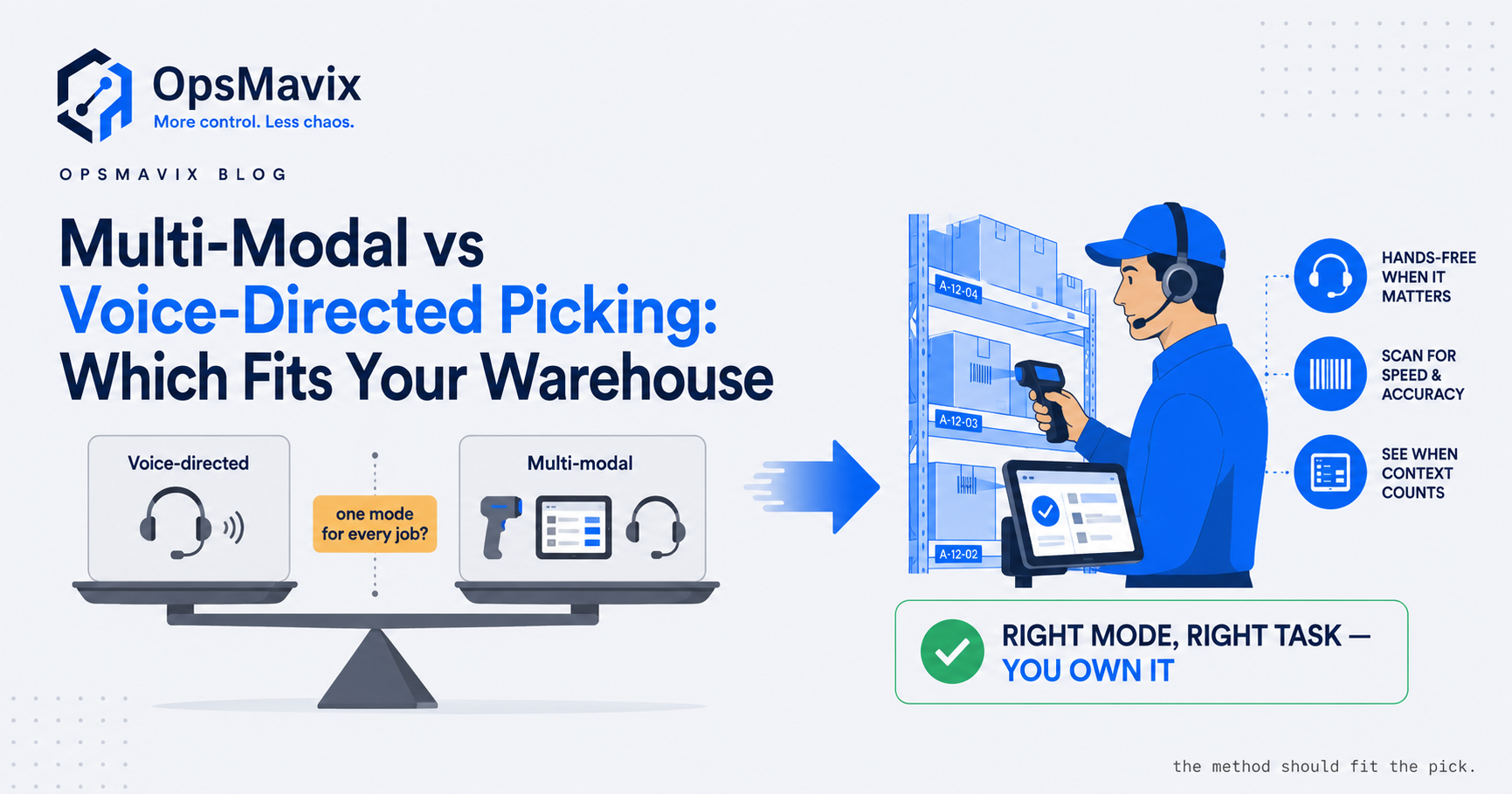
Multi-modal vs voice-directed picking comes down to how many senses your picker uses at once: voice-directed picking runs entirely on spoken commands through a headset, while multi-modal picking combines voice, barcode scanning and a small screen so the worker uses whichever input is fastest at each step. Voice keeps hands and eyes free for pure speed; multi-modal adds a scan or a screen check where accuracy or complexity demands it.
Neither is universally “better”. The right method depends on your SKU profile, your error patterns, how much your staff turn over, and whether a mispick costs you a few pence or a returned pallet. This guide compares the two honestly so you can match the method to how your warehouse actually runs, not to a vendor’s demo.
Key Takeaways
- Voice-directed picking frees the hands and eyes completely, which suits fast-moving, forgiving SKUs and high pick density.
- Multi-modal picking layers scanning and a screen on top of voice, catching the errors that voice alone can wave through.
- The deciding factor is error cost, not raw speed. If a wrong pick means a costly return or a compliance breach, verification pays for itself.
- Staff turnover changes the maths. Voice needs voice-template training; multi-modal’s visual prompts get temps productive faster.
- Serial numbers, batches and lots almost always push you toward multi-modal, because voice can’t reliably confirm a 20-digit code.
- The method is only as good as the system feeding it. Wrong slotting or stale stock data makes any picking method fail.
How Voice-Directed Picking Actually Works
In a voice-directed workflow, the picker wears a headset connected to the warehouse system. The system speaks a location; the worker walks there and reads back a check digit to confirm they’re in the right slot; the system tells them a quantity; they pick and confirm by voice. No screen, no scan gun, no paper.
The appeal is obvious once you watch it. Both hands stay on the product, both eyes stay on the shelf and the travel path. There’s no looking down at a device, no fumbling to scan. For high-volume grocery, ambient food, or any operation where pickers cover long aisles all shift, that hands-free, eyes-free state is where the speed comes from.
The catch is verification. Voice confirms a location with a check digit, but it confirms the product only by the picker saying they picked the right thing. If two SKUs sit in adjacent slots and look near-identical, voice trusts the human. One inventory manager told us their voice rollout cut walk time nicely but did nothing for their “lookalike SKU” mispicks, because the system never actually saw the barcode.
How Multi-Modal Picking Fills the Gaps
Multi-modal picking keeps the voice backbone but adds a barcode scanner and a wearable or handheld screen, and lets the workflow choose the right input per step. Location confirmation by voice check digit. Product confirmation by scan. A screen prompt when the item needs an image, a batch selection, or a special-handling note.
The point isn’t to scan everything. It’s to scan the risky steps and speak the rest.
A wholesale distributor described the shift plainly: they moved to multi-modal not for speed but to kill returns on their serialised electrical lines, where a customer receiving the wrong model number meant a two-way freight cost and a lost account. Voice couldn’t verify a serial. A scan could. Speed stayed roughly flat; the error line dropped, and that was the whole point.
This is the trade-off in one line. Voice optimises for the pick itself; multi-modal optimises for the pick being correct.
The Real Comparison: Accuracy, Speed, Training, Cost
Accuracy. Multi-modal generally wins on accuracy anywhere product identity matters, because a scan is a machine-verified fact and a spoken “got it” is a promise. Voice is highly accurate on location thanks to check digits, but it can’t independently confirm the item. If your errors are location errors, voice fixes them. If your errors are wrong-item errors, you likely need a scan.
Speed. Voice usually edges multi-modal on pure picks-per-hour in simple, dense operations, because every scan costs a second or two and interrupts the rhythm. But that gap narrows fast when SKUs are complex, because a picker hunting visually for the right variant is slower than a scan that just confirms it.
Training. Multi-modal is generally faster to onboard. A screen showing a picture of the item and a green tick on a good scan is intuitive; a new temp is productive in hours. Voice needs the worker to train a voice template and get comfortable with an all-audio rhythm, which takes longer, though modern systems have narrowed this.
Cost. Voice-only hardware (a headset and a small terminal) is typically cheaper per picker than multi-modal (headset plus scanner plus wearable screen). But hardware is rarely the expensive part. The expensive part is the cost of the errors each method leaves on the table.
Which Method Fits Which Warehouse
Reach for voice-directed picking when:
- SKUs are visually distinct and hard to confuse.
- Pick density is high and travel distance dominates the shift.
- You rarely deal with serials, batches or lot capture at the pick face.
- Errors are cheap to fix and returns are rare.
Reach for multi-modal picking when:
- You handle lookalike SKUs, variants, sizes or colours that voice can’t tell apart.
- You capture serial numbers, batch codes, expiry dates or lot traceability.
- A mispick is expensive: costly returns, compliance exposure, or a lost B2B account.
- Staff turnover is high and you need people productive on day one.
- Some tasks genuinely need a picture or an on-screen instruction to get right.
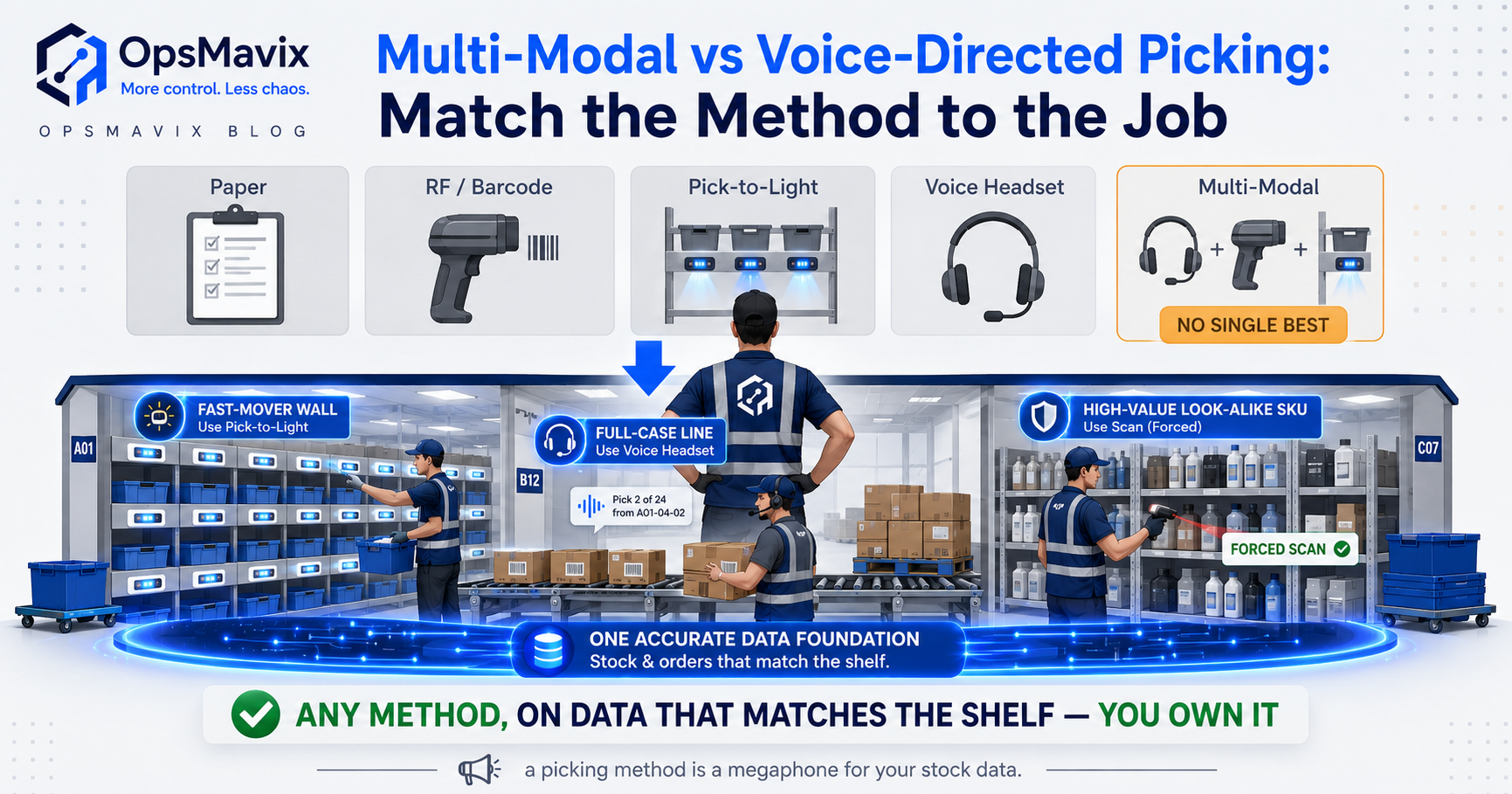
Many operations that think they’re choosing one are really choosing a blend: voice through most of the aisles, multi-modal on the two or three zones where identity or traceability actually bites. That’s a legitimate answer, not a fudge.
For a wider view of how these sit alongside cluster, batch, zone and pick-to-light approaches, see our picking methods compared hub. If you’ve already decided voice is your direction, the deeper mechanics live in our guide to a voice-directed picking system.
The Thing Both Methods Depend On
Here’s the uncomfortable part vendors skip: the picking method is downstream of your data and your layout. Neither voice nor multi-modal fixes a warehouse where the location data is wrong, the stock counts are stale, or fast-movers are slotted in the back corner.
A picker who’s sent to an empty slot doesn’t care whether the instruction came by voice or screen. A worker walking twice the distance they should because slotting was never optimised loses more time than any input method saves. Get warehouse slotting right and a decent picking method flies; get it wrong and the best method in the world is polishing a broken process.
This is where the “which method” question quietly becomes a “which system” question. Voice or multi-modal is just the last few centimetres of a chain that starts with accurate stock, sensible locations and a live picture of what’s where. If that chain is held together by a spreadsheet and someone’s memory, changing the headset won’t save you.
An Honest Build-vs-Buy Take
Plenty of solid off-the-shelf voice and multi-modal products exist, and if your operation is standard, one of them may fit fine. There’s no shame in buying a good tool that matches how you already work.
The problem shows up when the tool assumes a warehouse you don’t have: it wants voice-only, but half your SKUs are serialised; or it forces a scan on every line when most of your picks are perfectly safe by voice. You end up bending your process to the software’s assumptions and calling the friction “just how it is”.
The middle path is a system shaped around how you actually run: voice where voice is safe, scanning where identity matters, screens where a task genuinely needs one, all reading from one live stock picture instead of three disconnected tools. Not an ERP you’ll spend two years configuring, and not a rigid box you have to work around. One operations system you own, that picks the right input for each step because it knows your SKUs, your zones and your error patterns.
If you’re weighing multi-modal against voice-directed picking, start by answering one question: where do your errors actually come from? Map that first, and the method mostly chooses itself.
Keep reading
Getting value from OpsMavix? Add us as a preferred source on Google — you'll see more of our operations content in your AI Overviews, AI Mode and Search.