
Blue Yonder WMS Alternative: Right-Sized for a Growing Warehouse
Blue Yonder WMS is built for very large, complex supply chains — long, costly to deploy, and far more system than most growing warehouses will ever use. The honest Blue Yonder WMS alternative for a mid-sized operation isn't another giant suite. It's a right-sized warehouse system built around your real flow, live in weeks, that you own.
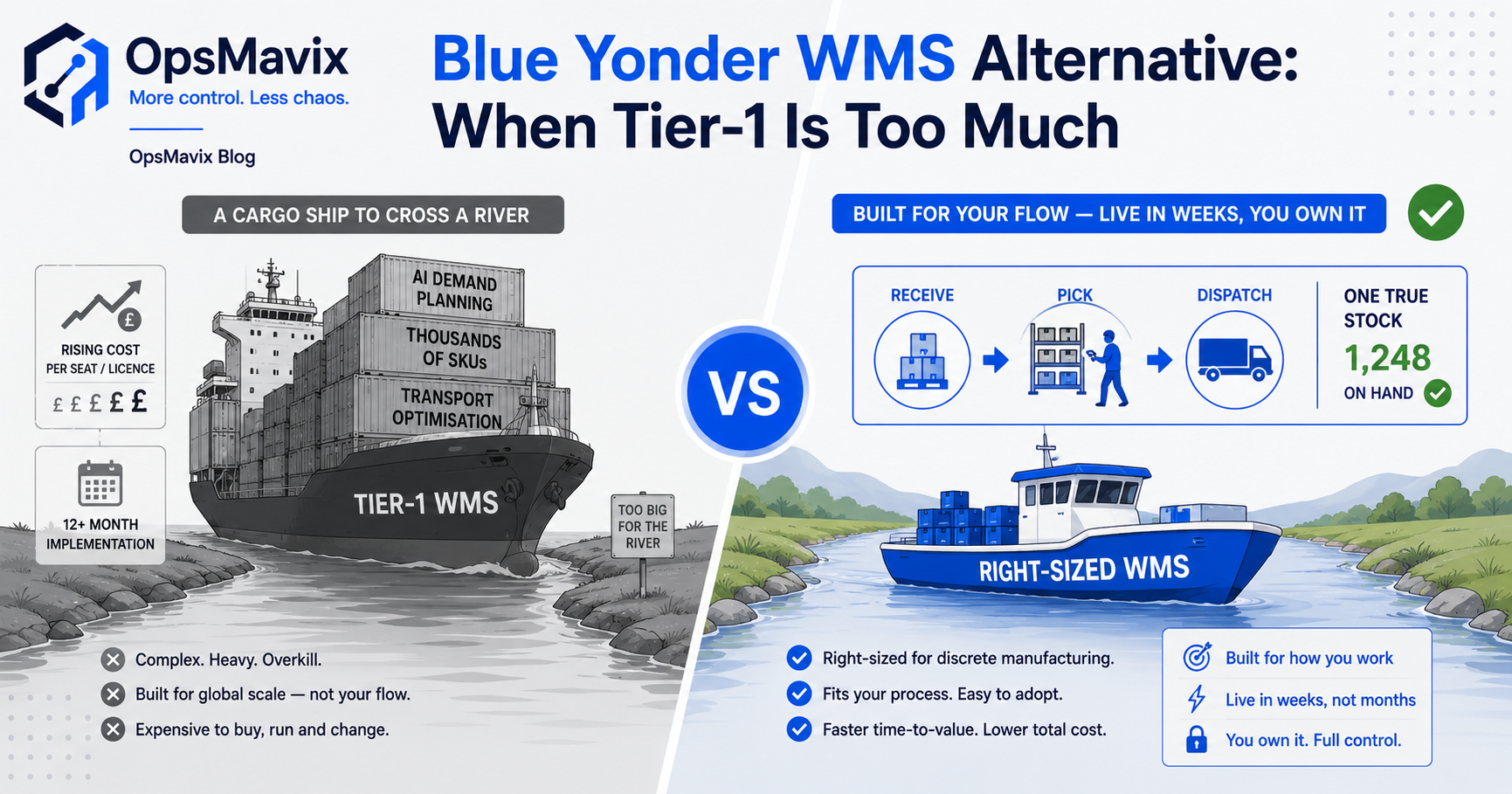
The honest Blue Yonder WMS alternative for most growing businesses isn’t another enterprise suite. Blue Yonder (formerly JDA) is a tier-1, AI-driven supply-chain and warehouse platform built for very large, very complex operations — national distribution networks, demand planning across thousands of SKUs, the kind of scale where a long, expensive implementation pays back. If that’s you, it earns its place. If you’re a mid-sized warehouse looking at it and quietly thinking “this is more system than we’ll ever use,” you’re probably right. The alternative isn’t to find a smaller version of the same giant. It’s a warehouse system built around how your operation actually runs — receiving, picking, dispatch, reorder — that goes live in weeks and that you own outright.
This post covers what Blue Yonder WMS is genuinely built for, the real signs it’s overkill for you, what to look for in an alternative, and what a built-for-you system does instead. If the deeper question is whether you need a packaged WMS at all, the WMS-versus-right-sized decision covers that sibling call.
Key Takeaways
- Blue Yonder WMS is a tier-1 enterprise suite built for very large, complex supply chains — and it’s a strong fit at that scale.
- The clearest sign it’s overkill: the implementation timeline and cost are sized for an operation far bigger than yours.
- You don’t need AI demand-planning across thousands of SKUs to fix a warehouse where the stock figure doesn’t match the shelf.
- The middle ground most growing businesses actually want is right-sized: shaped to your flow, live in weeks, no per-seat creep, owned by you.
- Don’t pick a suite by its logo. Pick by whether it fits the operation you run today, not the one a vendor says you’ll become.
1What Blue Yonder WMS Is Actually Built For
Blue Yonder does a real, hard job. It’s an end-to-end supply-chain platform — warehouse management, demand and supply planning, transportation, often AI-led forecasting — aimed at enterprises moving enormous volume across many sites. For a national retailer or a global distributor, that breadth is the point: one suite coordinating planning, inventory and fulfilment at a scale where a 1% efficiency gain is worth millions. At that size, a long implementation and a serious budget are rational investments, not red flags.
The trouble is that the same breadth is dead weight for a smaller operation. A growing warehouse rarely needs AI demand-planning across thousands of SKUs or transportation optimisation across a fleet. It needs the stock figure to match the shelf, pickers to find the right bin, and a reorder to fire before the bestseller runs out. Buying a tier-1 suite for that is paying for a cargo ship to cross a river.
2The Real Signs It’s Overkill for You
The honest tells aren’t about Blue Yonder’s quality — it’s a capable platform. They’re about fit. The first is the implementation: if the deployment is measured in many months and the cost is sized for an enterprise, that’s a signal the system was built for an operation far larger than yours. A right-sized warehouse system should be live in weeks, not a year-plus project that ties up your team while the warehouse still runs on spreadsheets in the meantime.
The second tell is the feature list. If most of what you’re paying for is planning and optimisation you’ll never switch on, you’re funding capability for someone bigger. Mid-sized operators feel this exact squeeze — caught between tools that are too small and suites that are too large. As one summed it up: “QBO is too small, NetSuite is too expensive. What’s a middle ground?” Blue Yonder sits even further up that scale. If you’re asking that question, a tier-1 suite is the wrong end of the answer.
3You Don’t Need AI Planning to Fix a Broken Stock Number
Here’s the contrarian bit, because it saves real money: most warehouses chasing a Blue Yonder WMS alternative don’t have a forecasting problem. They have a trust problem. The stock figure says one thing and the shelf says another, and no amount of AI demand-planning fixes a count that’s wrong at the source. An inventory manager put the everyday version of it plainly: “we would consistently oversell items we didn’t even have on hand.” That’s not a planning failure — it’s a system that doesn’t reflect what’s physically in the building.
A tier-1 suite layers sophisticated planning on top of your inventory data, but if that underlying number drifts, the clever forecast is built on sand. The fix that actually moves the needle is unglamorous: every stock movement — receive, pick, move, dispatch — recorded against one figure everyone reads from, so the number on the screen is the number on the shelf. Get that right and most of the “we need enterprise software” feeling evaporates. That accuracy is the spine of an inventory automation system.
4The Cost Most Operators Miss Isn’t the Licence
A tier-1 suite’s price isn’t just the licence — it’s the implementation, the consultants, the integration work, the per-seat fees as your team grows, and the years you’re locked into a platform you don’t control. That total is rational at enterprise scale and brutal below it. And the deeper cost is dependence: when a system that big sits at the centre of your operation, the vendor sets the terms — pricing, roadmap, what gets sunset — and you live with the decision.
Mid-sized operators have been burned by exactly this pattern further down the market. Tools get repriced or retired with little warning; one operator described a platform being discontinued as something that “invalidates two years worth of work.” The lesson holds at every tier: the more a vendor controls, the more your operation is hostage to a decision you didn’t make. A built-for-you system flips it — fixed scope, no per-seat creep, and nothing a vendor can switch off, because you own it. The honest framing of where this sits is in whether you need an operations system or a full platform.
5What to Look For in a Blue Yonder WMS Alternative
If you’ve decided tier-1 is too much, don’t just shop for a cheaper giant. The thing to look for is fit, not feature count. Does it match your actual flow — the way stock moves from goods-in to pick to dispatch in your building, not a generic template? Can it go live in weeks, so the warehouse stops bleeding while you wait? Does it connect to the tools you already run — Shopify, Xero, your couriers, your suppliers — instead of demanding you rip them out? Does the price stay fixed as you grow, or does it tax every new seat and order?
And critically: do you own it, or are you renting capability you’ll never fully use? A right-sized system gives the floor team exactly what they need — a stock figure they trust, scanning that records movements, reorder alerts that fire on time, roles so you know who changed what — without the enterprise machinery wrapped around it. The right size is the one that fits the operation you run today, not the one a sales deck says you’ll become. If part of your need is genuinely physical tracking, RFID and barcode scanning in the warehouse covers how that layer fits a right-sized build.
6What a Built-For-You Warehouse System Covers
A custom system isn’t a stripped-down WMS — it’s built around how your warehouse genuinely runs. One true stock figure that every screen reads from, updated the instant anything is received, moved or dispatched, so the count matches the shelf. A receiving flow that books goods in cleanly, picking that points to the right bin, packing checks that catch errors before they ship, and dispatch tracking that closes the loop. Reorder alerts on a number you can trust, so you stop running out of bestsellers and stop overstocking dead lines. Roles and an audit trail, so when a count goes wrong you can see how, not just that it did.
The difference from a tier-1 suite is that nothing is there for show. Where Blue Yonder gives you planning machinery sized for a global network, a built-for-you system gives you the part of a WMS you’ll actually use, shaped to your flow and connected to the tools you already run. If your stock has to stay right across sales channels too, that’s multichannel inventory automation; if the pain is really on the order desk, a wholesale order management system handles intake and pricing. Same principle throughout: built around your operation, owned by you.
7When NOT to Switch (the Honest Bit)
Be fair to Blue Yonder: at genuine enterprise scale it does things a right-sized build shouldn’t try to. If you’re coordinating planning across many distribution centres, forecasting demand across thousands of SKUs, and optimising transportation across a real fleet, a tier-1 suite is the correct tool, and trying to hand-build that would be reckless. Don’t downsize on principle. The same honesty cuts both ways — adding capability you don’t need is a leak, and so is ripping out capability you do.
The switch earns its place when the maths tips — when the implementation cost, the per-seat fees, the unused capability and the years of vendor dependence cost you more than building the right thing once. Our view is plain: pick the alternative when a tier-1 suite is more system than your operation will ever use, not because the logo is intimidating. Then move once, onto something sized for the warehouse you actually run.
Blue Yonder vs a Built-For-You System
| Blue Yonder WMS (tier-1 suite) | Built-for-you system | |
|---|---|---|
| Built for | Very large, complex global supply chains | One growing warehouse’s real flow |
| Scope | Planning, WMS, transport, AI forecasting | Receiving, pick, dispatch, reorder — what you use |
| Go-live | Long, multi-stage implementation | Live in weeks |
| Stock accuracy | Strong — on top of your data | One true figure that matches the shelf |
| Pricing | Licence + implementation + per-seat | Fixed build (£3k–£25k range), you own it |
| Lock-in | Vendor controls roadmap and terms | You hold it; nothing to switch off |
| Best fit | Enterprises at genuine scale | Too big for spreadsheets, too small for tier-1 |
Common Questions
What is the best Blue Yonder WMS alternative?
There isn’t one best answer — it depends on whether your problem is “I run a global supply chain and need enterprise coordination” or “I run a growing warehouse and a tier-1 suite is more than I’ll ever use.” If you’re at genuine enterprise scale, another large platform — Manhattan is the other tier-1 name worth weighing — may be the right comparison. If you’re mid-sized, overselling because the stock number drifts, and put off by a long, costly implementation, a right-sized system built around your flow — with one true stock figure and a go-live in weeks — addresses the real cause without the enterprise overhead.
Is a custom warehouse system as capable as Blue Yonder WMS?
For a global supply chain, no — and it shouldn’t try to be. Blue Yonder is built for planning and optimisation at a scale a right-sized build has no business attempting. For a growing warehouse, the question is reversed: a custom system is more capable where it counts, because it’s shaped to your actual receiving, picking and dispatch instead of a generic template, and it carries none of the machinery you’d never switch on. Capability you don’t use isn’t an advantage. It’s cost.
How long does a built-for-you system take versus a tier-1 implementation?
A tier-1 suite implementation is typically a long, multi-stage project sized for enterprise complexity. A right-sized build is scoped to your flow and goes live in weeks, so the warehouse stops running on spreadsheets sooner rather than waiting out a year-plus rollout. The shorter timeline isn’t a corner cut — it’s the natural result of building only what your operation actually needs.
Will a custom system stop overselling and phantom stock?
Yes — that’s a core reason to build one. Every movement, from goods-in to dispatch, is recorded against one shared figure everyone reads from, so the count on the screen matches the shelf and you can’t confirm an order for stock that isn’t there. Tier-1 suites promise accuracy too, but if the underlying number drifts, the planning built on top of it drifts with it. A single trusted figure removes the drift at the source.
How OpsMavix Can Help
OpsMavix builds right-sized warehouse and inventory systems for businesses that are outgrowing spreadsheets but nowhere near needing — or wanting to pay for — a tier-1 suite like Blue Yonder. We build around how your warehouse actually runs: one true stock figure that matches the shelf, a receiving-to-dispatch flow shaped to your building, reorder alerts on a number you can trust, roles and an audit trail for a real team, and links into the order management and tools — Shopify, Xero, couriers, suppliers — you already use. It’s live in weeks, fixed scope from around £3k, and you own it outright — no per-seat fees, no long implementation, nothing a vendor can switch off.
If you’ve looked at a tier-1 suite and it’s clearly more system than you’ll ever use, that middle ground is exactly what we build. Book an Operations Leak Audit and we’ll map where your stock accuracy, picking and reordering break down today, what it’s costing you, and whether a right-sized system is genuinely worth the move.