
The OrderWise Alternative When the ERP Outweighs the Problem
Most businesses hunting for an OrderWise alternative are not unhappy with its features. They are paying for and maintaining a heavy ERP where a focused operations system would close the actual leak. Here is the honest build-vs-buy take.
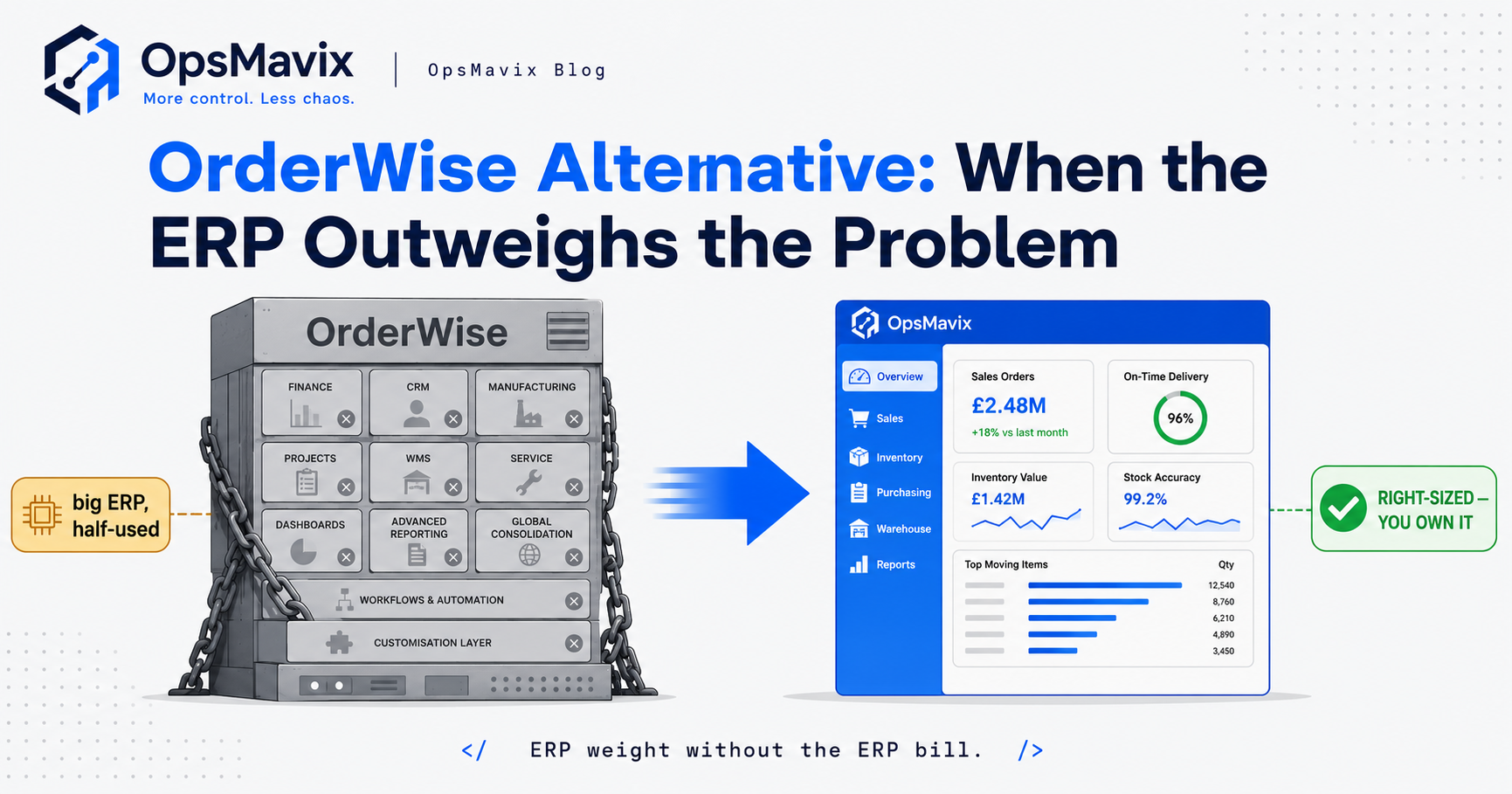
If you are searching for an OrderWise alternative, the honest answer is usually not another order-and-inventory suite sitting next to it on a comparison grid. It is one owned operations system shaped to how your business actually runs. Swapping OrderWise for Cin7, Linnworks or another configurable ERP tends to move the same weight from one shelf to another. The businesses that come out ahead are the ones that stop shopping for a bigger tool and start closing the specific leak that made them look in the first place.
Here is the reframe most comparison articles skip. Most people typing “OrderWise alternative” are not unhappy with what OrderWise does. They are unhappy with how much of themselves they have to bend to fit it, and how much of the suite they pay for, configure and maintain while using a fraction of it. That is not a feature complaint. That is a signal that the operation has outgrown spreadsheets but has been handed something built for a much larger, more complex business than it currently is.
Key Takeaways
- The real alternative is a right-sized system, not a rival ERP. Replacing one heavy suite with another keeps the maintenance burden and the unused modules.
- OrderWise is a genuinely capable, UK-built suite. Order management, WMS, POS and ecommerce under one roof, with a real UK client base. The problem is fit, not quality.
- The ceiling is scope, not capability. Growing distributors and manufacturers often pay for and maintain far more than they use.
- Pricing is quote-based and implementation-heavy. Expect configuration, training and ongoing support costs, not a published per-user figure.
- Sometimes buying OrderWise is the correct call. High SKU counts, complex warehousing and multi-channel volume can justify the weight.
- The middle option is real. An owned operations system sits between a spreadsheet and a full ERP and closes the one leak that is actually costing you.
What OrderWise Actually Is
OrderWise is a UK-built ERP and order, inventory and warehouse management suite. It is developed by Wise Software (UK) Ltd, based in Lincoln, and was acquired by Forterro, a European ERP group, in 2022. It is available both on-premise and in the cloud, and it is aimed squarely at UK distributors, wholesalers and manufacturers.
Give it real credit. This is not thin software. OrderWise brings order management, warehouse management, stock control, POS, transport management and ecommerce integration into a single configurable platform, and it has a substantial UK client base to show for it. For a business running high SKU volumes across multiple channels, having sales orders, purchase orders, warehouse operations and despatch all speaking to each other in one system is genuinely valuable. It removes the reconciliation tax of stitching four disconnected tools together, and it does so with software written and supported in the UK rather than bolted onto a foreign platform.
If you are comparing it against lighter cloud tools, it is worth reading how it stacks against the Linnworks alternative and Cin7 alternative conversations, because the trade-offs there are the mirror image of the one OrderWise forces.
Where OrderWise Hits Its Ceiling
The ceiling is not capability. It is scope. A configurable ERP is priced, built and maintained on the assumption that you will use a wide surface area of it. Most growing businesses use a narrow slice.
That mismatch shows up in a few predictable places. The first is the modules you carry but do not run: transport management you never switched on, POS you do not sell through, ecommerce connectors you configured once and left. You still pay for the platform that houses them, and you still absorb the complexity they add to upgrades and support.
The second is the leak that sits just outside the suite’s shape. A wholesaler might run OrderWise cleanly for stock and despatch, yet still manage supplier lead times, backorder promises or production sub-assemblies in a spreadsheet on the side, because the way they do it does not match the way the ERP expects it to be done. The tool is not wrong. It simply was not built around your one awkward process, and configuring it to bend that far costs more than the process is worth. When a manufacturer hits this with bills of materials or production stages, the gap is the same one covered in operational systems vs ERP.
The third is the pace of change. Heavy suites are slow to reshape. When your operation changes faster than the ERP can be reconfigured, the workarounds multiply, and the spreadsheets you were trying to kill quietly grow back.
The Pricing Reality
OrderWise does not publish a fixed per-user price, and you should treat any specific figure you see repeated online with caution. It is sold on a quote basis, scoped to your modules, user count, deployment model and implementation needs. All pricing here is in £.
The model matters more than a headline number. With a configurable ERP, the licence is only part of the spend. The larger, less visible costs are implementation and configuration, data migration, training your team, and ongoing support and upgrades. On-premise deployment adds infrastructure and maintenance you own; cloud shifts some of that into a recurring fee. None of this is unusual or dishonest on OrderWise’s part; it is simply how enterprise-grade suites are priced. But it means the true cost of an OrderWise alternative is never the sticker. It is the total weight of running the thing, year on year, whether or not you use most of it.
If you cannot get a straight answer on total cost of ownership before committing, that itself is information.
When OrderWise Is Genuinely the Right Choice
Sometimes buying it is correct, and it would be dishonest to pretend otherwise.
If you are running tens of thousands of SKUs, complex multi-location warehousing with slotting and pick-path logic, POS and ecommerce and trade counter all at once, and real transport management, then a broad, integrated, UK-supported suite earns its keep. At that scale, the cost of the platform is smaller than the cost of the chaos it replaces, and the modules you “do not use yet” are ones you will grow into. A business that genuinely needs warehouse management software at depth, with the process complexity to match, is exactly who OrderWise is built for. If that is you, buy it, implement it properly, and use it fully.
The mistake is buying that weight to solve a problem that is one leak wide.
The Right-Sized Middle: One Operations System
Between a spreadsheet and a full ERP there is a middle that most comparison articles pretend does not exist. It is one owned operations system, shaped to how your business already runs, that closes the specific leak costing you money and nothing else.
This is the OpsMavix position. Not another suite to configure and grow into, and not a return to spreadsheets, but the practical layer for a business that is outgrowing spreadsheets and disconnected tools. Instead of bending your operation to fit an ERP’s assumptions, the system is built around your actual order flow, your actual stock logic, your actual supplier and production quirks. You own it. You use all of it, because there is nothing in it you did not ask for.
The point is not code. The point is the outcome: the backorder that stops slipping, the stock count that stops drifting, the manual reconciliation that stops eating a day a week. You keep OrderWise where it earns its place, or you skip the heavy suite entirely, and you close the leak that made you search in the first place.
If your pain is concentrated in orders rather than the whole operation, a focused wholesale order management system closes it without the surrounding weight, and the boundary between the two approaches is exactly what the audit exists to draw.
The Honest Build-vs-Buy Take
Build versus buy is the wrong frame when it is treated as all or nothing. You do not have to choose between a spreadsheet and a 200-person ERP suite. The real question is narrower and more useful: is your problem broad enough to justify a full platform, or is it one or two processes wide?
If it is genuinely broad, buy OrderWise or a peer, and use it properly. If it is one leak wide, an owned, right-sized operations system will close it faster, cost less to run, and never charge you for modules you will never switch on. The best OrderWise alternative is not a smaller version of the same shopping trip. It is deciding, honestly, how big your problem actually is, and buying exactly that much and no more.
Keep reading
Getting value from OpsMavix? Add us as a preferred source on Google — you'll see more of our operations content in your AI Overviews, AI Mode and Search.