
The Cin7 Alternative for Businesses Stuck Between a Spreadsheet and an ERP
If you're hunting for a Cin7 alternative, the real question isn't which inventory tool is "better"; it's whether you need a packaged product or a system shaped around how your operation actually runs. Cin7 is strong for standard multichannel stock and orders, but it strains when your process doesn't fit its mould.
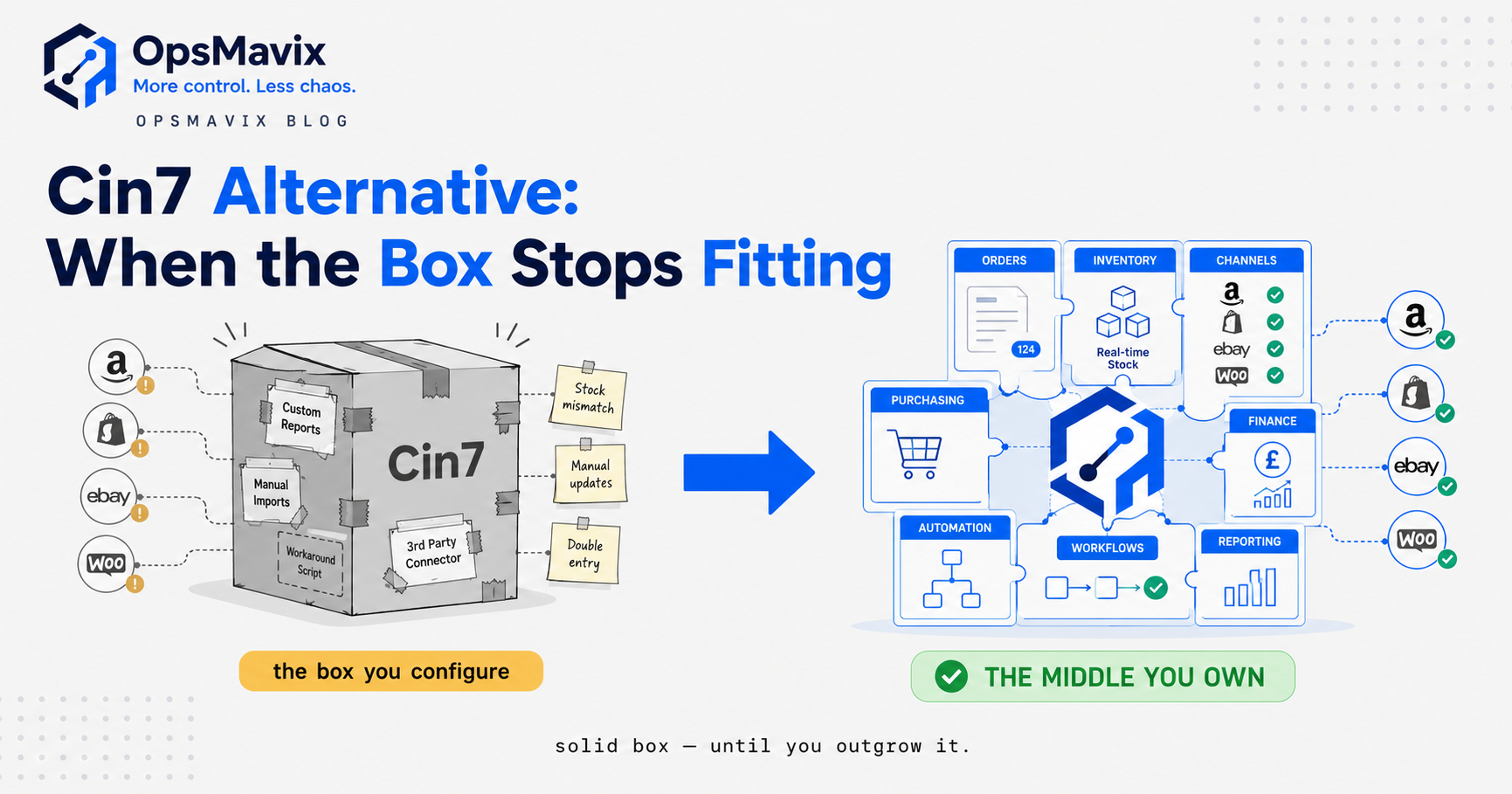
The best Cin7 alternative depends entirely on why Cin7 stopped fitting: if you outgrew spreadsheets and need standard multichannel inventory and order management, Cin7 Core is a genuinely capable product. But if your operation keeps forcing workarounds because your process doesn’t match the software’s assumptions, the answer isn’t another off-the-shelf tool, it’s a system built around how you actually work.
That distinction matters because most people searching for a Cin7 alternative aren’t unhappy with Cin7’s features. They’re unhappy that they’re bending their operation to fit the tool, paying for modules they half-use, and still exporting to a spreadsheet to answer the one question the software can’t. This post is an honest look at where Cin7 earns its place, where it hits a ceiling, and what the right-sized middle looks like.
Key Takeaways
- Cin7 is inventory and order management, not a full ERP. It does multichannel stock, purchasing, and order flow well, and Cin7 Core is aimed squarely at small and mid-sized product sellers.
- Ownership is worth knowing: Cin7 is majority-owned by private-equity firm Rubicon Technology Partners, which acquired DEAR Systems (now Cin7 Core) and Orderhive in 2021 to build the current product family.
- The pricing is US-dollar tiered: Cin7 Core runs roughly £275–£790/month across its plans (converted from its US-dollar tiers), while Cin7 Omni is custom-quoted for larger, EDI-heavy operations.
- The real ceiling isn’t features, it’s fit. Packaged tools assume a standard process, and the friction shows up when yours isn’t.
- The middle option is a system you own: not an ERP, not a cheaper clone of Cin7, but software shaped to your actual workflow.
- Build-vs-buy is a fit decision, not a cost decision. Buy when your process is standard; own a system when the workarounds are the problem.
What Cin7 Actually Is
Cin7 is inventory and order management software with two distinct products under one brand. Cin7 Core (formerly DEAR Systems) is the cloud-based inventory and order management system aimed at small and mid-sized businesses, covering real-time stock across locations, purchase orders, bills of material, kitting, and integrations with the usual suspects: Shopify, Amazon, Xero, QuickBooks. Cin7 Omni is the larger sibling, built for higher-volume operations that need EDI, retail POS, and heavier integration work.
It’s a serious product with a real track record. The company is majority-owned by Rubicon Technology Partners, a private-equity firm that took its stake in 2019 and funded the 2021 acquisitions of DEAR Systems and Orderhive to form today’s line-up. If you sell physical products across a few channels and your process is fairly conventional, Cin7 Core will very likely do the job.
So this isn’t a hit piece. Cin7 is a capable inventory system. The question is whether “capable inventory system” is what your operation is actually short on.
Where Cin7 Hits Its Ceiling
The ceiling on any packaged tool is the same: it’s built for a standard process, and it’s brilliant right up until your process isn’t standard. Cin7 assumes a particular shape to how you receive stock, allocate it, pick, pack, invoice, and report. When your business matches that shape, it’s smooth. When it doesn’t, you start building workarounds — and the workarounds are the tell.
Operators tell us the same story in different words. One warehouse manager described running the “real” allocation logic in a spreadsheet every morning because the system couldn’t handle how they prioritised backorders across two sites and a consignment stock arrangement. The software was live. The spreadsheet was still the source of truth. That’s not a Cin7-specific failing — it’s what happens to any off-the-shelf tool when your operation has a genuinely non-standard step.
The other ceiling is the module trap. You buy the tier that has the one feature you need, and you inherit a stack of features you don’t. You pay for the Advanced plan because of WMS, then use a fraction of it. The cost isn’t just the subscription; it’s the training, the half-configured modules, and the reporting that almost answers your question.
The Pricing Reality
Cin7 Core is tiered and priced in US dollars: converted to sterling, roughly £275/month for the Standard plan, around £475 for Pro (which adds manufacturing/MRP), and about £790 for Advanced (which adds warehouse management), with seat and order-volume limits stepping up at each tier. Cin7 Omni doesn’t publish pricing; it’s custom-quoted for larger, EDI-driven operations and lands well above Core.
In sterling terms that’s roughly £280–£800 a month for Core before implementation, add-ons, and premium integrations. That’s not expensive for what it is. But it’s worth being clear-eyed: you’re paying a recurring subscription for a product you don’t own and can’t reshape, and the price steps up as you grow whether or not the new tier’s headline feature is the one you needed.
The honest framing is this: subscription cost is predictable, but it’s rent. Over three or four years, a mid-tier plan plus integrations and the occasional consultant adds up to a number that’s often in the same postcode as owning a system built around your process — except at the end of the rental you still don’t own anything and you’re still doing the morning spreadsheet.
The Middle Option Most People Miss
There’s a gap between “another inventory product” and “a full ERP”, and it’s where a lot of growing operations actually belong. It’s the practical layer between a spreadsheet and an ERP: one system that models your inventory, orders, purchasing, production, and reporting the way your operation genuinely runs, not the way a product assumes it should.
This is the OpsMavix position, and it’s deliberately not “cheaper Cin7”. We don’t sell an ERP and we don’t sell a clone. We build the operations system you own, shaped to the non-standard steps that break packaged tools — the consignment stock, the two-site allocation rule, the report that has to be right the first time. The point isn’t more features. It’s zero workarounds.
For businesses outgrowing spreadsheets but not looking for the weight and cost of a full ERP rollout, this middle is usually the honest answer. It’s the same principle behind a fully automated inventory system: the aim is that stock, orders, and reporting move themselves, without a human patching the gaps between tools every morning.
How to Choose Between Cin7 and Building Your Own
Run the decision on fit, not features. Ask three questions:
Is your process standard? If you receive, allocate, pick, and invoice in a fairly conventional way, a packaged tool like Cin7 is the sensible buy. Don’t pay to rebuild what you can rent.
Where do the workarounds live? List every spreadsheet, manual re-key, and “we just do that bit by hand” step. If they cluster around one or two genuinely non-standard parts of your operation, that’s the signal a packaged tool will always strain there.
What’s the report you can’t get? Nearly every operation has one question the software can’t answer cleanly — margin by channel after returns, true available-to-promise across sites, real production throughput. If answering it means an export and a spreadsheet, you’re already running two systems.
If you’re weighing Cin7 against the broader field, it’s worth reading around the category — our take on Linnworks alternatives covers the same buy-versus-build logic for a different product, and the Mintsoft competitors rundown does the same for order and fulfilment tooling. The pattern repeats across every vendor: the tool is fine; the question is fit.
The Honest Build-vs-Buy Take
Here’s the straight version. Buy Cin7 if your operation is standard and your only real complaint is the subscription. Switching to a marginally cheaper inventory product won’t fix a fit problem, it’ll just move it. Cin7 Core is a good product for conventional multichannel selling, and the sensible move is often to configure it properly rather than replace it.
Own a system when the workarounds are the operation — when the spreadsheet is the source of truth, when you’re paying for a tier because of one feature, when the report is 90% right and someone checks the other 10% by hand every day. At that point you’re not short of features. You’re short of fit, and no amount of shopping for another packaged tool fixes that.
The middle isn’t an ERP and it isn’t a cheaper Cin7. It’s the practical layer in between, built around how you actually run, and it’s the option most people searching for a “Cin7 alternative” didn’t know was on the table. If that sounds like your operation, the cheapest first step is just finding out where the leak actually is.
Keep reading

Getting value from OpsMavix? Add us as a preferred source on Google — you'll see more of our operations content in your AI Overviews, AI Mode and Search.