
Multi-Location Inventory Rebalancing: Getting Stock Where Demand Is
A stockout at the shop while the same SKU gathers dust at the warehouse two counties over — that's a rebalancing failure, not a buying one. Multi-location inventory rebalancing is the act of moving stock between sites so the right quantity sits where demand is. Here's how to decide what to move, track it in transit, and know when the handling cost isn't worth it.
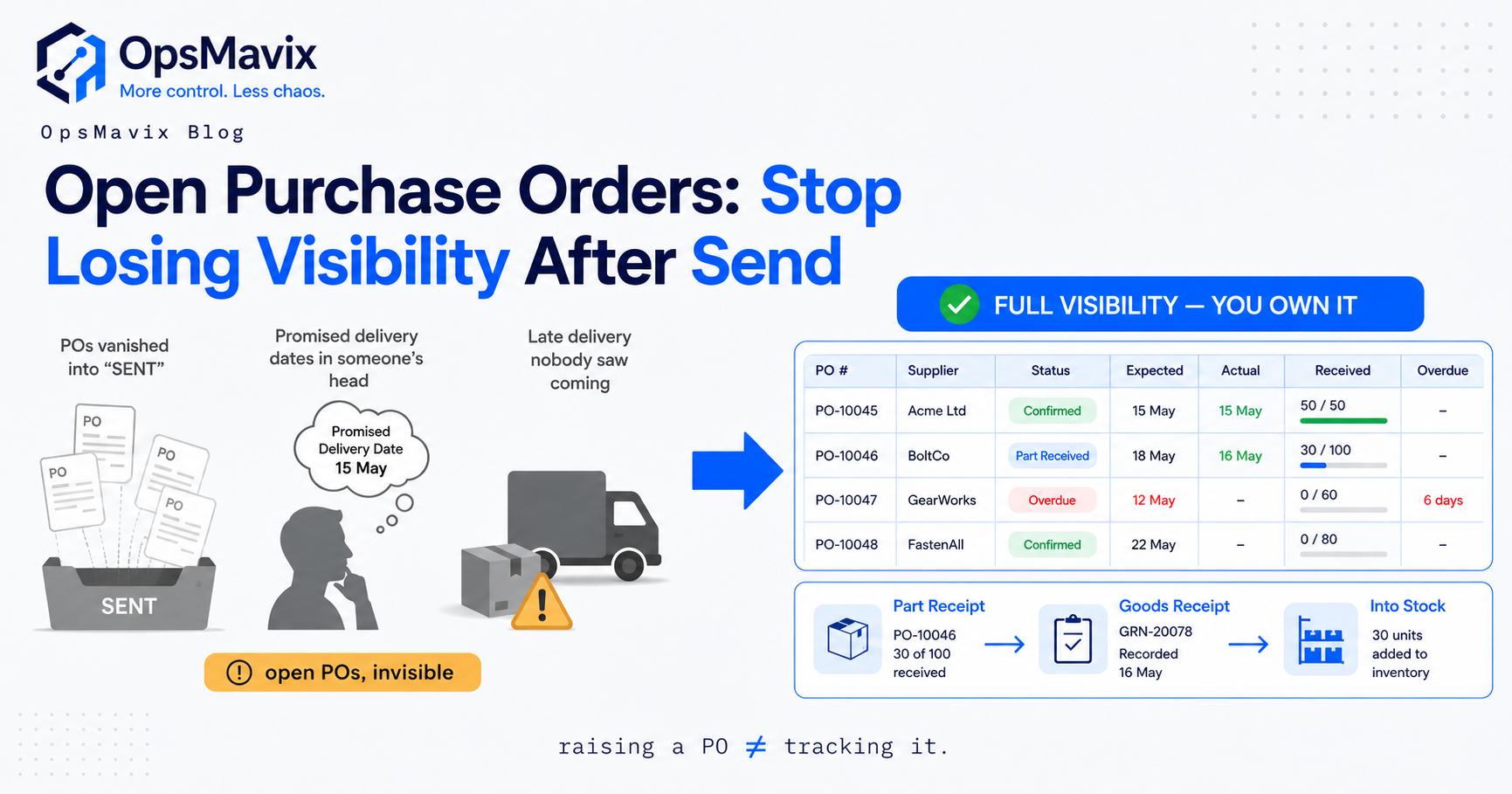
Multi-location inventory rebalancing is moving stock between your sites so the right quantity ends up where demand actually is — pulling units from a location that’s overstocked to one about to run dry. It’s a specific operation, distinct from holding and counting stock across several places. Managing multi-location inventory is knowing what you own and where; rebalancing is acting on that to shift stock sitting in the wrong building. Get it right and you kill the classic split failure: a stockout at one site while the same SKU gathers dust — and slides toward dead stock — at another.
This post is about the moving, not the counting. If you’re still working out how to hold one live picture across several sites, start with multi-location inventory management — the pillar this sits under. Here we go deeper into one job most businesses do badly or not at all: deciding what to transfer between sites, tracking it while it’s on a van, and knowing when the handling cost means the smartest move is to leave the stock where it is.
Key Takeaways
- Multi-location inventory rebalancing is the act of moving stock between sites so quantity matches demand per location — separate from managing (holding and counting) stock across those sites.
- The failure it prevents is the split: a stockout at one location while the same SKU sits idle at another, losing a sale on one side and ageing toward dead stock on the other.
- Stock drifts to the wrong site for predictable reasons — uneven demand, central receiving that fills one hub, and returns landing wherever the customer sends them — so imbalance is normal, not a one-off.
- Decide what to move on demand and cover per location, not gut feel: how fast each site sells the line and how many days of cover it holds right now.
- A transfer is stock you can’t sell while it’s on a van — track the in-transit leg or the total lies and someone promises units that are between buildings.
- Rebalancing isn’t always worth it. For a single site it’s irrelevant; for two nearby sites, occasional manual transfers can beat any system — move stock only when the sale saved is worth the handling cost.
What Rebalancing Actually Is — And Isn’t
Managing multi-location inventory is a state problem: how much of each SKU do I own, in which building, right now. Rebalancing is a flow problem: given that state, what should move, from where, to where, and is it worth moving at all. The two get lumped together because you can’t rebalance without an accurate per-site picture first — but they’re different jobs. One tells you the shop has two units and the warehouse has ninety; the other decides whether to send thirty of those ninety over before the weekend clears the shop out.
That distinction matters because most businesses invest in the first and never operationalise the second. They get one consolidated view, feel organised, and still let stock sit in the wrong place for weeks — because seeing the imbalance and acting on it are separate muscles. Rebalancing is the acting: a repeatable, ideally routine decision about redistributing stock you own so it earns its keep where it can sell.
Why Stock Drifts to the Wrong Location
Imbalance isn’t a sign anyone got the buying wrong. It’s the normal consequence of running more than one site, from three predictable places. First, uneven demand: your city shop turns a line over in days while the regional warehouse holds the same SKU for a month, so even a balanced opening stock drifts apart within a fortnight. Second, central receiving: a supplier delivery lands at the main hub because that’s where goods-in is, and stays there until someone deliberately pushes it out — which, without a trigger, they often don’t. Third, returns: a customer sends a unit back to whichever address is on the label, and now you’ve saleable stock at a site with plenty and demand at a site with none.
None of those are mistakes — they’re the physics of a multi-site operation, running continuously in the background. Stock you bought correctly, in the right total quantity, quietly ends up distributed wrong: heavy where it sells slowly, thin where it sells fast. Left alone, that drift produces the split failure this operation exists to prevent.
The Cost of Imbalance — Both Sides Lose
The split failure costs you twice from one event. On the empty side, a customer wants the item, the site can’t fulfil, and you either lose the sale or eat an emergency transfer or expedited supplier order to save it. On the full side, the same SKU sits past its sell-through window, ties up cash, and — if it’s seasonal, perishable or trend-led — starts sliding toward dead stock you’ll eventually discount or write off. One imbalance, a lost sale and a margin risk, from stock you already own in the right total quantity.
That’s what makes rebalancing worth the effort: you’re not buying anything, you’re redeploying stock that’s already paid for. A unit that would have gone stale at the warehouse instead clears at full price in the shop. Put rough numbers on it — a line that stocks out loses, say, £40 of margin a day it’s empty, while the same units age toward a 30% markdown elsewhere — and the cost of not moving stock you own becomes concrete. A transfer’s handling cost is usually a fraction of the sale saved plus the markdown avoided. Usually. Not always, which is the point we get to at the end.
How to Decide What to Move — Demand and Cover, Not Gut Feel
The wrong way to rebalance is eyeballing which site “looks low.” The right way is two numbers per location per SKU: rate of sale (how fast that site sells the line) and days of cover (current stock divided by that rate). A site with six units selling three a day has two days of cover and is about to stock out; a site with ninety selling one a day has three months of cover and is where the surplus lives. The transfer suggests itself: move enough to bring the fast site up to sensible cover without dragging the slow site below its own floor.
That floor matters. You don’t strip the source bare to feed the destination — you leave it its own safety stock, tuned to how it sells, then move the genuine surplus above that line. Do this per SKU across every site and the same total stock covers more demand, because it’s distributed by where it sells rather than where it landed. The judgement is real, but it’s judgement on numbers, not on which shelf looked empty when the manager walked past.
Transfer Orders and In-Transit Visibility
Deciding to move stock is half the job. The other half is not losing it while it moves. A transfer between sites is not a delete-here-add-there in one keystroke — for the day or three the stock is on a van, it’s left the source and not yet arrived. Treat it as an instant swap and you either double-count it (available at both ends) or lose it (subtracted from the source, not yet added, invisible to everyone). Either way the total lies, and someone promises a customer units that are currently on a motorway.
A proper transfer order has three states: dispatched, in transit, received and confirmed. In transit is the one people skip and the one that matters — stock you own but can’t sell, with an owner and an expected arrival, visible as moving rather than missing. It’s also where rebalancing and slotting meet: stock arriving at a busy site needs somewhere sensible to land, and if the destination’s warehouse slotting is a mess, the transfer you booked to fix a stockout becomes stock nobody can find. The move is only finished when the units are received, put away and sellable — not when the van leaves.
Spreadsheets Versus a System for This
A spreadsheet can tell you what you hold. It’s poor at telling you what to move. Rebalancing needs per-site rate of sale and current cover side by side, refreshed as sales happen — and a spreadsheet is a snapshot that’s stale the moment someone sells a unit and doesn’t update the sheet. So the transfer decision gets made on yesterday’s numbers, or the manager’s memory — exactly the gut-feel trap. Worse, spreadsheets have no concept of in-transit: start tracking a three-day journey between sites and a flat sheet forces you to either fudge the total or lose the stock.
A system built for this does the arithmetic continuously: it knows each site’s pace, cover and floor, and surfaces the imbalance the moment it opens up rather than when someone notices the shelf is empty. That’s the line between reacting to stockouts and preventing them. For two sites and a handful of SKUs, a sheet and a sharp manager genuinely can hold it together. Past that, the site-by-SKU combinations you’d have to eyeball every morning grow faster than anyone keeps up with, and the imbalances you miss are the ones that cost you.
Rebalancing Rules and Suggested Transfers
The step up from watching numbers to running the operation is turning the decision into rules. Set a min and max per location per SKU — the floor each site should never drop below, the ceiling above which it’s carrying surplus — and the system compares every site against its own band and flags the mismatches. Site A is below min and falling; Site B is above max on the same line; a suggested transfer writes itself. You’re no longer scanning for imbalances by hand, you’re reviewing a shortlist the system already found.
Suggested, not automatic — that’s the deliberate bit. The system proposes the transfer with the numbers behind it; a person confirms it against what the numbers don’t know: a promotion about to hit one site, a van already going that way tomorrow, a source that’s low for a reason. Full automation of physical movement tends to over-move and rack up handling cost on marginal transfers. Same discipline as live inventory automation on a single site — thresholds trigger a suggestion, a person signs it off — extended to the question of where.
When Rebalancing Isn’t Worth It
Not every imbalance should be corrected, and pretending otherwise burns money on handling. Start with the obvious: a single-site business has nothing to rebalance — one location, stock is either there or on order; the job is reordering and safety stock. And even with two or three sites close together, occasional manual transfers often beat any system: when the warehouse and shop are a ten-minute drive apart and someone’s making that run most days anyway, chucking a box in the boot when a line runs low is cheaper and faster than any software telling you to.
The test is always the same — does the sale you’d save, plus the markdown you’d avoid at the source, clear the cost of picking, packing, moving and putting away the stock? For a £6 item moving between sites two hours apart to cover one day’s demand, it doesn’t; you’d spend more on the transfer than the stockout costs, so let the fast site run dry and reorder instead. Rebalancing earns its place when imbalances are frequent, the stock is worth enough to matter, and the sites are far enough apart that “just drive it over” isn’t already solving it. Below that bar, a good manager and a short drive beat a rebalancing engine.
FAQ
What is multi-location inventory rebalancing?
It’s moving stock between your physical sites so the quantity at each location matches demand there — pulling units from a site that’s overstocked to one about to run out. It’s distinct from multi-location inventory management, which is holding and counting stock accurately across sites. Rebalancing is acting on that: redistributing stock you already own so it sits where it can sell, rather than ageing in the wrong building.
How do I decide what stock to move between locations?
Use two numbers per site per SKU: rate of sale (how fast that location sells the line) and days of cover (current stock divided by that rate). Move the surplus from sites with lots of cover to sites about to stock out — but never below the source’s own safety stock, tuned to how it sells. That’s a decision on live numbers, not on which shelf looked empty.
When is multi-location rebalancing not worth doing?
When moving the stock costs more than the sale it saves. A single-site business has nothing to rebalance. Two or three sites close together are often better served by occasional manual transfers — a ten-minute drive with a box in the boot. Rebalancing earns its place when imbalances are frequent, the stock is valuable enough to matter, and the sites are far enough apart that ad-hoc runs aren’t already solving it.
How OpsMavix Can Help
Most businesses running several sites can already see their stock — what they can’t do is act on the imbalance fast enough to matter. OpsMavix builds the acting part: per-site rate of sale and days of cover, min-max bands per location, and suggested transfers a person confirms — tracked through the in-transit leg so nothing goes missing on the van. Shaped around your real sites and the tools you already run, owned outright with no per-seat fees. And honest about the floor: if a move costs more than the stockout, the system says leave it.
If you’re stocking out at one location while the same SKU ages toward a markdown at another, the fix isn’t buying more — it’s moving what you’ve got. Book a Free Operations Leak Audit and we’ll map where stock sits idle versus where demand is going unmet across your sites, what the split is costing you, and what a right-sized rebalancing setup would fix first.
Keep reading
Getting value from OpsMavix? Add us as a preferred source on Google — you'll see more of our operations content in your AI Overviews, AI Mode and Search.