
Landed Cost: How to Calculate the True Cost of Imported Stock
Landed cost is the true, all-in cost of getting a product from a supplier to your shelf — product, freight, insurance, duty, handling and more. This guide gives you the full formula, a worked example in pounds, and shows why ignoring landed cost quietly destroys margin on imported lines.
What landed cost actually means
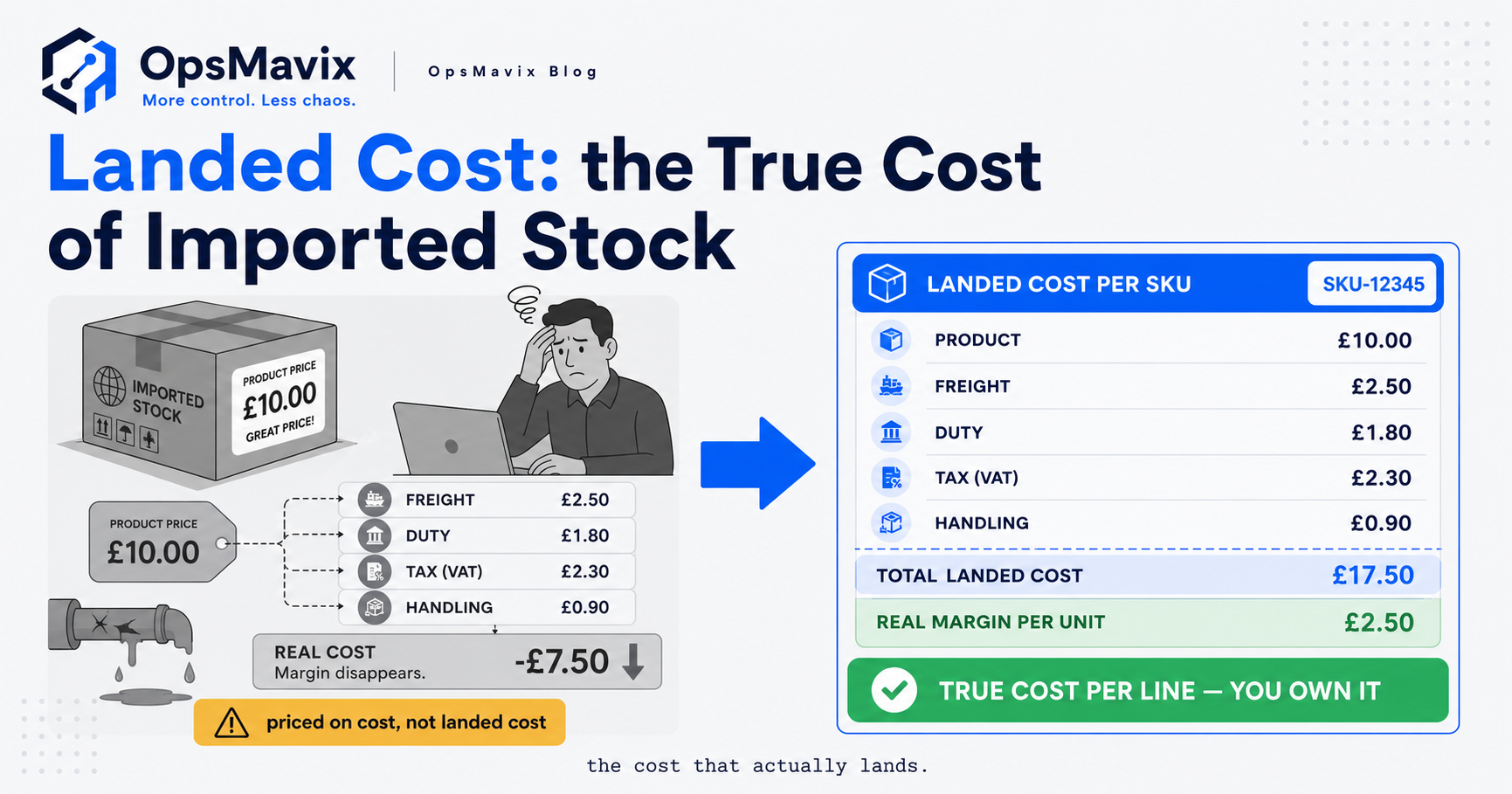
Landed cost is the true, all-in cost of a product once it has “landed” in your warehouse and is ready to sell. It is not the price on the supplier’s invoice. It is that price plus every cost you incur moving the goods from the factory gate to your shelf: shipping, insurance, import duty, customs clearance, port and handling charges, and any brokerage or admin fees along the way.
The gap between the two numbers is the whole point. A supplier quotes you £8 a unit, and it is tempting to treat £8 as your cost. But by the time that unit is sitting on your rack, it may have cost you closer to £10 — and if you priced and reported off the £8, you have been quietly overstating your margin on that line since the day it arrived. For anyone importing stock, landed cost is the difference between a margin you think you have and the margin you actually have.
This is closely related to how you cost any job or product. If you already track what a full job costing exercise involves, landed cost is the inbound-goods version of the same discipline: capture every real input, not just the obvious one.
The landed cost formula
The formula is simple to state and easy to get wrong in practice:
Landed cost = Product cost + Freight + Insurance + Duty + Taxes + Handling and fees
Then divide the total by the number of units received to get the landed cost per unit. Written per shipment:
Every term matters, and each one has its own quirks — particularly duty and tax, which depend on the goods’ classification and, in the UK, on how import VAT is treated. We will work through a full example in pounds below, but first, what each component actually covers.
The components, one by one
Product cost. The supplier’s price for the goods themselves. Straightforward — but watch the Incoterms on the quote, because they decide how much of the freight and insurance is already baked into that price. A price quoted “Ex Works” includes almost nothing beyond the goods; a price quoted “Delivered Duty Paid” already contains most of the downstream costs. The Incoterms rules published by the International Chamber of Commerce define exactly where the seller’s responsibility ends and yours begins, and misreading them is a common way to double-count or miss a cost.
Freight. The cost of physically moving the goods — sea, air or road. This is usually a per-shipment cost, not a per-unit one, which is why allocation (below) matters so much.
Insurance. Cover for the goods in transit. Often small relative to freight, but real, and it forms part of the customs value.
Duty. Customs duty charged on import, calculated as a percentage of the customs value of the goods. The rate depends on the commodity code of the product, which you look up in the UK Trade Tariff. The customs value the duty is applied to is normally the cost of the goods plus freight and insurance to the UK border — HMRC sets out the accepted methods for valuing your imports.
Taxes. Import VAT and any other import taxes. In the UK this is where most landed-cost calculations go wrong — see the VAT trap section, because for a VAT-registered business import VAT usually should not sit in landed cost at all.
Handling and fees. Customs clearance, brokerage, port charges, terminal handling, documentation, and any inland delivery to your warehouse. Individually small, collectively significant — and the line most often left out entirely.
A £ worked example
Take a single shipment. You import 1,000 units of a product.
| Component | Amount |
|---|---|
| Product cost (1,000 × £8.00) | £8,000.00 |
| Freight (sea) | £1,200.00 |
| Insurance | £150.00 |
| Customs value (cost + freight + insurance) | £9,350.00 |
| Duty at 4% of customs value | £374.00 |
| Handling, clearance and port fees | £250.00 |
| Total landed cost | £9,974.00 |
| Landed cost per unit | £9.97 |
Notice what happened. The supplier’s price was £8.00 a unit. The true landed cost is £9.97 a unit — roughly 25% higher. Every downstream number you build on cost is now off by a quarter unless you use £9.97.
Note that import VAT does not appear in this table. If your business is VAT-registered, you will pay import VAT on the way in but reclaim it, so it is not a true cost of the goods. If you are not VAT-registered, or the goods relate to exempt supplies, VAT becomes a real, non-recoverable cost and belongs in the calculation — which is exactly the trap covered next.
The UK VAT trap
Most landed-cost guides you will find online are written for a US audience, quote everything in dollars, and lump “tax” into the landed cost as though it were always a cost. In the UK, that is usually wrong.
Import VAT is charged at 20% on the value of most imported goods, but a VAT-registered business reclaims it on its VAT return — often through postponed VAT accounting, where you account for and recover the import VAT on the same return rather than paying it at the border. Because it is recovered, import VAT is not part of the true cost of the goods for a registered business, and baking it into landed cost would overstate your cost and understate your margin.
The distinction that matters:
- VAT-registered, taxable supplies: import VAT is recoverable → leave it out of landed cost.
- Not VAT-registered, or goods used for exempt supplies: import VAT is not recoverable → it is a real cost and belongs in landed cost.
Customs duty, by contrast, is never reclaimable — it is always a genuine cost and always belongs in the calculation. Getting this one distinction right is often worth more than any other refinement, because a 20% VAT figure wrongly added to cost dwarfs the 4% duty that legitimately belongs there.
Why ignoring landed cost silently kills margin
Here is the part that costs real money. Suppose you sell that imported unit for £12.00.
- On the invoice price (£8.00): you believe your gross margin is £4.00 a unit, or about 33%.
- On the true landed cost (£9.97): your actual gross margin is £2.03 a unit, or about 17%.
You have not lost the money in a dramatic, visible way. You have lost roughly half your margin quietly, and every report you run confirms the wrong number because it was built on the wrong cost. Multiply £1.97 of hidden cost across 1,000 units and one shipment has £1,970 of margin you thought you had and did not.
It gets worse on your cheapest lines. Freight, duty and handling are largely fixed per shipment, so as a percentage they hit low-value items hardest. A £2 product carrying the same £2-a-unit of import overhead has doubled in cost. Businesses that never calculate landed cost routinely discover that their “best-selling” low-price imports are the ones losing money on every sale — the volume is real, the profit is imaginary. This is the same failure that undermines stock management in fast-moving categories: high turnover on a mispriced cost base multiplies the leak instead of covering it.
Allocating cost per unit: the hard part
The formula is easy. The genuinely hard part is allocation — spreading shipment-level costs (freight, insurance, duty, handling) fairly across the individual SKUs in a mixed container.
If a shipment contains one product, you divide by the number of units and you are done. If it contains twelve different products of different sizes, weights and values, you have to decide how to apportion the £1,200 of freight and the £250 of handling. The common methods:
- By unit count — simplest, but unfair when items differ wildly in size.
- By weight — good for freight, since carriers largely price on weight or volume.
- By value — often used for duty, since duty is value-based anyway.
- By volume (cubic measure) — closest to how sea freight is actually charged.
Most accurate is a blend: allocate freight by weight or volume, duty by value, and handling by unit. Do that by hand across a dozen SKUs and several shipments a month, and the arithmetic becomes a part-time job — which is precisely why so many businesses skip it and fall back on the invoice price.
Why spreadsheets break down here
A spreadsheet can calculate landed cost for one shipment. It cannot keep it true.
The problem is that landed cost is not a one-off sum — it is a moving number that has to attach to stock and follow it. Freight rates change between shipments. Duty rates change with classification. The same SKU arrives at £9.97 in one container and £10.40 in the next because freight moved. Your spreadsheet gives you a snapshot; what you need is a live cost per SKU that updates as goods arrive and flows automatically into pricing, reporting and margin.
In practice, spreadsheet-based landed costing decays fast. Someone works it out carefully at the start, the numbers drift as rates change, nobody re-runs the allocation under pressure, and within a couple of quarters everyone is quietly back to costing off the supplier invoice. The calculation was never the hard part. Keeping it accurate, per SKU, across every shipment, month after month, is — and that is a systems problem, not a maths problem. It is the same reason product and job costing tools exist instead of a costing tab in a workbook.
How an owned system bakes landed cost into every SKU
The durable fix is to stop treating landed cost as a calculation you do and start treating it as a property of the stock itself. When goods are received, the system captures the shipment costs, allocates them across the SKUs by whatever rule you have chosen, and writes a true landed cost onto each unit received — automatically, every time.
From then on, that real cost is the number every other part of the operation reads. Margin reports use it. Pricing decisions use it. Reorder and profitability analysis use it. Nobody re-keys freight into a spreadsheet, and nobody costs off the invoice by accident, because the accurate cost is already sitting on the SKU.
This is exactly the kind of leak an owned operations system is built to close — the middle ground for a business that has outgrown spreadsheets and disconnected tools. You are not buying a heavyweight platform to get landed costing; you are having the specific mechanic — receive goods, allocate shipment costs, stamp true cost per SKU — wired into how your business already receives and sells stock. The outcome is not more software. It is margin numbers you can trust because the cost underneath them is real.
Landed cost feeds every decision after it
Landed cost is not an accounting nicety you calculate once and file. It is the foundation number that every profit decision sits on. Get it wrong and your pricing is wrong, your margin reporting is wrong, your view of which products actually make money is wrong, and your reorder decisions pour more cash into lines that lose it. It is also the number most ledgers never carry, which is why landed cost is the first gap we cover in accounting software for distribution companies.
Get it right — and, crucially, keep it right per SKU across every shipment — and the rest of your operation finally tells you the truth. You can price with confidence, drop the imports that only looked profitable, and know that the margin on your reports is the margin in your bank. For an importer, that is the difference between growing on real profit and scaling a hidden leak.
Sources
- Incoterms rules — International Chamber of Commerce
- How to value your imports for customs duty — GOV.UK
- UK Trade Tariff: look up commodity codes, duty and VAT rates — GOV.UK
- Complete your VAT Return to account for import VAT (postponed VAT accounting) — GOV.UK
- Import goods into the UK: step by step — GOV.UK
Keep reading
Getting value from OpsMavix? Add us as a preferred source on Google — you'll see more of our operations content in your AI Overviews, AI Mode and Search.