
Landed Cost vs FOB: What the Difference Costs You
FOB is the price on the supplier's invoice at the moment the goods cross the ship's rail. Landed cost is what that stock actually cost you once freight, insurance, duty and handling are added. Costing your imported lines at FOB quietly overstates margin on every one of them. This guide draws the line between the two with a full £ worked example.
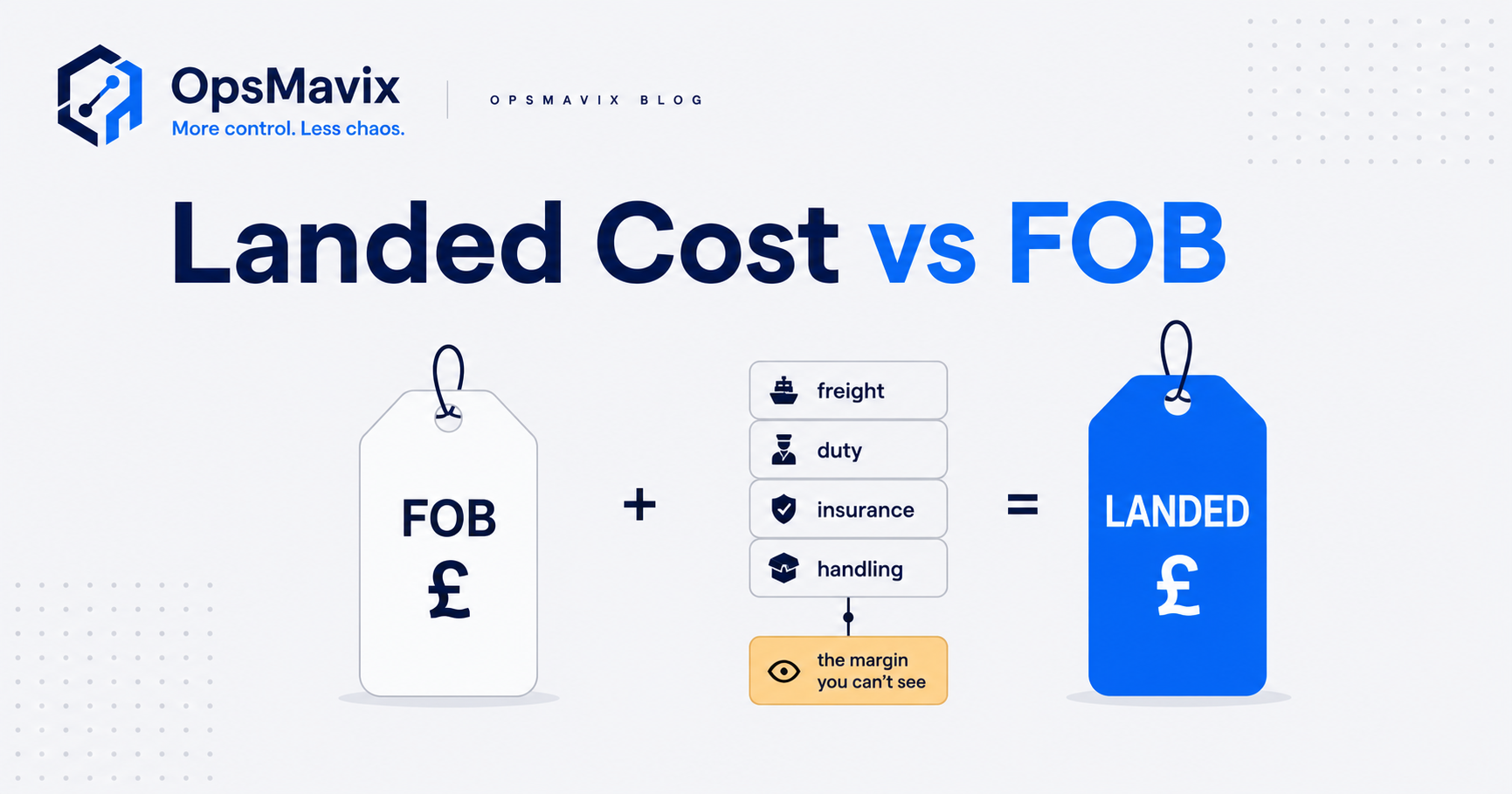
Quick summary: FOB (free on board) is a shipping term that fixes the price and the point where risk passes from supplier to buyer — the moment the goods are loaded onto the vessel at the origin port. Landed cost is the true, all-in cost of that same stock once freight, insurance, customs duty, and handling are added on top of the FOB price. The difference matters because the FOB figure is what lands on the supplier’s invoice, so it is the number most businesses cost their stock at — and it is always lower than what the stock actually cost them. Cost an imported line at FOB and you overstate its margin by every pound of import cost you left out.
FOB and landed cost describe the same shipment at two different moments. FOB is the price at the origin port. Landed cost is the price on your shelf. Everything that happens between those two points — the freight across the water, the insurance on the crossing, the duty at the UK border, the handling at the port — is real money you spend, and none of it appears on the FOB line. This page draws the line between the two, prices the gap in pounds, and shows why costing at FOB is the quietest margin leak in an importing business.
For the full mechanics of calculating the all-in figure, the companion piece is landed cost: how to calculate the true cost of imported stock. This page is narrower: it is about the FOB comparison specifically, and why the two numbers get confused.
Contents
- What FOB actually means
- What landed cost actually means
- Landed cost vs FOB at a glance
- Why the FOB price is not what the stock costs you
- A £ worked example: FOB vs landed on one order
- Why costing at FOB silently overstates margin
- FOB vs CIF vs DDP: where the costs sit
- Where the FOB-to-landed gap hides in your business
- How an owned system bakes true landed cost into every SKU
- FAQ
What FOB actually means
FOB stands for free on board. It is one of the Incoterms — the standardised trade terms published by the International Chamber of Commerce that define, for any international sale, who pays for what and where the risk passes from seller to buyer.
Under FOB, the seller is responsible for the goods up to and including loading them onto the vessel at the named port of origin. From the moment the goods are on board, cost and risk transfer to the buyer. The ICC’s own guidance is explicit that the FOB rule is intended only for sea and inland waterway transport, where “on board a vessel” is a meaningful point.
Two consequences follow, and both matter for costing:
- The FOB price covers the goods plus everything up to loading — the supplier’s product cost, their margin, inland transport to the origin port, export clearance, and loading. That is what you are quoted and invoiced.
- The FOB price covers nothing after loading. Ocean freight, marine insurance, arrival-port charges, UK import duty, customs clearance, and delivery to your warehouse are all on you, and none of them are in the FOB figure.
So an FOB price is a genuine, useful number — it is the clean price of the goods at the origin port, comparable across suppliers. What it is not is the cost of the stock once it reaches you. That is a different number, and it is always bigger.
What landed cost actually means
Landed cost is the total cost of getting a product from the supplier all the way to your warehouse, ready to sell. It starts with the FOB price and adds every cost incurred moving the goods from the origin port to your shelf:
Landed cost = FOB price + Freight + Insurance + Duty + Handling and fees
Each of those is a real, invoiced cost:
- Freight — the ocean (or air) carriage from origin port to UK port, plus any inland leg to your door.
- Insurance — marine cargo cover for the crossing.
- Duty — UK import duty, charged as a percentage of the customs value under the UK Integrated Online Tariff, varying by commodity code.
- Handling and fees — port charges, terminal handling, customs clearance, broker fees, and any admin along the way.
Landed cost is the inbound-goods version of the same discipline as job costing: capture every real input, not just the obvious headline one. On a job it is labour and materials and overhead; on imported stock it is FOB plus freight plus duty plus handling. The failure mode is identical — cost only the obvious line, and every decision downstream runs on a number that is too low.
Landed cost vs FOB at a glance
| FOB (free on board) | Landed cost | |
|---|---|---|
| What it is | The price of the goods at the origin port, loaded onto the vessel | The all-in cost of the goods once they reach your warehouse |
| Where cost/risk sits | Passes to you the moment goods are on board | Sits with you all the way to your shelf |
| What it includes | Product cost, supplier margin, inland transport to port, export clearance, loading | FOB price plus freight, insurance, duty, handling and fees |
| What it excludes | Freight, insurance, duty, arrival handling — everything after loading | Nothing relevant to getting the goods to your door |
| Where you see it | On the supplier’s invoice | Only if you build it — it spans several invoices |
| Use it for | Comparing supplier quotes on a like-for-like basis | Pricing, margin, valuation, reorder decisions |
| Relationship to the other | The starting number | FOB + every import cost on top |
The single most important row is the last one. Landed cost is not an alternative to FOB — it contains FOB. FOB is the first line of the landed-cost calculation. The problem is never that FOB is wrong; it is that businesses stop at FOB and treat the first line as the whole sum.
Why the FOB price is not what the stock costs you
The FOB price has one property that makes it dangerous as a cost figure: it is the only import cost that arrives on a single, clean, itemised invoice at the point of purchase.
Everything else comes later and scattered. The freight forwarder invoices you weeks after you agreed the FOB price. The duty is calculated at the border by your customs broker. The port handling shows up on yet another line. Insurance might be an annual policy, not a per-shipment charge. By the time all of it has landed, the goods are already booked into stock — usually at the FOB value, because that was the number available on day one.
That is the whole mechanism of the leak. The FOB price is early, clean, and single-source. The rest of the landed cost is late, messy, and multi-source. Human nature and most accounting workflows reach for the number that is easy to get, and the easy number is FOB. So the stock record says the unit cost is what the supplier charged at the origin port — and stays silent about the third of the cost that piled on afterward.
The result is a stock valuation and a margin figure that are both understated on the cost side, which means margin looks better than it is on exactly the lines where you can least afford the illusion: imported ones.
A £ worked example: FOB vs landed on one order
Take a single import order. A UK business buys 2,000 units of a homeware product from an overseas supplier. All figures are illustrative and in pounds.
The FOB price:
| Item | Amount |
|---|---|
| FOB price per unit | £6.00 |
| Units | 2,000 |
| FOB order value | £12,000 |
So far, so simple. The invoice says £12,000, or £6.00 a unit. If the business costs the line here — as most do — every one of those 2,000 units goes onto the stock record at £6.00.
Now add everything the FOB price left out:
| Cost component | Amount | Notes |
|---|---|---|
| FOB order value | £12,000 | The supplier’s invoice |
| Ocean freight | £1,800 | Origin port to UK port |
| Inland delivery to warehouse | £400 | UK haulage |
| Marine insurance | £150 | Cargo cover for the crossing |
| Import duty | £1,020 | Say 8.5% on a £12,000 customs value |
| Port + terminal handling | £320 | Arrival charges |
| Customs clearance / broker fee | £110 | Per-shipment admin |
| Total landed cost | £15,800 |
Now divide the true total across the 2,000 units:
| Basis | Cost per unit |
|---|---|
| FOB price per unit | £6.00 |
| True landed cost per unit | £7.90 |
The stock did not cost £6.00 a unit. It cost £7.90 — nearly 32% more than the FOB figure the business was costing it at. That £1.90 per unit is not a rounding error. It is freight, duty and handling that were always going to be spent, sitting invisible because they arrived on different invoices at a different time from the FOB price.
Note one detail that trips people up: import VAT is not in the landed cost. A VAT-registered UK business reclaims import VAT, so it is not a cost of the goods — it is cash-flow, not margin. Duty, by contrast, is a genuine sunk cost and belongs in the landed figure. Confusing the two is one of the most common ways the calculation goes wrong; the landed cost calculation guide walks through the VAT trap in full.
Why costing at FOB silently overstates margin
Carry the worked example one step further into pricing.
Suppose the business sells that homeware unit for £12.00.
| Margin basis | Cost | Profit per unit | Gross margin |
|---|---|---|---|
| Costed at FOB (£6.00) | £6.00 | £6.00 | 50.0% |
| Costed at true landed (£7.90) | £7.90 | £4.10 | 34.2% |
Same product, same selling price, same order. Costed at FOB, it looks like a 50% margin line. Costed at what the stock actually cost, it is a 34% line. The difference — nearly 16 margin points — is not a modelling choice. One number is fiction and the other is fact. The FOB-costed margin is simply wrong by the amount of import cost that was left out.
That gap does damage in three directions at once:
- Pricing. Discount a “50% margin” line by 20% for a big order and you think you are still comfortably profitable. On the real 34% cost base, that discount has taken you close to break-even — and you would never have agreed to it if the number on screen had been honest.
- Product decisions. You keep, promote, and re-order the imported lines that look most profitable. If their apparent margin is an FOB illusion, you are steering the whole range toward the wrong products.
- Stock valuation. Every imported unit on the shelf is on the books at FOB, so the balance sheet understates what the inventory cost you. Not fraud — just a quietly wrong number that everything else inherits.
The insidious part is that it is silent. Nothing breaks. There is no error message when you cost at FOB. The line just reports a margin that is too good, month after month, and the business makes confident decisions on a number that was never real. For fast-moving imported ranges the effect compounds hardest — the same overstatement repeats on every unit of every reorder, which is why FMCG stock management lives or dies on getting the landed figure right rather than the invoice figure.
FOB vs CIF vs DDP: where the costs sit
FOB is not the only Incoterm you will meet, and which one you buy on changes who invoices you for what — but not the landed cost itself. Landed cost is the same total regardless of the term; the Incoterm just decides how much of it is bundled into the supplier’s price versus billed to you separately.
| Incoterm | Supplier’s price includes | You are separately invoiced for | Landed cost still equals |
|---|---|---|---|
| FOB (free on board) | Goods + transport to origin port + loading | Freight, insurance, duty, handling | The full all-in total |
| CIF (cost, insurance, freight) | Goods + freight + insurance to destination port | Duty, arrival handling, inland delivery | The full all-in total |
| DDP (delivered duty paid) | Goods + freight + insurance + duty + delivery | Little or nothing | The full all-in total |
This is why you cannot compare a CIF quote from one supplier against an FOB quote from another by looking at the invoice price — they include different things. It is also why buying DDP feels “simpler”: more of the cost is folded into one supplier price, so it looks like there is no landed-cost gap. There still is — it is just hidden inside the supplier’s number instead of arriving on separate invoices. Whichever term you buy on, the discipline is the same: work back to the true all-in cost per unit, and cost your stock at that.
Where the FOB-to-landed gap hides in your business
The gap between FOB and landed cost is not usually a single visible mistake. It hides in the seams between systems:
- Between purchasing and receiving. The PO is raised at FOB. The goods are booked in at FOB. The freight and duty invoices arrive later and go straight to a general “shipping” or “import costs” expense line, never allocated back to the stock they belong to.
- Between accounts and the stock record. Finance sees the total import spend in an expense category and the goods on the stock ledger at FOB. Both are internally consistent; neither is the true unit cost.
- Between shipments. Freight cost per unit swings with container fill, fuel, and route. A landed cost worked out once and hard-coded goes stale, and the FOB gap grows or shrinks unnoticed from one shipment to the next.
- On mixed containers. One container holds several products. The freight and duty have to be allocated across those SKUs — by value, weight, or volume — and doing that by hand in a spreadsheet is where most importers quietly give up and default back to FOB.
That last one is the practical breaking point. Allocating shared freight and duty across a mixed shipment, per SKU, on every arrival, is exactly the kind of repetitive calculation a spreadsheet does badly and a person does inconsistently — and the moment it gets skipped, everything reverts to the FOB figure on the invoice.
How an owned system bakes true landed cost into every SKU
The fix is not more spreadsheet columns. It is making landed cost the only cost the business sees, so FOB never gets a chance to masquerade as the real number.
In an owned operations system shaped around how you actually import, that means:
- Every purchase order captures its FOB price and its expected import costs — freight, duty rate, insurance, handling — as structured fields, not notes.
- Arrival invoices are allocated back to the goods, automatically. When the freight and duty invoices land, the system spreads them across the units on that shipment — by value, weight or volume — so each SKU carries its share.
- The stock record shows landed cost, not FOB. The number every downstream decision reads — pricing, margin, valuation, reorder — is the true all-in figure, updated each time a new shipment lands with different freight or duty.
- Mixed containers allocate correctly without anyone doing the maths by hand, which is the exact point where manual costing fails.
- Margin is reported off landed cost by default, so a 34% line can never again show up on screen as a 50% line.
This is the same principle as clean receiving and matching generally: reconcile what you ordered, what arrived, and what you were invoiced, then let the true cost flow into stock rather than an approximation. For businesses too messy for spreadsheets but not ready for a full ERP, the right-sized version is exactly this — one product record where the cost is the landed cost, kept honest automatically, so nobody has to remember to add freight and duty back on.
FAQ
What is the difference between FOB and landed cost?
FOB (free on board) is the price of the goods at the origin port, loaded onto the vessel — it is what the supplier invoices you. Landed cost is the total cost of getting those same goods to your warehouse: the FOB price plus freight, insurance, duty and handling. FOB is the first line of the landed-cost calculation, not an alternative to it. Landed cost is always higher, because it includes everything that happens after the goods are on board.
Is FOB the same as the cost of goods?
No. FOB is the cost of the goods at the origin port only. Your true cost of goods — the figure you should value stock and calculate margin on — is the landed cost, which adds every import cost incurred after loading. Treating FOB as your cost of goods understates the real cost on every imported line and overstates the margin by the same amount.
Why does costing at FOB overstate margin?
Because FOB leaves out freight, duty and handling — costs you genuinely pay but that arrive on later, separate invoices. If you cost the stock at FOB but sell it for a fixed price, the reported margin is calculated against a cost that is too low, so it looks better than it is. In the worked example above, a line that looked like 50% margin at FOB was actually 34% once true landed cost was used.
Does landed cost include import VAT?
No, not for a VAT-registered UK business. Import VAT is reclaimable, so it is a cash-flow item, not a cost of the goods. Import duty is different — it is a genuine sunk cost and belongs in the landed-cost figure. Mixing the two up is one of the most common landed-cost errors.
If I buy DDP, is there still a landed-cost gap?
Yes, but it is hidden. Under DDP (delivered duty paid) the supplier folds freight, insurance and duty into their price, so it arrives as one number and looks like there is nothing to add. The landed cost is still the full all-in total — it is just bundled into the supplier’s invoice instead of arriving on separate ones. You still need to know the true per-unit cost to price and value correctly.
Sources
- ICC — Incoterms 2020 Rules — the FOB rule and its restriction to sea and inland waterway transport, and the transfer of cost and risk on loading.
- UK Integrated Online Tariff — commodity codes and the import duty rates that determine the duty component of landed cost.
- GOV.UK — Import goods into the UK: step by step — the sequence of freight, customs, duty and VAT charges a UK importer incurs after the goods leave the origin port.