
The NetSuite Alternative Between a Spreadsheet and an ERP
Most businesses hunting for a NetSuite alternative have outgrown spreadsheets but are nowhere near needing a full ERP. This is the honest case for the right-sized middle: one owned operations system shaped to how you already work, instead of a platform you spend two years growing into.
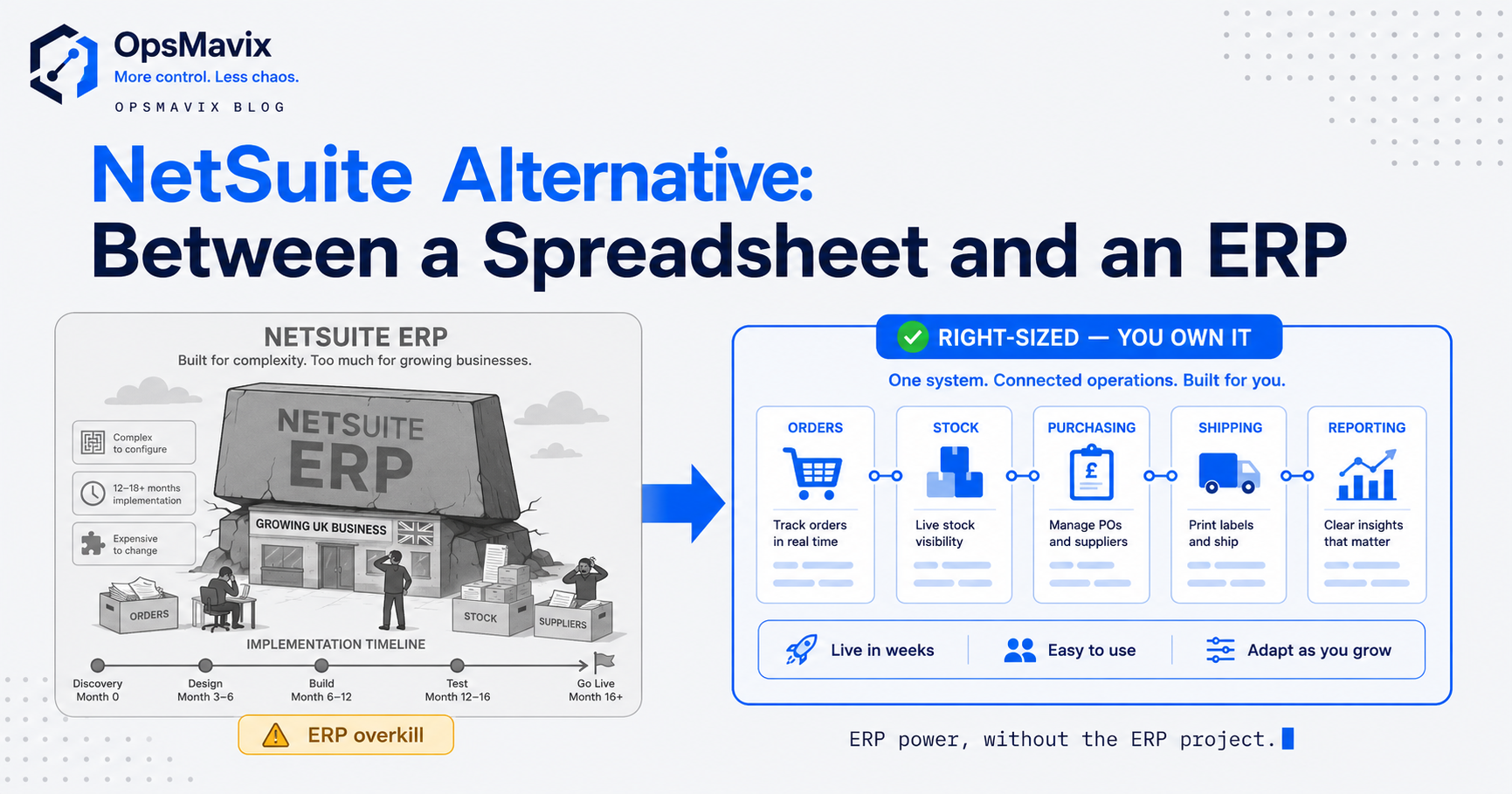
If you are searching for a NetSuite alternative, the most useful answer is one you probably were not expecting: for a growing UK business, the best alternative to NetSuite is usually not another ERP at all. It is one owned operations system, shaped around how your business actually runs — inventory, orders, production and reporting connected in one place — without the weight, cost and multi-year commitment of a full enterprise platform you will only ever half-use.
That reframe matters, because most people typing “NetSuite alternative” into a search bar are not unhappy with NetSuite’s feature list. They are quietly uneasy about something else. They are looking at a system built to run a 500-person, multi-entity, multi-currency operation, and they are trying to work out how to bend their 15-to-80-person business to fit it — or how to justify paying for finance consolidation, advanced revenue recognition and a full CRM suite when the real pain is that stock counts are wrong and orders fall through the cracks. The instinct to shop around is correct. The instinct to shop for another ERP is where it usually goes wrong.
Key Takeaways
- The real question is not “which ERP”. It is “how much system do we actually need” — and for most growing SMBs the honest answer is far less than NetSuite.
- NetSuite is genuinely strong at what it was built for: consolidating finance, inventory, orders and CRM for larger, more complex, often multi-entity organisations.
- Its ceiling is fit, not capability. You pay for breadth you may never touch, and you reshape your operation to match the platform rather than the other way round.
- Pricing is quote-based and priced in USD, built from an annual licence plus per-user seats plus implementation — the total cost of ownership, not the sticker, is what bites.
- The right-sized middle exists. An owned operations system closes the specific leaks — stock, orders, production, reporting — without the enterprise overhead.
- Build-vs-buy is a judgement call, not a religion. Sometimes NetSuite is exactly right. Often it is a two-year answer to a problem you have this quarter.
What NetSuite Actually Is
Credit where it is due. NetSuite is a mature, cloud-based ERP — one of the earliest true cloud ERPs, and still one of the most complete. It is owned by Oracle, which acquired NetSuite in 2016, and it now sits within Oracle’s applications portfolio. In a single platform it covers financials and accounting, inventory and order management, and customer relationship management, with modules extending into manufacturing, procurement, ecommerce and professional services.
For the organisation it is designed for, that breadth is the point. If you are running multiple legal entities, consolidating accounts across currencies, closing books to audit standards and coordinating inventory across several warehouses and channels, having all of it in one governed system is a real advantage. NetSuite is not a toy, and it is not a fad. It earned its place by doing genuinely hard, unglamorous enterprise work well. Any honest comparison has to start there: when the complexity is real, NetSuite handles it.
Where NetSuite Hits Its Ceiling
The ceiling is not what NetSuite can do. It is the gap between what it can do and what a growing SMB needs it to do.
The first leak is fit. A full ERP assumes your processes will conform to its model. That is fine at enterprise scale, where standardisation is worth the pain. At 20 or 40 people it often means rewriting the way your team already works so the software stays happy — and paying consultants to configure the parts you will never open. You end up owning a platform that owns you back.
The second leak is the “everything except the actual problem” trap. Most SMBs feel operational pain in a narrow band: stock levels that do not match reality, purchase orders raised from guesswork, production or fulfilment steps that live in someone’s head, month-end reporting stitched together from exports. NetSuite can address all of that — but you buy the finance-and-CRM aircraft carrier to get it, and the specific leaks still need configuring, customising and maintaining on top. The heaviest part of the tool is rarely the part you needed.
The third leak is time and dependency. Enterprise ERP implementations are measured in quarters, not weeks, and they usually require a partner. That is a long time to wait for stock accuracy, and a long-term dependency on external configuration for changes you would rather make yourself.
The Pricing Reality
NetSuite does not publish a public price list, and that is the first thing to understand about its cost. Pricing is quote-based and negotiated. The model is an annual licence fee for the platform, plus a per-user charge for each seat, plus separate one-off implementation and configuration costs — and pricing is set in US dollars, so a UK buyer is also carrying currency exposure on top.
Because the figures are bespoke to each deal, any specific number you see quoted online should be treated as unverified. What is safe to say is structural: the annual licence and per-seat model means cost scales with your headcount and the modules you switch on, and the implementation spend is a substantial separate line that lands before you see value. For a growing UK SMB, the total cost of ownership over the first two years — licence, seats, implementation, and the internal time to adopt it — is the number that matters, and it is consistently larger than the platform’s reputation suggests. None of that is a scandal. It is simply enterprise pricing meeting a business that is not yet an enterprise.
When NetSuite Is Genuinely the Right Choice
Sometimes buying NetSuite is the correct decision, and pretending otherwise would be dishonest. If you are running multiple legal entities and need consolidated financials, if you operate across several currencies and jurisdictions, if you need audit-grade accounting with proper controls, or if your complexity is genuinely enterprise-shaped and still growing, then a full ERP is the right tool and NetSuite is a leading option. In that situation, a lighter system would be the thing you outgrow in eighteen months. Buy the platform, budget for the implementation, and get on with it.
The test is simple: is your pain financial-consolidation-and-governance pain, or is it operational-mess pain? If it is the former, NetSuite deserves a serious look. If it is the latter, read on.
The Right-Sized Middle: One Operations System
Most businesses searching for a NetSuite alternative sit in the awkward middle — outgrowing spreadsheets and disconnected tools. Spreadsheets have stopped coping: stock is wrong, orders slip, and reporting eats a day a week. But nothing about the operation is enterprise-shaped. There is no case for consolidating five legal entities. There is a case for stock that matches reality and orders that cannot fall through the gaps.
That middle is where an owned operations system fits. Instead of buying breadth and configuring down, you build up from the specific leaks: inventory, purchasing, production or fulfilment, and reporting, connected into one system that mirrors how your business already runs. You own it, it is sized to you, and it does not carry the finance-and-CRM weight you were never going to use. The goal is not more software — it is the leak closed, and a system that changes as fast as your operation does.
If you want to see how that middle layer is put together, our writing on operational systems vs ERP draws the line clearly, and our overview of an operations management system shows what the connected version looks like in practice. For the specific pain most NetSuite shoppers actually have — stock that will not stay accurate — a fully automated inventory system is usually the fastest leak to close.
The Honest Build-vs-Buy Take
Build-versus-buy is not a loyalty test. NetSuite is an excellent ERP for the organisation it was built for, and if your complexity is real and enterprise-shaped, buying it is the grown-up answer. But most businesses searching for a NetSuite alternative are not that organisation — not yet, and maybe not for years. They are paying an enterprise price, in dollars, for a platform they will grow into slowly while the actual leak keeps costing them every week.
The alternative worth considering is not another tool to evaluate. It is a decision about scale: buy the enterprise platform when you have an enterprise problem, and until then, own the right-sized system that closes the leak you have today. That is the middle NetSuite was never designed to occupy — and for a growing UK SMB, it is usually the better answer.
Keep reading
Getting value from OpsMavix? Add us as a preferred source on Google — you'll see more of our operations content in your AI Overviews, AI Mode and Search.