
FMCG Stock Management: Stop the Spoilage and Stockouts
Fast movers sell out before you notice; slow lines expire on the shelf. Here's how FMCG stock management ends spoilage and stockouts across every site.
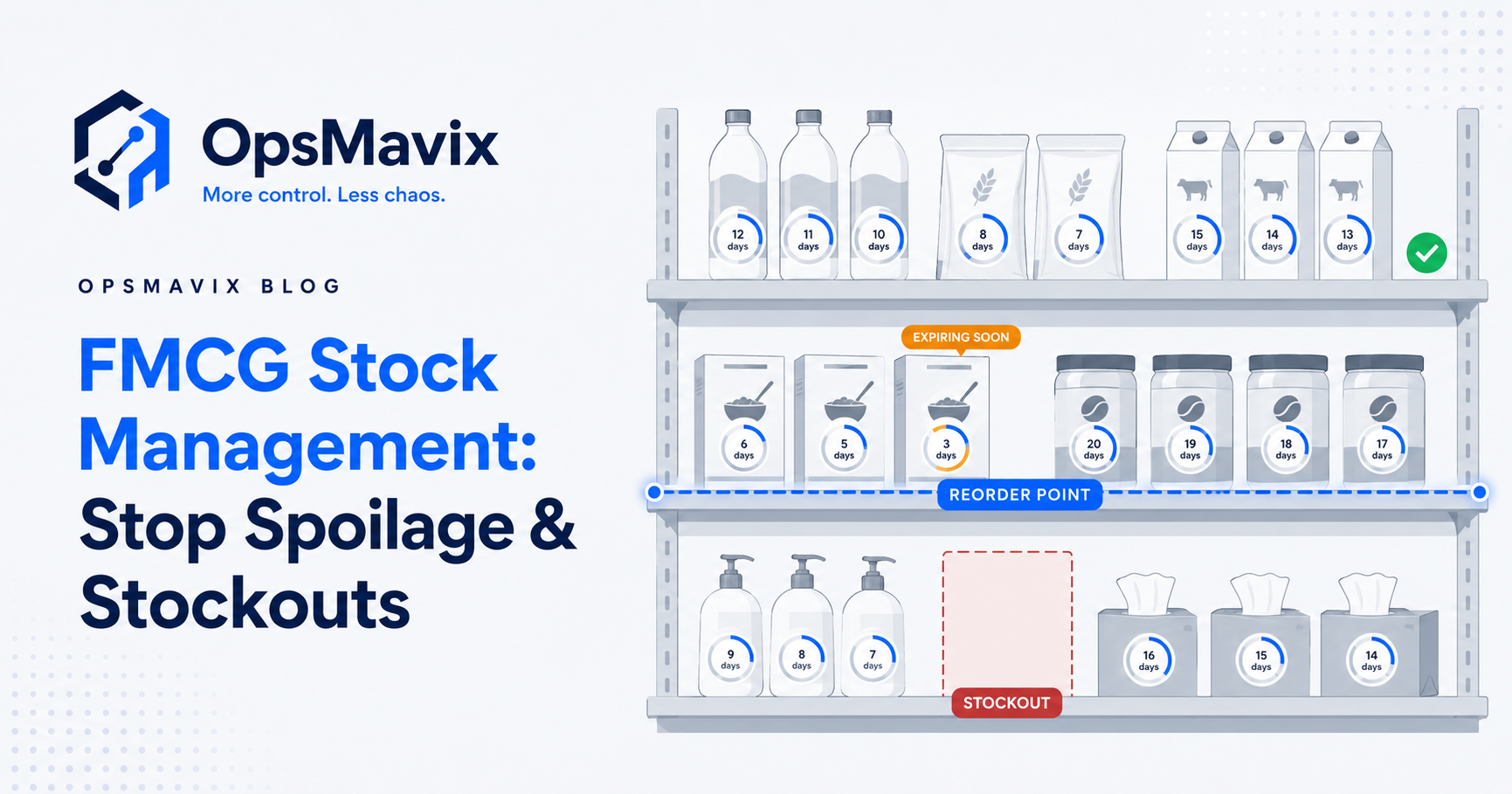
Good FMCG stock management is one live figure per SKU, per site, that knows how fast each line moves and how long each batch has left. Count harder and you still won’t have it. The trap in fast-moving goods is that the same number is too high on a slow line and too low on a bestseller on the same day: short shelf life punishes overstocking with write-offs, fast turnover punishes understocking with empty shelves and oversells.
Most growing food, drink and consumer-goods businesses run this on spreadsheets long after the spreadsheets stopped coping. The result is a number nobody trusts. In this sector, an untrusted number is either spoilage or a stockout waiting to happen.
Here’s what breaks FMCG stock, and how to get a figure that holds across every site and every shelf-life date.
Key Takeaways
- FMCG stock fails in two directions at once: spoilage on slow lines, stockouts on fast ones.
- Shelf life turns overstock into a direct loss — dead stock here doesn’t just tie up cash, it expires.
- One spreadsheet can’t track velocity, expiry and multiple sites at once without drifting.
- Reorder points have to be per-SKU and per-site — one blanket rule guarantees you’re wrong somewhere.
- The fix is one live figure that updates on every movement and flags expiry before it bites.
1Fast Movers Sell Out Before You Notice
Velocity is what defines FMCG. Bestsellers move so quickly that a count taken this morning is wrong by lunchtime. When the number only changes when someone remembers to change it, the gap between shelf and system widens fastest on exactly the lines you can least afford to run out of. By the time a manual count catches up, you’ve already promised stock you don’t have.
This is the leak Stockout Steve, the inventory operator in our avatar research, describes plainly: “we would consistently oversell items we didn’t even have on hand — the stock never matches the system, and I’m running a million messy spreadsheets for the warehouse.” In a slow category that’s an annoyance. In FMCG it happens daily.
2Slow Lines Quietly Expire on the Shelf
The opposite problem costs just as much. Order too much of a line that doesn’t move, and in most sectors you’ve tied up cash. In FMCG you’ve often lost it outright: the stock reaches its use-by or best-before date and gets written off. Spoilage is dead stock with a deadline, and it rarely shows up in a count that tracks quantity but not age.
Without batch and expiry tracking, the oldest stock isn’t necessarily the stock that ships first. You pick from the front, the back ages out, and the write-off lands at month-end as a number nobody can fully explain. Real FMCG stock management tracks how long each batch has left, not just how many units exist.
3Spreadsheets Can’t Hold Velocity, Expiry and Sites at Once
A spreadsheet handles one of these acceptably. Ask it to track fast-changing quantities, batch expiry dates and stock split across several sites, all kept in sync by hand, and it collapses. Each tab gets updated by a different person at a different time. The moment one slips, every figure that leans on it is wrong.
Our avatar research flags the same trap: counts that “wind up being off, sometimes wildly so,” and the dread of “phantom stock” — numbers that change for no visible reason. The cause isn’t careless staff. It’s that people have become the integration layer between sheets that were never built to talk to each other, as we cover in why your stock never matches the system.
4Multi-Site Stock Means One SKU, Several Truths
Most FMCG operations hold stock in more than one place: a central warehouse, a couple of depots, a shop, a 3PL. When each site keeps its own count, you don’t have one figure for a SKU. You have several that disagree. Customer service quotes availability off one list, the warehouse picks from another, and a transfer between sites updates neither in time.
The danger stays invisible until it costs you a sale. One site shows the last cases as available; they shipped from the other this morning. A connected approach treats a SKU as one shared number across every site, with transfers and receipts updating it live, so availability is real wherever it’s checked. The same figure feeds your wholesale order management and any retail or eCommerce channels drawing on the same pool.
5Reorder Points Have to Match How Each Line Actually Moves
The reflex fix is “set a minimum, reorder when you hit it.” In FMCG that isn’t enough, because one rule can’t fit a range where this SKU sells out weekly and that one lingers for months. Set the trigger high enough to protect the fast movers and you overstock the slow ones into spoilage. Set it low to avoid waste and you stock out your bestsellers.
Reorder points need to be per-SKU and per-site, tuned to each line’s real velocity and lead time, and they need to fire on their own. OpsMavix’s view here is deliberately unfashionable: you don’t need a six-figure WMS to get this. You need a stock number you can trust and alerts that reflect how your specific lines move, not a generic dashboard demoing someone else’s catalogue.
FAQ
What is FMCG stock management?
It’s keeping accurate, live stock figures for fast-moving consumer goods — products that sell quickly and often have a limited shelf life. Beyond counting units, it tracks velocity, batch and expiry dates, reorder points and stock spread across multiple sites, so you avoid both spoilage and stockouts.
How do I stop FMCG stock from spoiling?
Track batch and expiry, not just quantity, so you ship oldest stock first and see what’s nearing its date before it’s lost. Pair that with per-SKU reorder points tuned to real demand, so you stop over-ordering slow lines that age out on the shelf.
Why do my fast-selling lines keep running out?
Usually because the stock figure updates too slowly to keep pace with how fast they sell, and reorder alerts either don’t exist or use one blanket rule. Fast movers need their own triggers based on actual velocity and supplier lead time, firing automatically rather than when someone spots an empty shelf.
Can I manage multi-site FMCG stock in a spreadsheet?
You can, until the sites start disagreeing, which they will, because nothing keeps separate counts in sync in real time. Once stock moves between sites or sells across channels, you need one shared figure per SKU that every location reads from and writes to.
Do I need a full ERP for FMCG stock management?
Rarely, if you’re a growing SMB. An ERP is often overkill and badly overpriced for a mid-size operation. A custom system built around your actual SKUs, sites and shelf-life rules usually gives you the trustworthy number without the cost or the lock-in.
How OpsMavix Can Help
OpsMavix builds custom inventory systems for FMCG operations where every movement — receipt, pick, transfer, sale and write-off — updates one live figure per SKU, per site. Add batch and expiry tracking so stock ships oldest-first and flags what’s near its date, plus per-line reorder alerts tuned to how each product moves, and the figure stops being a guess you re-check before every promise.
You own the system outright: no per-seat fees, no vendor switching it off, no number that changes for reasons nobody can explain. If spoilage and stockouts are eating your margin on the same day, that’s a measurable operational leak. Book an Operations Leak Audit and we’ll map where your FMCG stock breaks down, and what it’s costing you.