
Sicon Works Order Processing Alternative: Production Control You Own
Sicon Works Order Processing is a solid way to run production control — if you already live inside Sage 200 and are happy to pay a Sage licence, a module subscription, mandatory support and a partner to implement it, on a "stops working if you stop paying" basis. The honest Sicon Works Order Processing alternative for makers who don't want that lock-in is a custom system built around your real floor, that you own outright.
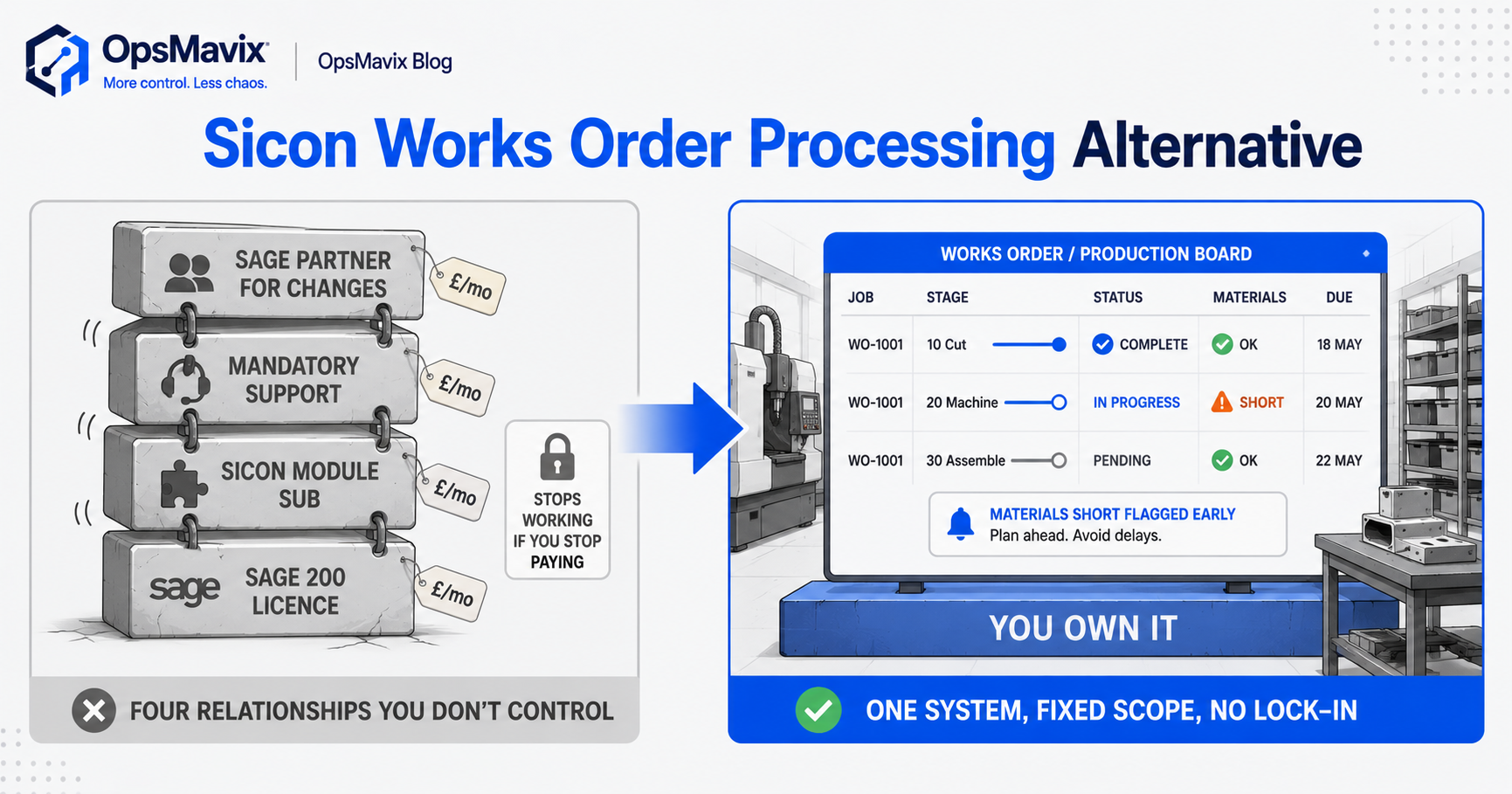
The honest Sicon Works Order Processing alternative for most manufacturers isn’t another bolt-on module. Sicon WOP is a genuine production-control tool — but it’s built exclusively for Sage 200 and can’t run without it. So the real choice isn’t “WOP versus something cheaper.” It’s “do I want my works orders, BOMs and shop-floor tracking tied to the Sage ecosystem, paid for on a stacked recurring bill, with a partner in the middle — or do I want a system built around how my floor actually runs that I own outright?” If you already run Sage 200 and love it, WOP is a fair route. If you don’t, or you don’t want to be locked in, there’s a different answer.
This post covers what Sicon WOP is built for, the Sage 200 dependency that defines it, what it really costs once you stack the bills, and what a built-for-you system does instead. If the underlying question is whether you need a packaged MRP at all, a custom MRP system covers that sibling call.
Key Takeaways
- Sicon Works Order Processing is a real production-control module — but it runs only on Sage 200 and cannot work standalone.
- The headline price is £279/month for WOP, ex-VAT — but that sits on top of a separate Sage 200 licence, mandatory annual support, and partner implementation.
- It’s subscription-gated: the vendor states the product stops working if the subscription isn’t maintained. You’re renting production control, not owning it.
- If you don’t already run Sage 200, adopting WOP means adopting the whole Sage stack and a Sage partner to wire it together.
- The alternative for makers who want production tracking without the lock-in is a custom system shaped to your floor — works orders, BOMs, issue/back-flush, job costing — that you own with no per-module subscriptions.
1What Sicon Works Order Processing Is Actually Built For
Sicon WOP does a real, useful job. It turns Sage 200 bills of materials into works orders with version control, lets you allocate, issue and back-flush components against a build, explodes multi-level BOMs, handles over-run booking, rolls up cost, and links works orders to Jobs for costing. It supports traceable items, and it plugs straight into Sage 200’s BOM, Stock and SOP modules. As part of the wider Sicon Manufacturing suite — WOP, MRP, Kitting, Shop Floor Data Capture — it gives a Sage 200 manufacturer a coherent way to run production inside the system they already keep their books in.
If that’s your world, it’s a sensible fit. The whole point of WOP is that it doesn’t make you leave Sage: your stock, your sales orders and your works orders share one ledger, and a Sage partner can stand it up using patterns they’ve deployed many times before. For a business committed to Sage 200, that integration is the value.
2The Dependency That Defines It: No Sage 200, No WOP
Here’s the structural fact that decides everything: Sicon WOP cannot run on its own. It’s a module that requires Sage 200 underneath it — remove Sage and WOP has nothing to attach to. That isn’t a criticism of the engineering; it’s the design. But it means the decision to use WOP is really the decision to commit to Sage 200 as the centre of your operation.
For a business already on Sage 200, that’s a non-issue — the dependency is already paid for. For a manufacturer on QuickBooks, Xero or a mix of spreadsheets, it changes the maths completely. You’re not evaluating a £279/month module. You’re evaluating a migration to Sage 200, a Sage licence, the module on top, and a partner to integrate the lot — to get works-order tracking you could have built around your existing tools instead.
3The Cost Most Makers Miss Isn’t the £279
The published figure is clean: WOP is £279/month, ex-VAT, per Sage site licence, bought as a subscription through the Sage Marketplace. But that line is the smallest part of the real bill. Underneath it sits a separate Sage 200 licence — its own ongoing cost. WOP also carries mandatory annual support; it isn’t optional, and it stacks on top. And because Sicon sells and implements through Sage partners rather than self-serve, there’s a partner implementation cost to wire it into your BOMs, stock and SOP.
So the honest total is four layers, not one: Sage 200 licence + WOP subscription + mandatory support + partner implementation — recurring, indefinitely. None of that makes WOP bad value for a committed Sage 200 shop. It makes the £279 headline a poor guide to what production control actually costs you.
4Subscription-or-It-Stops: You’re Renting Production Control
This is the part that deserves the clearest reading. Sicon’s own position is that the product stops working if the subscription isn’t maintained. Read that plainly: the day you stop paying, your works-order processing stops. Not “you lose new features” — the module that runs your production control switches off.
For some businesses that’s an acceptable trade for staying current inside a supported Sage stack. But it’s worth naming for what it is: you are renting your production system, not owning it. The works orders, the BOM logic, the cost roll-ups — the operational spine of how you make things — sit behind a subscription you can never let drop without the floor going dark.
5The Lock-In Isn’t Just Software — It’s the Ecosystem
The deeper cost of WOP is that it ties you to more than one product. You’re tied to Sage 200, to the Sicon module roadmap, to mandatory support renewals, and to a Sage partner for changes. Each is a relationship you don’t fully control — pricing, what gets supported, which versions stay current, how fast a change gets made are set inside the Sage/Sicon/partner ecosystem, not by you.
The pattern with any tied ecosystem is the same: every change to the floor means a ticket to a partner, a quote, and a wait, because nobody in the building can touch the system directly. Your process ends up bending to suit the software, instead of the software bending to you. That’s the real tax of a tied ecosystem. The honest framing of where this sits is in running shop-floor and job tracking without a full ERP.
6What a Built-For-You Production System Covers
A custom system isn’t a stripped-down WOP — it’s built around how your floor genuinely runs. Works orders raised from your real BOMs, with the version control and multi-level explosion you actually use. Components allocated, issued and back-flushed against a build, with traceability where your products or auditors demand it. Over-runs booked honestly, cost rolled up per job so you know what each build truly cost, tied to job costing so margin is visible, not guessed. The same production-control jobs WOP does — shaped to your workflow rather than to Sage’s data model.
The difference is what surrounds it. There’s no Sage 200 requirement underneath, because the system is built around the tools you already run — your accounting, your stock, your sales. There’s no per-module subscription stacking up, and nothing that switches off if you stop paying, because you own it outright. If the priority is live production visibility, that’s manufacturing and production tracking, built around your operation and owned by you.
7When NOT to Switch (the Honest Bit)
Be fair to Sicon: if you already run Sage 200, keep your books there, and want production control that shares one ledger with your stock and sales, WOP is a legitimate, well-integrated route. Ripping out a working Sage 200 setup just to avoid a subscription would be reckless. If Sage 200 is your committed centre and the four-layer cost is one you’ve made peace with, WOP earns its place.
The switch earns its place when the maths tips — when you don’t run Sage 200 and don’t want to, or the stacked recurring cost and subscription-or-it-stops gate outweigh the integration benefit. Choose the alternative when the lock-in costs more than the convenience, not because Sage is a bad product. Then build the right thing once, around your actual floor, and own it.
Sicon Works Order Processing vs a Built-For-You System
| Sicon WOP (Sage 200 module) | Built-for-you system | |
|---|---|---|
| Runs standalone | No — requires Sage 200 underneath | Yes — built around your existing tools |
| Scope | Works orders, BOM, issue/back-flush, cost roll-up | The same, shaped to your real floor |
| Pricing | £279/mo + Sage licence + support + partner | Fixed build (£3k–£25k range), you own it |
| If you stop paying | Vendor states it stops working | Keeps running — you own it outright |
| Implementation | Via a Sage partner, not self-serve | Built with you, live in weeks |
| Lock-in | Sage 200 + module + support + partner | None — you hold the system |
| Best fit | Committed Sage 200 manufacturers | Makers who want control without the Sage stack |
Common Questions
What is the best Sicon Works Order Processing alternative?
It depends on whether you already run Sage 200. If you do and you’re committed to it, WOP is a strong native route and the honest “alternative” may just be other Sage-ecosystem modules. If you don’t run Sage 200, or you do but you’re put off by the stacked recurring cost and the subscription-or-it-stops gate, the better alternative is a custom production system built around your existing tools — works orders, BOMs, issue/back-flush and job costing shaped to your floor, with no Sage dependency and nothing to switch off because you own it.
Does Sicon Works Order Processing work without Sage 200?
No. WOP is a module built exclusively for Sage 200 and cannot run standalone — it requires Sage 200 underneath it. That’s the single most important fact for anyone evaluating it: adopting WOP means committing to Sage 200 as the centre of your operation. If you’re not already on Sage 200, the real cost of “adding WOP” is adopting the whole Sage stack plus a partner to implement it, which is often the point where a built-for-you alternative makes more sense.
What does Sicon Works Order Processing actually cost?
The published WOP subscription is £279/month, ex-VAT, per Sage site licence, via the Sage Marketplace — but that’s only one layer. It sits on top of a separate Sage 200 licence, mandatory annual support that you can’t drop, and partner implementation to wire it into your BOMs, stock and sales orders. So the real recurring cost is four things stacked, indefinitely. A custom system is a fixed build cost you own, rather than an open-ended subscription you can never stop without the floor going dark.
Will a custom system give the same works-order and BOM control?
Yes — that’s the core of what we build. Works orders raised from your real BOMs with version control, multi-level explosion, components allocated, issued and back-flushed against each build, over-run booking, cost roll-up and a link to job costing. The same production-control jobs WOP does inside Sage, built instead around your actual workflow and the tools you already run — with no Sage 200 requirement and no kill-switch if you stop paying.
How OpsMavix Can Help
OpsMavix builds right-sized manufacturing and production-tracking systems for makers who want real production control without being locked into the Sage ecosystem to get it. We build around how your floor actually runs: works orders from your real BOMs, allocate-issue-back-flush against each build, over-run booking, cost roll-up, traceability where you need it, and a clean link to job costing — connected to the accounting and stock tools you already use, not a platform you’re forced to migrate onto. It’s live in weeks, fixed scope from around £3k, and you own it outright — no Sage 200 licence underneath, no per-module subscription, and nothing that stops working if you stop paying.
If you’ve looked at Sicon WOP and realised the real cost is the whole Sage stack — or you simply don’t want production control you can never own — that’s exactly what we build. Book a Free Operations Leak Audit and we’ll map where your works-order tracking, BOM accuracy and job costing break down today, what it’s costing you, and whether a built-for-you system is worth the move.