
ERP for Small Business: When You Need One and When You Do Not
ERP for small business gets sold as the grown-up upgrade, but most SMBs buy one to fix three specific leaks and then pay for hundreds of features they never touch. This is the honest buyer's guide: when you genuinely need an ERP, when you would drown in one, and the right-sized owned system for a business that has outgrown spreadsheets and disconnected tools rollout.
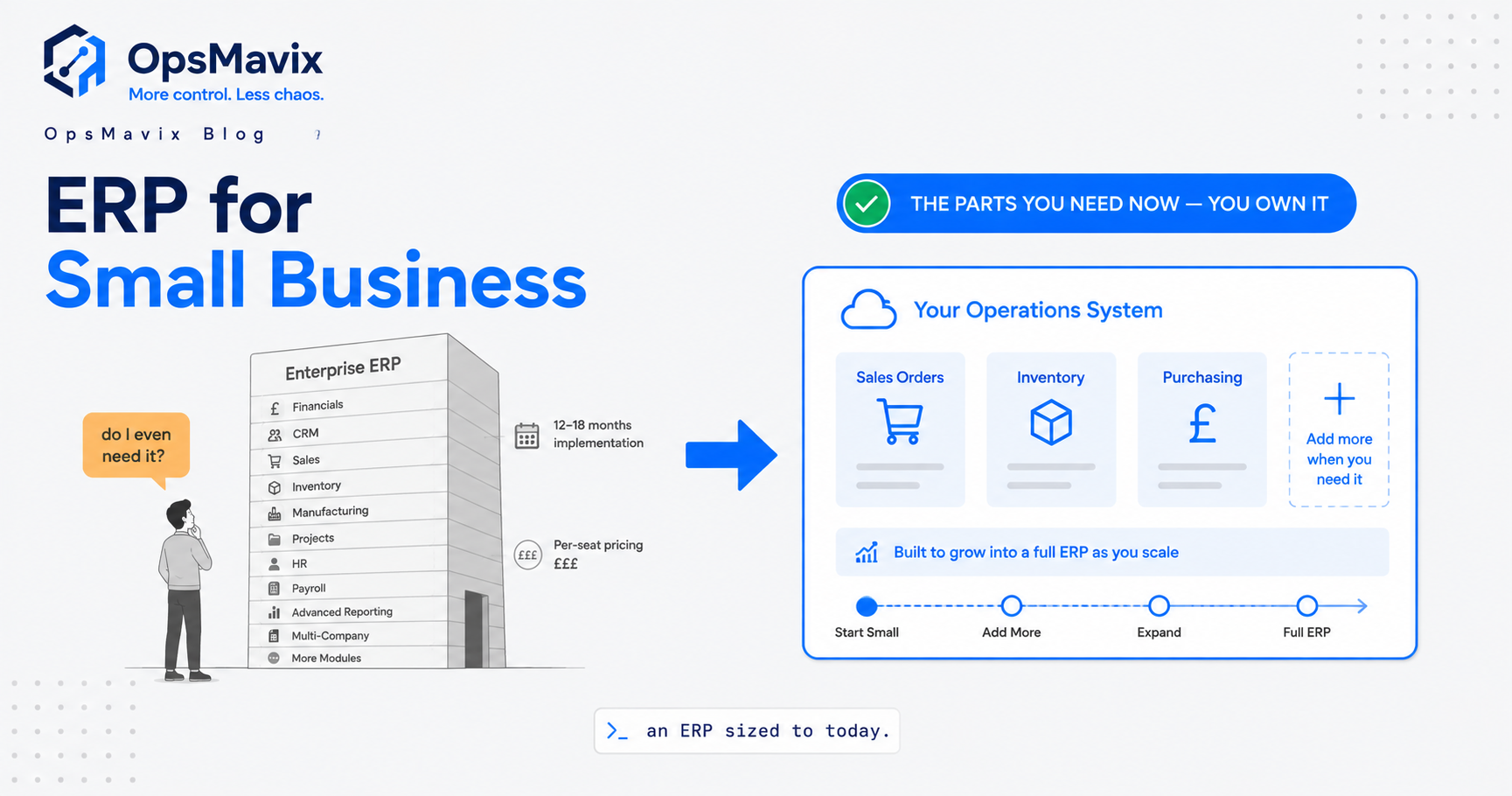
Weighing up ERP for small business usually means one thing: the spreadsheets have started lying to you. Stock says one number on the shelf and another on the sheet. An order slips because it lived in someone’s inbox. Month-end takes three days of copy-paste before anyone trusts a figure. So you start looking, and every vendor points you at the same answer, a full ERP that promises to put finance, stock, orders and production into one system. The pitch is tidy. The reality is that most small businesses buy an ERP to close three specific leaks and then pay, per seat, forever, for three hundred features they never open.
That is the decision worth getting right, because it cuts both ways. Wait too long and you drown in manual admin and version-conflict spreadsheets. Buy too much too soon and you drown in a rollout that takes months, bends your business to the software’s shape, and lands a bill that dwarfs the problem you were solving. The honest question is not “which ERP.” It is whether you need an ERP at all, or whether the cheapest thing that closes your actual leak is something smaller.
What an ERP System Actually Does
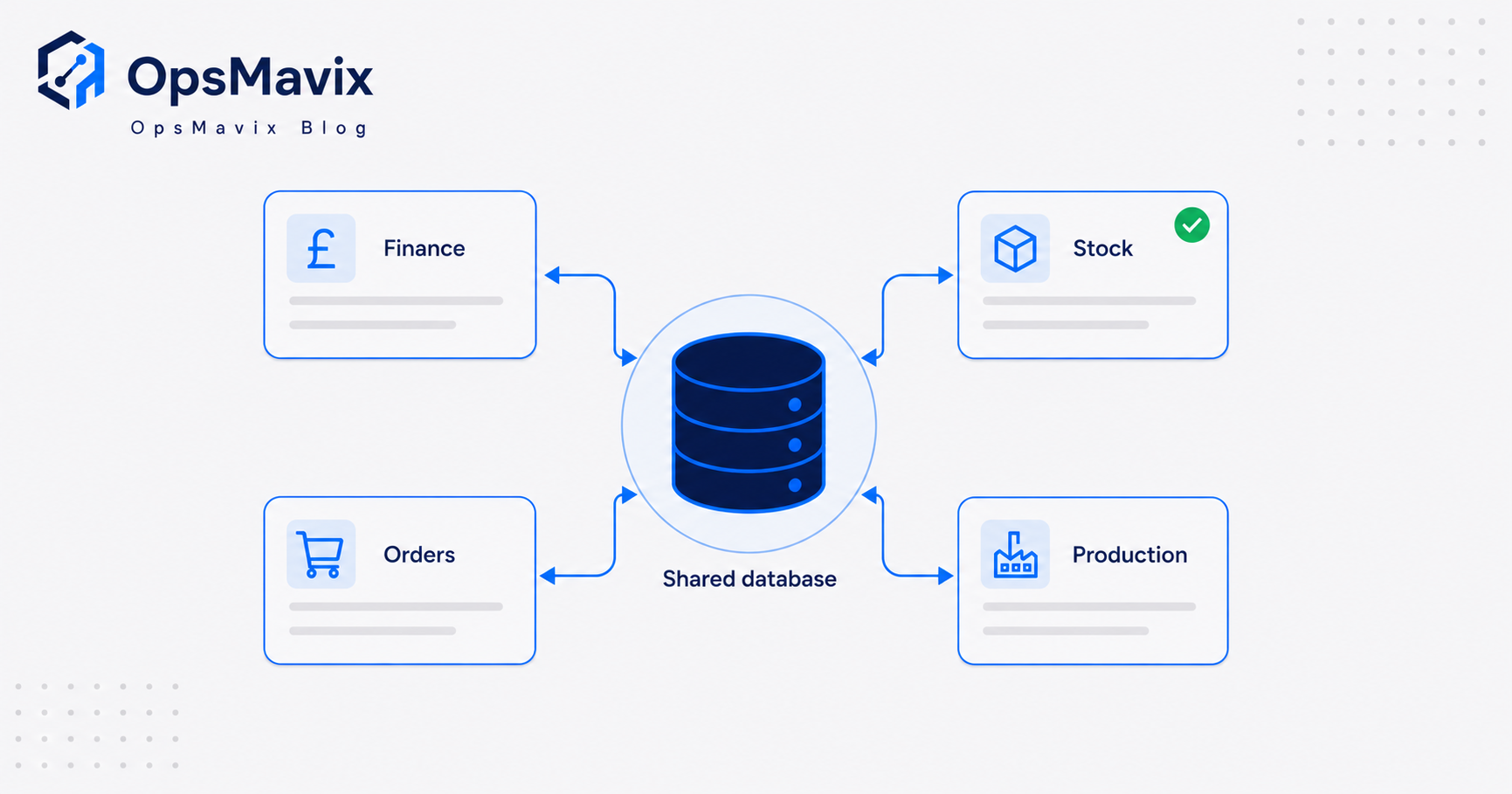
Strip the acronym back and ERP means one thing: a single system where the main parts of a business share one database. Finance, stock, purchasing, sales, and often production and HR, all read and write to the same set of records, so a sale in one place updates the ledger, the stock count and the reorder trigger without anyone typing it twice. That shared database is the whole idea. As the standard definition puts it, ERP “provides an integrated and continuously updated view of core business processes, typically using a shared database” (Wikipedia).
The strength of that model is real: when it works, everyone looks at the same truth. The weakness is the flip side. To serve every function, an ERP ships with modules for every function, and a small business rarely runs all of them. You buy the whole suite to use a third of it, configure your operation to fit its assumptions, and keep paying for the rest whether you touch it or not. For a large company with dozens of interlocking processes that trade is worth it. For a fifteen-person wholesaler with three leaky processes it often is not.
The distinction that matters is between a finance-first ERP and an operational ERP that leads with stock, orders and production. Many small businesses reach for “an ERP” when the pain is entirely operational, and end up with an accounting-shaped system and an inventory bolt-on that never quite fits how they move goods.
The Three Leaks Most Small Businesses Buy ERP to Fix
Talk to enough owners who bought an ERP and a pattern shows up. The trigger is almost never “we needed all of it.” It is one of three specific, expensive leaks, and usually a mix.
Leak one: stock that is never quite right. The number on the system and the number on the shelf disagree, so you either oversell and disappoint a customer or overstock and tie up cash you did not need to. Every stock count turns up discrepancies nobody can explain, because the movements live in a spreadsheet updated by hand, when someone remembers.
Leak two: orders that fall through the cracks. An order arrives by email, gets re-keyed into a sales sheet, then re-keyed again into a picking list, then again into the accounts. Each hop is a chance to fat-finger a quantity or lose the order entirely. The re-keying tax is invisible until you count the hours and the mistakes.
Leak three: reporting that takes days and still cannot be trusted. Month-end is a manual reconciliation because the numbers live in four places that never agree. The owner cannot answer “what is our real margin on this product line” without a person spending an afternoon in a spreadsheet.
Every one of those is a genuine problem worth solving. The point is narrower than the ERP pitch suggests: you have three leaks, and an ERP is a system with roughly three hundred features. You are buying the reservoir to fix three taps.
Signs You Genuinely Need an ERP
Some businesses really do need the full thing, and it is worth being honest about when. The signs are about breadth and interdependence, not just pain.
- Multiple functions are genuinely entangled. Finance, manufacturing, warehousing and purchasing all need to react to the same event in real time, and getting them out of sync causes real cost, not just annoyance.
- You run several entities, currencies or sites that must consolidate into one set of accounts, with intercompany movements that a bolt-on cannot cleanly handle.
- Compliance or audit demands a single, traceable system of record, where “it was in a spreadsheet” is not an acceptable answer to a regulator or a big customer.
- You have outgrown three or four separate tools that each half-solve a problem, and the integration tax between them now costs more than one system would.
- The headcount and transaction volume justify the spend. If manual admin is soaking up several full salaries, the maths on a proper system starts to work.
If most of those describe you, an ERP may be the right buy, and the job becomes choosing and implementing one well rather than talking yourself out of it. Go in with eyes open on cost and timeline, which the next sections cover.
Signs You Would Drown in One
The opposite case is more common and less discussed, because no vendor makes money telling a small business to buy less. You would likely drown in a full ERP if:
- You have two or three broken processes, not ten. The leaks are real but contained. A whole enterprise suite to fix a stock count and an order flow is a lot of system for a small job.
- Nobody internally can own an implementation. ERP rollouts are not install-and-go. They need someone to map processes, clean data, configure modules and train people, on top of the day job.
- Your process is your edge, and it is not standard. If the way you quote, build or fulfil is unusual and it is why customers pick you, bending it to fit an ERP’s built-in template can quietly damage the thing that works.
- The budget and timeline scare you, and they should. UK ERP implementations for small businesses commonly land at £15,000 to £50,000 once consulting, implementation and support are counted (The HBP Group), and independent breakdowns put SMB implementation at £20,000 to £120,000 over a two to six month rollout, with services alone often running one to three times the software fee (ERP Research).
- You cannot absorb a failed rollout. This is the part the brochures skip. Gartner research finds that roughly 55% to 75% of ERP projects fail to meet their objectives (Rand Group). For a small business, a failed six-figure rollout is not a lesson, it is an existential event.
Drowning does not mean the pain is not real. It means the cure is out of proportion to the disease. This is the exact territory where the alternative lives: a business too complex for spreadsheets but poorly served by a full ERP.
The Honest Three-Way Comparison
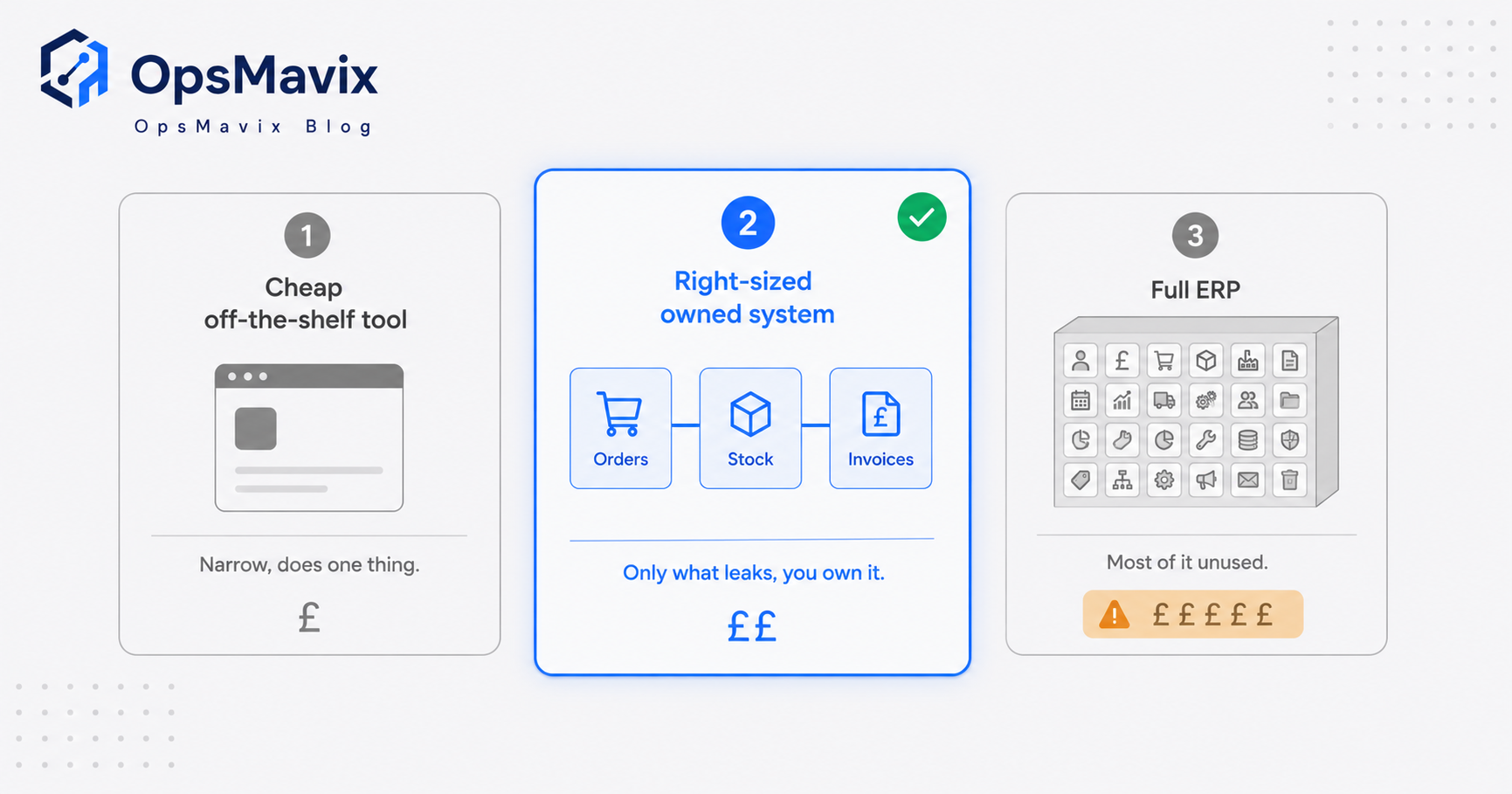
Almost every buyer’s guide presents this as a two-way choice: keep struggling, or buy an ERP. There is a third path, and a fair comparison shows all three side by side. Recommend the cheapest thing that closes your real leak.
| Cheap off-the-shelf tool | Full ERP | Right-sized owned system | |
|---|---|---|---|
| Best for | One clean problem (stock, or invoicing, or orders) | Large, complex, multi-entity operations | Two to five entangled processes that no single template fits |
| Cost shape | Low monthly fee per seat | £15k to £50k+ to implement, per-seat licences forever | One build cost, then low running cost; expandable in stages |
| Time to value | Days | Two to six months, often longer | Weeks, built around what leaks first |
| Fit | You bend to the tool, fine until you outgrow it | You bend your business to the software | The system is shaped to how you already run |
| Coverage | Narrow, does one thing well | Everything, most of it unused | Exactly the processes that leak, nothing you do not need |
| Who owns it | The vendor | The vendor | You own the system and the data |
| Scaling | Hit a ceiling, then rip and replace | Scales, at enterprise cost and complexity | Add modules as you grow, up to a full ERP if you get there |
The off-the-shelf tool is the right answer more often than pride allows. If your only real leak is stock, a dedicated inventory app is cheaper and faster than anything custom, and you should buy it. The full ERP is the right answer when the entanglement is genuine and the budget is proportionate. The owned system earns its place in the middle, when you have several leaks that no single cheap tool covers, but not enough to justify bending the whole business to an enterprise suite.
Integrations and Why Ownership Matters
Whatever you choose, the thing that decides whether it works is the joins. A business does not run on one system, it runs on the handoffs between systems: the stock app to the accounts, the website to the warehouse, the supplier emails to the purchase orders. An ERP promises to remove the joins by owning everything. The trouble is that it rarely owns everything cleanly, so you end up with an expensive core plus connectors to the things it does not do well, and you are back to babysitting integrations, only now they are load-bearing.
Ownership is the quieter issue, and it compounds. With a packaged tool or a full ERP the roadmap belongs to the vendor. Your “small feature request” queues behind the priorities of a company you will never meet, per-seat pricing climbs as you grow, and the tool holding your stock truth is only as durable as someone else’s business decisions. Intuit bought TradeGecko, rebranded it, then retired it. Vendors sunset products, prices change, terms change.
An owned operations system inverts that. The joins are built to match how your data actually moves, the system is the source of truth rather than a template you feed, and when the business changes, the system changes with it because you own it. It syncs to whatever accounting you run, pulls from your sales channels, and expands a module at a time. It is not a rejection of packaged software. It is the honest answer for the business whose shape does not fit the box, and it can scale up to a full ERP later if the day comes.
A Worked Example: The Distributor Who Nearly Bought Too Much
The figures below are illustrative, not a claim about a specific client.
Picture a UK wholesale distributor. Eighteen staff, roughly £4m turnover, selling to trade customers through email, phone and a basic web store. Their pain is textbook. Stock is tracked in a spreadsheet that never matches the shelf, so they oversell about twice a month and carry maybe £60,000 of dead stock they daren’t clear because they cannot see what actually moves. Orders are re-keyed three times between inbox, picking and accounts. Month-end takes two people three days.
They get quoted for a full ERP: around £38,000 to implement, a four month rollout, and roughly £1,400 a month in licences once live. The system covers manufacturing they do not do, HR they run through a payroll bureau, and a CRM they will never use. To make it fit, they would have to re-shape their trade-pricing rules, the reason half their customers stay, into the ERP’s standard model.
Now the honest maths. Their three leaks (stock accuracy, order re-keying, month-end reporting) do not need manufacturing, HR or CRM modules. A right-sized owned system covering exactly those three, syncing to their existing accounts and web store, might cost a fraction of the ERP to build and to run, with no per-seat creep as they hire. The dead stock and the oversells are the real prize: closing them is worth more each year than the entire build. This business was about to pay enterprise money, and bend its best asset, to fix three taps. The cheapest thing that closed the leak was smaller.
FAQ
Is an ERP overkill for a small business?
Often, yes, but not always. If you have a handful of contained problems, a full ERP is usually more system, cost and disruption than the job needs, and a cheap tool or a right-sized owned system closes the leak faster. If multiple functions are genuinely entangled and the manual admin is costing you real salaries, an ERP can be the right buy. Match the tool to the number and shape of your leaks.
How much does ERP cost for a small business in the UK?
For a UK small business, implementation commonly lands between £15,000 and £50,000 once consulting, configuration and support are counted, with per-user subscription fees on top (The HBP Group). Independent breakdowns put SMB implementation at £20,000 to £120,000 and note that services alone often run one to three times the software fee (ERP Research). Budget for the total cost of ownership, not the licence line.
What is the difference between ERP and a normal business app?
A normal business app does one job well, like invoicing or stock, and lives in its own database. An ERP tries to run many functions off one shared database so they stay in sync. That breadth is the benefit and the burden: you get one truth, but you also buy and maintain a lot of function you may never use.
Can I start small and add ERP modules later?
With a packaged ERP you can usually switch modules on over time, though you are still buying into that vendor’s model and pricing from day one. A right-sized owned system takes the staged idea further: you build the module that leaks first, prove it, then add the next, and you own each piece rather than renting the whole suite up front.
What if I only have one problem, like stock?
Then buy a dedicated tool for it. If your only genuine leak is stock, a good inventory app is cheaper, faster and lower-risk than any ERP or custom build, and you should use it until you outgrow it. Building or buying something bigger to solve one clean problem is exactly the over-buying this guide warns against.
How OpsMavix Can Help
OpsMavix builds right-sized operations systems for businesses stuck in the awkward middle, outgrowing spreadsheets and disconnected tools rollout, and not keen to pay enterprise money to fix three taps. We start by finding where your operation actually leaks, then build a system shaped around how you already run, covering the processes that cost you and none of the ones that do not. You own it, it syncs to the accounting and channels you already use, and it expands a module at a time, up to a full ERP if you ever genuinely need one. If you want to know whether you need an ERP at all, the fastest way to find out is to see where the money is actually leaking first. Book a Free Operations Leak Audit
Sources
- Wikipedia: Enterprise resource planning. Standard definition of ERP as integrated applications sharing a common database across business functions.
- Rand Group: What percentage of ERP implementations fail?. Cites Gartner that roughly 55% to 75% of ERP projects fail to meet their objectives.
- The HBP Group: ERP pricing guide. UK ERP cost ranges by business size, small business £15,000 to £50,000, plus per-user subscription pricing.
- ERP Research: ERP implementation cost breakdown. SMB implementation budgets (£20,000 to £120,000), two to six month timelines, and services running one to three times the software fee.
Keep reading
Getting value from OpsMavix? Add us as a preferred source on Google — you'll see more of our operations content in your AI Overviews, AI Mode and Search.