
Sales Order Credit Hold Software: US Wholesale Guide
Control held trade orders before the warehouse ships. A US wholesale guide to credit checks, authorized release, payment updates and software tests.
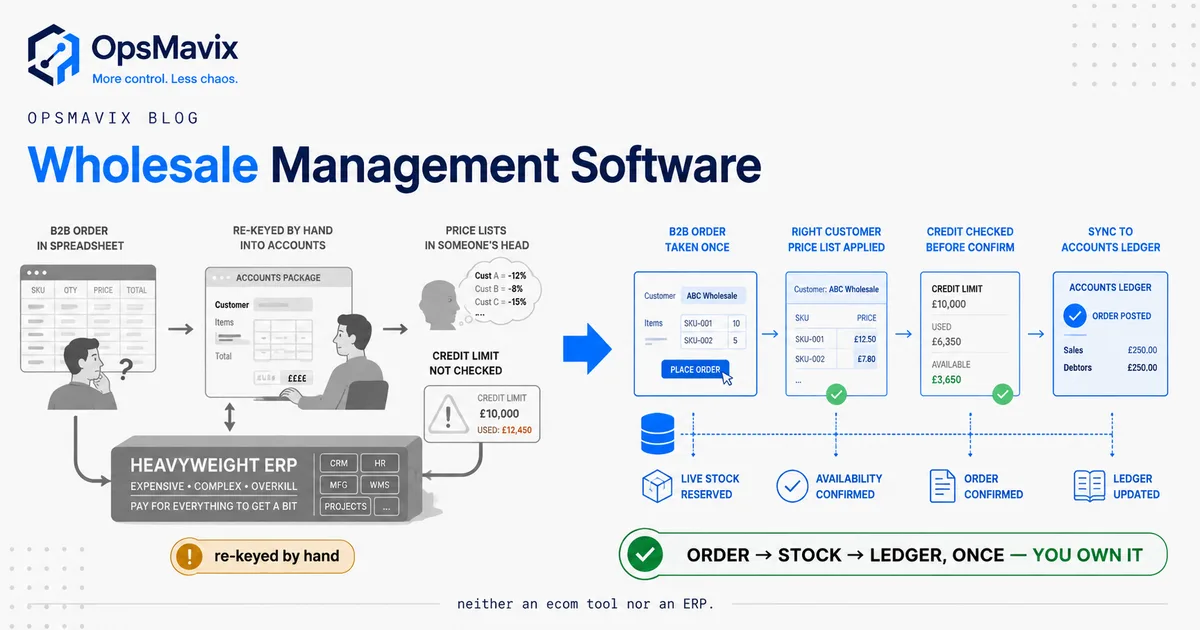
Sales order credit hold software stops a trade order at an agreed checkpoint when the account or transaction needs a credit decision. For a US wholesaler, the useful control is a visible hold with a clear reason, current account information and an authorized release route before the warehouse acts.
A warning on the customer record is easy to miss. An email from accounts can arrive after picking starts. The workflow needs to connect the decision to the specific order and the next action your business permits.
This guide focuses on operational controls for B2B wholesale orders. It explains what to specify, how to test a release and how to avoid blocking the wrong order after a payment or amendment.
Credit holds in 30 seconds
- A credit hold is a restriction on progressing an order, not a cancellation.
- Define the checkpoint: order confirmation, allocation, picking, shipment or another agreed step.
- Keep the financial reason separate from stock shortages, fraud checks and quality holds.
- Limit exceptions to an authorized person, a documented reason and a defined scope.
- Recheck relevant changes rather than treating yesterday’s approval as permanent permission.
- Measure unresolved holds and release delays separately from overdue invoices.
A wholesale order management system is the relevant starting point when the problem is the handoff between sales, finance and fulfillment. Ask the provider to include credit checks and exception release explicitly in the scope.
1. Decide what the hold must prevent
Name the checkpoint
“Customer blocked” is not a sufficient specification. Can sales create a draft? Can purchasing order a special item? Can the warehouse reserve stock? Can staff print a pick list? Agree those questions before configuring software.
A business may allow draft entry while preventing shipment. Another may avoid allocating scarce stock until finance has reviewed the order. Neither design should be assumed from a red account banner.
Microsoft’s Dynamics 365 documentation describes blocking rules and credit-management checkpoints for sales orders. Its product-specific implementation illustrates why a rule and the stage at which it is enforced both matter. Your chosen software must demonstrate the behavior your business needs.
Keep other restrictions independent
An order can pass its credit review and still be unable to ship because the address is incomplete or the goods are unavailable. Releasing a credit hold must not silently remove unrelated restrictions.
| Restriction | Decision owner to define | Possible next action |
|---|---|---|
| Credit exposure above policy | Authorized finance reviewer | Review payment or approve a defined exception |
| Product unavailable | Inventory or purchasing team | Replenish, split or agree a new date |
| Shipping details incomplete | Order desk | Confirm the missing details |
| Goods awaiting inspection | Quality or warehouse team | Complete the release process |
These are example responsibilities, not a universal company structure. Assign the roles that exist in your operation.
2. Define exposure before building a formula
The amount owed in accounts is not necessarily the whole amount already committed. An order may be accepted but unshipped; a shipment may be awaiting an invoice; a payment may be received but not allocated.
Write down which buckets your policy includes and where they originate. Avoid counting an order value again after it has become an invoice. Agree how sales tax, shipping charges, deposits, credits and currency conversion are treated where relevant.
A hypothetical US dollar example
Assume a wholesaler uses the following simplified policy. Every bucket is distinct, and all included amounts are measured on the same basis.
| Included commitment | Amount |
|---|---|
| Open receivables | US$18,000 |
| Existing accepted orders not included above | US$7,000 |
| New order under review | US$6,000 |
| Total exposure under this policy | US$31,000 |
| Approved account limit | US$30,000 |
| Amount above the limit | US$1,000 |
Under this illustrative rule, the new order needs review. These figures are invented to explain the workflow; they are not recommended limits or an OpsMavix customer result.
Now a US$4,000 payment is correctly allocated against the receivables. If no other commitments change, exposure becomes US$27,000. Whether the order is released automatically or sent back to a reviewer is a policy choice. The system should not assume that a bank notification alone is a verified, allocated payment.
3. Give finance a usable review queue
A reviewer should not need to open six unrelated screens to understand one hold. Show the order reference, customer account, restricted stage, hold reason, exposure calculation, data timestamp and the evidence needed to decide.
Useful queue fields include the next action, responsible person and latest customer communication. “Awaiting payment” is clearer than an unexplained red status, but it still needs an owner and follow-up date.
Preserve the evidence used
Record the relevant figures at the time of review as well as the latest balance. Otherwise, a later payment can make an earlier decision look inexplicable.
Keep a stable link to the order version being approved. A release for a US$6,000 order should not quietly authorize a later increase to US$16,000.
This is different from the wider process of credit control and chasing payment. Collections manages the outstanding debt; an order hold controls whether a new transaction may progress. They need shared information, not identical workflows.
4. Make release specific and traceable
A useful release record answers who approved it, what they approved, why and how long the exception remains valid.
| Release design | Risk to test | Control to specify |
|---|---|---|
| Whole-account override | Other orders may proceed unexpectedly | Restrict to the intended transaction where appropriate |
| Time-limited exception | It may remain active after expiry | Apply the expiry in the actual processing route |
| Amount-limited approval | An amended order may exceed permission | Compare the current amount with the approved basis |
| Partial shipment permission | Staff may interpret it as full release | Identify the permitted lines or quantities |
Do not use a shared manager login to make the queue move faster. Named decisions are easier to investigate and revoke. Define an emergency process without turning emergency access into the normal route.
Recheck after relevant changes
Examples include a larger quantity, revised terms, a new charge or a newly posted overdue balance. Not every edit needs a new approval, but your policy must say which changes invalidate an existing one.
5. Connect the hold to warehouse work
A finance decision is useful only if the downstream system observes it. Test the actual pick, pack and ship routes, including imports and manually created transfers.
If a hold is placed after picking begins, show the warehouse what must stop and who will decide the next action. Stock already picked may need a controlled return to storage. A posted shipment cannot be made unshipped merely by changing a status flag.
Handle stale data openly
Decide what happens when the accounting connection is unavailable. The order desk needs to know when financial data was last refreshed and whether a manual review is required.
A connected workflow should surface failed updates, duplicate messages and conflicting versions. It should not display an old balance as if it were current. The broader sales order management workflow still needs reliable identifiers and handoffs around the credit decision.
6. Test software with realistic exceptions
Use one sample account and run the following demonstration before selecting a system.
- Create an order that exceeds the agreed exposure rule.
- Confirm the intended checkpoint actually prevents progression.
- Try the same action through the warehouse’s normal route.
- Allocate a payment and check the refreshed calculation.
- Release one order and confirm unrelated orders remain controlled.
- Increase the released order above the approved basis.
- Process two simultaneous orders against the same remaining headroom.
- Interrupt the accounting update and inspect the visible failure state.
- Retrieve the original hold, decision and subsequent amendments.
The simultaneous-order test matters because both orders must not independently consume the same available headroom. Ask the provider to explain how updates are coordinated rather than accepting two screenshots showing individually correct numbers.
7. Compare configuration, integration and custom work
Start with the software you already use. It may support an effective credit hold that is poorly configured or bypassed by a separate order route. Fixing that route may be simpler than replacing the platform.
A packaged ERP or order-management product can be appropriate when its checkpoints, exposure basis and permissions match the operation. Test the edition and integration included in the quotation.
A focused custom workflow is worth assessing when finance holds reliable account data but sales and fulfillment cannot act on the same decision. The scope should identify the authoritative balance, order owner, release rules and recovery process.
OpsMavix’s wholesale service describes connected order handling, stock and financial handoffs. Treat the controls in this guide as requirements to discuss, not a claim that every feature is included automatically in every project.
8. Build a business case without promising recovered debt
Separate administrative effort from credit losses. Fewer review steps do not prove fewer bad debts, and releasing more orders is not automatically a better outcome.
For illustration, 30 hold reviews a week taking eight minutes each represent four hours. At a hypothetical loaded staff cost of US$35 per hour, that is US$140 of weekly staff capacity. Only the portion removed by a tested process belongs in an estimated benefit. It is not guaranteed cash savings.
Track time to first review, time awaiting evidence, repeated holds caused by stale data and orders processed outside the agreed release path. Review the reasons behind exceptions before changing limits or thresholds.
FAQ
Is a credit hold the same as cancelling an order?
No. A hold pauses a permitted part of the workflow pending a decision. Cancellation is a separate commercial outcome.
Should a payment automatically release an order?
Only if that is the agreed policy and the payment has been correctly verified and reflected in the calculation. Some orders may still need review for another reason.
Can we hold shipment while allowing sales to enter a draft?
Yes, that is a possible design. Your software must enforce the chosen checkpoint rather than relying on staff noticing a warning.
What happens if the order changes after approval?
Define which amendments invalidate approval. Preserve the original approved amount or scope and compare it with the current transaction.
Do we need to replace our accounting package?
Not necessarily. A reliable integration can connect existing financial records to order controls. First check the current package’s capabilities and integration limits.
Does this guarantee that customers will pay?
No. Software can enforce an agreed review process and retain evidence. It cannot guarantee payment or substitute for a sound commercial credit policy.
How OpsMavix can help
If finance says an account is on hold while the warehouse is already picking its next order, map that handoff first. Explore wholesale order management built around your operation and contact OpsMavix with one recent held order, the information used to review it and the route it took to fulfillment.
That gives the scoping discussion a concrete test: can the system enforce the intended decision, preserve the evidence and keep sales, finance and the warehouse aligned?
More control. Less chaos.
Sources and further reading
- Microsoft Learn: Credit holds for sales orders. An official product example of blocking rules and checkpoints; configuration and versions matter.
- OpsMavix wholesale order management. Current commercial service information.
The workflow tests are proposed operating practices. Dollar examples are hypothetical. The cover is an existing OpsMavix illustration of the broader wholesale workflow; its displayed currency figures are illustrative, not the US calculation in this guide. Published 17 October 2026.
Keep reading


Getting value from OpsMavix? Add us as a preferred source on Google — you'll see more of our operations content in your AI Overviews, AI Mode and Search.