
Sales Order Amendment Control: UK Wholesale Guide
Control late wholesale order changes without leaving old picks in circulation. A UK guide to approvals, stock reservations and revised instructions.
Sales order amendment control keeps an agreed customer change connected to the stock, picking instructions, delivery plan and invoice records it affects. For a UK wholesaler, the critical question is whether an order can be changed safely after the warehouse has already started work.
Changing a quantity on the sales screen may leave an old printed pick list in circulation, a parcel already labelled or a reservation against the wrong product. A controlled amendment process establishes what can still change, who must approve it and which downstream records must be reconciled. The OpsMavix wholesale order management system is a relevant starting point when those handoffs are fragmented. Amendment permissions and recovery behaviour should be scoped explicitly for your operation.
Why amendments become difficult after release
A trade customer orders ten cartons for next-day delivery. After the warehouse prints its pick list, the customer asks to reduce the quantity and add another line. Sales updates the order and emails the warehouse, but the picker continues using the original sheet.
The error is not simply that someone missed a message. The business has no reliable connection between the amendment decision and the work already in progress. There is also no clear acknowledgement that the old instruction has been withdrawn.
This article focuses on changing an existing order after confirmation or release. The broader UK order management software guide covers capture, allocation and fulfilment. A system that handles those standard stages still needs a tested route for the exceptions.
Establish what stage the order has reached
The same request needs different treatment depending on the physical and financial position. An order marked “processing” is too vague if it could mean awaiting allocation, partly picked or already packed.
| Current position | Questions before accepting the amendment |
|---|---|
| Confirmed, not released | Have stock reservations or supplier commitments already been created? |
| Released, not picked | Can the warehouse withdraw the old instruction and acknowledge the new version? |
| Partly picked | Which quantities have moved and where are they physically held? |
| Packed or labelled | Must the package, label, weight or carrier instruction be replaced? |
| Dispatched | Is this now a return, exchange or separate follow-up transaction? |
| Invoiced | What finance review and document correction are required? |
These stages can overlap. Part of an order may be dispatched while the remainder is still open. Review at line and quantity level where the workflow requires it, rather than assuming one header status describes every item.
Avoid undoing completed events merely to make the order resemble the customer’s latest request. Preserve what physically happened and use the appropriate authorised process for the new outcome.
Define the amendment record
Give each request a stable reference linked to the original order. Record the requester, time received, affected lines, original values, requested values and the reason.
Separate a proposed change from the accepted revision. Customer service may be authorised to request an amendment without having authority to change a price, release a credit hold or reverse a completed delivery.
Useful evidence includes:
- The original customer instruction and the accepted revised instruction.
- The order version reviewed by the decision maker.
- The fulfilment position checked before acceptance.
- The affected stock reservations, picks and supplier orders.
- The revised price, charge and delivery promise.
- Approvals, acknowledgements and completed downstream actions.
Use identifiers that remain stable when a product description or delivery date changes. Retain previous versions in history, but make the currently authorised operational instruction obvious at the point of use.
A practical sales order amendment workflow
Capture the difference clearly
State the requested difference in business terms: reduce line A by two cartons, replace line B with another SKU or change the delivery address. Confirm the unit and the specific product variant. A request for “two fewer” is ambiguous when the customer buys cartons and the warehouse counts individual items.
Check who is authorised to request the change under your customer process. An operational record should preserve the instruction without pretending a software status alone settles contractual rights.
Check feasibility and pause affected work
Establish the order’s current position with the warehouse and, where relevant, purchasing or the carrier. Use a controlled hold on affected work when necessary. Record who must acknowledge it and what the hold prevents.
A hold in the sales application may not stop a picker working from paper or an instruction already sent to a third party. Test how the physical team receives and acknowledges the change. Do not assume that sending an email means work stopped.
Recalculate the consequences
Review available stock, allocations, pack quantities, customer pricing, minimum order rules and delivery charges. A quantity reduction can change the applicable price break or remove the basis for a free-delivery offer.
Check commitments created specifically for the original order. A special purchase, custom label or subcontract service may not be reversible simply because the sales line is editable. Record any additional cost or delay for the commercial decision.
Approve and release the revised version
Record acceptance of the revised scope, price and delivery promise through the agreed customer and internal process. Authorisation should refer to the version actually being released.
Replace or withdraw obsolete instructions. Where pick lists are printed, define how the old copy is identified and removed from use. Where instructions are digital, make sure the operator can see a revision or hold warning rather than an unnoticed changed quantity.
Reconcile stock and fulfilment
Confirm which reservations were released, retained or newly created. Check that picking records reflect the revised authorised quantities and that already picked goods have an appropriate disposition.
An address change may also affect a shipping label or carrier booking. A product substitution can change package weight, handling requirements or availability. Include these in the completion check where relevant.
Confirm the finance outcome
Retain references to the accounting documents and any approved follow-up process. An order amendment should not silently rewrite a posted invoice or imply a refund has occurred.
Finance must decide the appropriate treatment for the actual circumstances. Keep operational acceptance, accounting correction and payment actions as distinct recorded outcomes, with the relevant owner for each.
Locking an order is only one part of the design
Odoo’s official quotation documentation describes confirmed sales orders becoming locked when its Lock Confirmed Sales setting is enabled. This is an example of a configurable edit restriction, not a complete amendment-control process.
A lock can prevent casual editing, but the business still needs a route for authorised changes. Ask who can unlock or revise an order, which fields they can change and whether the resulting changes reach connected warehouse records.
A history log can show that a field changed. It does not automatically prove that the warehouse withdrew an earlier instruction or that a carrier received the replacement address. Evaluate the complete handoff.
Worked UK example: reduce one line and add another
Hypothetical example, all amounts in GBP and excluding VAT. A wholesaler receives an order for ten cartons of product A at £40 per carton. The goods value is £400. Each carton contains 12 units, so the warehouse instruction is for 120 individual units.
Before picking begins, the customer requests eight cartons of A and two cartons of B at £35 per carton. Product B contains six units per carton. Assume prices remain valid and delivery charges are unchanged for this simplified example.
| Line | Original authorised quantity | Revised authorised quantity | Revised goods value |
|---|---|---|---|
| Product A | 10 cartons, 120 units | 8 cartons, 96 units | £320 |
| Product B | None | 2 cartons, 12 units | £70 |
| Total | £400 goods value | Two distinct product lines | £390 |
The revised order is £10 lower, but the stock change is not a generic reduction of ten units. The warehouse must release 24 units of A from the original demand and allocate 12 units of B, subject to actual availability and the system’s reservation process.
If 120 units of A have already been picked, reducing the sales quantity alone is insufficient. The warehouse needs an authorised instruction for the 24 units no longer required, including any physical return to storage and corresponding record.
If the requested product B is unavailable, the amendment remains proposed until an acceptable alternative is agreed. The software should not quietly substitute a later delivery promise while displaying the change as complete.
Comparing software approaches fairly
| Approach | Useful fit | What to demonstrate |
|---|---|---|
| Existing order platform configuration | Core order and warehouse records already share a reliable workflow | Permissions, holds, revisions and acknowledgement routes |
| OMS or WMS integration | Sales and warehouse systems each work well but changes cross the boundary | Line-level mapping, failure recovery and conflicting edits |
| Focused connected workflow | Approval and exception handling are the main missing pieces | Clear ownership without creating a competing order master |
| Broader ERP | Amendment control is one part of a justified wider process change | Actual exception scenarios, adoption effort and full implementation scope |
A configurable packaged system may already meet the requirement. Test it before commissioning replacement software. A focused custom workflow can be appropriate where the gap is specific, but it still needs maintenance and a dependable connection to the authoritative order and stock records.
Do not accept a demonstration that only changes a quantity before confirmation. Bring an order that has genuinely reached the operational stage where your errors occur.
Implementation costs and limitations
Budget for process mapping, authority rules, status definitions, data cleanup, integrations, document templates, device access, testing, training and support. Include how revised instructions reach external warehouses or suppliers.
Hypothetical cost example, excluding VAT: suppose configuration and training cost £1,500, support costs £100 per month and internal preparation takes 12 hours at an assumed £25 per hour. The first three months cost £1,500 + £300 + £300 = £2,100. These invented amounts are not OpsMavix prices or market benchmarks.
Compare that cost with measured re-picking, additional carriage, customer-service effort and confirmed credits caused by amendment failures. Do not count the full value of every changed order as a saving.
The process also needs a workable cut-off policy. Some late changes may be technically possible but commercially unreasonable. Make exceptions explicit and communicate the accepted outcome to the customer. Software can support the rule; it cannot remove every physical constraint once goods have moved.
Pilot and demonstration checklist
Choose one common amendment type and include the warehouse in testing. Use anonymised data and agree the expected results before the demonstration.
- Reduce quantity after allocation and confirm released stock is available correctly.
- Add a line after a pick list is issued and withdraw the obsolete instruction.
- Request a substitution when the replacement item is unavailable.
- Change an address after a label is created.
- Amend an order with a partial delivery already completed.
- Interrupt the integration after one system accepts the revision, then recover without duplicating work.
- Run two competing amendments and show which version is authorised.
- Retrieve the original order, revised approval and warehouse acknowledgement.
Measure obsolete-instruction incidents, amendment turnaround time, unresolved holds and downstream reconciliation failures. Fast acceptance is not useful if the revised work remains unconfirmed in the warehouse.
Frequently asked questions
Can we allow customer service to edit confirmed orders?
Yes, if permissions and the agreed workflow support the relevant changes. Define which amendments can be accepted directly and which require warehouse, commercial or finance review.
Should every amendment stop the whole order?
Not necessarily. A controlled hold can be limited to affected work if the systems and physical process reliably support that separation. Test whether unaffected lines can proceed without creating confusion.
What if the warehouse uses paper pick lists?
Use an issue and withdrawal process with acknowledgement. A revised screen does not replace paper that is already being used. Make the authorised copy easy to identify.
Can we change an order after dispatch?
The customer’s request may need a return, exchange or separate order process instead of rewriting the completed dispatch. Preserve the record of what actually shipped and agree the follow-up with the responsible teams.
Does an order amendment automatically create a credit or refund?
It should not be assumed. Finance and payment actions depend on the actual transaction and the approved process. Track their completion separately from the order edit.
Keep the revised instruction connected to the work
The useful outcome is one explainable chain: customer request, feasibility check, accepted revision, warehouse acknowledgement and reconciled fulfilment. Start with the amendment type causing the most repeated problems and prove that chain before expanding.
Discuss wholesale order management with OpsMavix if sales changes, picking instructions and finance updates are disconnected. Bring an anonymised original order, a late customer change and the documents the warehouse used. Send an enquiry to scope the permissions and integrations around your actual workflow.
Sources and further reading
- Odoo 19 documentation: Create quotations — primary product documentation for confirmation and the configurable confirmed-order lock; reviewed 20 October 2026.
- OpsMavix: Order management software UK — broader guidance on capture, allocation and fulfilment.
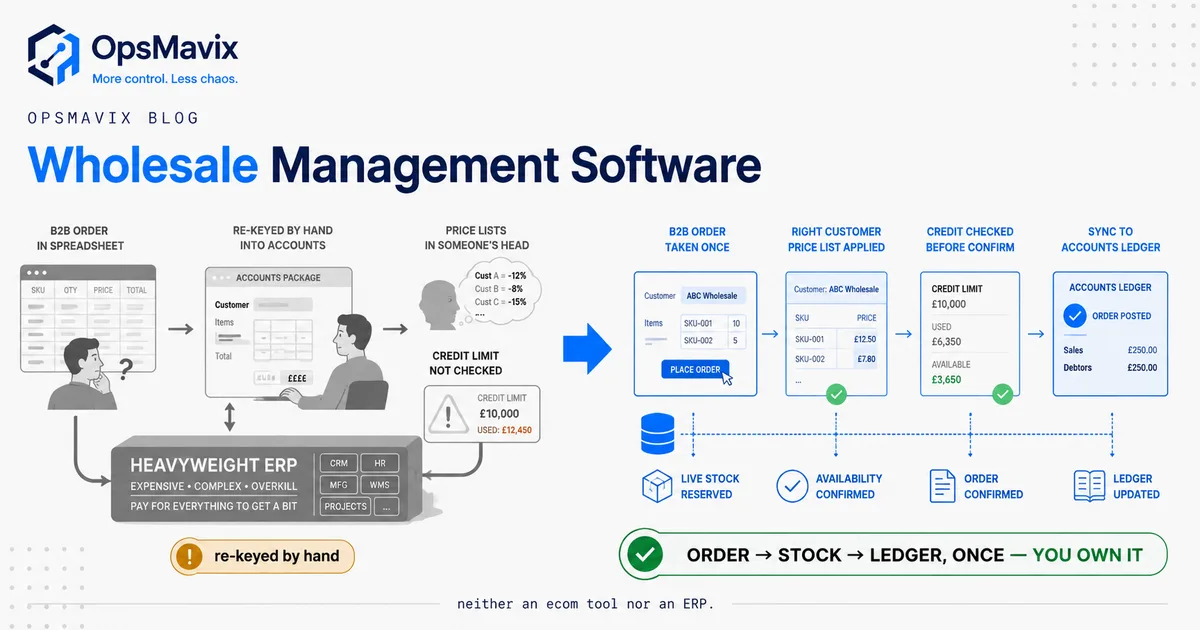
The workflow and GBP examples are practical suggestions and hypothetical calculations, not client results or a promise of particular software capabilities. The cover is an existing OpsMavix wholesale-process illustration, not a screenshot of the amendment workflow described here.
Keep reading
Getting value from OpsMavix? Add us as a preferred source on Google — you'll see more of our operations content in your AI Overviews, AI Mode and Search.